Outsourcing transportation management is often framed as a cost-cutting tactic. The actual payoff runs deeper: better carrier leverage, access to technology that would cost $150,000–$250,000 to build independently, and the ability to redirect your team toward work that actually grows the business.
This article breaks down five concrete, outcome-driven reasons why outsourcing transportation management delivers results — not just in theory, but in measurable freight spend, on-time performance, and operational capacity.
Key Takeaways
- Outsourcing transportation management hands carrier procurement, routing, freight auditing, and execution to a specialized partner
- The five core reasons: cost reduction, industry expertise, enterprise technology access, scalability, and freeing up internal resources
- Companies that haven't benchmarked their carrier contracts in 2–3 years are typically overpaying by 15–30%
- Benefits compound over time; longer partnerships produce increasingly refined, cost-efficient operations
- Done correctly, outsourcing improves visibility and control rather than reducing them
What Is Transportation Management Outsourcing?
Outsourcing transportation management means handing the planning, execution, and oversight of your freight and shipping operations to a qualified external partner — rather than running those functions with internal staff.
In practice, that covers:
- Carrier procurement and contract negotiation
- Route planning and mode optimization
- Shipment execution and real-time tracking
- Freight bill auditing and payment
- Performance reporting and carrier scorecards
- Claims management and compliance
Each of these functions requires specialized expertise, carrier relationships, and technology — which is why businesses outsource them to achieve specific outcomes: lower costs, better service levels, and greater agility.
Business Solutions Group operates as a 4PL managed logistics provider, taking responsibility for a client's full transportation program. Carrier contracts are negotiated directly in the client's name, so businesses retain visibility into rates and keep negotiating leverage over time.
5 Reasons to Outsource Transportation Management
Each reason below connects to a metric your business already tracks: freight spend, on-time delivery, carrier performance, or employee capacity. These aren't abstract benefits.
Reason 1: Significant and Sustained Cost Reduction
Transportation is one of the largest controllable cost lines for any shipper — and without external benchmarking, most businesses are overpaying without knowing it.
The core mechanism of outsourced cost reduction is carrier volume consolidation. A managed transportation partner negotiates across a combined book of business far larger than any single shipper could represent alone. That volume translates into stronger contracted rates, better lane coverage, and access to capacity during tight markets. Business Solutions Group, for instance, leverages billions of dollars in consolidated client volume to negotiate carrier pricing — delivering average savings of 23.6% on small parcel and 20–25% on LTL freight.
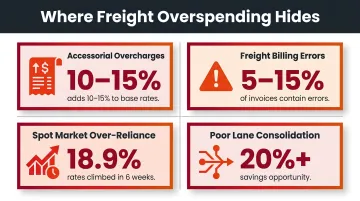
Where does the overspending typically hide? BSG's benchmark analysis identifies several consistent patterns:
- Accessorial overcharges — fuel surcharges, liftgate fees, reclassifications adding 10–15% to base rates without clients noticing
- Freight billing errors — 5–15% of freight invoices contain errors; manufacturing-specific error rates reach 12–15%
- Spot market over-reliance — during the 2025 holiday season, spot rates climbed 18.9% in six weeks, from $2.32/mile to $2.76/mile
- Poor lane consolidation — 3PL load-consolidation programs can save more than 20% over standard LTL rates
KPIs impacted: freight cost per shipment, total transportation spend as a percentage of revenue, accessorial frequency, carrier rate variance.
BSG offers a complimentary benchmark analysis — completed in approximately one week — that quantifies the savings opportunity before any commitment. If there's no meaningful opportunity, there's nothing to sign.
Reason 2: Instant Access to Expertise and Industry Benchmarks
Building transportation expertise in-house — carrier performance analysis, mode optimization, compliance, rate market intelligence — takes years and significant investment. Most mid-market shippers skip it, which means they have no reliable way to know whether their performance is good, average, or poor.
An outsourced partner closes that gap immediately. Experienced logistics partners carry benchmarks that individual shippers cannot access: what on-time pickup rates should look like for a given lane, what claims ratios indicate carrier problems, what cost-per-unit targets are achievable at your shipping volume.
The 2025 Third-Party Logistics Study by NTT DATA found that 68% of shippers say 3PLs provide innovative ways to enhance logistics effectiveness, and 82% report measurable customer service improvement. The average on-time delivery rate for LTL shipments was 82% in 2024 — but without external data, most shippers have no idea where they stand relative to that number.
This matters most for:
- Mid-size shippers managing 5–20 carriers across multiple lanes without centralized analytics
- Companies shipping primarily LTL (over 63% of mid-market shippers), where carrier selection and mode optimization directly affect both cost and service
- Organizations where shipping data sits across carrier portals, invoices, and spreadsheets rather than a single system
BSG's advisory team uses carrier performance scorecards — evaluating reliability, claims ratios, and on-time results — to identify underperforming carriers and create accountability structures that most in-house teams can't build independently.
KPIs impacted: on-time pickup and delivery rates, cost per case/unit/pound, claims ratio, carrier performance scores.
Reason 3: Advanced Technology Without the Capital Investment
A transportation management system (TMS) with real-time tracking, AI-powered route optimization, freight analytics, and reporting dashboards is powerful — and expensive to procure, implement, and maintain.
Licensed TMS costs range from $10,000 to $250,000 in upfront fees, with cloud/SaaS models running $50–$500 per user per month. Implementation typically takes 4–5 months. For a mid-market shipper, that's a significant capital commitment — before accounting for IT staff, training, and ongoing maintenance.
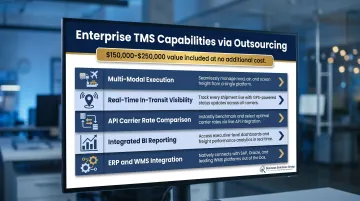
Outsourcing eliminates that barrier. Clients gain access to enterprise-grade TMS infrastructure through the partner's existing platform. BSG, for example, provides a full TMS as part of managed service engagements — typically representing a $150,000–$250,000 investment value — at no additional cost.
Capabilities clients access through outsourcing:
- Multi-modal shipment execution across parcel, LTL, FTL, air, ocean, and rail
- Real-time in-transit visibility with automated exception alerts
- API-powered carrier rate comparison and dynamic pricing
- Integrated BI reporting with historical shipment analytics
- Seamless ERP and WMS integration
Satisfaction with 3PL IT capabilities jumped to 87% in the 2025 NTT DATA study, up from 49% the prior year. Outsourced technology has improved faster than most in-house teams can replicate — and for mid-market shippers, it's often the most direct route to enterprise-grade logistics infrastructure without a six-figure capital outlay.
Reason 4: Built-In Scalability and Flexibility
Shipping volume doesn't stay flat. Seasonal peaks, growth into new markets, supply chain disruptions — all of these create demand spikes that an internal team struggles to absorb without either overhiring or underserving customers.
The structural problem: most mid-market shippers don't operate private fleets (78%+ are entirely dependent on third-party carriers). When volume surges, capacity access and carrier management complexity surge with it.
A managed transportation partner builds elasticity into the operation:
- Carrier capacity scales on demand — the partner's carrier network can absorb volume increases without the business managing new carrier relationships
- No headcount fluctuations — operational support scales up during peaks and down during slow periods without hiring or layoffs
- Rate stability — contract rates insulate clients from spot market volatility that can spike 18%+ in weeks
KPIs impacted: order fulfillment rate during peak periods, lead time consistency, carrier capacity availability, cost variance during volume fluctuations.
BSG's managed transportation model handles the full freight lifecycle — routing, carrier tendering, tracking, auditing, claims — meaning volume surges add work to BSG's team, not the client's. The TMS infrastructure automates the administrative layer, so increased shipment counts don't require increased internal bandwidth.
Reason 5: Refocus Internal Resources on Core Business Priorities
Carrier coordination, freight auditing, dispute resolution, compliance tracking, performance reporting — these functions consume significant internal hours every week. For a growing mid-market company, that's hours diverted away from sales, production, customer relationships, and product development.
The burden compounds for companies that ship LTL and manage 5–20 carriers simultaneously. Billing discrepancies, accessorial disputes, and carrier performance issues require active follow-up that most logistics teams handle reactively rather than systematically.
What outsourcing transfers off internal plates:
- Day-to-day shipment execution and routing decisions
- Carrier communication and dispute resolution
- Freight bill auditing and error recovery
- Claims management from pickup through resolution
- Compliance monitoring and performance reporting
BSG's model is designed to augment internal teams, not replace them. Clients maintain visibility and control through dashboards and regular performance reviews while the operational execution sits with BSG's dedicated team. The result: internal staff redirected toward sales, customer relationships, and growth initiatives.
The model works especially well for companies in rapid growth or market expansion — situations where operational bandwidth is already stretched and adding logistics headcount creates more overhead than it solves.
What Happens When Transportation Management Isn't Outsourced
The consequences of managing transportation without specialized support rarely show up all at once — they compound quietly across invoices, contracts, and carrier relationships until the gap between what a business pays and what it should pay becomes significant.
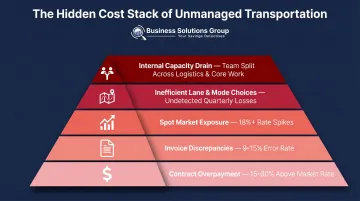
The hidden cost stack looks like this:
- Companies overpay by 15–30% on carrier contracts that haven't been benchmarked in 2–3 years
- 9% of freight invoices contain discrepancies for SMBs; in manufacturing, that rate hits 12–15%
- Spot market dependence exposes shippers to rate spikes of 18%+ during peak periods
- Without benchmarking data, inefficiencies — poor lane consolidation, misclassified freight, wrong mode selection — go undetected, adding unnecessary cost each quarter
- Internal teams stretched across logistics and core responsibilities underperform on both
Freight audits alone can surface up to 15% in recoverable logistics costs — savings most shippers never find because the internal visibility simply isn't there.
How to Get the Most Value from Outsourced Transportation Management
The quality of the engagement depends on choosing the right partner — one who functions as a strategic extension of your business, embedded in your goals and accountable to your results.
What separates high-value outsourcing arrangements:
- Define KPIs at the outset — freight cost per shipment, on-time delivery rate, claims ratio. Review them monthly or quarterly rather than assuming the relationship self-corrects
- Require ongoing benchmark analysis — not just at onboarding, but as a continuous service that tracks market shifts and flags new savings opportunities
- Treat it as a long-term partnership — the data, process improvements, and carrier relationships that build over 12–24 months are where the largest compounding gains appear
- Demand full transparency — carrier contracts should be in your company's name; fees should be clearly structured with alignment between your savings and your partner's compensation
Business Solutions Group structures its engagements around these same principles. Under the Off-Bill Incentive (OBI) model, BSG's fees are paid by carriers — if clients don't save, BSG doesn't get paid. That alignment removes the guesswork from vendor incentives.
Ongoing results are tracked through dedicated Client Success teams using spend intelligence software that monitors KPIs continuously. The goal is sustained improvement quarter over quarter, not a single cost reduction at contract signing.
Conclusion
Outsourcing transportation management gives businesses access to carrier leverage, benchmarking data, enterprise technology, and operational capacity that most companies can't build cost-effectively on their own — without sacrificing visibility or control over their supply chain.
The five reasons covered here — cost reduction, expert benchmarking, technology access, scalability, and resource reallocation — don't operate in isolation. They reinforce each other. Better data leads to stronger carrier negotiations; better technology surfaces billing errors; freed-up internal capacity accelerates growth initiatives.
For businesses ready to stop treating transportation as a fixed cost and start treating it as a lever for profitability, a structured outsourcing partnership is a practical first step.
Frequently Asked Questions
What are the benefits of outsourcing transportation?
The primary benefits are lower freight costs through consolidated carrier leverage, access to logistics expertise and benchmarking data, improved on-time delivery performance, and the ability to scale operations without adding internal headcount. Most shippers also recover significant spend through freight audit services they couldn't run effectively in-house.
What is logistics outsourcing?
Logistics outsourcing means hiring a third-party provider to manage supply chain functions (such as transportation, freight auditing, or warehousing) that would otherwise require internal staff. The scope can range from a single function like carrier negotiation to full transportation management.
What does a transportation manager do?
A transportation manager handles carrier selection and negotiation, route planning, shipment tracking, freight auditing, and performance reporting. When outsourced, these functions are handled by the partner's dedicated operations team with access to specialized tools and a broader carrier network.
Is transport management in demand?
Yes. U.S. 3PL gross revenues reached $307.9 billion in 2024, with the global market projected to grow at a 9.1% CAGR through 2033. Rising freight complexity, e-commerce volume growth, and volatile capacity markets have made transportation management increasingly critical — and increasingly outsourced.
What's the difference between a TMS and a WMS?
A Transportation Management System (TMS) optimizes the movement of goods — carrier selection, routing, freight auditing, and in-transit tracking. A Warehouse Management System (WMS) manages inventory and operations within a facility. Both are often provided or integrated through 3PL and 4PL partners.
What are the four types of outsourcing in logistics?
The four primary 3PL categories are:
- Dedicated Contract Carriage (DCC): Supplies drivers and fleet management
- Domestic Transportation Management (DTM): Handles non-asset-based freight within North America
- International Transportation Management (ITM): Covers cross-border freight forwarding
- Value-Added Warehousing and Distribution (VAWD): Manages long-term contract warehousing and distribution