Introduction
Managing a third-party logistics operation has never been more demanding. Carrier rates shift without warning, client expectations for real-time visibility keep rising, and margins get squeezed from every direction. Most logistics teams end up reacting to problems rather than preventing them, buried in manual tracking calls, invoice disputes, and rate guesswork.
A Transportation Management System (TMS) addresses all of this directly. Today's platforms go well beyond shipment tracking — they centralize carrier management, automate rate shopping, and give operations teams the visibility to make faster, better-informed decisions.
This guide breaks down what a TMS actually is, which features move the needle, how it reduces costs, and what to look for when evaluating options. Whether you run a freight brokerage, an asset-based operation, or a multi-modal operation, the same core questions apply.
Key Takeaways
- A TMS manages freight planning, carrier selection, real-time tracking, and billing automation across multiple clients simultaneously
- Must-have features: multi-modal support, automated load tendering, rate shopping, and performance analytics
- TMS implementations typically reduce freight spend by 5–10%, with an industry survey average of 8%
- Deep integration with WMS, ERP, and carrier networks eliminates manual bottlenecks
- Match the platform to your modes, client volume, and integration requirements before evaluating feature lists
What Is a TMS and How Does It Work?
A Transportation Management System is software designed specifically for third-party logistics providers. Unlike a standard shipper TMS — which serves one organization's freight — a provider TMS must manage shipments across multiple client accounts simultaneously. Each client account carries its own rate tables, carrier preferences, billing rules, and visibility requirements.
The Core Workflow
When fully automated, the TMS runs this sequence without manual intervention:
- Order ingestion — pulls shipment data from client ERP or OMS systems
- Load building — optimizes consolidation based on weight, destination, and cost
- Carrier selection and tendering — rates shop across carriers and auto-tenders to the best fit
- Real-time tracking — aggregates carrier data into a centralized dashboard
- Billing and settlement — matches invoices against contracted rates, flags discrepancies
- Performance reporting — generates KPI dashboards for internal teams and clients
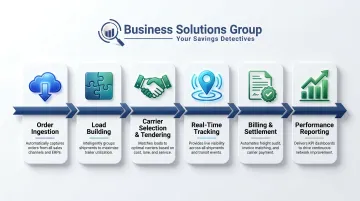
Every manual step in that chain is a bottleneck. For a provider managing dozens of client accounts, those bottlenecks compound — which is exactly where automation delivers its clearest ROI.
TMS vs. WMS: A Quick Distinction
A TMS governs the movement of goods between origin and destination. A Warehouse Management System (WMS) governs inventory and fulfillment inside a facility. They serve different functions, but the most effective logistics operations integrate both. The result: a connected data flow from the moment an order is placed to the moment it's delivered — with no gaps between warehouse and transit visibility.
Key Features of a Transportation Management System
Not all TMS platforms are built for this level of complexity. These are the capabilities that actually drive results.
Multi-Modal Transportation Management
A TMS must handle truckload (TL), less-than-truckload (LTL), air freight, rail, ocean, and intermodal shipments within a single platform. Carrier matching algorithms evaluate cost, transit time, capacity, and service level requirements simultaneously — then recommend the optimal mode and carrier for each shipment.
Business Solutions Group's TMS supports all six major shipping modes (parcel, LTL, FTL, air, ocean, and rail) within one unified dashboard, with least-cost routing applied automatically across every shipment.
Automated Load Tendering and Rate Shopping
Manual tendering — phone calls, emails, waiting for carrier callbacks — is one of the largest time sinks in freight operations. Automated EDI tendering delivers an 80% reduction in administrative tasks and drives error rates below 0.5%, compared to rates far higher in manual processes. Carrier responses arrive in seconds rather than hours.
BSG's rate shopping tool consolidates UPS, FedEx, USPS, LTL, FTL, and courier rates into a single dashboard, with real-time quoting and booking — no manual searching across carrier websites.
Real-Time Shipment Visibility and Exception Management
Real-time visibility has moved from differentiator to baseline expectation. 77% of supply chain professionals now consider it indispensable, and IoT/AI tracking adoption more than doubled from 25% to 53% in a single year. For logistics providers, this means clients expect live shipment data — and will switch providers to get it.
The TMS centralizes carrier tracking data, triggers automated alerts for delays or exceptions, and enables proactive client communication — without staff intervention on routine status requests.
Freight Billing, Audit, and Settlement Automation
Billing discrepancies in logistics are far more common than most shippers realize. Incorrect weight classifications, duplicate charges, rate errors, late delivery credits not applied, and accessorial fees added in error all drain revenue that's difficult to recover after the fact.
Automated invoice auditing matches every carrier invoice against contracted rates and flags discrepancies before payment. BSG's audit process covers all transport types — parcel, LTL, FTL, air, ocean, and rail — with most clients seeing measurable returns within the first billing cycle.
Performance Analytics and KPI Reporting
The data a TMS captures — on-time delivery by carrier and lane, cost per shipment, freight spend by client, carrier performance rankings — gives operations teams the visibility to negotiate better carrier terms, identify underperforming lanes, and make decisions based on actual performance data rather than estimates.
External-facing client dashboards showing freight spend and service levels are a key competitive differentiator for logistics providers retaining and growing accounts. When clients have direct access to their own performance metrics, the relationship shifts from transactional to strategic — and that's where long-term retention is built.
How a TMS Reduces Costs and Boosts Profitability
Freight Spend Optimization Through Carrier Selection
The verifiable industry benchmark: TMS implementation reduces freight spend by 5–10% (Descartes), with an 8% average reported in an ARC Advisory Group survey of TMS users. For a shipper moving $5 million in freight annually, that's $250,000–$500,000 in recoverable cost — without renegotiating a single carrier contract.
Automated rate shopping and lane-level cost analysis surface opportunities that manual processes consistently miss, particularly on lanes with inconsistent volume where spot rates fluctuate.
Load Consolidation and Eliminating Empty Miles
ATRI's 2025 report found empty miles reached 16.7% of all non-tank trucking operations — dead capacity that someone is paying for. TMS route optimization engines tackle this directly:
- LTL-to-FTL consolidation can reduce per-unit freight costs by 5–10%
- Continuous-move planning to minimize deadhead miles recovers 2–3% of freight spend
- Day-of-week cost analysis identifies when shifting a ship date by 24 hours reduces lane costs measurably
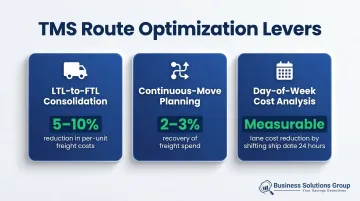
Each of these levers depends on lane-level data — the kind that manual coordination can't generate consistently at volume.
Reduced Administrative Overhead
Every manual task a TMS automates — load building, tracking calls, invoice auditing, report generation — is labor that can be redirected toward higher-value work. Automation in the booking process alone saves 5 to 10 minutes per transaction, translating to a 3–4% reduction in labor costs per Descartes benchmarks.
For a provider processing hundreds of shipments daily, that compounds quickly.
Lower Detention and Accessorial Charges
The industry-wide cost of driver detention reached $3.6 billion in direct expenses in 2023, with an additional $11.5 billion in lost productivity — yet fewer than 50% of detention invoices are actually paid. Real-time visibility and automated dock scheduling reduce driver wait times, with TMS dock management modules cutting waiting-time penalties by up to 25%.
Preventing detention is far more cost-effective than recovering fees after the fact.
BSG's Spend Intelligence Advantage
All the savings above assume you know where you stand relative to the market — and that's where most teams have a blind spot. Business Solutions Group's proprietary spend intelligence software benchmarks client freight spend against current market rates at the lane, carrier, and mode level, pinpointing where companies are overpaying and by how much. Clients who run this benchmark analysis typically discover savings of 15–35%, with a current average of 23.6%. The analysis — covering 6–12 months of shipment-level detail — is included at no charge as part of BSG's initial engagement.
Integration, Scalability, and Logistics Automation
The Integration Ecosystem
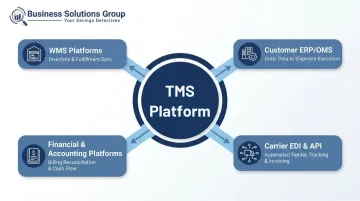
The degree of TMS integration determines how much of the workflow actually runs automatically versus requiring manual intervention. A fully connected TMS integrates with:
- WMS platforms — inventory and fulfillment sync
- Customer ERP/OMS systems — order data flows directly into shipment execution
- Carrier EDI and API connections — automated tender, tracking, and invoicing
- Financial/accounting platforms — billing reconciliation and cash flow management
Business Solutions Group's TMS uses an open RESTful API for ERP connectivity and includes pre-built integrations with major WMS and accounting platforms, which cuts implementation time compared to building custom connections from scratch.
Cloud vs. On-Premise Deployment
| Factor | Cloud-Based | On-Premise |
|---|---|---|
| Implementation speed | Faster | Slower |
| Upfront cost | Lower | Higher |
| Automatic updates | Yes | Manual |
| Data control | Shared infrastructure | Maximum control |
| Remote access | Any device | Limited |
On-premises TMS still held 61% market share in 2025 per Global Market Insights — the transition to cloud is underway, but it isn't complete. Mid-market providers scaling quickly have driven cloud adoption hardest, and the reason is straightforward: faster implementation and no hardware investment fit their growth timelines. Business Solutions Group's TMS is cloud-based, which means faster onboarding and no infrastructure overhead for clients.
Scalability for Growing Operations
A scalable TMS accommodates new carrier integrations and client onboarding without rebuilding workflows. It supports multi-client, multi-location operations from a single platform — allowing providers to grow revenue without proportional headcount growth. The cloud architecture handles volume spikes during peak seasons without requiring infrastructure investment before demand arrives. That elastic capacity is also what makes end-to-end logistics automation practical: the system scales the automated processes alongside the volume, rather than forcing manual workarounds at the edges.
How to Choose the Right TMS
Define Requirements Before Evaluating Vendors
Before contacting a single vendor, document your operational profile:
- Transportation modes you handle (parcel only, multi-modal, international)
- Number of active carriers and EDI/API connection requirements
- Client volume and multi-tenant complexity
- Required integrations (WMS, ERP, accounting)
- Whether you need a white-label client portal
A TMS optimized for freight brokers differs significantly from one built for asset-based or multi-modal operations. Getting this mapping wrong wastes months.
Key Evaluation Criteria
Focus on these differentiators during vendor reviews:
- Carrier integration depth — EDI and API coverage for your specific carrier mix
- Business rule configurability — how flexibly can carrier selection logic be tuned?
- Reporting quality — both internal analytics and client-facing dashboards
- Implementation support — realistic onboarding timeline (typically 3–9 months depending on complexity)
- Total cost of ownership — subscription fees, implementation, training, and integration costs
Avoiding Common Selection Mistakes
- Don't choose on feature lists alone — validate integration compatibility with your existing WMS and ERP before signing anything
- Don't oversize — enterprise platforms that exceed your operational complexity add cost without value
- Don't undersize — a basic tool that can't scale will require replacement as you grow
- Request references from providers of similar size and freight profile, not the vendor's flagship accounts
Advisory Support During Selection
Avoiding these pitfalls is easier with outside perspective. Many operators work with logistics advisors during TMS selection to pressure-test vendor claims, validate integration fit, and run carrier RFPs in parallel with implementation planning.
Business Solutions Group supports freight operations through this process — evaluating technology investments, benchmarking carrier contracts, and structuring eProcurement strategies alongside TMS deployment. The result is a selection process that improves both system fit and freight cost outcomes at the same time.
The Future of TMS: AI and Emerging Technologies
AI-Driven Predictive Operations
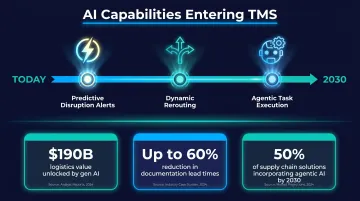
Machine learning is moving TMS platforms from reactive tracking to predictive decision-making. AI models now anticipate disruptions before they occur, proactively reroute loads based on weather and traffic conditions, and dynamically adjust capacity plans in real time.
The scale of the opportunity is significant: McKinsey estimates gen AI can unlock roughly $190 billion in travel and logistics value, with documentation lead times dropping by up to 60% and logistics coordinator workloads reduced by 10–20%.
AI-powered load matching is already delivering measurable results — Uber Freight's recommendation engine yielded a 12% increase in bookings for active users, though that figure comes from vendor-produced data.
Agentic AI and the Autonomous TMS
Agentic AI takes automation a step further — these systems don't just recommend decisions, they execute multi-step logistics tasks autonomously: appointment scheduling, load recovery, carrier negotiations. Gartner predicts 50% of cross-functional supply chain management solutions will incorporate agentic AI by 2030, with 55% of supply chain leaders expecting it to reduce entry-level hiring needs.
Several converging technologies will reshape what a TMS can do sooner than most providers expect:
- IoT sensors on trailers — real-time location, temperature, and condition monitoring
- Computer vision — automated facility check-in and damage detection without manual inspection
- Agentic AI systems — coordinating across all of the above to act, not just alert
Providers that invest in platforms with open architecture and strong API ecosystems now will absorb these capabilities as they mature — rather than facing a costly migration when the market demands them.
Frequently Asked Questions
What is a TMS and how do logistics providers use it?
A TMS (Transportation Management System) is software that plans, executes, and optimizes freight movements. Logistics providers use it to manage carrier selection, load tendering, real-time tracking, billing, and performance reporting across multiple clients and modes. This replaces manual coordination with automated workflows at scale.
What does third-party logistics mean in transportation?
Third-party logistics refers to companies that provide outsourced logistics services — including transportation management, warehousing, and fulfillment — on behalf of businesses that prefer to focus on their core operations.
What is the logistics provider hierarchy in transportation?
The hierarchy runs from self-managed to fully outsourced. First-party logistics moves its own goods; second-party covers asset-owning carriers; third-party provides outsourced logistics with carrier networks; fourth-party orchestrates multiple providers; and fifth-party represents fully integrated supply chain technology platforms.
How much does a transportation management system cost?
SaaS platforms range from roughly $50 to $500 per user per month; enterprise platforms use custom pricing and can run significantly higher. Total cost of ownership includes implementation, training, and integrations. Business Solutions Group includes TMS access — typically a $150,000–$250,000 investment — at no additional cost within its managed logistics engagements.
What is the best TMS software for logistics providers?
There's no single best option. The right TMS depends on your transportation modes, client volume, carrier integration requirements, and scalability needs. Evaluating platforms alongside your carrier contract strategy — with an advisory partner if needed — tends to produce better long-term fit than selecting software in isolation.