Introduction
Carrier contracts are designed to favor the carrier. UPS and FedEx invest heavily in pricing teams whose job is to capture as much of your shipping spend as possible — at the lowest discount they can get away with. For businesses spending $500,000 or more annually on parcel and freight, a poorly negotiated contract doesn't just cost money once.It erodes margins every year through rate increases, surcharge creep, and clauses that box you in.
This guide is for small parcel shippers, freight shippers, and logistics managers who want to understand how carrier contracts actually work — and how to negotiate them more effectively. You'll learn how carriers structure agreements to lock you in, what pre-negotiation preparation looks like, and which specific tactics reduce total shipping cost.
Key Takeaways
- Know your shipping profile — zones, weights, service mix, and surcharge exposure — before negotiating
- Carriers use volume clauses, primary carrier designations, and RFP restrictions to limit your leverage
- Benchmark your rates against real market data; without it, you're negotiating blind
- Negotiate total landed cost, including surcharges — not just base rates
- Renegotiation is an ongoing process, not a one-time event; build it into your operations calendar
What Is a Carrier Contract and What Does It Cover?
A carrier contract is a formal agreement between a shipper and a transportation provider that defines rates, service levels, and the terms governing the shipping relationship. There are two main types:
- Parcel contracts — for individual packages, typically under 150 lbs, with carriers like UPS and FedEx. Standard contract terms run 36 months.
- Freight contracts — for palletized or bulk shipments, structured as LTL (Less-Than-Truckload) or FTL (Full Truckload), priced differently based on freight classification or lane.
Both contract types are negotiable — but the specific terms, discount structures, and pressure points differ significantly between them.
Key Contract Components
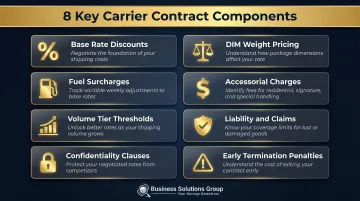
Every carrier contract contains multiple components — and every one of them is a potential negotiation point:
- Base rate discounts — percentage off published rates by service level and zone
- Dimensional (DIM) weight pricing — both UPS and FedEx use a standard DIM divisor of 139 for domestic shipments; higher actual weight or DIM weight determines billable weight
- Fuel surcharges — published weekly, floating with diesel or jet fuel prices; currently running 8–10% for Ground and 14–18% for Express
- Accessorial charges — residential delivery, address corrections, liftgate, extended area, peak season fees
- Volume tier thresholds — the spend levels that unlock discount tiers
- Liability and claims terms
- Confidentiality clauses
- Early termination penalties
FedEx parcel contracts carry a timing trap worth flagging: base rate discounts typically apply indefinitely, but surcharge discounts often carry a one-to-three-year term. That expiration date is easy to miss — and carriers count on it.
This is why knowing every component — not just the headline discount — is what separates a well-negotiated contract from one that quietly erodes your margins over time.
How Carriers Structure Contracts to Lock You In
The foundational dynamic in parcel contracting: UPS and FedEx structure discounts as a percentage off their published rates — but they control those published rates. A 30% discount becomes effectively 10% if the carrier raises its base rates by 20%. The discount stays the same; your actual savings evaporate.
According to Parcel Industry, fewer than 3% of shippers see their costs increase by only the announced GRI percentage or less. The average actual increase runs 10.25% for UPS and 12.86% for FedEx — far above the headline 5.9% GRI announced for 2026.
Rate erosion is just the start. Carriers also embed structural mechanisms in contract language that quietly eliminate your negotiating options.
Minimum Volume Requirements
Carriers measure compliance using a 52-week rolling spend average. If your volume drops below the threshold, discounts shrink incrementally or revert to published rates. In practice, carriers typically set the minimum threshold at or near your total annual parcel spend — meaning there's essentially no room to divert volume elsewhere without triggering a penalty.
Primary Carrier Designation Clauses
Some contracts require you to route 92% of all small parcel shipments through one carrier. This clause is designed to prevent multi-carrier diversification. Even if a regional carrier offers better pricing on specific lanes, the designation clause can make acting on that quote a contract violation.
RFP Prohibition and Early Termination Penalties
Two clauses that often go unread until it's too late:
- RFP prohibition — prevents you from formally soliciting bids from competing carriers until a narrow window before contract expiration (often 90 days). This eliminates meaningful rate shopping during the contract term.
- Early termination penalties — structured as a flat fee, a percentage of annual spend, or both. These clauses typically offer no recourse even when carriers introduce new surcharges mid-contract. One documented example: carriers lowered the Additional Handling – Weight threshold from 71 to 51 lbs., increasing costs for shippers who had no contractual path to push back.
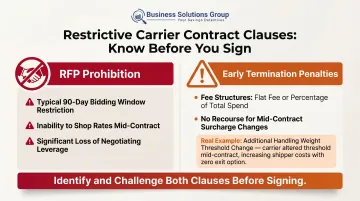
Both clauses should be identified and challenged before signing — once the contract is executed, your leverage to modify them effectively disappears.
Pre-Negotiation Preparation: Know Your Numbers
Successful negotiation is determined largely before anyone sits at the table. The shipper with clean, detailed shipping data holds the leverage.
Build Your Shipping Profile
Before approaching any carrier, compile a complete picture of your shipping operations:
- Package dimensions and weights by shipment type
- Origin/destination zones and volume by lane
- Service level usage (Ground vs. Express breakdown)
- Accessorial charge exposure by category
- Claims rates and seasonal volume patterns
Carriers know your business better than most shippers realize. They see your invoice data. Walking in without equivalent knowledge puts you at an immediate disadvantage.
Conduct a Pre-Negotiation Audit
Research from Shipware estimates that **20% of all shipping invoices contain billing errors** — duplicate charges, misapplied accessorials, incorrect DIM measurements, and discounts that weren't honored. Shippers can reclaim approximately 5–8% of total shipping spend through formal audit processes.
Business Solutions Group's audit process covers parcel, LTL, FTL, air, ocean, and rail, surfacing incorrect weight classifications, duplicate billing, late delivery credits not applied, and accessorial fees added in error.
Beyond recovering past overcharges, audit findings become negotiation ammunition: documented proof of where the current agreement is underperforming.
Benchmark Against Market Rates
Carriers don't advertise competitive rates. Without external market data, you have no way to know whether your current discounts are reasonable or whether you're paying 30% above market on specific zones.
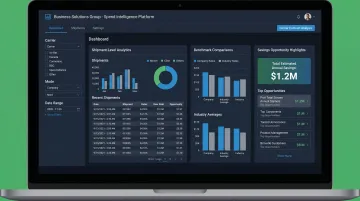
Business Solutions Group's spend intelligence platform manages over $3 billion in parcel spend, giving clients visibility into thousands of pricing agreements. Key capabilities include:
- 40+ actionable insights through shipment-level dashboards
- Savings opportunities based on actual parcel activity, not estimates
- Benchmark precision to one-tenth of a percent
Their clients have averaged 19% rate reductions on small parcel shipments, with typical negotiated savings ranging from 15% to 40%.
Prioritize What Actually Moves Your Needle
Build a "must-have vs. nice-to-have" list based on your actual shipping data. If 70% of your shipments are Zone 3–5, a contract weighted toward Zone 6–8 discounts looks impressive but delivers minimal real value. Know which terms affect your actual spend before you push hard on anything.
Shop Strategically Before You Negotiate
Get competitive quotes from alternative or regional carriers before approaching your incumbent. One caution: don't reveal your full shipping volume to new carriers. Ask them to bid on a defined segment — specific lanes or weight classes — so they price competitively rather than simply reframing their offer to capture your entire book.
Proven Carrier Contract Negotiation Strategies
Negotiate Total Landed Cost, Not Just Base Rates
Base transportation rates are only part of the expense. Surcharges now represent 30–40% of total parcel spend, and that percentage has been climbing steadily. Fuel surcharges, residential delivery fees, peak season charges, and address corrections can collectively rival your base rate line.
Walk into negotiations with a full surcharge exposure analysis drawn from your audit. Use it to demand concessions across all cost categories simultaneously — not just the line rate.
Use Competing Offers as Documented Leverage
Once you have quotes from alternative carriers, return to your incumbent with documented alternatives. The framing matters: unannounced surcharge changes combined with an upcoming GRI represent a double-digit effective cost increase that makes the current contract untenable without adjustments. Specific numbers are more compelling than general complaints.
Business Solutions Group supports clients through this phase by reviewing carrier proposals, identifying shortfalls, and coaching counter-responses, drawing on insight from former UPS and FedEx senior pricing analysts.
Offer Carriers What They Value
Carriers value predictability. If your shipping profile is stable, that stability is a negotiating asset. Use it to pursue:
- Better discount tiers in exchange for volume commitments
- Waived residential or address-correction surcharges
- Reduced peak-season fees tied to reliable pickup windows
Commit only to thresholds you're confident you'll hit — volume penalties erase hard-won discounts fast.
Peel Off Growth Volume
If you're growing 10% year-over-year, route that incremental volume to a new carrier while maintaining minimum thresholds with your incumbent. This builds a multi-carrier relationship, creates long-term leverage, and doesn't trigger penalties. Most shippers see meaningful leverage gains within one to two contract cycles using this approach.
Present Multiple Structured Offers
Rather than making a single demand, present two or three contract variations that differ in volume commitment, term length, or service levels. This keeps you in control of the parameters while giving the carrier a sense of flexibility. State your non-negotiable terms early — it saves time and signals preparation.
Key terms worth anchoring upfront:
- Maximum annual GRI cap (fixed percentage or formula)
- Surcharge freeze windows around peak season
- Notification requirements before unilateral rate changes
Beyond Base Rates: Surcharges and the DIM Divisor
Surcharges deserve their own negotiation track. Accessorial fees alone can add as much as 30% to an individual package's cost. During peak season, UPS surcharges for high-volume shippers range from $0.40 to $8.75 per package, with large package fees reaching $90.50–$107 per package.
Three surcharge negotiation approaches worth pursuing:
- Surcharge caps — a ceiling on how high a specific surcharge (fuel, residential) can go during the contract term
- Surcharge-free thresholds — for example, residential delivery waived up to a defined volume
- Fixed surcharge rates — locking in a specific rate as an alternative to floating carrier-controlled tables
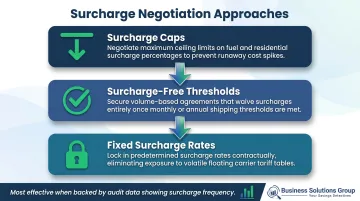
These negotiations are most effective when you can show exactly which surcharges hit your shipments most frequently, drawn directly from your audit data.
The DIM Divisor Is Negotiable
The standard DIM divisor is 139 for both UPS and FedEx domestic shipments. Negotiating that divisor from 139 to 166 reduces DIM weight charges by more than 16% on every dimensionally charged package. For shippers with lightweight, bulky products — think subscription boxes, apparel, or retail goods — this single change can outperform many base rate discounts.
Before bringing it to the table, calculate the financial impact across your specific shipment mix. Run your top 20% of shipments by volume through both divisors, quantify the difference, and present that figure as the cost justification carriers need to approve the change.
When to Renegotiate — and How to Keep Leverage Over Time
Miss a renegotiation window and you're locked into yesterday's rates — often for longer than you realize. Key triggers that should prompt a contract review include:
- Annual GRIs — announced in the fall, effective late December (UPS) or early January (FedEx)
- Surcharge discount expirations — which can occur as soon as 6 months into a contract
- Significant changes in shipping volume or product mix
- Carrier service failures — late deliveries, damage claims, or billing non-compliance
- New regional carrier alternatives creating competitive pressure
- Business growth that changes your volume leverage
UPS's revenue per piece grew 10.5% in a single quarter — a gain driven largely by shippers who weren't actively managing their agreements. Carrier contracts auto-renew at existing rates unless you push back. Build reviews into your operations calendar at least annually, or passive management becomes a recurring cost.
Maintaining Leverage Between Cycles
- Build and maintain relationships with backup carriers — even if you're not actively using them
- Run quarterly spend analyses to catch cost creep before it compounds
- Document carrier service failures systematically; they become negotiation ammunition at renewal
- Monitor surcharge table changes mid-contract; carriers adjust these without notice
Business Solutions Group supports clients through every phase of this cycle — from ongoing KPI tracking and carrier performance scoring to renegotiation support between renewals. The goal is keeping your contracts aligned with current market conditions, not the ones that existed when you last signed.
Frequently Asked Questions
What are popular carrier contract negotiation tactics?
Start by benchmarking your current rates against market data, then bring competing carrier quotes as leverage. Negotiate total landed cost — surcharges included — not just base rates. Identify what the carrier needs (volume certainty, specific lanes) and structure terms around those mutual interests.
What terms are negotiable in a carrier contract?
More than most shippers realize: base rates, DIM weight divisors, fuel surcharge structures, residential and peak surcharge rates, volume thresholds, payment schedules, and early termination penalties are all on the table. Treat every element as a starting position, not a fixed term.
What does a contract negotiator do in a carrier context?
A contract negotiator analyzes your spend data, benchmarks it against market rates, identifies unfavorable clauses, and guides the negotiation toward better pricing and reduced surcharge exposure. Firms like Business Solutions Group — whose team includes former UPS and FedEx pricing analysts — bring inside knowledge of how carriers build and defend their rate structures.
What are the 5 C's of a contract?
The traditional framework covers: Competency (legally capable parties), Consent (mutual agreement), Consideration (value exchanged), Capacity (authority to sign), and Conditions (terms and obligations). In carrier contracts, conditions get the most negotiation attention — rate structures, surcharge terms, volume commitments, and termination clauses are all in scope.
What does white glove mean in logistics?
White glove delivery refers to a premium final-mile service involving inside delivery, placement, assembly, and debris removal — beyond standard doorstep drop-off. If your carrier agreement includes white glove service tiers, the specific service elements and associated fees should be explicitly defined in the contract rather than left to interpretation at the time of delivery.