The outsource-vs.-in-house question around Freight Audit & Payment (FAP) sits at the intersection of cost control, operational capacity, and logistics strategy. Get it wrong in either direction and you either bleed money through uncaught billing errors or build internal infrastructure that costs more than it recovers.
This article breaks down what FAP actually involves, the practical advantages of outsourcing it, when in-house management is a reasonable choice, and how to get the most out of whichever path you choose.
Key Takeaways
- FAP covers invoice verification, error detection, dispute resolution, and carrier payment — and billing errors in this process are both common and expensive.
- Professional FAP providers recover 1%–5% of total transportation spend through systematic pre-payment auditing.
- Outsourcing removes the staffing and scaling ceiling — no need to build specialized internal teams as volume grows.
- In-house FAP only makes sense with low invoice volume, genuine freight expertise on staff, and the right technology already in place.
- The strongest case for outsourcing: companies managing multiple carriers, high invoice volumes, or limited internal freight expertise.
What Is Freight Audit & Payment?
Gartner defines FAP services as "invoice collection, preaudit, processing, payment and analytics of transportation invoices across multiple modes and geographies." The definition covers more ground than most logistics teams budget for — FAP is a multi-step control process, not a back-office accounting task.
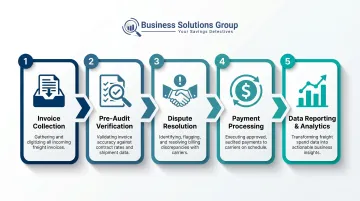
A complete FAP function covers five distinct activities:
- Invoice collection — receiving and normalizing carrier invoices across all modes
- Pre-audit verification — validating rates, reviewing accessorial charges, detecting duplicates
- Dispute resolution — managing exceptions, communicating with carriers, processing claims
- Payment processing — consolidated carrier payments, GL coding, cost center allocation
- Data reporting and analytics — spend visibility, trend analysis, contract compliance monitoring
The timing of your audit determines how much you recover. Errors caught before payment have recovery rates approaching 100%. Let an overpayment clear, and that rate drops to 60–80% — and your cash flow has already absorbed the hit.
FAP is the control point between your contracted freight rates and what you actually pay. The accuracy of that process also determines the quality of spend data your logistics team relies on for planning and negotiation.
Key Advantages of Outsourcing Freight Audit & Payment
The advantages below aren't theoretical. They're tied to measurable outcomes in cost recovery, staffing efficiency, and spend visibility — and they compound in significance as invoice volume and carrier complexity grow.
Cost Recovery Through Invoice Accuracy
Freight billing errors are more common than most shippers expect. Industry sources consistently cite error rates of 3% to 6% of freight invoices, with errors concentrated in accessorial charges, misapplied discounts, incorrect weight classifications, and duplicate billings.
Business Solutions Group's audit process covers exactly these categories: overcharges, duplicate service charges, accessorial fees added in error, late delivery credits not applied, and incorrect surcharges. That spans parcel, LTL, FTL, air, ocean, and rail. According to their internal data, roughly 1 in 5 shipping invoices contains an error of some kind, with most clients seeing recoveries within the first billing cycle.
Professional FAP providers recover between 1% and 5% of total transportation spend through systematic pre-payment auditing. For a company moving $10 million in freight annually, that translates to $100,000–$500,000 in recovered overcharges — without cutting service levels or renegotiating a single contract.
This advantage is highest-impact for companies processing large invoice volumes, working across multiple modes, or those running a formal audit process for the first time. Track these KPIs to measure it: freight invoice error rate, cost recovery amount per period, and total transportation spend.
Operational Efficiency and Scalability Without Proportional Headcount
Managing FAP internally requires staff who genuinely understand carrier contracts, tariff structures, fuel surcharge calculations, and exception resolution — not just accounts payable generalists. As freight volume grows, so does the need for more people, more oversight, and more system capacity.
Outsourcing removes that ceiling. The provider absorbs scaling costs, handles carrier communications and dispute resolution, and takes on the operational complexity that would otherwise require multiple internal hires and system investments.
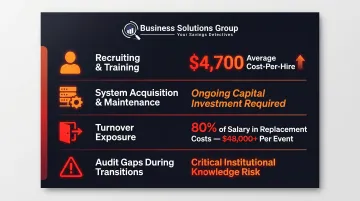
Companies routinely underestimate the hidden costs of building FAP infrastructure internally:
- Recruiting and training specialized freight audit staff (SHRM data puts average cost-per-hire at nearly $4,700 in direct costs alone)
- System acquisition and maintenance for invoice ingestion, rate matching, and reporting
- Turnover exposure — Gallup estimates replacement costs at 80% of salary for technical professionals, meaning a mid-level FAP analyst at $60,000 could cost $48,000+ to replace
- Audit gaps during transitions, when institutional knowledge walks out with departing staff
For growing mid-market shippers, the math shifts quickly. Building internal FAP infrastructure means committing to ongoing investment in people and systems at exactly the point when freight volumes — and the complexity of getting it right — are accelerating.
Key operational KPIs to track here: HR overhead cost, invoice processing time, error resolution cycle time, and internal staff hours diverted from core functions.
Transportation Spend Visibility and Data-Driven Decision Making
Outsourced FAP providers don't just audit invoices. They normalize and aggregate data across carriers, modes, lanes, and cost centers — producing a consolidated view of transportation spend that would take significant internal resources to replicate.
Business Solutions Group's spend intelligence platform integrates with client ERP and TMS systems to eliminate data silos, providing drill-down visibility into freight spend by mode, carrier, and shipment detail. Their Transportation Management Software functions as a data warehouse for historical shipment analytics, giving logistics and finance teams the structured data they need for carrier negotiations and cost center reporting.
This matters strategically. Spend data that's properly structured and analyzed identifies high-cost lanes, surfaces carrier performance trends, and builds the financial case for contract renegotiations — functions that go well beyond closing accounting entries.
The KPIs this unlocks — transportation cost per unit, carrier performance metrics, on-contract compliance rate, and freight spend by mode or lane — are exactly what logistics and finance leadership need to negotiate from a position of strength rather than guesswork.
For businesses with multiple shipping locations or complex carrier networks, this visibility is often the deciding factor in whether freight spending is actively managed or simply paid.
What Happens When FAP Is Ignored or Poorly Managed
Poor FAP management doesn't produce a single, visible failure. It produces a slow accumulation of costs that never gets flagged because no one is looking systematically.
Three compounding consequences are common:
- Reactive dispute management — without a proactive audit cycle, billing errors are caught post-payment (if at all), reducing recovery rates and straining carrier relationships
- Cost opacity — without normalized spend data, there's no reliable way to identify where freight costs are rising or why
- Scaling breakdown — manual or under-resourced FAP processes degrade as invoice volume increases, leading to delayed payments and damaged carrier relationships
The industry standard payment window is 7–14 days. Companies managing FAP poorly often stretch that to 30–60 days, eroding negotiating leverage and making carriers less inclined to prioritize their loads.
Freight billing errors left unaddressed can cost mid-market shippers 3% to 7% of total freight spend annually, and each manual invoice error costs an average of $53.50 to resolve.
In-House Freight Audit & Payment: When It Makes Sense
In-house FAP isn't inherently inferior. Under the right conditions, it's a viable choice. The problem is that those conditions are more specific than most companies assume.
In-house FAP is most likely to work when all three of the following are true:
- Low to moderate invoice volume with limited carrier complexity — a single mode, a handful of carriers, predictable billing patterns
- Genuine internal expertise in carrier contracts, tariff structures, accessorial charge rules, and dispute resolution — not just general AP knowledge
- Purpose-built technology capable of invoice ingestion, automated rate matching, exception flagging, and spend reporting
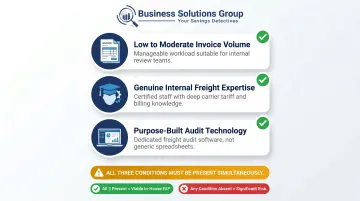
If any one of these conditions is missing, the risks multiply: audit gaps, unresolved disputes, delayed payments, and spend data that's too fragmented to act on.
In-house FAP also requires ongoing investment in staff training, system maintenance, and process updates as carrier billing rules change. That investment is defensible when volume is manageable and expertise is already in place. When either starts to slip — volumes climb, a key team member leaves, a carrier updates its tariff structure — audit accuracy drops and overpayments accumulate before most finance teams catch the shift.
How to Get the Most Value from Outsourced FAP
Outsourcing FAP produces the best results when it's treated as a strategic partnership, not a task handoff. That means staying actively engaged with the data and insights your provider generates — and using those insights to drive decisions, not just recover overcharges.
Three practices that separate high-performing FAP relationships from average ones:
Establish clear KPIs at the start: recovery rate, invoice processing time, and error rate — then review them on a defined schedule. Business Solutions Group provides weekly and monthly reporting with executive dashboards that show exactly where savings originate.
Use spend data beyond invoice recovery: carrier negotiations, routing optimization, and cost center reporting all benefit from the same data the audit process generates. Business Solutions Group's benchmark analysis typically reveals 15–40% savings potential in parcel contracts and 20–25% reductions in LTL freight spend.
Integrate the FAP platform with your existing systems. Business Solutions Group connects with WMS and ERP environments through an open RESTful API, moving data directly into existing workflows rather than creating a separate reporting silo.
The compounding effect is real: audit recovery addresses immediate overcharges, while contract optimization — informed by that same spend data — lowers the baseline cost going forward. Each round of auditing makes the next round of negotiations more precise.
Conclusion
The outsourcing decision hinges on a clear-eyed look at three variables: your invoice volume, the depth of freight expertise you have in-house, and how much visibility into transportation spend your logistics strategy actually requires.
When volume is high, carrier networks are complex, or internal resources are stretched, outsourcing delivers compounding advantages:
- Recovered overcharges improve cash flow immediately
- Structured spend data supports stronger carrier negotiations at renewal
- Pre-payment audits catch billing errors that post-payment recovery never fully recoups
FAP isn't just a cost of doing logistics business. Done well, it converts transportation spend from a cost center into a source of intelligence that grows more valuable the longer a disciplined process is in place.
Frequently Asked Questions
What is freight bill audit and payment?
Freight bill audit and payment (FAP) is the process of verifying carrier invoices for accuracy — checking for overcharges, duplicate charges, rate discrepancies, and misapplied accessorial fees — then reconciling them against contracted rates and shipping documents before processing timely payment to carriers.
What is the difference between outsourcing FAP and managing it in-house?
Outsourcing delegates the full FAP process to a specialist provider with dedicated technology and freight expertise, while in-house management keeps the process internal — requiring trained staff, audit software, and ongoing process maintenance. The core difference is who absorbs the operational complexity, scaling costs, and staffing risk.
When should an organization choose not to outsource freight audit and payment?
In-house FAP is more appropriate when invoice volumes are low and carrier relationships are straightforward, when the company already has trained staff and capable audit technology, or when data sensitivity requirements make third-party access to logistics data a concern.
How much can a company typically save by outsourcing freight audit and payment?
Published audits cite freight invoice error rates of 3–6%, with professional auditors recovering 1–5% of total transportation spend. For a shipper with $10 million in annual freight spend, that's $100,000–$500,000 in potential recoveries annually — actual results vary by carrier mix, mode, and how long billing errors have gone unaddressed.
What should businesses look for when choosing a freight audit and payment provider?
Prioritize integration capability with existing ERP and TMS systems, experience across relevant shipping modes (parcel, LTL, FTL, ocean, air), transparent spend analytics, and a demonstrated track record of measurable cost recovery — not just audit coverage.
Can small and mid-size businesses benefit from outsourcing freight audit and payment?
Yes — often more than larger shippers. Small and mid-size businesses typically lack the internal resources to staff and maintain a rigorous audit function, yet face the same invoice complexity as enterprise shippers. The ROI on outsourcing is proportionally higher when building an equivalent internal capability isn't feasible.