The challenge isn't just cost—it's operational complexity. Many businesses find that as they grow, their fulfillment processes don't scale with them. Errors increase, shipping rates stay high, and peak seasons expose every gap in their setup.
This article focuses on the practical, measurable benefits of 3PL warehouse management services: lower logistics costs, inventory accuracy, scalability, and how to ensure you're getting full value from the arrangement over time.
TL;DR
- 3PL warehouse management converts fixed warehouse overhead into variable costs that scale with order volume
- WMS-supported 3PLs achieve inventory accuracy above 99%, compared to the industry average of ~95%
- A single mis-pick costs $30–$75; 80% of customers won't return after a poor delivery experience
- Businesses processing 500+ orders per month find outsourced fulfillment more cost-effective than in-house operations
- Track KPIs, benchmark costs, and treat your 3PL as a strategic partner to get maximum value
What Are 3PL Warehouse Management Services?
A third-party logistics (3PL) provider takes on the warehousing, inventory management, order fulfillment, and shipping functions a business would otherwise run internally. The operational backbone is a warehouse management system (WMS)—software that tracks every unit from the moment it arrives at the dock through the moment it ships to the customer.
These services apply to businesses selling physical products across e-commerce, retail, or B2B channels. The common thread: they need reliable, scalable fulfillment without the capital commitment of owning or operating their own warehouse infrastructure.
That demand has scale behind it. According to Armstrong & Associates, the U.S. 3PL market reached $307.9 billion in total value in 2024, and 90% of Fortune 500 companies now use at least one 3PL provider—a clear signal that outsourced fulfillment has become standard operating practice.
The real value of 3PL warehouse management is the ability to compete on delivery speed and service quality without carrying the overhead of warehouse infrastructure yourself.
Key Advantages of 3PL Warehouse Management Services
Each advantage below connects to metrics that operations and finance teams actively track. These aren't abstract benefits—they show up in cost per order, error rates, and the ability to fulfill during peak demand without breaking the budget.
Advantage 1: Lower Logistics Costs Without Fixed Overhead
The most direct financial benefit of 3PL warehousing is converting fixed costs into variable ones. Instead of committing to a long-term lease, purchasing equipment, and carrying full-time warehouse staff regardless of order volume, businesses pay per pallet stored, per order fulfilled, and per shipment processed.
3PL providers create this cost advantage in three ways:
- Shared infrastructure — costs are spread across multiple clients, so no single business bears the full weight of lease, equipment, and technology expenses
- Volume-based carrier discounts — 3PLs aggregate shipping volume to access UPS and FedEx discounts ranging from 10% to 70% off published rates, pricing that individual mid-size shippers can't qualify for independently
- WMS automation — reduces labor hours per order through directed picking, automated cycle counts, and exception handling
Labor is worth examining on its own. According to CognitOps, warehouse labor represents 50–70% of total distribution center operating costs. That's where 3PL cost-sharing delivers its greatest impact.
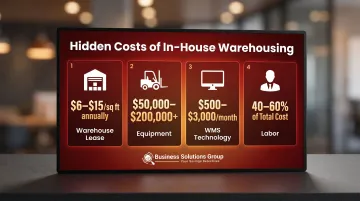
What businesses avoid by outsourcing:
| Cost Category | Typical Range |
|---|---|
| Warehouse lease | $6–$15 per sq ft annually |
| Equipment (forklifts, conveyors) | $50,000–$200,000+ initial investment |
| WMS technology | $500–$3,000 per month |
| Labor | 40–60% of total warehouse cost |
KPIs impacted: Cost per order fulfilled, warehousing cost as a percentage of revenue, carrier shipping rates, labor cost per shipment.
When this matters most: Businesses with seasonal demand swings, growing order volumes, or SKU counts that make fixed warehouse costs disproportionately expensive relative to actual throughput.
Advantage 2: Inventory Accuracy and Faster Order Fulfillment
Inventory drift is expensive. When stock counts are off, businesses oversell, miss ship dates, and process refunds—each incident eroding both revenue and customer trust.
3PL providers using WMS technology eliminate this through:
- Barcode scanning or RFID at every touchpoint—receiving, putaway, picking, and shipping
- Directed picking paths that reduce travel time and minimize the chance of a picker pulling the wrong SKU
- Automated cycle counts that keep inventory data current without requiring full manual audits
The accuracy gap between WMS-supported and manual operations is significant. Top-performing warehouses achieve 99.888% inventory accuracy, while facilities running without WMS-directed processes typically see error rates of 1–3%. Best-in-class 3PL operations target 99.5–99.9% order accuracy.
The financial consequences of missing that standard are concrete:
- A single mis-pick costs $30–$75 on average
- 23% of e-commerce returns result from customers receiving the wrong product
- 80% of customers refuse to shop with a brand again after a poor delivery experience
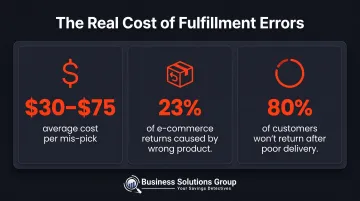
Each fulfillment error carries two costs: the immediate expense of the mis-pick and the long-term loss of a customer who won't return.
Accurate picking also accelerates cycle times. When pickers aren't backtracking to correct errors, orders ship sooner—a measurable edge for businesses competing on delivery speed.
KPIs impacted: Inventory accuracy rate, order error rate, average fulfillment time, return rate due to incorrect shipments.
When this matters most: High SKU counts, multi-channel sales, or customer expectations of same-day or next-day delivery.
Advantage 3: Scalability and Supply Chain Flexibility
In-house warehousing is structurally rigid. Leases don't flex with demand, headcount can't ramp overnight, and equipment sits idle during slow months while proving insufficient during peaks. The result: businesses either over-invest in capacity they rarely fill, or scramble when volume spikes.
3PL warehouse management solves this at both ends:
- Multi-warehouse networks allow geographic distribution of inventory, converting expensive long-zone shipments into shorter, cheaper ones. An average shipping zone score above 5.0 suggests inventory is positioned too far from the customer base—a problem that distributed 3PL networks directly address.
- Flexible storage models accommodate seasonal swings without renegotiating leases or committing to space you'll only fill three months per year
- Carrier integrations enable rate shopping across multiple options at the time of shipment, not just at contract signing
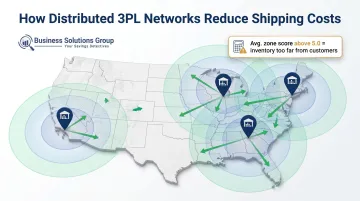
Shipping fees exceeding 15–20% of total revenue signal that fulfillment inefficiencies are directly eroding margins—a threshold that better geographic distribution and carrier rate management can meaningfully move.
Distributed inventory also reduces exposure to localized disruptions. Carrier failures, weather events, or demand forecasting errors affect one node—not the entire fulfillment operation.
KPIs impacted: Order fulfillment rate during peak periods, shipping zone distribution, time-to-scale for new markets, logistics cost variability.
When this matters most: Fast-growing e-commerce brands, businesses entering new geographic markets, and companies with pronounced seasonal demand variation.
What Happens Without Professional Warehouse Management
Without structured 3PL support, businesses commonly fall into a reactive fulfillment pattern that builds over time:
- Inventory discrepancies create overselling, delayed orders, and a customer service backlog that grows with order volume
- Rising per-unit costs as manual processes don't improve with scale—they just generate more errors at higher volume
- Peak season failures when emergency labor and last-minute carrier agreements replace the flexible capacity a 3PL maintains year-round
- Margin erosion from return processing costs, re-ship expenses, and the customer churn that follows poor fulfillment
Industry benchmarks suggest the average business achieves only a 90% perfect order rate—meaning 1 in 10 orders has some deficiency. For a business processing 500 orders per month, that translates to 50 problem orders per month driving refunds, re-ships, and avoidable churn.
How to Get the Most Value from 3PL Warehouse Management Services
A 3PL relationship delivers its full value when treated as an active partnership, not a passive outsourcing arrangement. That means regular performance review, cost benchmarking, and an evolving scope as the business grows.
Review Performance Data Consistently
Track these KPIs against industry benchmarks:
| KPI | Minimum Threshold | Best-in-Class Target |
|---|---|---|
| Order accuracy rate | 96–98% | 99%+ |
| On-time shipping rate | 98% | 99.8%+ |
| Inventory accuracy | 97% | 99.888% |
Note that SLAs function primarily as pricing adjustment mechanisms after a failure occurs—not as prevention. A 3PL can repeatedly miss targets and simply issue modest credits. Active monitoring of actual performance data, not just SLA compliance, is what catches problems early.
Benchmark Costs Against Market Rates
3PL costs—carrier contract terms, storage fees, pick-and-pack rates—can drift above market without anyone noticing until the annual review. Carrier benchmarking and spend intelligence analysis, such as what Business Solutions Group provides, identifies where costs have moved above market norms and where contract renegotiation is warranted. Their benchmark analysis covers freight contracts and rate structures from pre-contract through renewal.
Expand the Relationship as Your Business Grows
Returns management, value-added packaging, and additional fulfillment locations are services most 3PLs can layer in over time. When evaluating your 3PL annually, bring a list of emerging operational needs—that conversation often reveals services already available within your existing contract.
Conclusion
3PL warehouse management services deliver more than cost savings. Operational control, inventory precision, and the ability to scale without committing capital to fixed infrastructure are what separate businesses that grow efficiently from those that don't. Those gains multiply when companies track performance data, benchmark costs against market rates, and treat their 3PL as a strategic partner accountable to shared outcomes.
Fulfillment shapes customer experience, cash flow, and margin — yet many businesses manage it reactively. Higher costs, more errors, and lost repeat customers tend to follow. Companies that manage fulfillment actively, hold their 3PL to clear performance standards, and review the relationship regularly are the ones that turn logistics into a competitive asset.
Frequently Asked Questions
What are the benefits of using a 3PL warehouse?
3PL warehouses provide professional fulfillment infrastructure, carrier volume discounts, and WMS-driven inventory accuracy without the fixed costs of running your own facility. The core financial advantage: fixed overhead (leases, equipment, staff) converts into variable costs that scale with actual order volume.
What is a 3PL warehouse management system?
A 3PL WMS is specialized software that tracks inventory, directs order fulfillment, and manages multiple client operations in real time within a shared warehouse environment. Unlike a single-business WMS, it allocates storage, labor, and costs per client and generates client-specific reporting and billing.
What is 3PL inventory management?
3PL inventory management means outsourcing stock tracking, storage, and replenishment to a third-party provider whose systems maintain real-time accuracy across all SKUs and fulfillment locations — replacing manual counts with automated, always-current data.
What is the role of third-party logistics in supply chain management?
3PLs serve as the operational link between a business's product and its end customer, handling warehousing, order fulfillment, shipping, and returns so businesses can focus on procurement, sales, and growth rather than day-to-day logistics execution.
What are the benefits of warehouse management software?
WMS delivers real-time inventory visibility, automated picking workflows, and barcode verification at every step. The result is lower error rates, faster fulfillment cycles, and fewer returns from incorrect shipments.
How do I know if my business is ready for 3PL warehouse management?
Key readiness signals include rising fulfillment errors, warehouse costs consuming a disproportionate share of revenue, order volumes outpacing in-house capacity, or plans to expand into new markets or sales channels. Businesses processing 500+ orders per month typically find 3PL more cost-effective than running their own facility.