Yet many companies struggle to connect WMS features to real operational outcomes. It's easy to understand what a WMS does. It's harder to see exactly where it shows up in cost per order, error rates, or cash flow — until you've mapped each benefit to the KPIs your team already tracks.
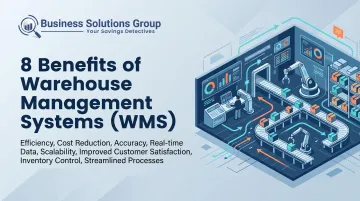
This article breaks down 8 specific, measurable benefits of a WMS: what each one does, why it matters, and when it delivers the most impact.
Key Takeaways
- A WMS automates warehouse operations end-to-end — from receiving through shipping — on one platform
- The 8 core benefits cover inventory accuracy, cost reduction, fulfillment speed, real-time visibility, space optimization, scalability, compliance, and system integration
- Each benefit ties to trackable KPIs: error rates, labor costs, order accuracy, space utilization
- Without a WMS, inefficiencies compound — and accelerate as order volume grows
- ROI builds over time as the system scales with order volume and data usage
What Is a Warehouse Management System?
A WMS is software that controls and coordinates the daily work of a warehouse: inventory tracking, task assignment, order picking, packing, and shipping — all managed through one platform rather than spreadsheets, paper logs, or disconnected tools.
WMS applies anywhere physical inventory moves at meaningful scale:
- Distribution centers and fulfillment warehouses
- Third-party logistics (3PL) providers
- Manufacturers managing inbound raw materials and outbound finished goods
- Retailers and e-commerce businesses with high SKU counts or multi-location inventory
Wherever it's deployed, a WMS is a means to a business outcome — not a technology upgrade for its own sake. Faster fulfillment, lower operating costs, and accurate inventory visibility are what compound over time and ultimately show up in financial results.
8 Key Benefits of a Warehouse Management System
Each benefit below maps to operational metrics businesses already track — inventory accuracy, labor cost, order cycle time. The focus is where real-world impact actually shows up.
Benefit 1: Enhanced Inventory Accuracy
Inventory accuracy means knowing exactly what stock you have, where it is, and in what condition. Manual systems consistently fail to maintain this at scale.
A WMS creates accuracy through real-time tracking — barcode scanning or RFID at every touchpoint (receiving, put-away, picking, shipping) — eliminating manual counts and the reconciliation guesswork that follows.
Why it matters: IHL Group research estimates global retail loses $1.73 trillion annually from inventory distortion — the combined cost of stockouts and overstock. That's not an abstract number. Every unfilled order and every dollar tied up in excess stock traces back to inaccurate inventory data.
Accurate inventory enables better purchasing decisions, prevents both lost sales (stockouts) and tied-up capital (overstock), and frees managers from firefighting discrepancies.
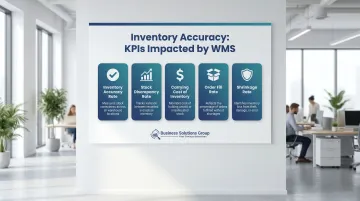
KPIs impacted:
- Inventory accuracy rate
- Stock discrepancy rate
- Carrying cost of inventory
- Order fill rate
- Shrinkage rate
When this matters most: High SKU counts, seasonal demand swings, and perishable or date-restricted stock — where errors translate directly to write-offs.
Benefit 2: Reduced Operational and Labor Costs
Labor is the single largest and most variable cost in warehouse operations, typically accounting for 50–65% of total warehouse operating costs. Inefficient workflows multiply this cost.
Workers walk longer routes, managers spend time correcting errors, and headcount grows to compensate for process gaps rather than actual volume.
A WMS reduces these costs by:
- Optimizing pick paths to cut unnecessary travel time
- Automating task assignment so the right person handles the right task
- Streamlining receiving workflows to reduce double-handling
- Replacing manual cycle counts with system-directed inventory audits
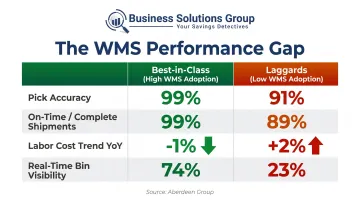
Why it matters: Aberdeen Group data shows that best-in-class warehouse operations (with significantly higher WMS adoption) achieved a 1% year-over-year decrease in labor costs, while laggard organizations saw a 2% increase — a 3-percentage-point performance gap that compounds annually. Aberdeen also found that voice-directed picking, a WMS-adjacent technology, drives 15–25% worker productivity gains while maintaining pick accuracy above 99%.
KPIs impacted:
- Cost per order
- Labor hours per shipment
- Overtime as a percentage of labor cost
- Error rate
- Fulfillment cost as a percentage of revenue
When this matters most: High-volume operations, businesses in tight labor markets, and any company that has outgrown spreadsheet-based warehouse management.
Benefit 3: Improved Order Fulfillment Speed and Accuracy
Order accuracy and speed are the metrics customers experience directly. A mis-shipment isn't just an operational error — it's a customer service failure with measurable financial consequences.
A WMS improves both by:
- Supporting wave and zone picking strategies that consolidate multi-order runs
- Supporting batch and zone picking strategies for high-volume operations
- Providing staff with real-time, mobile-accessible pick lists that eliminate guesswork
- Flagging potential errors before a box is sealed
Why it matters: According to OPEX, manual picking processes carry error rates as high as 4%, with each picking error costing $20–$60 to correct. WMS-directed systems achieve accuracy of 99.96%–99.99%. At scale, that gap is enormous — a warehouse processing 5,000 orders daily at 4% error rate generates 200 errors per day, each requiring correction.
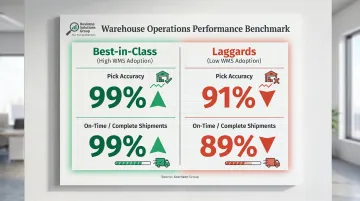
Aberdeen's benchmark data reinforces the gap: best-in-class operations achieve 99% pick accuracy and 99% on-time/complete shipments, while laggards average 91% and 89% respectively.
KPIs impacted:
- Order accuracy rate
- Order cycle time
- On-time shipment rate
- Return rate
- Customer satisfaction score
When this matters most: Peak seasons, e-commerce businesses with high daily order volumes, and any operation where retailer SLAs or customer agreements carry financial penalties for late or inaccurate shipments.
Benefit 4: Real-Time Visibility and Data-Driven Decision Making
A WMS gives managers a live view of inventory levels, order status, and warehouse performance. That shift — from reactive guesswork to proactive decision-making — has meaningful downstream effects.
Real-time visibility enables:
- Accurate demand forecasting based on actual movement data
- Faster bottleneck identification before backlogs develop
- Smarter staffing decisions aligned to actual workload
- Purchasing decisions grounded in real stock positions, not stale counts
Why it matters: Companies with real-time supply chain visibility are 2.5 times more likely to be high-performing than those with limited transparency — yet 76% of businesses still lack end-to-end visibility across their supply chains (Gartner, via Pallite Group).
Inventory carrying costs run 20–30% of average inventory value annually. Better visibility directly reduces the excess stock that drives those costs up.
For businesses using spend intelligence and analytics tools alongside a WMS, this operational data can feed into consolidated reporting — connecting warehouse performance to sales, order management, and financial outcomes in one view. Business Solutions Group's supply chain analytics platform is built specifically for this kind of cross-functional visibility.
Benefit 5: Optimized Space Utilization
A WMS analyzes product velocity, size, weight, and turnover rates to recommend optimal storage locations. Fast-moving SKUs land closer to pick stations. Slower-moving stock moves deeper into the facility. That logic, applied consistently, squeezes more throughput from the same physical footprint.
Why it matters: Warehouse space isn't cheap. Average U.S. base rental rates sit at $0.85 per square foot per month, with total occupancy costs reaching $1.10/sq. ft. when operating expenses are included. Poor space utilization means paying for square footage you can't effectively use — or expanding earlier than necessary.
Better slotting also cuts worker travel time, which feeds directly back into labor cost reduction.
KPIs impacted:
- Warehouse capacity utilization rate
- Average travel time per pick
- Storage cost per unit
- Throughput per square foot
Benefit 6: Scalability and Operational Flexibility
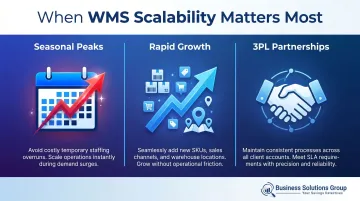
A WMS scales with business demand — handling seasonal volume spikes, new product lines, or additional warehouse locations — without requiring proportional increases in headcount or manual process redesign. The system enforces consistent operating procedures regardless of volume, which is critical when you're running 2x normal order volume during peak periods.
When this matters most:
- Businesses with pronounced seasonal peaks where hiring temporary staff is expensive and unreliable
- Companies in rapid growth phases adding new SKUs, channels, or warehouse locations
- Operations evaluating 3PL partnerships, where process consistency across locations is a contractual requirement
MHI's 2025 Annual Industry Report found that 56% of supply chain leaders are increasing technology investments specifically to build this kind of scalable capacity. The businesses that build operational infrastructure ahead of growth avoid the painful — and expensive — scramble to catch up.
Benefit 7: Regulatory Compliance and Risk Management
A WMS automatically maintains accurate, auditable records: lot numbers, batch tracking, expiration dates, and chain-of-custody documentation at every step. For regulated industries, this isn't optional — it's the difference between passing an audit and facing enforcement action.
Industry relevance:
- Food and beverage: FSMA Section 204 requires detailed traceability records for foods on the FDA's Food Traceability List
- Pharmaceutical: DSCSA mandates electronic, interoperable drug tracing across the entire prescription drug supply chain
- Healthcare supply: GMP compliance requires documented storage and handling procedures at every stage
Why this matters financially: FDA civil penalties for non-compliance typically run $10,000–$20,000 per violation, with enforcement frequently pursuing multiple violations simultaneously. Beyond fines, consequences include product seizures, consent decrees, and reputational damage that no fine schedule captures.
A WMS converts compliance from a manual documentation burden into an automatic byproduct of normal operations.
Benefit 8: Connected Integration with Business Systems
A WMS doesn't operate in isolation — or shouldn't. Integration with ERP, TMS, CRM, and e-commerce platforms creates a unified data flow that eliminates manual handoffs and gives every department an accurate, current view of inventory and orders.
What this looks like in practice: When an order is placed, the WMS, finance system, and logistics platform update simultaneously. There's no lag, no re-keying, and no discrepancy between what the warehouse has and what the finance team sees.
Manual data entry carries an average 1% error rate — and that compounds across every system that receives data from another. For businesses integrating WMS with TMS, Business Solutions Group's platform connects WMS, ERP, and accounting systems into a single data environment — giving operations teams real-time shipment visibility and eliminating the manual handoffs that compound errors across departments.
KPIs impacted:
- Data entry error rate
- Order processing time
- Invoice accuracy
- Cross-departmental reporting latency
What Happens When a WMS Is Missing or Ignored
Operating without a WMS carries a measurable cost. Manual processes create error rates up to 4% compared to 0.04% in WMS-directed environments. That's a 100x difference, and it compounds with volume.
The performance gap is well documented. Aberdeen Group's data shows:
| Metric | Best-in-Class (High WMS Adoption) | Laggards (Low WMS Adoption) |
|---|---|---|
| Pick accuracy | 99% | 91% |
| On-time/complete shipments | 99% | 89% |
| Labor cost trend (YoY) | -1% | +2% |
| Real-time bin visibility | 74% | 23% |
Those gaps worsen at scale. At low volume, manual inefficiencies are manageable. At high volume, they become operational liabilities — missed shipments, inaccurate stock counts, and poor space utilization all compound as order volume grows without consistent process controls.
Businesses without WMS visibility make inventory and staffing decisions on incomplete data. The downstream effects hit multiple areas at once:
- Reactive purchasing driven by guesswork rather than real-time stock data
- Excess carrying costs from overstocking or emergency replenishment
- Missed customer SLAs that erode both margin and retention
These aren't isolated failures — they tend to surface together, making them harder to diagnose and fix without system-level visibility.
How to Get the Most Value from Your WMS
A WMS delivers its greatest return when it's configured to match actual warehouse workflows — not applied as a generic tool — and when its data is actively reviewed and acted upon, not just collected.
Practical steps to maximize ROI:
- Configure to your workflows — map your actual processes before implementation, not after
- Enforce SOPs through the system — the WMS should make the correct process the easiest process
- Review KPIs on a regular cadence — weekly or monthly, depending on volume
- Act on the data — improvements identified in reporting only deliver value when implemented
- Integrate fully — connect your WMS to ERP, TMS, and e-commerce platforms to eliminate data silos
Choosing the right WMS — cloud-based, ERP-integrated, or standalone — matters as much as the implementation itself. Understanding your supply chain cost structure before you buy determines whether the system fits your actual operation or forces your operation to fit the system.
For businesses working through that evaluation, Business Solutions Group offers supply chain advisory services that include spend analysis, TMS selection support, and carrier contract benchmarking — practical groundwork that helps ensure a WMS investment delivers real operational gains rather than just new software overhead.
Conclusion
The value of a WMS lies in control, clarity, and consistency across warehouse operations. Each of the 8 benefits outlined here represents a measurable lever: inventory accuracy reduces write-offs and stockouts, labor optimization cuts cost per order, fulfillment accuracy protects revenue and retention, and real-time visibility enables decisions based on facts rather than estimates.
WMS advantages compound over time. The gains from better inventory accuracy reduce carrying costs, which in turn free up capital for other operational priorities. Teams that review performance data regularly — and adjust workflows accordingly — tend to see returns that accelerate rather than plateau.
A warehouse running on accurate data, optimized labor, and reliable fulfillment stops being a source of operational drag. The right WMS, used consistently, shifts it into something that actively supports the bottom line.
Frequently Asked Questions
What does warehouse management system software do?
WMS software automates and coordinates core warehouse operations: inventory tracking, order picking, packing, and shipping. It replaces manual processes with system-directed tasks that reduce errors and improve throughput, using real-time data and rules-based workflows.
What is the primary goal of implementing a warehouse management system?
The primary goal is to optimize warehouse operations for efficiency and accuracy: reducing costs, minimizing errors, and improving fulfillment speed. Done well, this strengthens overall supply chain performance.
What are the main benefits of a warehouse management system?
The 8 key benefits are: enhanced inventory accuracy, reduced operational and labor costs, improved order fulfillment speed and accuracy, real-time visibility, optimized space utilization, scalability, regulatory compliance, and seamless integration with business systems.
How much does a WMS cost?
WMS costs vary by deployment type, feature set, and scale. Cloud-based SaaS options typically range from $100–$500+ per user per month, while on-premises systems require $50,000–$200,000 or more in upfront investment.
What are the 5 benefits of inventory management?
Effective inventory management reduces carrying costs, prevents stockouts and overstock, improves order accuracy, supports demand forecasting, and strengthens cash flow. A WMS supports all five through automation and real-time tracking.