Telecom expense management (TEM) gets discussed most often in enterprise contexts, but the core benefits—cost recovery, contract leverage, and operational efficiency—apply directly to mid-size companies. In some ways, the ROI is proportionally higher at this scale, because mid-size businesses have fewer internal resources to catch the problems that TEM is specifically designed to find.
This article explains how TEM creates concrete, day-to-day value for mid-size businesses—not in theory, but in terms of the operational outcomes that actually show up on a budget review.
Key Takeaways
- Mid-size businesses routinely lose 5–10% of annual telecom spend to billing errors and unused services—often without realizing it
- TEM provides access to benchmark pricing data that levels the playing field against carriers in contract negotiations
- Each month without a formal TEM process locks in compounding overpayments that quietly erode margins
- Automating invoice review and dispute tracking recaptures staff hours currently absorbed by manual telecom management
- The performance-based TEM models available today make measurable ROI accessible without enterprise-scale spend
What Is Telecom Expense Management?
TEM is the ongoing process of auditing, tracking, and optimizing all telecom-related expenses—invoices, contracts, inventory, and carrier agreements—to eliminate waste and maximize the value of every dollar spent on communications services.
Where it applies:
- Fixed-line and voice services
- Mobile and wireless plans
- Internet connectivity
- UCaaS, CCaaS, and SIP trunking
- Carrier-billed services across all office locations, remote employees, and company-owned devices
TEM is not a software category or a one-time audit. It's an ongoing management discipline. The initial cleanup recovers historical overcharges, but the ongoing program stops new waste from accumulating—which is where sustained, compounding savings come from.
Key Advantages of TEM for Mid-Size Businesses
Each advantage below maps directly to metrics mid-size business leaders track: recoverable spend, staff hours, and contract leverage. The operational impact is concrete and measurable.
Advantage 1: Systematic Recovery of Overpaid and Wasted Telecom Spend
Mid-size businesses routinely pay for services they no longer use. Lines tied to employees who left six months ago. Services scheduled for cancellation that were never actually terminated. Duplicate charges that slip through because no one is cross-referencing invoices against active inventory.
TEM creates a structured solution: automated invoice auditing that cross-references every charge against contracted rates, current headcount, and active services—flagging discrepancies before they're paid.
According to Tangoe's 2024 TEM ROI analysis, invoice auditing and reconciliation can recover roughly 5–10% of annual telecom spend in year one. For a mid-size business spending $200,000 annually on telecom services, that's $10,000–$20,000 in recoverable costs—money that was already being spent, just not accounted for.
The FCC has documented that small unauthorized charges can remain undetected on telephone bills for years, and has received tens of thousands of billing complaints annually. Carriers are not always the source of intentional errors, but their billing systems are complex, and without a review process in place, discrepancies default to the carrier's favor.
KPIs impacted:
- Monthly telecom spend
- Invoice error rate
- Active vs. billed line count
- Cost per employee for telecom services
When this advantage matters most: Companies that have grown through hiring, acquisition, or office expansion—where services were added faster than they were audited—carry the highest density of recoverable waste. This is where TEM's initial audit delivers the fastest, most visible returns.
Advantage 2: Carrier Contract Leverage Through Benchmark Data
Mid-size businesses typically negotiate carrier contracts without knowing what comparable companies are actually paying. Enterprise buyers walk into renewals with dedicated procurement teams, historical contract data, and market benchmarks. Mid-size companies often walk in with last year's invoice and an expiration date.
Without benchmark intelligence, mid-size companies consistently leave savings on the table—not because they negotiated poorly, but because they negotiated without the right data. Carriers price based on what buyers know, and that gap is rarely in the buyer's favor.
TEM aggregates spend data, benchmarks rates against current market pricing, and applies structured negotiation frameworks. Business Solutions Group's spend intelligence software and cost reduction advisory services are built specifically for this: identifying where current rates diverge from market benchmarks and building the factual case for renegotiation. Their carrier contract optimization approach covers:
- Coaching clients through proposal analysis
- Identifying shortfalls in carrier offers
- Crafting counter-responses grounded in competitive market data
KPIs impacted:
- Contract rates vs. market benchmark
- Cost per unit of service (per line, per MB, per device)
- Contract renewal cycle time
- Total contract value
When this advantage matters most: Contract renewal cycles, new service location additions, and post-merger consolidations. Mid-size businesses in growth mode are particularly exposed when contracts renew on autopilot—often at above-market rates with terms that no longer reflect current usage.
Advantage 3: Staff Time Recapture and Operational Focus
In most mid-size businesses, telecom invoice review lands on someone in finance or IT who was never trained for it. They do their best, but the process depends on individual effort rather than a system—which means errors get missed, disputes go unfiled, and the work expands as the company grows.
Tangoe's benchmarking data puts manual telecom invoice processing at an average of 18.5 minutes per invoice, with automation reducing that to under 10 seconds. For a business receiving dozens of monthly invoices across carriers and locations, that time adds up fast.
Time is only part of the cost. Manual management also produces:
- Disputes that never get filed due to bandwidth constraints
- Billing anomalies that compound across two or three cycles before anyone catches them
- Budget questions that take days to answer because telecom data is spread across spreadsheets and email threads
TEM automates invoice processing, dispute tracking, inventory updates, and reporting. When spend data is centralized and current, IT and finance leaders can respond to budget questions, support expansion planning, and catch anomalies in real time.
KPIs impacted:
- Hours spent monthly on telecom invoice review
- Dispute resolution cycle time
- Invoice processing accuracy rate
- Time-to-provision for new services
When this advantage matters most: Lean IT and finance teams—where the person handling telecom invoices is also running other critical functions—see the largest proportional efficiency gains. Removing the manual burden from those roles has an outsized impact on overall productivity.
What Happens When TEM Is Missing
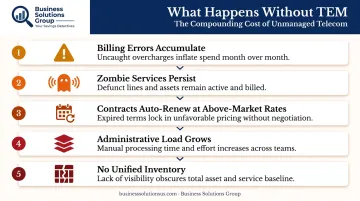
Without TEM, mid-size businesses don't just miss savings in a single month. Each unchecked billing cycle adds another layer of unrecovered cost — and the longer the gap, the larger the cleanup effort. The consequences tend to compound in predictable ways:
- Billing errors accumulate undetected — unauthorized charges and misapplied rates go unpaid, building into material annual overcharges
- Zombie services persist — lines for former employees, decommissioned locations, and cancelled projects continue generating monthly charges
- Contracts auto-renew at above-market rates — with no benchmark data and no formal review, renewal defaults to whatever the carrier proposes
- Administrative load grows with the business — as headcount and locations increase, so does invoice volume, placing more pressure on finance and ops teams
- No unified inventory — without an accurate picture of active services, budgeting and carrier negotiations both happen blind
A 2010 audit of New Jersey's state government found more than 19,000 unused phone lines still generating charges, with total recoverable savings of approximately $3.2 million annually. The public-sector scale is different, but the pattern is the same: services accumulate faster than anyone tracks them, and the bill keeps arriving regardless.
How to Get the Most Value from TEM
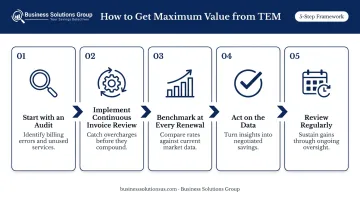
TEM produces the best results when it runs as an ongoing discipline, not a one-time project:
- Start with an audit — the initial cleanup identifies historical waste and establishes a baseline of what's actually being spent and why
- Implement continuous invoice review — automated processing catches new errors before they're paid, not after
- Benchmark at every renewal — contract terms should be validated against current market rates each cycle, not accepted automatically
- Act on the data — TEM creates value only when findings drive decisions: disputing an invoice, renegotiating a contract, or eliminating a service that's outlived its purpose
- Review regularly — weekly, monthly, or quarterly reporting cycles keep the program current and maintain accountability
Executing all five of these consistently takes bandwidth most mid-size teams don't have. Working with an advisory partner is often the fastest path to results.
Business Solutions Group offers spend intelligence software and cost reduction advisory services built around this process — auditing invoices, benchmarking contracts against current market rates, and driving recoveries. Their compensation is structured as a percentage of monthly savings achieved, so they earn only when clients save. Clients retain 100% of recovered credits.
Conclusion
For mid-size businesses, TEM's practical value comes down to three outcomes: recovering money already being lost to billing errors and unused services, gaining the contract leverage needed to negotiate competitive rates, and freeing internal staff to focus on work that actually moves the business forward.
Those advantages compound over time. A well-maintained telecom environment gives you a clear picture of exactly what you're paying and why — no surprises at renewal, no inherited waste from contracts signed years ago. Carrier relationships shift from passive obligations into active leverage. Staff hours that once disappeared into invoice review get applied to work that actually builds the business.
TEM works best as an ongoing practice, not a one-time fix. Businesses that manage it continuously catch errors before they compound, renegotiate from a position of data rather than urgency, and avoid the reset costs that come from years of neglect. Waiting until something breaks is an option — it's just a consistently expensive one.
Frequently Asked Questions
What does telecom expense management include for a mid-size business?
TEM covers invoice auditing, contract management, inventory tracking, carrier negotiation, and cost allocation across fixed-line, mobile, internet, and UCaaS services. For mid-size businesses, it replaces scattered invoices with a complete, current picture of spend across all locations, devices, and carrier agreements.
Do mid-size businesses really need TEM, or is it only for large enterprises?
TEM originated as an enterprise discipline, but mid-size businesses face the same billing error exposure and contract disadvantages at smaller scale. Because they typically have fewer internal resources to catch these issues, the ROI from TEM is often proportionally higher—more waste per staff hour available to find it.
How much can a mid-size business realistically save with TEM?
Industry benchmarks put year-one savings at roughly 5–10% of annual telecom spend; vendor-reported figures reach 10–30%, though these aren't independently verified. Actual results depend on how long telecom spend has gone unmanaged and the scope of the current contract portfolio.
How long does it take to see results from a TEM program?
Initial savings from invoice audits and billing corrections typically surface within the first 60–90 days. Contract renegotiation savings materialize at the next renewal cycle.
Can TEM work if we don't have a dedicated IT or telecom team?
TEM is specifically designed to function without internal telecom expertise. Managed programs and advisory partners handle the operational work—invoice review, dispute filing, inventory tracking—so mid-size businesses aren't blocked by generalist staff with competing priorities.
How does TEM help during carrier contract renewals?
TEM provides benchmark pricing data, current inventory details, and usage analytics that give businesses a factual basis for negotiation. Instead of accepting whatever rate the carrier proposes, mid-size companies can enter renewals with market intelligence that shifts the dynamic—and the outcome.