The consequences are real. A New Jersey State Comptroller audit found the state was paying for more than 19,000 unused and unnecessary phone lines—nearly one in six state phone lines—projecting more than $3.2 million in annual savings just from disconnecting them. One wireless line had remained active for nearly six years after an employee resigned.
This guide walks through what telecom inventory management actually involves, why it breaks down, and what organizations can do to fix it.
Key Takeaways
- Telecom inventory must cover both physical assets and logical services—tracking one without the other creates blind spots
- Unused "zombie" services are a documented, measurable waste that accurate inventory directly prevents
- Manual tracking cannot keep pace with Moves, Adds, Changes, and Deletions (MACD); automation is necessary at scale
- Focus audit efforts on the small percentage of services driving most of your spend—that's where the largest savings hide
- Accurate inventory enables carrier renegotiation and is the foundation for any meaningful cost reduction
What Is Telecom Inventory Management?
Telecom inventory management is the ongoing process of identifying, tracking, and managing all telecommunications assets and services across a business. That includes the obvious hardware—phones, routers, modems—but also service contracts, mobile subscriptions, internet connections, SIP trunks, leased circuits, and software licenses.
Gartner's 2024 Market Guide for Telecom Expense Management Services describes this as requiring "robust cost optimization, asset inventory and workflow automation capabilities." The scope is broader than most organizations initially assume.
Physical vs. Logical Inventory: What's the Difference?
TM Forum's resource inventory standards draw a clear line between two inventory layers:
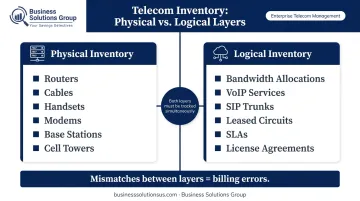
- Physical inventory: Tangible hardware—routers, cables, handsets, modems, base stations, cell towers
- Logical inventory: Non-physical resources—bandwidth allocations, VoIP services, SIP trunks, leased circuits, SLAs, license agreements
Effective telecom inventory management must account for both simultaneously. A circuit that appears in billing records (logical) needs to be tied to physical infrastructure at a specific location. When those two layers don't match, billing errors and untracked services follow.
Key Data Fields Every Telecom Inventory Should Capture
According to ETMA's 2021 Technology Expense Management RFP guidance, a complete telecom inventory should capture:
- Asset type, make, and model
- Vendor name and account number
- Active/inactive status
- Assigned user name and employee ID
- Physical location and cost center
- GL code and department
- Contract start/end and renewal dates
- Monthly recurring charges
- Device identifiers (IMEI, SIM number for mobile)
- Service type and usage metrics
These fields are what separate a passive asset list from an active management tool — one you can use to catch billing errors, identify unused services, and make informed contract decisions.
Why Telecom Inventory Management Matters for Cost Control
The connection between inventory accuracy and cost control is direct: every untracked service is either an uncaptured charge or an overpayment waiting to happen.
When services aren't mapped to a department, user, or cost center, billing errors go undetected. Subscriptions continue after employees leave. Circuits get provisioned for projects that ended. Without inventory discipline, none of this surfaces until someone specifically goes looking for it.
The Cost of Poor Visibility
A 1997 GAO audit of the Department of the Interior found nearly 137,000 telephone lines supporting roughly 70,000 employees. The audit uncovered two significant findings:
- The Bureau of Reclamation eliminated 1,405 unnecessary lines, realizing $320,000 in annual savings
- A separate review identified $1.1 million in potential savings from duplicate data circuits — yet only $200,000 had been captured by the time of the report, because the inventory process to act on findings wasn't in place
That gap between identified savings and captured savings is where most organizations stall. Spotting the problem without the infrastructure to act on it produces reports, not results.
Strategic Decisions Require Accurate Inventory
Beyond billing, inventory accuracy supports larger technology decisions:
- Technology transitions: With carriers retiring copper networks under FCC technology transition rules, organizations need to know exactly which POTS lines they're running before those services are discontinued
- Capacity planning: Moving from MPLS to SD-WAN or evaluating 5G and IoT expansion requires knowing current circuit inventory and utilization
- Compliance: GDPR Article 30 requires records of processing activities; mobile services that handle personal data benefit from inventory documentation supporting data mapping
Common Challenges of Telecom Inventory Management
Challenge 1 – Fragmented Visibility
Large organizations typically have telecom data scattered across carrier portals, billing systems, departmental spreadsheets, and IT ticketing systems—with no unified view. Each source may tell a different story. Reconciling them manually is time-consuming and still produces gaps.
AOTMP's 2025 TEM vendor-selection guidance identifies data accuracy and integration as primary selection criteria precisely because fragmented data is the most common starting point.
Challenge 2 – Dependence on Manual Processes
Spreadsheet-based tracking cannot keep pace with a constantly changing telecom environment. Manual entry introduces errors and delays that compound as networks grow, headcount shifts, and new services come online.
Beyond accuracy, manual systems depend on someone remembering to update them. That rarely happens consistently, and the gaps accumulate fast.
Challenge 3 – Asset Lifecycle Complexity
Telecom assets require more nuanced oversight than standard IT equipment. The full lifecycle spans provisioning, configuration, moves, adds, changes, and deletions (MACDs), and eventual decommissioning. Gaps in any stage produce records that no longer reflect reality — costs get allocated incorrectly, and unused services keep billing.
Challenge 4 – Employee Turnover and MACD Changes
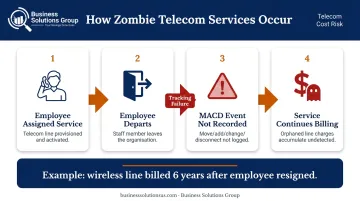
When employees join or leave, their devices and service subscriptions must be updated promptly. The NJ Comptroller audit's finding of a wireless line active nearly six years after an employee resigned is a documented example—not an edge case. Untracked MACD events are the direct cause of "zombie" services: lines and subscriptions still being billed for people who are long gone.
Challenge 5 – Multi-Vendor Complexity
Managing inventory across multiple carriers means dealing with different billing formats, contract terms, and renewal schedules. Layering in compliance requirements — security patches, audit trails, SLA documentation — adds real administrative weight. No single carrier portal gives you the full picture.
Proven Solutions to Overcome Telecom Inventory Management Challenges
Solution 1 – Centralize All Inventory Data
Consolidating asset, service, and contract data into one platform is the foundational fix. A unified inventory gives every stakeholder a consistent view of what the business has, where it is, and what it costs. The GAO specifically recommended department-wide mobile service and device inventories with documented usage-monitoring procedures after finding that only 5 of 15 high-spending federal agencies had complete inventories.
Solution 2 – Automate MACD Tracking and Lifecycle Updates
Automation eliminates the manual burden of logging every move, add, change, or deletion. ETMA's RFP framework calls for systems that manage procurement from quote and MACD through milestone tracking and automatic inventory updates. When a device is decommissioned or a service is added, the inventory should reflect that change without someone having to remember to update a spreadsheet.
Solution 3 – Conduct Regular Inventory Audits
A clean inventory requires periodic verification—not just an initial build. Audits should confirm:
- Services being billed are actually in use and functioning
- Circuit speeds match contracted rates
- Flag low-usage or zero-usage lines for review
- Investigate any unusual activity
The NJ audit's recommendation to generate periodic reports of lines with zero usage is a practical, proven starting point.
Solution 4 – Apply the 80/20 Principle
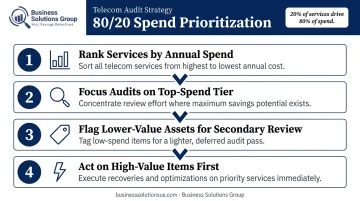
20% of your services and assets typically drive 80% of total spend. Identifying that high-spend segment first and directing audit, optimization, and renegotiation efforts there generates the fastest savings.
A practical sequencing approach:
- Rank services and circuits by total annual spend
- Focus initial audits and optimization on the top-spend tier
- Flag lower-value assets for a secondary review pass
- Don't let the volume of small items delay action on the big ones
Solution 5 – Use Inventory Data for Carrier Renegotiation
Comprehensive inventory is the foundation for negotiating better pricing. Businesses that can demonstrate current usage volumes, identify underperforming services, and benchmark their rates against market pricing enter negotiations from a position of strength.
That prioritized spend data from Solution 4 becomes your most powerful tool at the negotiating table. Business Solutions Group combines spend intelligence and benchmark analysis to translate inventory data into concrete negotiation leverage—showing clients what they're currently paying versus what market rates actually are.
BSG's model includes a free savings analysis to identify the largest opportunities before any formal engagement begins.
How to Build and Maintain an Accurate Telecom Inventory
Step 1 – Go Beyond Billing Invoices
Many organizations build their initial inventory from billing data alone. That's a reasonable starting point but an incomplete one. Invoices miss granular details: circuit IDs, physical locations, feature configurations, and carrier service record data. A complete initial build should verify every service at the location level, not just the account level.
ETMA's guidance specifies that inventory should include items from both bills and customer service records (CSRs) for lines, circuits, and mobile services.
Step 2 – Verify Services Through Testing and Usage Analysis
Once the initial inventory is built, validate it:
- Test active services to confirm they're functional
- Review low-usage lines to determine whether they serve a current business purpose
- Check circuit speeds against contracted rates
- Flag zero-use services for disconnection or reassignment
Unused or underperforming services identified at this stage are immediate cost-reduction opportunities.
Step 3 – Establish Real-Time Update Protocols
An accurate inventory today becomes outdated quickly. Organizations need defined workflows for updating records whenever services are installed, changed, or deleted. The goal is for MACD events to trigger inventory updates automatically, or at minimum through a documented manual process with clear ownership.
Step 4 – Integrate with Financial and Procurement Systems
Connecting telecom inventory to ERP, financial management, or eProcurement platforms gives cost data and usage patterns a direct role in budgeting, billing validation, and procurement decisions. ETMA's RFP standards call for automated feeds with accounting systems, plus API integration with HR and help desk systems.
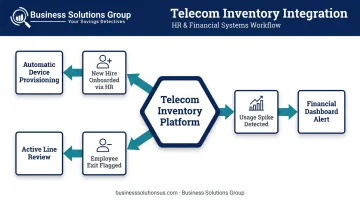
This is what moves telecom management from reactive to proactive. Practical examples include:
- A new hire onboarded through HR automatically triggers device provisioning
- An employee exit flags active lines for review or disconnection
- Usage spikes surface in financial dashboards before they hit the next invoice
What to Look for in a Telecom Inventory Management Approach
Whether you're evaluating software, an outsourced TEM provider, or a hybrid advisory model, the core capabilities to assess are consistent:
| Capability | What to Evaluate |
|---|---|
| Data accuracy | How is inventory data sourced, validated, and kept current? |
| Integration depth | Does it connect with ERP, HR, and financial systems? |
| Workflow automation | Are MACD events tracked automatically? |
| Audit and reconciliation | Can it validate bills against contracts, tariffs, and MACD activity? |
| Reporting and analytics | Does it surface unused services, billing discrepancies, and spend trends? |
| Scalability | Can it handle growth in assets, locations, and vendors? |
Gartner's 2024 TEM Market Guide emphasizes cost optimization, asset inventory, and workflow automation as the core buyer criteria. AOTMP extends those evaluation criteria to include data accuracy, security/compliance, and change management.
Beyond tracking, look for advisory depth. The right approach should benchmark your spend against market rates, identify where you're overpaying, and provide a clear path to act on those findings.
Frequently Asked Questions
What is inventory management in telecom?
Telecom inventory management is the process of tracking and managing all telecommunications assets and services—both physical (equipment, cables, towers) and logical (contracts, software licenses, circuits)—to control costs, ensure billing accuracy, and support reliable service delivery. It serves as the system of record for everything a business is paying for across all carriers and locations.
What are the 4 types of inventory management?
The four common approaches are just-in-time (acquiring assets as needed), ABC analysis (prioritizing by value or impact), FIFO/LIFO (asset rotation methods), and demand forecasting. In telecom, ABC analysis is most directly applicable—it focuses audit and optimization efforts on the high-spend services that drive the majority of costs.
What is the 80/20 rule in inventory?
The 80/20 rule (Pareto principle) holds that 20% of items account for 80% of total value or spend. In telecom, this means identifying the small percentage of services and assets driving the majority of your costs, then concentrating audit and renegotiation efforts there first for the fastest savings impact.
What is the difference between physical and logical inventory in telecom?
Physical inventory refers to tangible hardware: routers, cables, handsets, and cell towers. Logical inventory refers to non-physical resources such as bandwidth allocations, VoIP services, SLAs, and software licenses. Effective management requires tracking both layers to prevent billing gaps and unaccounted assets.
How does telecom inventory management help reduce costs?
Accurate inventory reveals unused services, duplicate contracts, and overprovisioned assets that can be cut or renegotiated. It also enables invoice validation against contracted rates and usage data, catching billing errors before they compound into significant overspend.
What are the biggest challenges in telecom inventory management?
The most common challenges are fragmented data across multiple systems, reliance on manual tracking that can't keep pace with change, difficulty capturing MACD events in real time, multi-vendor complexity, and keeping inventory accurate as telecom environments constantly evolve.