The result: telecom spend grows more complex while internal oversight stays flat or shrinks.
Outsourcing telecom expense management addresses that gap. This article examines three specific, measurable advantages it delivers — cost recovery, stronger contracts, and reclaimed internal capacity — along with what happens when those functions go unmanaged.
TL;DR
- Outsourced TEM hands off invoice auditing, contract management, inventory tracking, and vendor negotiation to specialists — freeing your team to focus elsewhere.
- Direct benefits include recovered billing credits, eliminated unused services, better contract rates, and freed-up IT and finance capacity.
- Unmanaged telecom spend accumulates through small billing errors, orphaned lines, and auto-renewed contracts that go unreviewed.
- Savings accumulate over time — each audit cycle and contract renewal builds on prior recoveries.
- TEM delivers the most value when treated as an ongoing discipline rather than a one-time project.
What Is Outsourced Telecom Expense Management?
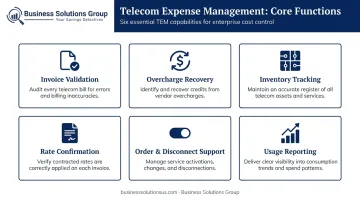
Outsourced TEM is the practice of engaging a third-party provider to manage a company's telecom spend on an ongoing basis. According to ETMA's TEM BPO framework, the core functions include:
- Validates invoices against contracted rates to catch billing discrepancies early
- Identifies overcharges and files recovery requests directly with carriers
- Tracks inventory across circuits, lines, and devices
- Confirms billed rates match negotiated contract terms
- Supports ordering and disconnects for active inventory changes
- Reports usage and spend across vendors, locations, and cost centers
It applies most directly to organizations managing multiple carriers across wireless, wireline, data circuits, and UCaaS environments — where no single internal team has full visibility across all spend.
For those organizations, outsourced TEM provides a structured way to confirm that every dollar spent on telecom is authorized and tied to actual business needs.
Key Advantages of Outsourced Telecom Expense Management
The advantages below are tied to outcomes businesses actually track: cost recovery, contract performance, resource utilization, and financial visibility.
Advantage 1: Direct Cost Recovery Through Proactive Invoice Auditing
Billing errors in telecom aren't edge cases. They're a routine feature of high-volume carrier invoicing environments — and they persist precisely because most organizations lack the dedicated resources to catch them before payment clears.
Outsourced TEM addresses this systematically. Every invoice is imported into a managed platform, reviewed by analysts who recognize common carrier billing patterns, and cross-referenced against contracted rates and active inventory. Discrepancies get flagged before payment, not discovered months later when dispute windows have expired.
The practical stakes are real. Lumen's business platform agreement, for example, requires written notice of disputed amounts within 90 days of the invoice date and SLA credit requests within 60 days after the event month. Delayed review doesn't just mean late discovery — it can mean forfeited recovery rights.
Case evidence illustrates the scale of recoverable value:
- A Fortune 100 paper manufacturer engaged RadiusPoint after six staff members were manually reviewing large monthly invoice boxes. The audit recovered over $450,000 in wireless refunds and identified $850,000 in ongoing first-year cost avoidance.
- A multinational manufacturing conglomerate with $20M in annual telecom spend and 35,000 global circuits saved over $5.1M within three years through a managed TEM program — reaching 99.8% inventory accuracy in the process.

KPIs this moves:
- Telecom spend as a percentage of IT budget
- Invoice error rate and credits recovered per billing cycle
- Month-over-month cost variance
- Dispute recovery as a share of total spend
This advantage is highest for organizations with multiple carrier relationships, high invoice volume, or recent M&A activity where no systematic audit has occurred in 12+ months.
Advantage 2: Stronger Carrier Contracts Through Expert Negotiation and Benchmarking
Most organizations renew telecom contracts without knowing whether their rates reflect current market conditions. Without benchmark data, the negotiation starts from the wrong position — and carriers have little incentive to offer improved pricing unprompted.
Outsourced TEM providers bring structural advantages that internal teams typically can't replicate:
- Cross-client benchmark data — visibility into what comparable organizations are actually paying for the same services
- Rate validation against contracted terms — confirming billed rates match negotiated pricing before each payment cycle
- Renewal tracking — so contracts don't auto-renew at above-market rates simply because no one had the renewal date calendared
- RFP management — running competitive carrier evaluations on the client's behalf when warranted
This is where firms like Business Solutions Group add concrete value. Their benchmark analysis and carrier contract evaluation services identify where contracted rates diverge from market, and their advisory approach converts that gap into recoverable savings — without requiring clients to switch carriers or disrupt operations. For clients managing wireless, wireline, and cloud services across locations, that kind of consolidated contract oversight is difficult to replicate internally.
KPIs this moves:
- Cost per circuit or per-user monthly spend vs. market benchmark
- Contract term risk exposure
- Early termination fee avoidance
- Pricing drift between renewal cycles
Contract benchmarking matters most ahead of renewal windows, during post-acquisition telecom consolidation, or when a carrier mix has grown organically without competitive evaluation.
Advantage 3: Operational Efficiency Through Centralized Visibility and Freed Internal Resources
There's a hidden cost to managing telecom in-house that rarely shows up in budget discussions: the hours IT and finance staff spend processing invoices, chasing down service inventories, and resolving carrier disputes. That time crowds out higher-value work.
Outsourced TEM reclaims those hours. Providers maintain a live inventory of all circuits, lines, and services, consolidate billing into unified views by vendor, location, or cost center, and handle carrier interactions directly. The internal team stops functioning as a de facto telecom operations desk.
The operational impact documented in case studies is significant:
- An automotive retailer with 5,000 stores eliminated 50 hours of weekly telecom administration after outsourcing TEM. Tangoe attributed 63% of total savings to productivity gains — more than the 37% from network cost reductions alone.
- The industrial conglomerate case above achieved 98% of mobility requests fulfilled within 8 hours, pointing to the workflow improvement that accompanies accurate, centralized inventory.
Beyond time savings, unified reporting changes how finance teams plan. Consolidated telecom dashboards let budget owners forecast spend by location and cost center, instead of working from carrier statements that obscure where dollars are actually going.
KPIs this moves:
- Internal hours spent on telecom management
- Invoice processing time
- Budget forecast accuracy by location and cost center
- Headcount required to support telecom operations
This matters most for organizations managing 10+ locations or 5+ carrier relationships, particularly where telecom responsibility is split between IT and finance with no dedicated owner.
What Happens When Telecom Expense Management Is Ignored
Unmanaged telecom spend doesn't announce itself. An unused line stays active because no one processed the disconnect. A billing error clears payment once, then repeats the next cycle. A contract auto-renews because no one was tracking the date.
The downstream consequences are predictable:
- Dispute windows close before errors are caught — Lumen requires notice within 90 days of invoice; AT&T caps liability to the preceding 24 months. Late discovery means forfeited credits.
- Carriers renew contracts on their own terms when expiration dates go untracked, typically at rates above what the market would support.
- Orphaned services pile up quietly. A 2023 RadiusPoint audit of a Fortune 100 manufacturer found active lines for former employees that no one had flagged.
- Finance and IT absorb reactive work — invoice disputes, carrier escalations, and inventory reconciliations become unplanned interruptions rather than managed processes.
- No single line item is large enough to trigger a review, but the cumulative drift compounds across billing cycles.
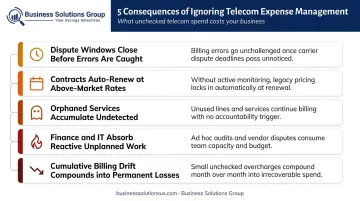
The real cost isn't any single line item — it's the volume of small leaks that go undetected long enough to become permanent losses.
How to Get the Most Value from Outsourced TEM
Outsourced TEM delivers its full value when it operates as a continuous management function — not a one-time project. The improvements compound: each audit cycle catches errors the previous cycle prevented from recurring; each contract renewal builds on benchmark data from the last.
Three conditions determine whether outsourced TEM performs at its best:
- Applied consistently — audits run on every invoice cycle, not just when something looks wrong; inventory stays current with real-time adds, moves, and disconnects
- Outcomes reviewed actively — monthly or quarterly reporting should drive decisions (disconnecting unused services, adjusting plans, preparing for renewals), not just filed away
- Recommendations acted upon — the full value of benchmarking and analysis is only realized when findings translate into implementation; companies that engage actively with their provider's recommendations consistently outperform those using reporting passively
Business Solutions Group's advisory approach extends this discipline beyond telecom. Telecom savings analysis integrates into a broader cost optimization framework — covering supply chain, freight, and payment advisory — so every dollar recovered contributes to organization-wide profitability, not just a single budget line. Companies that apply this integrated model consistently capture more total value than those managing telecom costs in isolation.
Conclusion
Outsourced TEM delivers value through three compounding factors:
- Recovering costs already lost to billing errors and unused services
- Preventing future overspend through benchmark-driven contracts and proactive inventory management
- Reclaiming operational capacity that internal teams spend on telecom administration
None of these advantages are theoretical. Case evidence shows:
- Recoveries in the hundreds of thousands to millions of dollars
- Productivity gains measured in staff-hours per week
- Inventory accuracy that supports faster service management
What ties these outcomes together is consistent execution — systematic auditing, active contract oversight, and centralized visibility sustained over time.
Organizations that treat outsourced TEM as an ongoing operational discipline — reviewing outcomes, acting on recommendations, and iterating on carrier strategy — turn telecom spend into measurable financial gains. Periodic cleanup can't replicate that because it lacks the continuity to catch what recurs month after month.
Frequently Asked Questions
What is TEM in telecom?
TEM (Telecom Expense Management) is the process of systematically tracking, auditing, and optimizing a company's telecom services and costs. It covers invoice validation, inventory management, contract negotiation, dispute resolution, and usage monitoring — applied on an ongoing basis across all carriers and service types.
How much can a business realistically save with outsourced TEM?
Savings vary by organization size, number of carriers, invoice volume, and how long services have gone unmanaged. Published case studies document recoveries ranging from hundreds of thousands to millions of dollars. Business Solutions Group's clients typically achieve 20–50% reductions in telecom costs, depending on the state of their contracts and inventory at engagement start.
What's included in a typical outsourced TEM service?
Core components include:
- Invoice auditing and processing
- Inventory tracking across circuits and devices
- Carrier contract management
- Dispute resolution and credit recovery
- Usage reporting by vendor and location
- Ongoing optimization recommendations
How does outsourced TEM differ from managing telecom expenses in-house?
The primary differences are specialized expertise, access to cross-client benchmark data, and dedicated resources. Internal teams typically split their time across responsibilities and lack the carrier market intelligence outsourced providers maintain across their entire client base.
Is outsourced TEM only for large enterprises, or can smaller businesses benefit?
TEM is most commonly associated with enterprise environments, but mid-sized businesses managing multiple carriers or locations can benefit substantially — especially when no one owns telecom oversight internally and invoices go unreviewed.
How long does it typically take to see results from outsourced TEM?
Initial audit findings and billing credits are typically identified within the first 30–90 days. Contract optimization benefits materialize at renewal cycles, with the full value from recurring recoveries, inventory cleanup, and improved terms building over 12+ months.