Introduction
Telecom invoices are some of the most complex documents a finance team ever has to review. They're dense, multi-page, and arrive monthly — which is exactly why billing errors, redundant services, and outdated pricing quietly accumulate for months or even years before anyone notices.
Most businesses assume their telecom costs are roughly what they should be. They aren't — industry research suggests billing errors appear in a significant share of telecom invoices. Contracts auto-renew at rates that no longer reflect the market, departed employees leave active mobile lines running, and carriers occasionally bill above negotiated rates without flagging it.
A telecom expense audit is the structured process that surfaces all of this, returning control over a spend category most businesses assume is already managed. This guide covers each step: building your service inventory, identifying waste, and putting governance in place so costs don't drift back.
Key Takeaways
- A telecom expense audit systematically reviews contracts, invoices, and usage to eliminate waste and recover overpayments.
- P3 Cost Analysts reports businesses can save 15–30% on phone, data, and wireless bills through a proper audit.
- The audit covers six stages: inventory, contract review, invoice analysis, rate benchmarking, optimization, and ongoing monitoring.
- Common savings targets include unused lines, duplicate charges, auto-renewed contracts, and unapproved fees.
- Audits deliver lasting value only when paired with continuous oversight, not treated as a one-time fix.
What Is a Telecom Expense Audit?
A telecom expense audit is a structured examination of an organization's telecom services, billing records, contracts, and usage data. It covers the full range of business communications: voice lines, mobile plans, internet circuits, WAN services, and cloud connectivity.
The audit answers a straightforward question — are you paying for what you actually use, at rates the market still supports?
Audit vs. Ongoing TEM
A one-time audit and a Telecom Expense Management (TEM) program serve different purposes:
- Audit: A defined-scope review that identifies errors, unused services, and rate misalignments — often completed in weeks
- TEM program: A continuous discipline built on the audit's findings, involving ongoing invoice review, contract tracking, and governance
The audit is the foundation. TEM is what keeps billing errors, contract drift, and unused services from quietly accumulating again once the audit closes.
Core Components of a Telecom Audit
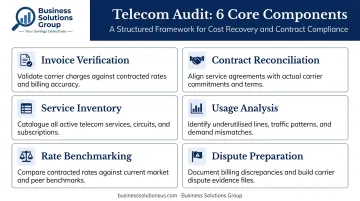
A complete audit covers:
- Invoice verification against contracted terms
- Contract reconciliation and expiration tracking
- Service inventory assessment across all locations
- Usage analysis by service and user
- Rate benchmarking against current market pricing
- Dispute preparation for confirmed billing errors
Why Telecom Expense Audits Are Critical for Cost Control
Telecom sits in an awkward position in most organizations: it's a significant monthly expense, but no single team owns it fully. IT manages the infrastructure, finance pays the invoices, and procurement negotiates the contracts — often without much coordination between them.
That gap is where costs accumulate.
Contracts auto-renew because no one tracked the notice window. Services stay active after office closures because decommissioning wasn't part of the offboarding checklist. And carriers occasionally bill above negotiated rates — not always intentionally, but consistently enough to matter.
Business Benefits of a Telecom Audit
- Recover overpayments from billing errors, unapplied discounts, and unauthorized charges
- Eliminate waste from inactive lines, vacated-site circuits, and expired equipment rentals
- Create negotiation leverage using verified usage data and current market benchmarks
- Improve visibility across departments that each manage pieces of the telecom spend
- Build a governance foundation that keeps costs controlled going forward
The Scale of What's at Stake
The City of Albuquerque identified $273,000 in annual cost savings and $240,000 in cost recoveries through a single telecom audit. At the enterprise level, a Cass case study documented an industrial conglomerate saving over $5.1M within three years of implementing telecom expense management.

For mid-sized businesses, the dollar figures are smaller — but the same categories of waste appear across the board. That's exactly what a structured audit is designed to surface.
How to Conduct a Telecom Expense Audit – Step by Step
The most common mistake businesses make with a telecom audit is treating it as a single event rather than a structured process with clear outputs at each stage. Here's how to do it properly.
Step 1 – Build a Complete Telecom Inventory
Document every telecom service across every location: voice lines, internet circuits, mobile plans, WAN connections, and cloud services. For each service, capture:
- Vendor name and account ID
- Service type and location
- Monthly cost
- Contract start and end dates
Many businesses are genuinely surprised by what this reveals. Active lines assigned to employees who left months ago, circuits serving locations that were vacated, mobile plans on devices that were returned — none of these cancel automatically.
Cross-reference each service against recent invoices and active headcount. Anything without a current business justification is a candidate for cancellation.
Step 2 – Collect and Review All Contracts
Gather every telecom contract and service agreement. For each, identify:
- Expiration date and auto-renewal terms
- Notice period required to prevent auto-renewal (many business telecom agreements require 60 or 90 days' advance written notice — though terms vary by provider)
- Early termination fees
- Negotiated rates and discount structures
Missing a renewal window often means another 12 months at rates you've since outgrown. That's a preventable cost.
Once you have the contracts, check whether the rates in those agreements match what's on your invoices. match what's on your invoices. Discrepancies between contracted terms and actual billing are common, and they're disputable.
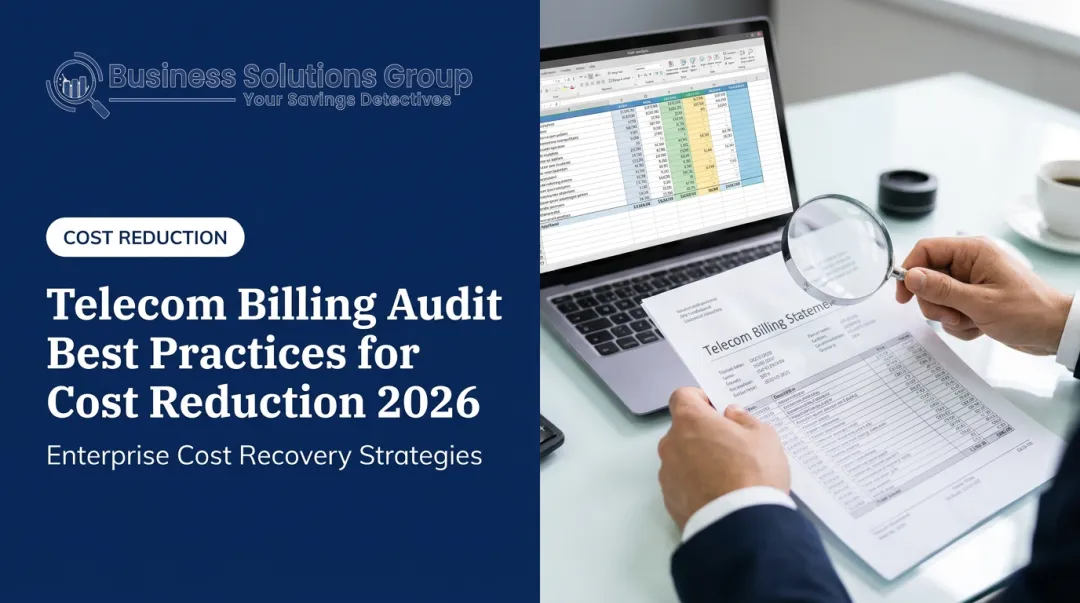
Step 3 – Conduct a Detailed Invoice Analysis
Pull 6–12 months of invoices for every telecom service. Look specifically for:
- Charges for terminated or inactive services
- Duplicate line items across billing periods
- Unapproved one-time fees
- International usage overages that better plan selection would eliminate
- Bundled services where only part of the bundle is being used
To make the impact concrete: five unused mobile lines at $29/line/month (Verizon's published business rate with AutoPay) cost $1,740 per year before taxes and fees. At AT&T's $40/line rate, that same scenario runs $2,400 annually — and most businesses with billing drift have far more than five orphaned lines.

Step 4 – Benchmark Rates Against Current Market Standards
Telecom pricing falls over time. According to TeleGeography's 2025 State of the Network report, 10 GigE prices declined 13% compounded annually from Q2 2021 to Q2 2024 across a range of markets. A business locked into a three-year-old contract for internet or WAN services is likely paying more than necessary.
Benchmarking compares your current contracted rates against what equivalent services cost today. This serves two purposes: it quantifies exactly where you're overpaying, and it gives you documented leverage before you walk into a renegotiation.
Business Solutions Group builds this benchmarking step into every client engagement, giving businesses the market data to quantify pricing gaps before entering any carrier negotiation.
Step 5 – Optimize Services and Negotiate with Vendors
With your audit findings in hand, take action:
- Cancel unused services immediately — don't wait for contract renewals if month-to-month terms apply
- Consolidate redundant services across providers where doing so reduces overhead and qualifies for volume discounts
- Enter renegotiation with carriers armed with verified usage data and competitive quotes
Approach these conversations as business discussions, not complaints. Carriers want to retain customers, and a data-backed request for rate alignment is far more effective than a general objection to the bill size. If a carrier knows you have documented alternatives, they move faster on pricing concessions.
Step 6 – Implement Ongoing Monitoring and Governance
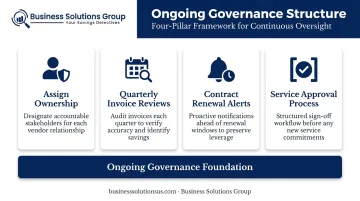
Finding problems through an audit is only half the work. Governance is what keeps them from returning.
Set up the following:
- Assign clear ownership — one person or team responsible for telecom expense oversight
- Schedule quarterly invoice reviews to catch new billing drift early
- Create calendar alerts for contract renewal windows, ideally 6–9 months before expiration
- Establish approval processes for any new service requests
Without this layer, savings erode. Carriers gradually reintroduce fees, new services accumulate without justification, and employee offboarding leaves active lines running for months. The audit gives you a clean baseline; governance keeps it that way.
Telecom Audit in Action – A Simplified Walkthrough
Consider a mid-sized company with five office locations that notices its telecom costs have risen steadily year-over-year — but no one can explain where the increase is coming from.
Step 1: Build a Complete Inventory
The team builds a complete service list and finds active voice lines and data services assigned to nine employees who left 6–12 months ago, plus a dedicated internet circuit at a location that closed eight months ago. None of these were ever decommissioned.
Step 2: Review Invoices Against Contract Terms
Digging into 12 months of invoices from their primary internet provider, the team discovers the carrier has been billing at a rate 15% above the contracted price for eight months straight. The carrier never flagged it. The overpayment is documented and submitted as a formal dispute.
Step 3: Benchmark and Renegotiate
Using current market rates for comparable WAN services, the team approaches their carrier with documented alternatives. They negotiate a corrected rate, secure a credit for the billing discrepancy, and consolidate two redundant voice services — cutting monthly spend by roughly 20%.
Step 4: Put Governance in Place
The company assigns its IT director to own telecom expense oversight, sets renewal calendar alerts seven months out for all active contracts, and schedules quarterly invoice reviews. Ongoing visibility replaces one-time cleanup — telecom becomes a managed cost, not a surprise.
How Business Solutions Group Can Help
Business Solutions Group brings both advisory expertise and spend intelligence to the telecom audit process — helping businesses find savings that internal teams, managing dozens of other priorities, typically miss on their own.
Their approach covers three core areas:
- Benchmark analysis to identify exactly where carrier pricing has drifted above market rates
- End-to-end cost reduction strategies that span the full audit cycle, from invoice review to contract restructuring
- Direct carrier negotiation to secure better rates and terms on clients' behalf
Telecom engagements typically deliver 10–25% savings from subscription and service optimization alone — eliminating zero-use lines and aligning plans with actual usage — with broader engagements achieving 20–50% in total telecom cost reductions.

Business Solutions Group operates on a contingency-based model: no savings means no fee. That structure removes the financial risk from starting the process, which makes a managed audit a straightforward decision for most businesses.
If telecom costs have been climbing without a clear explanation, or if it's simply been a while since anyone looked carefully at the contracts and invoices, reach out to Business Solutions Group at (949) 525-7677 or visit businesssolutionsus.com to request a free savings analysis.
Frequently Asked Questions
What is the average cost of a telecom audit?
Cost depends on scope, company size, and who conducts it. Many specialist firms — including Business Solutions Group — use contingency-based models where the fee is a percentage of savings achieved, meaning the audit costs nothing if no savings are found. This makes a third-party audit effectively risk-free for most businesses.
How do you prepare for a telecom expense audit?
Start by gathering all telecom contracts and at least 6–12 months of invoices. Build a service inventory across every location, then loop in stakeholders from IT, finance, and procurement — having this documentation ready shortens the audit timeline considerably.
What is included in a telecom audit?
A thorough audit typically covers:
- Contract review and rate benchmarking
- Invoice analysis and line-item reconciliation
- Service inventory across all locations
- Usage pattern examination
- Vendor dispute management
Together, these give a clear picture of where money is going and where it can be recovered or renegotiated.
What are the different types of telecom expense audits?
The three main types are internal audits (in-house teams), external audits (specialist firms with market benchmarking tools), and ongoing TEM programs (continuous monitoring vs. periodic reviews). Each involves different cost, depth, and resource trade-offs.
How often should a telecom expense audit be conducted?
A full audit at least once a year is a reasonable baseline, with quarterly invoice reviews in between. Audits should also be triggered by business events — office moves, significant headcount changes, acquisitions, or upcoming contract renewals — that alter the telecom footprint.
What are the most common telecom billing errors found in an audit?
Common errors include charges for inactive services, duplicate line items, rates that don't match contract terms, unapproved one-time fees, and incorrect international usage charges. Most go undetected because invoices are paid without line-by-line review.