For most businesses, telecom sits on the books as fixed overhead. That's the problem. It doesn't behave like a fixed cost. It scales with headcount, remote work arrangements, and technology changes. Without ongoing visibility, you're effectively paying for a snapshot of your business that no longer exists.
This article covers what telecom expenses actually include, why they're genuinely hard to control, five actionable strategies to take control, and the measurable benefits of doing so — including when it makes sense to bring in outside expertise.
Key Takeaways
- Telecom expenses span mobile plans, VoIP, internet, and carrier contracts — none of which manage themselves
- Roughly 7–9% of carrier invoices contain billing errors, many going unnoticed for months
- Regular audits and contract renegotiations can reduce total telecom spend by 5–10% on average
- Centralizing your telecom inventory is the prerequisite to every other cost-control strategy
- Small and mid-sized businesses often have the most to gain, as telecom costs there tend to go unmanaged the longest
What Are Telecommunication Expenses?
Telecom expenses cover every cost tied to a business's communication infrastructure. That includes both the services themselves and the contracts, devices, and data plans that support them.
Common line items include:
- Monthly mobile phone and data plans
- Broadband, fiber, and dedicated internet access
- VoIP systems and SIP trunking
- Desk phones and PBX infrastructure
- Video conferencing subscriptions
- Fax services and ISDN lines
- International calling charges
- SD-WAN and network connectivity services
The scope is wider than most finance teams realize. Satellite-connected locations, legacy POTS lines that haven't been reviewed in years, and cloud communications platforms that different departments adopted independently all add up — often without anyone tracking the combined cost.
Why "Fixed Overhead" Is the Wrong Frame
Treating telecom as a fixed cost creates a false sense of stability. In practice, telecom spend shifts constantly — new hires get provisioned, roles change, offices open and close, and carriers quietly adjust rates at renewal. A business that added 30 remote employees over the past 18 months and never adjusted its plans is almost certainly overpaying.
That's why ongoing visibility into telecom spend matters more than a one-time audit. Without a clear picture of what's active, what's redundant, and what's been auto-renewed at higher rates, even well-intentioned cost reduction efforts miss the mark.
Why Telecom Expenses Are Difficult to Control
The Multi-Vendor, Multi-Contract Problem
Most businesses manage several telecom vendors simultaneously — separate carriers for mobile, internet, VoIP, and data circuits, often with different billing cycles and contract terms. When different departments or locations maintain their own accounts with no centralized oversight, the total picture becomes impossible to see without dedicated effort.
Invoices add another layer of complexity. For every 25 telecom services, companies typically handle 100–300 invoices, and manually reviewing each one in detail can take weeks. That administrative load makes thorough quarterly audits impractical, so most businesses skip them entirely.
Billing Errors Are More Common Than You'd Expect
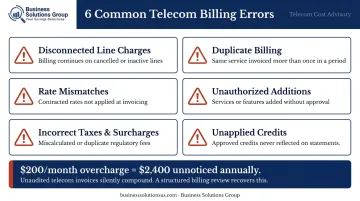
Telecom invoices are frequently inaccurate. According to Tangoe's advisory services observations, **7–9% of all carrier invoices contain billing inaccuracies**. Common error types include:
- Charges for disconnected or inactive service lines
- Duplicate billing across billing cycles
- Rates that don't match contracted terms
- Unauthorized service additions
- Incorrectly applied taxes or surcharges
- Credits owed but never applied
Errors also compound. A $200 monthly overcharge on an unmonitored line reaches $2,400 before anyone catches it.
Personal Use and Policy Gaps
Without clear written policies, company mobile plans become a gray area. Employees use corporate data plans for personal streaming, hotspot usage creeps up, and international roaming charges appear without prior approval. None of this is necessarily malicious. It's the predictable result of unclear expectations — and the cost appears on your invoice either way.
Key Strategies for Managing Telecommunication Expenses
Strategy 1: Centralize Your Telecom Inventory
Before you can reduce telecom costs, you need a complete list of everything you're paying for. That means building a single master inventory covering:
- Every active service line and device
- Carrier names, account numbers, and contract expiration dates
- Monthly costs per service and per location
- Assigned users (or lack thereof)
Without this, you can't identify redundant services, flag lines assigned to former employees, or build a case for renegotiating contracts. The inventory is the foundation — everything else depends on it.
Strategy 2: Conduct Regular Bill Audits
Systematic invoice review doesn't require a dedicated telecom team. Even a quarterly or biannual audit — comparing billed amounts against contracted rates and current service usage — can surface significant recoverable charges.
The audit process works best when you:
- Pull invoices from the past 6–12 months across all vendors
- Compare billed rates against your signed contracts
- Flag lines with zero usage for the past 60–90 days
- Document discrepancies and file formal disputes with carriers
According to Tangoe, companies that audit invoices, services, and inventory can recover 5–10% of total telecom expenses on average. For a business spending $200,000 annually on telecom, that's $10,000–$20,000 per year.
Strategy 3: Benchmark Your Spend
Knowing your spend figures is only half the picture. The other half is knowing whether those numbers are competitive. Comparing telecom spend per employee or per location against current market rates reveals whether you're working with sharp contracts — or paying legacy rates that nobody has pushed back on.
Business Solutions Group's spend intelligence platform surfaces these comparisons automatically. Key benchmarks to examine include:
- Cost per line versus industry averages for your company size
- Data plan pricing compared to current carrier market rates
- Voice and messaging costs per location relative to comparable businesses
Rather than walking into a renegotiation without context, clients can point to specific rate gaps and request alignment with current market pricing.
Strategy 4: Renegotiate Contracts Strategically
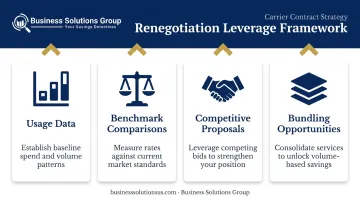
Carriers rarely offer better terms unless asked — and asked with documentation. Effective renegotiation relies on:
- Usage data showing actual consumption versus contracted minimums
- Benchmark comparisons demonstrating current market rates
- Competitive proposals from alternative carriers to establish leverage
- Bundling opportunities that consolidate services under one agreement
Business Solutions Group's approach to carrier negotiations includes a structured counter-proposal phase where every carrier offer is analyzed and improvement requests are developed to push toward each carrier's best and final terms. The goal is better pricing without service interruptions or forced migrations.
Strategy 5: Establish a Written Telecom Usage Policy
A clear policy prevents cost problems before they start. At minimum, a business telecom policy should define:
- Acceptable and unacceptable uses of company mobile plans
- Monthly data limits and roaming approval requirements
- The process for requesting new services or devices
- Device upgrade cycles and return procedures
- Consequences for repeated policy violations
A written policy also gives finance and IT teams a defensible framework when disputing charges with carriers — and a consistent standard for evaluating whether new service requests are justified.
The Business Benefits of Effective Telecom Expense Management
Direct Cost Savings
The most immediate benefit is straightforward: you stop paying for things you're not using, and you stop overpaying for things you are. Eliminating ghost lines, recovering billing errors, and renegotiating contracts to reflect current market rates can generate 5–10% in annual savings on average, with some complex environments seeing significantly more.
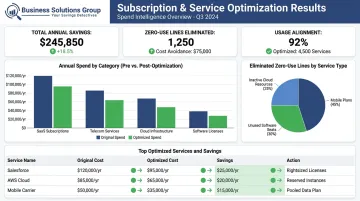
Business Solutions Group's subscription and service optimization work — aligning plans to actual usage and eliminating zero-use lines — typically delivers savings of 10 to 25 percent in that category alone.
Improved Budget Accuracy
Cost savings are only part of the picture. Unmanaged telecom creates unpredictable expenses — surprise overages, undisputed billing errors, and automatic contract renewals at unfavorable rates all distort what finance teams expect to spend versus what they actually spend.
With full inventory visibility and audited invoices, budgeting becomes more reliable. Finance teams can forecast telecom costs with confidence, avoid reactive scrambles when charges spike, and redirect freed-up cash toward growth investments.
Better Resource Allocation
Understanding exactly what you spend on telecom — and why — enables smarter decisions. Common examples include:
- Three departments paying separately for video conferencing that could run under one enterprise license
- Data circuits still active at a location that downsized
- Mobile plans sized for peak headcount from two years ago
Visibility surfaces these redundancies so you can act on them.
Reduced Administrative Burden
Manual invoice reconciliation is time-consuming. Companies typically take around three weeks to process and pay telecom invoices when workflows are manual and invoices are fragmented across vendors.
Systematic TEM — whether managed internally with structured processes or supported by software — frees IT and finance teams from chasing down charges and disputing errors.
Stronger Vendor Accountability
Businesses with organized telecom records are better positioned to hold carriers accountable. When a billing dispute arises, documented contracts, prior invoices, and written confirmation of contracted rates make the process faster and more likely to succeed. Without that documentation, disputes become subjective — and carriers have more leverage.
Conducting a Telecom Audit: Where to Start
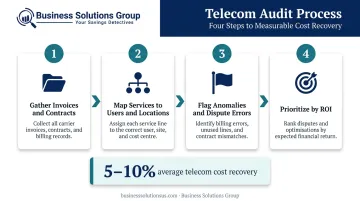
A structured audit doesn't require specialized software — just a methodical approach and the right data. Work through these four steps:
Gather all invoices and contracts. Pull 6–12 months of invoices from every telecom vendor alongside your current service agreements. This establishes what you're paying and what terms you're entitled to.
Map services to actual users and locations. Cross-reference every billed service against current employees and active locations. Flag lines assigned to former employees, services at closed offices, and accounts with zero recent usage — these cuts typically yield immediate savings.
Flag anomalies and dispute errors. Document every discrepancy between what you're being billed and what your contracts say. File formal disputes with carriers for each identified overcharge; many carriers have specific dispute processes with defined response windows.
Prioritize by ROI. Not every finding needs immediate action. Start with the highest-cost discrepancies and contract renewal opportunities — these deliver the fastest return and create momentum for broader optimization.
When to Seek Expert Help for Telecom Cost Optimization
In-house telecom management works well when someone actually owns it. The problem is that in most businesses, nobody does. Telecom responsibility gets split between IT (for infrastructure), finance (for invoices), and department managers (for mobile plans) — with no single team accountable for the full picture.
Signs it's time to bring in outside expertise:
- Multiple vendors with no centralized tracking or inventory
- No contract review in the past 12–18 months
- Telecom costs growing without a clear explanation
- No internal staff with carrier negotiation experience
- Finance team spending significant hours manually reconciling telecom invoices
Business Solutions Group operates as an advisory and optimization partner for telecom expense management, combining benchmark data, spend intelligence software, and structured carrier negotiation support. Their performance-based model means they're compensated based on savings achieved: clients receive 100% of recovered credits and rebates.
This model works particularly well for small and mid-sized businesses. Their telecom costs have often gone unreviewed the longest, and the savings from a first comprehensive audit can be significant.
An advisory partner brings carrier market knowledge and negotiation leverage that most internal teams simply can't replicate on their own.
Frequently Asked Questions
What are examples of telecommunication expenses?
Common business telecom expenses include monthly mobile phone and data plans, broadband and fiber internet services, VoIP and desk phone systems, video conferencing subscriptions, SIP trunking, fax services, and international calling charges. Legacy services like POTS and ISDN lines also fall under telecom, even if rarely reviewed.
What is telecom expense management (TEM)?
TEM is the systematic process of tracking, auditing, and optimizing a business's telecom services, contracts, and invoices. The goal is to eliminate waste, correct billing errors, and reduce overall communication costs through structured inventory management and ongoing invoice review.
How can businesses reduce telecom costs?
Effective cost reduction comes down to a few high-impact actions:
- Audit invoices regularly for billing discrepancies
- Eliminate unused or redundant service lines
- Renegotiate contracts using benchmark data
- Consolidate vendors where possible
- Set clear usage policies for employees
Unused lines and rate mismatches are where most businesses find the largest savings.
What are common billing errors found in telecom invoices?
Billing errors show up in predictable places: charges for disconnected lines, duplicate billing, rates that don't match contracted terms, unauthorized service additions, and incorrectly applied taxes or surcharges. Credits owed from prior disputes are also commonly missed.
When should a company outsource telecom expense management?
Outsourcing makes sense when a business lacks dedicated telecom expertise internally, manages multiple vendors without centralized tracking, or hasn't reviewed its contracts in over a year. Rising telecom costs without a clear cause are another strong signal it's time to bring in outside support.
How does telecom expense management affect overall business profitability?
Reducing telecom waste improves cash flow and frees budget for strategic investments. Better forecasting and lower administrative overhead also let finance and IT teams focus on revenue-driving work instead of chasing invoice errors.