The problem isn't spending too much. It's spending without visibility. Without a structured approach to tracking and analyzing IT costs, leaders make investment decisions based on gut instinct, renew licenses no one uses, and discover budget overruns only after they've happened.
That's exactly the gap IT Financial Management fills. ITFM is the discipline of tracking, planning, and controlling IT costs so every technology dollar is accountable and tied to a business outcome.
This article covers what ITFM is, who needs it most, how it differs from IT budgeting and FinOps, the core benefits, common adoption challenges, and a practical five-step path to implementation.
Key Takeaways
- ITFM is the structured practice of budgeting, tracking, and optimizing IT costs to align technology spending with business outcomes.
- Organizations with complex IT environments, heavy vendor spending, or active digital transformation initiatives benefit most.
- ITFM is broader than IT budgeting and distinct from FinOps — it provides a strategic view across all IT financial activity.
- Adoption follows five steps, from strategic alignment and current-state documentation through to tracking controls.
- The end goal is shifting IT from a cost center to a measurable value driver.
What Is IT Financial Management (ITFM)?
Gartner defines IT financial management tools as tools designed to help organizations better manage IT spend and enable spend transparency. More broadly, ITFM is the set of processes, policies, and tools used to manage, analyze, and optimize all IT-related spending — covering budgeting, cost allocation, expense tracking, and financial reporting across every IT resource and service.
Core Components of ITFM
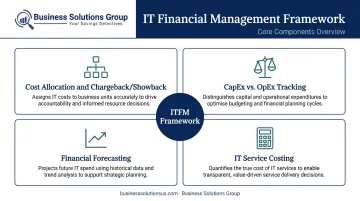
A functioning ITFM practice typically includes four building blocks:
- Cost allocation and chargeback/showback — assigns IT costs to specific departments, teams, or projects, creating accountability rather than treating IT as a single shared expense pool
- CapEx vs. OpEx tracking — distinguishes between capital investments (servers, infrastructure) and operational expenses (subscriptions, licenses) for accurate financial reporting
- Financial forecasting — projects future IT spend based on historical patterns and planned initiatives, reducing budget surprises
- IT service costing — calculates the actual cost of delivering individual IT services, enabling data-driven decisions about what to build, buy, or retire
The Strategic Shift ITFM Enables
Most organizations treat IT as a cost center — an expense line on the P&L that leadership wants to minimize. ITFM changes that framing. When IT costs are fully visible and tied to business outcomes, IT becomes a value driver — a function that directly supports revenue growth, operational efficiency, and competitive advantage. That's what moves the CIO/CFO conversation from "how do we cut the IT budget?" to "where should we invest next?"
Sustaining that shift requires ongoing discipline. ITFM is not a one-time project — it demands continued collaboration between IT, finance, and business leaders, and it evolves as technology landscapes change.
Who Should Adopt ITFM?
ITFM applies across industries and company sizes, but the urgency scales with IT complexity. Three profiles have the most to gain:
Large Enterprises with Multi-Department IT Ecosystems
When IT services dozens of business units with different needs and spending patterns, financial opacity becomes a serious governance problem. Without ITFM, there's no reliable way to trace costs, demonstrate ROI, or make fair allocation decisions across the organization.
Regulated Industries — Finance, Healthcare, Government
These sectors face compliance and reporting pressures that demand detailed financial documentation. IT spending isn't just a management concern; it's often a regulatory one. Organizations in banking and financial services are particularly exposed, given that technology spend can exceed 7% of revenue, according to Deloitte's CIO survey data.
Businesses Undergoing Digital Transformation or Heavy SaaS Adoption
BetterCloud's 2025 State of SaaS report found organizations now use an average of 106 SaaS tools. Without structured financial oversight, that kind of sprawl generates redundant spending and shadow IT that compounds quickly.
These three profiles carry the highest urgency, but smaller businesses aren't exempt. Establishing financial discipline before complexity scales is far easier — and cheaper — than untangling three years of untracked vendor contracts.
ITFM vs. IT Budget Management vs. FinOps
These three terms often get conflated, but they operate at different levels.
| Discipline | Scope | Primary Focus |
|---|---|---|
| IT Budget Management | Tactical, annual | Setting and staying within spending limits |
| FinOps | Operational, multi-domain | Maximizing technology value through engineering, finance, and business collaboration |
| ITFM | Strategic, comprehensive | Full IT financial lifecycle — planning, allocation, analysis, and value demonstration |
| TBM (Technology Business Management) | Enterprise-wide | Connecting technology investments to business outcomes at the organizational level |
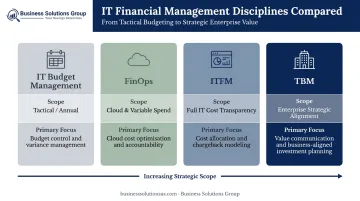
IT Budget Management is a planning baseline. It answers "how much can we spend?" — but stops there. It doesn't tie spending to outcomes, business value, or strategic priorities.
FinOps, as defined by the FinOps Foundation, is an operational framework focused on maximizing the business value of technology through collaboration between engineering, finance, and operations teams. It covers cloud, SaaS, licensing, and data center costs — operating at the workload and consumption level, not the enterprise strategy level.
ITFM is the broader strategic discipline that integrates financial planning into the full IT operating model. Above ITFM sits TBM (Technology Business Management), which the TBM Council defines as a value management framework for CIOs, CTOs, CFOs, and their teams to make data-driven decisions about IT initiatives, linking IT spending directly to enterprise-wide business outcomes.
Key Benefits of IT Financial Management
Cost Visibility and Waste Elimination
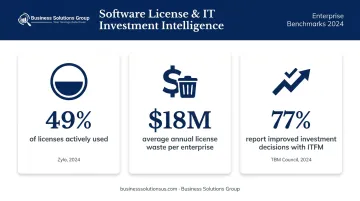
ITFM surfaces where money is actually going. Zylo's 2024 SaaS Management Index, analyzing over 30 million licenses and $34 billion in SaaS spend, found that only 49% of provisioned licenses were actively utilized, with average annual license waste reaching $18 million per enterprise. ITFM-style visibility is what catches that waste before it compounds.
ITFM also flags redundant vendor services, underutilized infrastructure, and overlapping contracts worth consolidating — without disrupting operations.
Improved Budgeting and Forecasting
Technology projects routinely overshoot without structured financial management. BCG's 2024 survey of C-suite executives across 25 industries found nearly half reported more than 30% of tech projects were over budget and late. ITFM reduces that exposure by grounding financial plans in actual spending data, not assumptions.
Informed Investment Decision-Making
The TBM Council's 2024 State of TBM survey of 680 organizations found 77% reported improved investment decisions after implementing TBM/ITFM practices. When financial context is clear, leaders can prioritize high-value initiatives, retire low-ROI investments, and stop automatically renewing legacy spending.
Stakeholder Alignment and Transparency
ITFM creates a shared financial language between IT and business leadership. CIOs gain the data to demonstrate technology value to CFOs and boards, while finance teams gain confidence that IT spending is governed — not just estimated. The result is less friction and faster decisions on both sides.
Business Agility
Real-time cost visibility lets organizations respond faster to shifting priorities. That means:
- Reallocating budget mid-cycle without waiting for annual planning
- Scaling resources up or down based on current demand
- Evaluating build-vs-buy decisions with actual financial data
Each of these moves becomes faster and lower-risk when the underlying numbers are clear.
Common Challenges of Adopting ITFM
Complexity of IT Cost Data
IT environments combine hardware, software, cloud services, labor, and third-party vendors — each with different billing models and contract structures. Consolidating that into a coherent financial picture takes significant effort.
Organizations managing both IT and supply chain spend often find costs fragmented across invoices, carrier portals, and internal systems — with no single source of truth. Advisory partners with spend intelligence tools can help structure this visibility, particularly across telecom, cloud, and vendor contracts that typically go untracked.
Finance and IT Misalignment
IT teams and finance departments operate with different objectives. IT prioritizes capability and performance; finance prioritizes cost control. Without deliberate cross-functional effort, ITFM initiatives produce reports that neither team fully trusts or acts on. Forrester has noted that CIOs face persistent pressure to justify technology spend and prove measurable business value — a challenge that doesn't resolve without structural collaboration.
Forecasting Inaccuracy
Predicting future IT costs is genuinely hard. Several factors contribute to forecast drift:
- Cloud consumption shifts month to month based on usage patterns
- Infrastructure needs surface outside the annual planning cycle
- Vendor pricing changes mid-contract without warning
Treat IT financial forecasting as a continuous discipline. Revisit assumptions quarterly and build variance analysis into the regular finance rhythm — not just at year-end.
Key Steps to Adopting ITFM
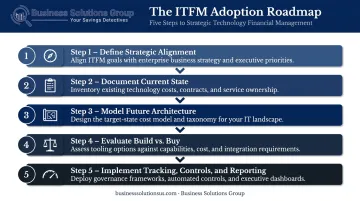
Step 1 — Define Strategic Alignment
Before tracking a single dollar, connect ITFM goals to business priorities. This means engaging both IT and business leaders to agree on what outcomes IT spending should drive — operational efficiency, customer experience, growth enablement, or all three. Financial decisions should be guided by strategic intent, not just budget limits.
Step 2 — Document the Current State
Create a baseline. Catalog all existing IT assets, services, costs, and financial management processes. Hidden inefficiencies, duplicate spending, and oversight gaps surface quickly once you have this snapshot — and you can't fix what you haven't measured.
Business Solutions Group's free savings analysis takes a comparable approach — auditing current vendor relationships and spending patterns across IT, telecom, and supply chain to surface cost reduction opportunities, typically within three to five business days.
Step 3 — Model the Ideal Future Architecture
Define the target state before committing to any tools or platforms. The goal is a clear picture of where the organization needs to land:
- Standardized financial processes across IT and finance teams
- Reporting structures that give leaders visibility into spend by service or department
- Cost transparency mechanisms that connect IT outputs to business value
- A shared evaluation framework for future technology investments
With this architecture defined, technology decisions get made against consistent criteria — not in isolation.
Step 4 — Evaluate Build-vs-Buy
Should you build internal ITFM capabilities or invest in a dedicated platform or advisory partner?
- Building offers customization but requires significant time, internal expertise, and ongoing maintenance
- Buying delivers faster deployment, proven frameworks, and immediate access to benchmark data
Organizations managing complex spend — particularly those with overlapping IT, telecom, and supply chain costs — often benefit from engaging an advisory partner rather than building from scratch. Business Solutions Group offers benchmark analysis and eProcurement solutions that give organizations financial visibility without the overhead of building a custom capability in-house.
Step 5 — Implement Tracking, Controls, and Reporting
Put the infrastructure in place:
- Chargeback or showback systems that assign IT costs to departments, creating accountability
- Anomaly detection to flag unexpected spending spikes before they become budget overruns
- Regular financial reviews that bring IT and finance together to assess actuals versus plan
- Performance metrics tied to the strategic outcomes defined in Step 1
ITFM adoption is iterative, not a one-time implementation. Budget for improvement cycles — the insights you gain in year one will reshape your priorities in year two, and the organizations that treat ITFM as a living practice consistently outperform those that treat it as a setup project.
Frequently Asked Questions
What is the full form of ITFM?
ITFM stands for IT Financial Management — a discipline focused on managing, planning, and optimizing an organization's technology spending. The goal is to align IT costs with business objectives and make technology investment decisions based on financial data rather than intuition.
What is the difference between ITFM and FinOps?
ITFM covers all IT financial activity including on-premise infrastructure, labor, software, and vendor costs. FinOps is a narrower framework that maximizes value across cloud, SaaS, and licensing spend through engineering and finance collaboration. It typically operates as a practice within a broader ITFM program.
What are the key components of an IT financial management framework?
The core building blocks are financial planning and budgeting, cost tracking and allocation, IT service costing, financial analysis and reporting, and governance mechanisms such as chargeback or showback systems. When implemented together, they give leadership a clear basis for deciding where to invest, cut, or consolidate.
Who is responsible for IT financial management in an organization?
ITFM is a shared responsibility, typically led through collaboration between the CIO and CFO. Many organizations also designate a dedicated IT finance lead or ITFM practice owner who bridges technology operations and financial reporting.
How does ITFM help reduce IT costs?
ITFM reduces costs by surfacing unused licenses, redundant vendor services, and wasteful spending through cost tracking. That visibility enables organizations to consolidate vendors, renegotiate contracts, and shift budget from low-ROI spending toward higher-value initiatives.
What are the biggest challenges when adopting ITFM?
Three barriers come up most often. First, consolidating cost data from diverse IT systems into a coherent picture is technically complex. Second, finance and IT teams frequently operate with misaligned priorities. Third, accurate forecasting is difficult when cloud consumption and vendor pricing shift frequently.