The market for specialized help is responding accordingly. According to Research and Markets, the global telecom expense management market is expected to grow from approximately $4.1 billion in 2024 to more than $7.7 billion by 2030 — a clear signal that businesses are recognizing telecom spend as a problem worth solving with dedicated tools and expertise.
This guide covers what TEM companies actually do, the warning signs that your organization needs one, how to evaluate providers, and where the category is heading.
Key Takeaways
- TEM companies manage the full telecom lifecycle: auditing, inventory, contracts, and usage optimization
- Billing errors, zombie lines, and poorly benchmarked contracts are the three biggest sources of telecom overspend
- Multi-carrier, multi-site, or high-device-count businesses see the greatest TEM benefit
- Savings of 10–30% on total telecom spend are commonly cited, though results depend heavily on how unmanaged the environment currently is
- A spend baseline and benchmark analysis removes guesswork when selecting a TEM vendor
What Is a Telecom Expense Management Company?
A telecom expense management (TEM) company is a specialized provider — delivering software, managed services, or both — that helps organizations monitor, control, and optimize costs across all telecommunications services. That includes phone lines, mobile devices, data plans, internet connectivity, and increasingly cloud communications like UCaaS and VoIP.
Why Telecom Is Uniquely Hard to Manage
Carrier invoices are notoriously complex. A single enterprise mobile invoice can span hundreds of line items, with rates, overages, discounts, and taxes intermingled in ways that make manual auditing impractical. Add multiple vendors, multi-year contracts, and usage data scattered across dozens of cost centers, and the problem compounds quickly.
Billing error rates on telecom invoices are estimated at 7–12%, based on vendor-cited figures across the industry. For an enterprise running millions in annual telecom spend, that range translates directly to recoverable dollars left on the table.
TEM vs. General Expense Management
Standard accounting or ERP tools track payments. TEM goes further, covering the entire telecom lifecycle:
- Procurement — sourcing and activating new services
- Inventory management — maintaining an accurate record of every active service
- Invoice auditing — catching errors and recovering credits
- Usage optimization — right-sizing plans to actual consumption
- Contract management — tracking terms, renewals, and rate compliance
- Disposal — decommissioning retired services and closing inactive lines
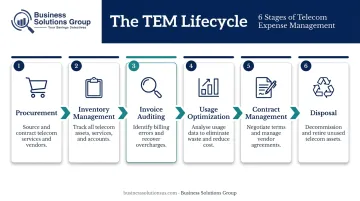
No spreadsheet, ERP module, or accounts payable workflow covers all six of these stages — which is precisely where TEM providers earn their value.
TEM vs. Technology Expense Management
TEM focuses specifically on telecom services — voice networks, mobile plans, internet, and carrier contracts. Technology expense management (sometimes called "TEM 2.0") extends coverage to cloud infrastructure, SaaS subscriptions, and hardware. Many TEM providers are actively expanding in this direction, so the distinction is blurring. When evaluating vendors, confirm exactly which categories they cover before assuming parity.
Core Services Telecom Expense Management Companies Provide
Understanding what TEM companies do day-to-day helps organizations assess whether a given provider actually covers their needs — or just checks boxes on a feature list.
Invoice Auditing and Error Recovery
TEM companies compare every carrier invoice against contracted rates, flagging discrepancies, unauthorized charges, and billing errors. Modern platforms use AI and machine learning to detect anomalies automatically, rather than catching problems weeks later through manual review. Credits are recovered; recurring errors get escalated to carriers for correction.
Inventory and Asset Management
Without a centralized, accurate inventory, organizations routinely pay for services no one uses. These are often called "zombie" lines — phone numbers, data plans, and devices tied to closed offices, departed employees, or decommissioned equipment. Vendor-sourced data suggests ghost services and unused lines can account for 5–10% of total telecom spend. TEM platforms maintain a live inventory of every asset: mobile devices, phone lines, data plans, application licenses, and network services.
Contract Management and Negotiation Support
Telecom contracts typically run two to five years. Without active tracking, renewal dates pass unnoticed and organizations stay locked into rates that no longer reflect market pricing.
TEM providers monitor contract terms, flag upcoming renewals, and verify that carriers are billing at agreed-upon rates. Many also offer negotiation support, using benchmarking data to help clients secure better pricing when contracts come up for renewal.
Usage Monitoring and Cost Optimization
TEM platforms analyze consumption patterns across departments, locations, and service types to surface:
- Underutilized plans that could be downgraded
- Excessive overages that indicate a plan needs adjustment
- Duplicate services covering the same function
- Allocations to inactive cost centers or closed sites
Cost allocation works alongside this — distributing charges accurately to departments, projects, or business units for proper budgeting and chargeback. That same visibility feeds directly into reporting and analytics.
Reporting, Analytics, and Compliance
Finance and IT leaders need visibility into telecom spend without pulling data from five separate carrier portals. TEM platforms provide consolidated dashboards, custom reports, and real-time spend analytics.
On the compliance side, platforms support:
- Audit trails for internal policy enforcement
- Usage records that satisfy regulatory requirements
- Mobile usage policy monitoring as workforce mobility grows
Signs Your Business Needs a Telecom Expense Management Company
A few organizational red flags indicate a business has outgrown manual telecom management:
- Unexplained telecom costs with no clear breakdown of what's driving month-to-month variation
- Hours lost to manual invoice reconciliation across multiple carrier statements each billing cycle
- Billing errors going undetected for months with no systematic audit process in place
- No current inventory of active lines, devices, or contracts — meaning you're likely paying for services no longer in use
- Multiple carriers, contracts, and locations — complexity has outpaced what spreadsheets can handle
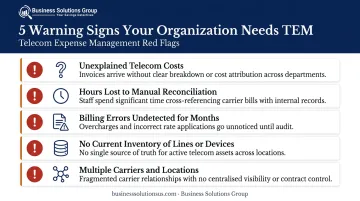
Organizations managing multiple service providers, large device fleets, or offices across different geographies are most likely to benefit from a dedicated TEM solution. Smaller organizations with fewer than 50–100 lines may not need an enterprise TEM platform, but they can still benefit from advisory support or lighter spend visibility tools.
Before committing to a TEM platform, a spend analysis gives you a clearer picture of where costs are out of line. Business Solutions Group offers benchmark analysis services that compare your current spending against market rates — a useful baseline for any business trying to understand where cost gaps exist before entering contract negotiations or platform evaluations.
Types of Telecom Expense Management Companies
Not all TEM providers are structured the same way. The three primary models:
| Model | What It Includes | Best For |
|---|---|---|
| Software-only | Platform access; client manages the process internally | Organizations with dedicated telecom or IT staff |
| Software + managed services | Platform plus optional professional services (invoice processing, negotiation, support) | Most mid-to-large enterprises; the most common model |
| Fully outsourced TEM | Provider takes complete ownership of all TEM processes | Organizations without internal resources to manage the software |
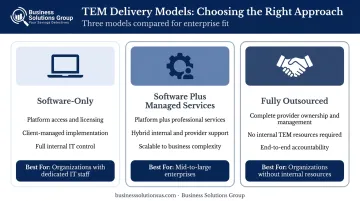
Beyond delivery model, the market splits between pure-play TEM specialists and integrated communications providers that bundle connectivity services with built-in expense management capabilities. Well-known names in the enterprise TEM space include Tangoe, Calero, Brightfin, and Sakon — each represented on Gartner Peer Insights' Telecom Expense Management Services, Global market listing.
Selecting the right model depends on three practical factors:
- Internal IT capacity to manage software and processes
- Size and complexity of the telecom environment
- Budget available for ongoing managed services versus a one-time platform investment
How to Choose the Right Telecom Expense Management Company
There's no universal answer here. The right TEM company depends on organizational size, integration requirements, internal capabilities, and strategic goals. That said, a few evaluation criteria apply across the board.
Inventory Management Depth
Poor inventory management is the root cause of most zombie lines and billing errors. Evaluate whether the vendor can audit all existing assets from day one, provide ongoing updates as services change, and flag discrepancies automatically. This isn't a nice-to-have — it's the foundation everything else depends on.
Integration with Existing Systems
A TEM solution that doesn't connect to your ERP, accounting, procurement, or ITSM tools creates data silos and manual workarounds. Ask vendors specifically about:
- Pre-built connectors for SAP, Oracle, ServiceNow, and similar platforms
- API flexibility for custom integrations
- Data sync frequency and error handling
Scalability, Support, and SLAs
The vendor should scale with your organization — including international expansion if relevant. Key questions:
- What are the uptime and response time SLAs?
- Is customer support accessible during your core business hours?
- For global operations: does the platform support multi-currency billing and multiple languages?
ROI and Total Cost of Ownership
Evaluate setup costs, ongoing subscription or managed service fees, and realistic savings potential. Industry sources commonly cite 10–30% reductions in total telecom costs from TEM implementations, driven by billing error recovery, elimination of unused services, and contract optimization. AOTMP cautions that savings guarantees from vendors can rely on optimistic projections — so verify the methodology behind any projected savings figure before signing.
That's where an independent baseline helps. Business Solutions Group's benchmark analysis establishes fair market rates before vendor negotiations begin, giving organizations an objective reference point to evaluate TEM proposals — rather than relying solely on vendor-provided projections. BSG's analysis is available at no cost or commitment.
The Future of Telecom Expense Management
Two technology shifts are reshaping what TEM companies must deliver.
AI and Machine Learning
AI and machine learning have moved from differentiator to baseline expectation. Modern TEM platforms use AI for predictive billing anomaly detection, automated contract analysis, and proactive usage recommendations. Tangoe's published platform materials describe processing invoices in seconds and automatically flagging discrepancies between carrier rates and contract terms — a speed and scale no manual audit can replicate.
Expanding Scope
Expanding scope is the bigger structural shift. As Gartner's 2024 Market Guide notes, TEM services should now deliver robust capabilities across cost optimization, asset inventory, and workflow automation for the full range of technology services — not just traditional telecom. The drivers are clear:
- 5G adoption is adding new enterprise service tiers and pricing complexity
- IoT proliferation means thousands of connected devices generating billable data across carrier networks
- UCaaS, SaaS, and cloud communications are now standard enterprise expenses that need the same lifecycle management telecom has always required
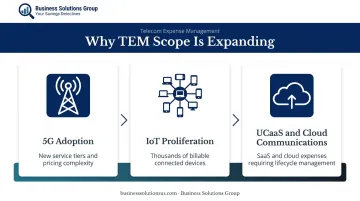
Each of these categories brings its own billing complexity and contract structure — and most legacy TEM platforms weren't built to handle them.
Organizations evaluating TEM vendors today should ask specifically about the vendor's roadmap for covering these emerging categories. A platform built only for traditional carrier invoices will likely need replacement or supplementation within two to three years.
Frequently Asked Questions
What is the difference between telecom expense management and technology expense management?
TEM focuses on telecom services — mobile plans, voice networks, internet, and carrier contracts. Technology expense management covers a broader scope including SaaS, cloud infrastructure, and hardware. Many TEM vendors are expanding into both areas, so buyers should confirm exactly what a platform covers before committing.
How much can businesses typically save by using a telecom expense management company?
Savings vary by organization, but industry sources commonly cite 10–30% reductions in telecom costs, driven primarily by billing error recovery, elimination of unused services, and contract optimization. Organizations with unmanaged telecom environments consistently see the largest gains.
What types of businesses benefit most from TEM companies?
Large enterprises with multiple carriers, hundreds of devices, and complex contracts benefit most. Mid-sized businesses with frequent billing errors or limited IT oversight also see strong ROI, particularly when a spend baseline analysis precedes platform selection.
How long does it take to implement a telecom expense management solution?
Basic deployments typically take 3–6 months. Complex global rollouts can require 12–18 months. Phased approaches often deliver initial cost savings within 60–90 days before full functionality is live.
What are the most common billing errors that TEM companies uncover?
The most frequent errors include charges for canceled accounts or closed offices, duplicate billing, rates that don't match contracted terms, unauthorized service additions, and inactive or unused lines (zombie lines).
Do small and mid-sized businesses need a full TEM solution?
SMBs with fewer than 100 lines often don't need an enterprise TEM platform. Lighter spend management tools, advisory services, or a cost benchmark analysis are usually more appropriate starting points — giving you a clear picture of where money is leaking before taking on a full platform.