Introduction
Most logistics managers treat carrier contract renegotiation as a calendar event—something that happens every two or three years when a contract technically expires. Meanwhile, UPS and FedEx quietly introduce new surcharge categories, adjust DIM weight billing, expand residential delivery zones, and compound fees quarter over quarter.
The result: businesses operating on contracts negotiated even 12–18 months ago are often paying significantly more than they realize—before anyone touches the base rate.
That gap is widening heading into 2026. Both UPS and FedEx announced 5.9% General Rate Increases effective late 2025 and early 2026, but the actual cost impact for many shippers reaches 8–12% once surcharge changes, residential delivery fee increases, and DIM weight adjustments are included.
This article breaks down five strategies that logistics managers, parcel shippers, and freight buyers can use to renegotiate smarter, surface hidden costs, and turn carrier contracts into a managed asset rather than a fixed expense.
Key Takeaways
- The 5.9% GRI headline understates real cost increases—model total landed cost, not base rates alone
- Accessorial charges represent 20–35% of total shipping spend and deserve more negotiation attention than base rates
- Start every negotiation with 12–18 months of shipping history covering service mix, zones, and package profiles
- Negotiate contract structure first — volume variance clauses, GRI caps, and auto-renewal opt-outs drive more long-term savings than initial discounts
- Review carrier contracts monthly and set renegotiation triggers — these are living documents, not one-time deals
What Is Carrier Contract Optimization?
Carrier contract optimization is the structured process of analyzing, negotiating, and actively managing carrier agreements—covering parcel, freight, and hybrid contracts—to reduce total transportation costs, improve service terms, and keep contract structure aligned with how your business ships.
The distinction from one-time rate negotiation matters. A single negotiation might secure a better base rate. Optimization covers the full picture: surcharge structures, contract terms, billing accuracy, performance accountability, and ongoing cost monitoring.
Understanding where optimization applies starts with knowing which agreement type governs your shipments.
Three Types of Shipping Agreements
| Agreement Type | Scope | Primary Carriers |
|---|---|---|
| Parcel contracts | Small packages under 150 lbs via integrated networks | UPS, FedEx, USPS |
| Freight contracts | LTL/FTL for larger shipments | Regional and national carriers |
| Hybrid agreements | Blended strategy covering parcel and freight under coordinated terms | UPS, FedEx, regional LTL carriers |
For most businesses, parcel and small freight contracts offer the largest immediate savings opportunity—which is where the five strategies below are focused.
Why 2026 Is a Critical Year to Revisit Your Carrier Contract
The 5.9% GRI numbers from UPS and FedEx are well-publicized. What's less discussed is what happens beneath the headline figure.
Ground minimum charges have increased 28% since 2022, rising from $9.35 to $11.99. Residential surcharges climbed again for 2026:
- UPS ground residential: $6.10 → $6.50 per package
- FedEx residential delivery: $6.55 → $6.95 per package
For e-commerce-heavy shippers, those per-package increases add up fast. A business shipping 500,000 packages annually pays roughly $200,000 more in residential surcharges alone.
US parcel volume is growing at a 3.9% CAGR and is projected to reach 26.8 billion packages by 2028. Carriers need reliable, high-volume shippers—which means well-prepared businesses have more negotiation leverage than they typically realize.
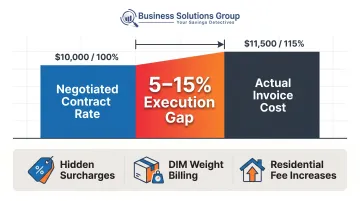
The shippers who capture that leverage are the ones who arrive with data. Those who don't face what analysts call the "Execution Gap"—an average 5–15% difference between negotiated rates and what actually appears on invoices. The five strategies below are designed to close that gap.
5 Proven Strategies for Carrier Contract Optimization in 2026
Strategy 1: Build a Complete Shipping Profile Before You Negotiate
Negotiation leverage starts with knowing your own shipping behavior in granular detail. Carriers have sophisticated pricing models and years of transaction data on your account. Walking in without equivalent data puts you at an immediate disadvantage.
The 12–18 month data set you need:
- Total parcel volume by month and season (reveals your peak-to-trough ratio)
- Service level mix: Ground, 2-Day, Overnight percentages
- Average package weight and dimensions by service type
- Destination zone distribution (zones 2–8 spread)
- Accessorial charges triggered and their frequency
This data serves two purposes. First, it shows you where your actual costs are concentrated. Second, it creates a "shipper narrative" that positions your business as a desirable long-term partner—one with predictable volume, growth trajectory, and geographic patterns that complement carrier network capacity.
The 12–18 month lookback isn't arbitrary. Anything shorter gives carriers grounds to dismiss your data as unrepresentative, particularly if it doesn't capture seasonal variation. A single Q4 spike can look very different from your actual annual profile.
Business Solutions Group builds this shipping profile as the first step in every advisory engagement—running detailed analysis of parcel invoice data to establish a precise baseline before any negotiation strategy is developed.
Strategy 2: Audit Accessorial Charges and Surcharges First
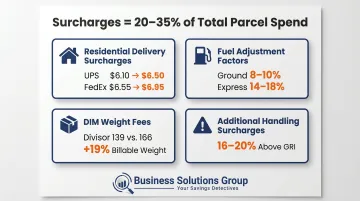
This is the highest-impact strategy most businesses skip. Accessorial charges and surcharges represent **20–35% of total parcel shipping spend** according to multiple industry analyses—yet they receive almost no scrutiny during standard contract negotiations.
The charges accumulate quietly. Residential delivery fees, fuel surcharge adjustments, DIM weight billing, address corrections, delivery area surcharges—each one looks small in isolation. Together they can represent a larger cost driver than the base rate itself.
The surcharges to audit first:
- Residential delivery surcharges – Critical for B2C shippers. UPS and FedEx both increased these for 2026, and rural/remote ZIP code expansions can shift a package from a $4.90 charge to $14.15+ overnight
- Fuel adjustment factors – Ground surcharges currently run around 8–10% of base rates; Express surcharges reach 14–18%. These adjust weekly and compound across high-volume accounts
- DIM weight fees – Both carriers use a divisor of 139 for contracted shippers. A switch from a 166 divisor (retail) to 139 increases billable weight by approximately 19% on the same package
- Additional handling surcharges – Triggered by dimension and weight thresholds, these have historically increased 16–20% above headline GRI rates
How to negotiate accessorials specifically:
- Request caps on specific surcharge categories as a percentage of base transportation
- Negotiate GRI escalator limits on accessorials—without written caps, carriers can raise surcharges independently of the headline GRI
- Seek waivers on certain fees given volume levels
- Build 60-day advance notification requirements into contract language for any off-cycle adjustments
BSG's audits consistently flag delivery area surcharges and additional handling fees as the highest-impact savings categories—areas where charges have been silently increasing well beyond what shippers realize.
Strategy 3: Use Benchmark Data to Negotiate from Strength
Most shippers enter negotiations without knowing whether their current rates are above or below market. That gap eliminates the ability to push back effectively. Carriers build pricing models based on what individual shippers will accept—and without external benchmarks, there's no way to know whether you're being offered a competitive deal or just a slightly better version of an overpriced one.
UPS and FedEx account managers have authority to offer discounts ranging from 10% to 70% off published rates depending on volume and profile. That range is wide enough to mean almost anything—which is exactly why shipper-specific benchmarking matters.
Effective benchmarking compares your current base rates, discount tiers, and accessorial fee structures against market data for shippers with a similar profile: comparable volume, service mix, and zone distribution. Generic rate comparisons don't work. A mid-size e-commerce shipper concentrated in zones 5–8 with high residential delivery rates requires a benchmark built on equivalent shipping characteristics.
Business Solutions Group's proprietary spend intelligence platform addresses this directly. It draws on visibility into thousands of pricing agreements to identify what discounts are achievable for shippers at your volume and profile—down to one-tenth of a percent.
BSG's advisory team includes former UPS and FedEx senior pricing analysts who understand how carriers structure offers and where discount room actually exists. The typical result: parcel savings averaging 23.6% across current engagements, with a range of 15–40% depending on starting position and shipping profile.
Strategy 4: Negotiate Contract Structure, Not Just Rates
A low base rate secured today can erode within 12 months if the contract structure doesn't protect it. This is where most shippers leave the most money on the table—they negotiate the number they can see and ignore the clauses that govern what happens next.
Structural provisions that determine long-term cost outcomes:
- Volume variance clauses – "Handcuff clauses" penalize shippers for falling below revenue tiers. Negotiate 12-month grace periods and tiered protections rather than hard minimums
- GRI escalator caps – Without written limits, carriers can raise accessorials independently of the headline GRI. Negotiate caps tied to a fixed annual percentage
- Mid-term review rights – Require carrier notification 60 days before any off-cycle rate adjustments
- Auto-renewal opt-out windows – Missed cancellation windows surrender negotiating leverage without warning. Get explicit opt-out dates in writing
- Service guarantee retention – Money-back guarantee waivers are sometimes offered in exchange for rate discounts. Evaluate this trade carefully; service guarantees provide financial credit for late deliveries that adds up over time
- Peak season capacity protections – Secure shipment priority commitments during Q4 in the contract, not as a verbal assurance
In practice, a shipper who secures a 50% discount but accepts uncapped accessorial escalators, waives the money-back guarantee, and misses the auto-renewal window will often pay more over the contract term than one who secured a 40% discount with robust structural protections.
Strategy 5: Treat Carrier Contract Optimization as a Continuous Process
The most expensive contract mistake isn't a bad negotiation—it's a good negotiation that gets ignored afterward. New surcharges appear mid-contract. Volume tiers shift. Billing errors accumulate. Discounts that should apply stop applying. None of these generate an alert.
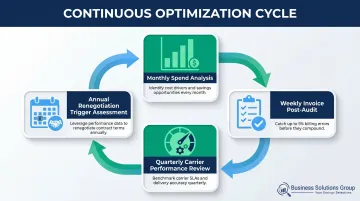
What continuous optimization looks like in practice:
- Monthly spend analysis – Track cost trends by service type and accessorial category to catch shifts before they compound
- Weekly post-audit of shipments – Verify that contracted rates are being applied correctly; up to 5% of UPS and FedEx parcel invoices contain billing errors
- Quarterly carrier performance reviews – Measure on-time delivery rates against contracted SLAs by zone and service type. During the 2025 peak season, UPS achieved 97.2% on-time delivery vs. FedEx Express at 95.3%—performance gaps that should inform SLA penalty thresholds
- Annual renegotiation trigger assessment – If you haven't optimized carrier agreements in the last 18 months, have grown significantly, or are approaching your MARC (minimum annual revenue commitment), it's time to re-engage
Transportation Insight research shows that 3–6% of freight invoices contain billing errors, with 1–5% of total freight spend recoverable through consistent audit processes. At scale, that's a meaningful cost recovery that requires no renegotiation—just attention.
Business Solutions Group's end-to-end supply chain optimization service handles this monitoring continuously: weekly invoice audits, monthly savings reports, quarterly performance reviews, and ongoing identification of contract improvement opportunities.
For businesses without the internal bandwidth to track these KPIs consistently, working with a logistics optimization partner converts contract management from a reactive task into a reliable savings mechanism.
Common Mistakes That Undermine Carrier Contract Optimization
Shippers who negotiate regularly still leave money on the table — usually because of the same three missteps:
Volume overcommitment is the first trap. Locking in hard guarantees based on optimistic growth forecasts creates financial penalties when reality falls short. Tiered volume structures with upside incentives are a safer bet than minimums that punish you during slower quarters.
Timing the negotiation wrong costs shippers just as much. Renegotiating during Q4 peak season — when carriers are at capacity and have zero incentive to concede — consistently produces inferior outcomes. Start renegotiations 6–9 months before contract expiration. Waiting until 30 days out hands carriers all the leverage; they know you can't realistically switch providers on short notice.
Fixating on base rate discounts while ignoring everything else rounds out the list. Money-back guarantee waivers, vague dispute resolution procedures, and punishing early termination clauses can erode savings faster than any rate cut recovers them. Read the full contract — not just the rate schedules.
Measuring and Managing Contract Performance After Signing
Contracts deliver savings on paper. Whether those savings show up in your financials depends on how consistently you track performance.
KPIs to establish and monitor consistently:
- Average cost per package by service type
- On-time delivery rate by carrier and zone
- Accessorial spend as a percentage of total shipping cost
- Billing accuracy rate (target: below 2% error rate)
- Volume tracking against committed tiers
Documentation matters as much as tracking. Log every late delivery, damage incident, and SLA violation throughout the contract term. That record becomes your evidence base at renewal — and the leverage you need to push for stronger penalty provisions or service guarantee improvements.
Frequently Asked Questions
How do you negotiate your rates with carriers?
Effective carrier rate negotiation starts with 12–18 months of shipping data and external benchmark comparisons. Arrive with specific targets for base rates, accessorial caps, and service guarantees—not just a general request for a discount. Carriers move on specifics, not generalities.
How do you measure contract performance?
Track on-time delivery rates, average cost per package, accessorial spend as a percentage of total shipping cost, billing accuracy, and volume against committed tiers. Monthly monitoring catches cost drift before it becomes significant.
What is shipping optimization?
Shipping optimization is the ongoing process of reducing total transportation costs and improving service outcomes. It involves analyzing shipping data, renegotiating carrier contracts, auditing invoices, and selecting the most cost-effective service level for each shipment type.
What is carrier contract management?
Carrier contract management is the end-to-end process of negotiating, executing, monitoring, and renewing agreements with shipping carriers—covering base rates, accessorial fees, service commitments, and compliance tracking throughout the contract's lifecycle.
What are the four pillars of contract management?
The four core pillars are: contract creation and negotiation, contract execution and compliance, performance monitoring and reporting, and contract renewal or renegotiation. Each one applies directly to how carrier agreements are managed day to day.
What are the three types of agreements?
Parcel contracts cover small packages via integrated networks like UPS and FedEx. Freight contracts cover LTL and FTL shipments for larger loads. Hybrid agreements combine both approaches to optimize costs across different shipment types and volumes.