Introduction
Picture this: a freight shipper finishes a solid quarter, then discovers their finance team has been paying a carrier 18% above the negotiated rate for eight months. The reason? A renegotiated rate was never loaded into the TMS, the old contract auto-renewed quietly, and nobody caught it until a routine audit.
That's not a one-off mistake. As EasyPost put it bluntly: "Most teams that overpay on shipping aren't actively making bad decisions. They're living with old ones."
In 2026, those old decisions are getting more expensive. Freight rates are swinging harder than they have in years — DAT data shows spot van rates were nearly 9% higher year-over-year in December 2025 — while carrier margins are tightening and compliance requirements are multiplying. Reactive contract management isn't just inefficient anymore. It's a direct drain on margin.
This article breaks down what freight contract management actually involves, why 2026 has raised the stakes, the five stages every shipper needs to master, and where the hidden costs are hiding.
Key Takeaways
- Contract leakage — the gap between negotiated rates and what's actually paid — costs organizations an average of 11% of contract value
- Spot truckload rates climbed nearly 9% YoY in late 2025; static contracts leave shippers exposed
- Freight contract management is a continuous cycle — skipping any stage compounds cost exposure over time
- Between 3–6% of freight invoices contain billing errors that go undetected without active auditing
- Spend intelligence and benchmark analysis pinpoint where you're overpaying — faster and more accurately than manual rate reviews
What Is Freight Contract Management?
Freight contract management is the end-to-end process of negotiating, executing, monitoring, and renewing agreements between shippers and carriers. It covers rates, service levels, performance obligations, accessorial charges, and compliance terms.
The critical word is active. Most companies treat a signed freight contract like a filing task — it gets stored and forgotten. That inaction is what turns a well-negotiated rate into an enforced one.
The Common Contract Types
Most businesses use a combination of:
- Spot rate agreements — priced per shipment at current market rates; flexible but typically higher cost
- Truckload/LTL volume contracts — negotiated rates locked in for a defined period (usually 12 months) in exchange for volume commitments
- Dedicated fleet contracts — capacity reserved exclusively for a shipper's lanes
- Broker-carrier agreements — covering third-party intermediary relationships, each with their own rate and compliance terms
Managing one contract type is straightforward. Managing a mix of all four across dozens of carriers is where most organizations lose control.
The Contract Leakage Problem
Contract leakage is the gap between what was negotiated and what's actually paid or enforced. According to WorldCC research, organizations lose an average of 11% of contract value post-signature — and most don't formally track these losses.
McKinsey puts procurement value leakage at 2% to 4% of total spend. For a company moving $10 million in freight annually, that's $200,000 to $400,000 walking out the door each year. The culprit isn't poor negotiation. It's contracts that were signed and never actively managed.
Why 2026 Demands Better Freight Contract Management
Rate Volatility Has Reaccelerated
The "Great Freight Recession" — the most prolonged freight downturn in history — officially ended in late 2024. Since then, the market has tightened fast. Spot rates climbed toward $2.80 per mile heading into 2026, and carriers have regained leverage, with tender rejections rising meaningfully as they selectively decline loads.
For shippers locked into last year's rates without active monitoring, two risks emerge at once: overpaying on lanes where rates softened, and losing windows to lock in favorable terms before they close.
Compliance Requirements Are Multiplying
Freight contracts can no longer be just rate sheets. They now need to address:
- Driver wage and hours-of-service regulations under FMCSA requirements
- Carbon emissions tracking — the SEC's 2024 climate disclosure rule requires publicly traded shippers to report Scope 3 supply chain emissions
- Zero-emission vehicle mandates — California's Advanced Clean Trucks regulation requires manufacturers to sell increasing percentages of ZEV trucks through 2035, which is already reshaping fleet decisions and contract terms for California-bound freight
- EPA greenhouse gas reporting — deadlines extended to October 2026, but the obligation exists
Contracts that don't address these obligations create compliance exposure that shows up as fines, delayed shipments, or legal liability.
Margin Pressure Makes This a Profit Issue
Rate volatility and compliance pressure both hit the bottom line directly. ATRI's 2025 report on 2024 trucking data found the truckload sector averaged -2.3% operating margins, while non-fuel operating costs hit a record $1.779 per mile. With carriers under that kind of financial strain, contract terms — accessorials, fuel surcharges, minimum charges — become negotiating battlegrounds.
Shippers who can't demonstrate performance data or market benchmarks walk into renewals blind.
The 5 Stages of Freight Contract Management
The freight contract lifecycle is a continuous loop — but most shippers treat it as a one-time event. That disconnect is where value quietly leaks out.
Stage 1: Contract Negotiation
Effective negotiation requires more than asking for a lower rate. Walk in with:
- Market benchmarks — what similar shippers on similar lanes are actually paying
- Historical shipment data — 12–18 months of volume, mix, and spend
- Defined KPIs — on-time delivery targets, load acceptance rates, damage thresholds
Avoid the RFP trap: selecting carriers purely on price almost always produces service failures that cost more than the savings. Carrier reliability data belongs in the scorecard alongside rate.
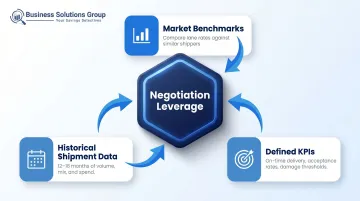
Business Solutions Group's negotiation team includes former UPS and FedEx senior-level pricing analysts. That institutional knowledge informs how BSG benchmarks client rates across thousands of pricing agreements before a single discussion begins.
Stage 2: Contract Creation and Standardization
A contract's enforceability depends entirely on how it's written. Dense legal paragraphs that nobody references are not contracts — they're liability documents.
Effective freight contracts should specify:
- Base rates and discount structures by lane and mode
- Accessorial fees (liftgate, detention, fuel surcharges) with clear definitions and caps
- SLA thresholds with measurable, documented metrics
- Renewal conditions and notice periods — explicitly, not by default
Without structured, auditable terms, disputed invoices go unresolved and SLA violations go unenforced — because there's no clear standard to reference.
Stage 3: Implementation and Operational Integration
This is the most common failure point. Procurement negotiates a rate. Operations books shipments using whatever's in the TMS. Finance pays invoices without validating against what was agreed.
The negotiated rate sits in a PDF while the actual payments flow at the old rate.
A contract's value is zero if it's disconnected from day-to-day operations. Negotiated terms must be loaded into the TMS and ERP before any shipment moves. BSG's TMS solutions include post-shipment audit capabilities that automatically verify invoices against contracted rates, catching discrepancies in real time rather than surfacing them months later during reconciliation.
Stage 4: Performance Monitoring and KPI Tracking
Contracted KPIs mean nothing if they're reviewed quarterly. By then, you've already absorbed the damage.
Real-time carrier scorecarding tracks:
- On-time delivery rate vs. contracted SLA thresholds
- Load acceptance rate and tender rejection frequency
- Damage claims rate and resolution speed
- Accessorial charge frequency and variance
This data serves two purposes: accountability in real time, and leverage at renewal. Shippers who can show a carrier's documented performance history negotiate from strength. Those who can't are guessing.
Stage 5: Renewal and Optimization
Most freight contracts auto-renew silently. That's not a neutral outcome — it's a decision to accept last year's terms in a market that has moved.
A proactive renewal process includes:
- Start 90–120 days before expiration — earlier than most teams think necessary
- Benchmark current rates against the market using fresh lane and mode data
- Pull 12–18 months of performance data to document carrier delivery against SLAs
- Identify accessorial drift — charges that crept up without formal renegotiation
- Enter discussions with documented leverage, not goodwill assumptions
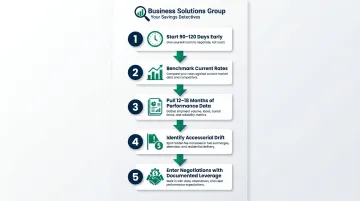
Continuous optimization means contracts evolve with your business. BSG's approach includes ongoing review and contract addendums to capture additional savings as shipping environments change.
The Hidden Cost of Poor Freight Contract Management
Invoice Errors Add Up Fast
Transportation Insight's 2025 analysis found that 3 to 6% of freight invoices contain billing errors — driven by misapplied discounts, incorrect accessorials, and complex fuel surcharge structures. Diligent freight audit can recover 1 to 5% of total freight spend, with additional savings from improved visibility.
Shippers also lose as much as 20% of accounts payable staff time resolving invoice disputes — a cost that rarely appears in freight spend analysis but is very real.
Uncollected SLA Credits
Most freight contracts include service credit provisions for late deliveries and damage. Most shippers never collect them. The claims process is documentation-heavy, performance data isn't tracked in real time, and the effort-to-recovery ratio discourages follow-through.
These credits exist in the contract — they just go unclaimed at every billing cycle.
Compliance Penalties Are Not Hypothetical
Under the FMCSA's 2025 civil penalty schedule, general non-recordkeeping violations of federal motor carrier safety regulations can reach $19,246 per violation. Recordkeeping failures run up to $1,584 per day. For shippers whose contracts don't actively track:
- Driver compliance obligations
- Certificate of insurance currency
- Emissions reporting requirements
...these are live exposures, not hypothetical ones.
The Silo Problem
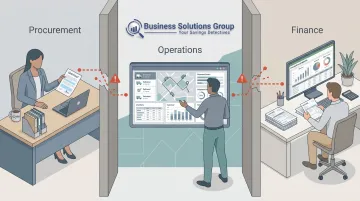
Three teams touch every freight contract — and none of them share the same data:
- Procurement negotiates the rates and terms
- Operations books the shipments
- Finance pays the invoices
Each works from its own slice of the picture. That disconnect is structural, and it's exactly what compliance failures and billing errors hide inside. Closing it takes more than communication — it requires a unified process built on shared contract data. Every carrier added to the network widens the gap.
Best Practices for Smarter Freight Contract Management
Centralize Contracts as Structured Data
Every freight agreement — rates, SLAs, accessorials, compliance obligations, renewal dates — should live in one searchable system with version control and audit trails. Shared drive folders and crowded inboxes don't cut it.
When contract terms live in structured data, they can be queried, monitored, and enforced automatically rather than manually interpreted when a dispute arises.
Build a Regular Review Cadence
A quarterly freight contract review should cover:
- Verify base rates and discounts are being applied correctly at the invoice level
- Accessorial charges — flag categories drifting above contracted levels (fuel, liftgate, and detention are the most common culprits)
- Compare carrier performance against SLA commitments using documented data, not anecdotal reports
- Check compliance gaps: expired certificates and unmet reporting obligations
- Benchmark current contracted rates against market to confirm they're still competitive
Reveel Group's carrier contract management research notes that accessorial charges can account for over 60% of total shipping spend — making them the highest-priority review item, not an afterthought.
Automate Where Possible
Catching accessorial drift and SLA breaches through manual review is only realistic up to a point. For shippers managing 10 or more carrier agreements, tracking renewals, validating invoices, and monitoring performance by hand quickly becomes unmanageable.
Key automation priorities:
- Invoice validation against contracted rates (catches errors before payment, not after)
- Renewal alerts triggered 90–120 days before expiration
- SLA breach notifications when carrier performance drops below contracted thresholds
- Accessorial variance flagging when charges fall outside contracted parameters
How Spend Intelligence and Benchmark Analysis Give You the Negotiating Edge
Most shippers walk into carrier negotiations without knowing whether the rate on the table is competitive. That information asymmetry costs money.
Spend intelligence tools aggregate actual shipment cost data and compare it against market benchmarks — by lane, mode, volume tier, and carrier. The output is concrete, comparable data — the kind that shifts a negotiation from back-and-forth to evidence-based.
What Benchmark Analysis Reveals
- Overpaid lanes — specific origin-destination pairs where contracted rates are above market
- Underutilized volume discounts — thresholds you're close to hitting but not capturing
- Accessorial drift — charges that have quietly increased across successive renewals without formal renegotiation
- Carrier pricing divergence — carriers whose rates have moved above market while contracts sat static
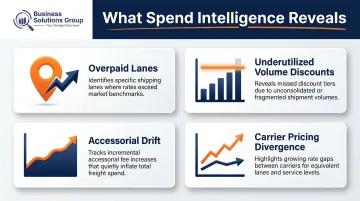
Armed with this data, shippers enter renewal negotiations with documented proof rather than gut instinct — and that changes the dynamic.
Business Solutions Group uses proprietary spend intelligence software to surface exactly these patterns. BSG benchmarks client rates against thousands of active pricing agreements — comparing by company size, industry, and volume — so clients know precisely where they stand relative to market.
Clients who go through the analysis identify savings ranging from 15% to 40%, with an average of 23.6%. The initial benchmark assessment is provided at no cost, with no commitment required.
For freight and LTL specifically, the analysis includes a full review of carrier mix, pricing agreements, freight classification accuracy, and accessorial structures — producing a financial baseline that shows exactly where money is being lost and what a market-appropriate contract should look like.
The engagement model is performance-based: BSG is compensated on verified savings generated, which means their incentive and the client's incentive are the same.
Frequently Asked Questions
What is contract management in logistics?
Contract management in logistics is the process of overseeing freight agreements with carriers across their full lifecycle — from negotiation and execution through performance monitoring and renewal. The goal is to ensure rates, service levels, and compliance obligations are consistently enforced, not just agreed to at signing.
What are the 5 steps of contract management?
The five core stages are: negotiation, contract creation and standardization, implementation and operational integration, performance monitoring, and renewal and optimization. The process is cyclical: renewal feeds directly back into negotiation for the next contract period.
What is the difference between spot freight and contract freight?
Spot freight is priced per shipment at current market rates, offering flexibility at higher cost. Contract freight locks in negotiated rates for a defined period (typically 12 months) in exchange for volume commitments. Most shippers use a combination of both, with approximately 75% of US truckload volume moving under contract arrangements.
What are the benefits of contract management?
The core benefits are cost control through enforced negotiated rates, improved service quality through SLA tracking, reduced compliance risk, and stronger carrier relationships built on documented performance data rather than assumptions.
What is CLM in logistics?
CLM (Contract Lifecycle Management) in logistics refers to using technology platforms to manage freight contracts across their entire lifecycle. It replaces manual, spreadsheet-based processes with structured data management, automated monitoring, and workflows that connect contract terms to operational execution.
What are the benefits of digital contracts?
Digital freight contracts provide real-time access and version control, automated invoice validation, faster renewals, audit trails for compliance, and direct integration with TMS and ERP systems. That last point matters most — it eliminates the gap between what was negotiated and what's applied at the point of booking.