Introduction
Warehouse managers are caught between forces pulling in opposite directions. E-commerce accounted for 56% of all U.S. retail goods sales growth in 2024, growing 8% year-over-year while in-store sales crawled at 1.8%. At the same time, industrial asking rents hit $10.20 per square foot in Q1 2026 — and every underutilized square foot is money left on the table.
Space costs are only part of the equation. Labor accounts for roughly 65% of total warehouse operating costs, and inefficient workflows can push that figure 30% higher. With margins this tight, the warehouses pulling ahead are the ones squeezing more throughput out of what they already have.
This article covers five practical strategies to close that gap — from layout and inventory decisions to technology, standardization, and workforce development. The tactics work independently, but stacking them is where the real cost savings compound.
Key Takeaways
- Layout first: Poor slotting and traffic flow waste 50%+ of pickers' time in unnecessary travel.
- Inventory accuracy matters more than volume: Inaccurate records cost the industry $1.77 trillion annually — cycle counting fixes this without shutting down operations.
- Technology accelerates what good process creates: WMS, RFID, and AMRs reduce errors and lift throughput, but only when built on solid operational foundations.
- KPIs without benchmarks are just numbers: Measure order accuracy, on-time shipment, and cost per order against industry standards.
- Turnover kills efficiency: At 37% annually, warehouse staff churn erases training investments. Structured incentives and cross-training protect your gains.
Strategy 1: Rethink Your Warehouse Layout and Space Utilization
Order picking represents up to 55–60% of total warehouse operating costs. Of that, travel time alone consumes more than half of every picker's shift. That means a substantial portion of your labor budget goes toward walking, not working. Layout is the root cause.
Slotting: Where the Quick Wins Are
Slotting optimization — placing the right products in the right locations — can increase picking productivity by 15–25% without adding headcount or square footage.
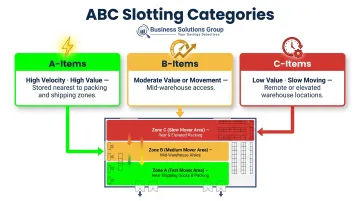
- A-category items (high velocity, high value) belong closest to packing and shipping
- Frequently co-picked items should be grouped together to reduce multi-zone trips
- C-category items can sit in remote or overhead locations with minimal access penalty
- Review slotting at minimum annually, seasonally for demand-driven industries
Use Vertical Space Before Expanding Horizontally
Most warehouses operate at 70–85% capacity utilization. Best-in-class facilities push closer to 90%. The gap is usually vertical: underused racking height, unstacked bins, and floor-level storage that could be elevated.
Tall racking systems, stackable containers, and automated vertical carousels can significantly increase capacity within the same footprint — a critical advantage when industrial rents are rising 2.1% year-over-year.
Design aisle flow to match the product journey: receiving → storage → picking → packing → shipping. Cross-traffic and backtracking are layout problems that compound every single shift.
Sustaining Layout Gains With 5S
Even a well-optimized layout deteriorates without a maintenance framework in place. The 5S methodology (Sort, Set in Order, Shine, Standardize, Sustain) addresses this directly. Originating from Japanese lean manufacturing, it creates a workspace that stays clean, organized, and safe over time — not just after a one-time reorganization.
Business Solutions Group works with operations teams to assess facility layout, racking strategy, and space utilization as part of broader supply chain optimization engagements.
Strategy 2: Master Inventory Management With Smarter Practices
Global inventory distortion costs an estimated $1.77 trillion annually, with stockouts alone accounting for $1.2 trillion of that figure. Inaccurate records don't just cause missed sales — they generate wasted labor, emergency replenishment costs, and excess safety stock that inflates carrying costs by 20–30% of average inventory value per year.
ABC Analysis: Let Velocity Drive Storage Decisions
ABC analysis classifies inventory by value and movement rate:
| Category | Characteristics | Storage Location |
|---|---|---|
| A-items | High value, high velocity | Near pick and ship zones |
| B-items | Moderate value or movement | Mid-warehouse access |
| C-items | Low value, slow moving | Remote or elevated locations |
This isn't a one-time exercise. Velocity patterns shift with seasons, promotions, and market changes — categories should be re-evaluated at least quarterly for fast-moving operations. That same visibility into movement patterns makes inventory accuracy the next critical lever to pull.
Cycle Counting Over Annual Physical Inventory
Annual physical inventory counts shut down operations, introduce stress-driven errors, and only catch problems once a year. Cycle counting — counting subsets of inventory on a rolling schedule — catches discrepancies early while the warehouse keeps running. Top-performing operations achieve 99.888% inventory accuracy through consistent cycle counting programs. The target range for most facilities is 98–99.9%.
Forecasting and Lean Replenishment
Demand forecasting using historical sales data, seasonal trends, and supplier lead times prevents two costly outcomes:
- Emergency replenishment orders that carry premium freight costs and disrupt supplier relationships
- Bloated safety stock that ties up working capital and inflates carrying costs
Lean inventory principles (smaller, more frequent replenishment rather than bulk ordering) reduce carrying costs while keeping cash flow flexible. For operations struggling to put these forecasting practices into place, Business Solutions Group's Demand & Inventory Planning software integrates with existing ERP systems and supports SKU velocity analysis and slotting strategy across locations.
Strategy 3: Leverage Technology and Automation
85% of supply chain organizations expect to adopt AI technologies within five years, and 55% are already increasing technology investment in supply chain operations. Manual, paper-based processes at scale introduce delays and picking errors that compound across every order.
The WMS as Operational Foundation
A Warehouse Management System (WMS) is the operational nerve center that makes everything else more effective. Key capabilities to evaluate:
- Real-time inventory visibility across all locations
- Automated pick-path optimization that reduces travel time
- Task interleaving to assign workers efficiently across multiple activities
- ERP integration to eliminate data re-entry and sync orders, receiving, and billing
These capabilities only deliver full value when the underlying data is unified. Business Solutions Group's Business Performance platform connects WMS, ERP, and supply chain data into consolidated dashboards, replacing the fragmented spreadsheet reporting that undermines most WMS investments.
Tracking Technology That Reduces Errors
| Technology | Typical Accuracy Improvement | Notable Impact |
|---|---|---|
| Barcode scanning | 95–97% → 99.5%+ | Eliminates manual entry errors |
| RFID tagging | ~65% → 95%+ average | Cuts cycle count time by up to 75% |
| Voice-directed picking | Reduces error rate significantly | Hands-free, eyes-free operation |
| Pick-to-light systems | Reduces mispicks | Visual confirmation at each location |
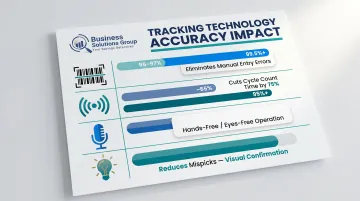
Across all four technologies above, each percentage point of accuracy improvement cuts error-related costs roughly in half. The ROI grows faster as accuracy climbs toward the upper thresholds.
Robotics: Targeted Automation Delivers Fast ROI
Over 450,000 logistics robots were sold globally in 2025, compared to 75,000 in 2019. Autonomous Mobile Robots (AMRs) and Automated Guided Vehicles (AGVs) handle repetitive transport tasks — moving goods between receiving, storage, and shipping — freeing workers for picking, packing, and quality checks.
Full automation isn't necessary to see returns. Common high-ROI starting points include:
- Inbound receiving lanes where AGVs move pallets from dock to putaway
- High-velocity pick zones where AMRs reduce worker travel between picks
- Outbound staging areas that bottleneck packing throughput
Targeting a single zone often delivers measurable payback within 12–18 months.
Strategy 4: Standardize Processes and Track the Right KPIs
Without documented Standard Operating Procedures, even a well-designed warehouse degrades over time. Different workers execute the same task differently. Training takes longer. Audits become guesswork. SOPs solve this by creating a consistent, repeatable baseline — which is also what makes KPI tracking meaningful.
The KPIs That Signal Operational Health
Not every metric deserves equal attention. These five cut to the core of warehouse performance:
- Order accuracy rate — Target: 99.5–99.9%. Tracks picking and fulfillment precision; errors here cascade into returns, reshipments, and customer losses
- On-time shipment rate — Target: 97–99%. Top 20% of operations hit 99.5%+
- Inventory turnover — Target: 4–8 turns annually. Low turnover signals overstock and carrying cost drag
- Receiving cycle time (dock-to-stock) — Target: under 3.5 hours for best-in-class operations
- Cost per order shipped — Tracks total fulfillment cost efficiency; rising cost per order signals process or labor inefficiency
Benchmarking Turns Numbers Into Action
Tracking KPIs internally is only half the equation. Without external benchmarks, a 97% on-time rate might look strong — until you learn the top 20% of operations sustain 99.5%+. That gap, multiplied across thousands of orders, is the difference between a competitive operation and one slowly losing margin.
Closing that gap requires knowing exactly where you stand. Business Solutions Group works with warehouse operators to benchmark performance against industry standards, pinpoint where inefficiencies are eroding margin, and rank improvement opportunities by ROI. The process starts with a no-cost exploratory phase, includes on-site operational review, and produces analysis specific enough to guide real decisions — not just general recommendations.
Strategy 5: Develop and Retain a High-Performing Warehouse Team
Technology and layout improvements only deliver results when the people executing them are skilled, consistent, and engaged. Warehouse staff turnover averages 37% annually — far above any other industry benchmark. Every departing worker takes training investment with them and resets the learning curve for whoever follows.
Training That Sticks
40% of poorly trained workers leave within their first year. Structured training programs address this directly:
- Onboarding covers equipment certification, safety protocols, and workflow training before workers touch live inventory
- Refresher training rolls out whenever processes change, not just for new hires
- Cross-training builds workers who can cover multiple roles, creating flexibility during absences and peak periods — reducing costly overtime and temp labor
Gamification and Incentives That Move the Needle
A Wakefield Research study of 750 warehouse workers found that 84% are more likely to stay with employers who offer workplace competitions, and 90% report gamification makes them more productive. Implementations that work:
- Leaderboards tied to pick accuracy and order completion rates
- Team-based challenges that build collaboration alongside competition
- Cash bonuses or recognition tied to KPI milestones
- Visible daily performance metrics — 88% of workers are comfortable with this transparency
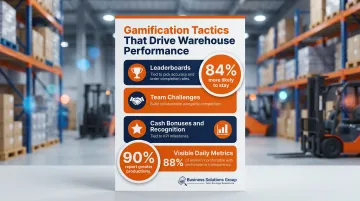
Incentives work best when tied directly to the KPIs the operation already tracks. Without underlying process standards, gamification can push speed over accuracy — which most warehouses can't afford. Align the competition to what actually matters, and engagement becomes a performance multiplier.
Frequently Asked Questions
How to improve warehouse operations?
Start with an operational audit to identify where time, space, and accuracy are being lost. Then address layout, inventory practices, technology, SOPs, and workforce systematically. Small, sustained improvements across each area compound into significant cost and efficiency gains over time.
What are the five key performance indicators in a warehouse?
The five most critical KPIs are order accuracy rate, on-time shipment rate, inventory turnover ratio, receiving cycle time (dock-to-stock), and cost per order shipped. Tracking these consistently against industry benchmarks drives data-driven decisions — not guesswork.
What is the 5S rule in warehousing?
5S stands for Sort, Set in Order, Shine, Standardize, and Sustain. It's a workplace organization framework that keeps your warehouse clean, orderly, and safe — so efficiency gains hold long after the initial redesign.
What are SOPs for warehouse operations?
Standard Operating Procedures are documented, step-by-step instructions for warehouse tasks such as receiving, putaway, picking, and shipping. They reduce errors, accelerate new hire training, and ensure consistent execution across shifts and team members.
What is continuous improvement in a warehouse?
Continuous improvement is an ongoing cycle of measuring performance, identifying waste, implementing changes, and re-evaluating results. In practice, this means quarterly slotting reviews, monthly KPI check-ins, and SOP updates driven by operational data — not just annual overhauls.