Introduction
Logistics capacity mismatches cost businesses in two directions simultaneously. Overcapacity means paying for idle trucks, empty warehouse space, and underutilized staff — a single idle truck costs carriers $500 to $1,000 per day, since 60–70% of fleet costs are fixed regardless of miles driven. Undercapacity pushes shippers onto the spot market, where rates swing unpredictably with demand — and spot truckload prices have historically run 15–25% above contracted rates during peak disruptions.
Both extremes erode margins. Closing that gap requires a deliberate planning process, not faster reactions to the latest disruption.
This guide covers what logistics managers, supply chain directors, and parcel and freight shippers need to build a working capacity plan:
- Core definitions and the three capacity dimensions
- Lead, lag, and match strategies
- A step-by-step planning process
- Best practices that reduce costs without sacrificing service
Key Takeaways
- Logistics capacity planning continuously aligns fleet, warehouse, and labor resources with forecasted shipment demand — not as an annual exercise, but as an ongoing operational discipline
- Three dimensions require planning: warehouse throughput, transportation/fleet, and labor/equipment
- Lead, lag, and match strategies each suit different demand conditions — most operations benefit from blending all three
- Demand forecast accuracy is the foundation — errors compound across every downstream planning step
- KPIs like OTIF, warehouse utilization, and cost per shipment must be tracked together, not in isolation
What Is Logistics Capacity Planning?
Logistics capacity planning is the process of aligning available resources — fleet, warehouse space, and labor — with current and forecasted shipment demand. The goal is simple: avoid costly bottlenecks without paying for capacity you don't need.
What separates effective capacity planning from reactive firefighting is consistency. The 2026 freight market has been defined by volatility, pushing shippers to build operations that can shift routes, carriers, and modes without dismantling their entire strategy. That requires an ongoing discipline, not a one-time project.
Capacity Planning vs. Resource Planning
These two terms get conflated constantly, but the distinction matters:
- Resource planning is tactical — allocating existing assets to current tasks efficiently
- Capacity planning is strategic — determining whether sufficient resources will exist to meet future demand
Both are necessary. A logistics team doing resource planning without capacity planning will always be reacting to problems rather than preventing them. A team doing capacity planning without resource planning will have a solid strategy and poor execution.
Design Capacity, Effective Capacity, and Actual Output
Every logistics operation runs across three performance tiers:
| Level | Definition | Example |
|---|---|---|
| Design Capacity | Theoretical maximum under ideal conditions | A warehouse handling 500 pallets/hour at full staffing |
| Effective Capacity | Realistic output accounting for maintenance, weather, variability | Same facility averaging 420 pallets/hour in practice |
| Actual Output | Day-to-day performance achieved | 380 pallets/hour once delays and errors are factored in |
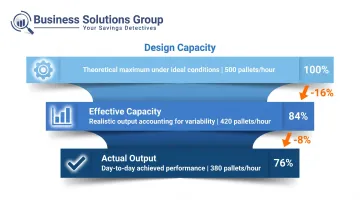
Best-in-class warehouse operations target approximately 90% average capacity utilization, per the 2025 WERC DC Measures Report. Closing that gap between effective and actual output is the central objective of capacity management — and for most operations, it's also the biggest source of unrecovered cost.
The Three Types of Capacity in Logistics
Logistics capacity spans three distinct dimensions — warehouse space, transportation, and labor — and a constraint in any one of them will drag down the other two, regardless of how well those look individually.
Warehouse Capacity
Warehouse capacity is about both space and flow. A facility can show 70% space utilization and still face serious throughput constraints due to poor layout, slow-moving cargo, delayed documentation, or inbound/outbound scheduling conflicts.
Travel time alone accounts for up to 50% of total order picking time — the clearest indicator of layout inefficiency. Inefficient warehouse operations can erode profits by 20–25%.
Key factors shaping effective warehouse capacity:
- Rack design and vertical space utilization
- Labor availability relative to scheduled volume
- Inbound/outbound dock scheduling
- Temporary storage solutions during peak periods
- Handling equipment speed and reliability
Transportation and Fleet Capacity
A fully deployed fleet can still represent reduced effective capacity. Trucks stuck at border crossings, loading docks, or congested corridors consume time without moving freight — and that drag doesn't show up in standard utilization reports.
Trucks move 72.7% of U.S. freight by weight and handle **85% of goods across the Mexican border** — meaning transportation capacity constraints ripple quickly across supply chains. Port congestion compounds this: peer-reviewed research confirms that port congestion has a significant positive effect on containership freight rates, driving up costs through fuel surcharges, vessel rerouting, and extended wait times.
Practical steps to manage fleet capacity:
- Lane-level capacity analysis to identify underperforming or overloaded routes
- Rebalancing fleet assets between high- and low-volume lanes seasonally
- Securing spot carriers or subcontractor relationships for short-term gaps
- Locking in contract capacity before anticipated peak periods
Labor and Equipment Capacity
Labor and equipment are where capacity plans most often break down in practice. A warehouse with open space and a full fleet still underperforms if staffing is short or a forklift is down — and both happen more often than most plans account for.
The numbers illustrate the stakes:
- 40% annual turnover in U.S. warehousing, with 70% of managers reporting hiring difficulties
- The truck driver shortage sits at approximately 60,000 drivers, projected to reach 175,000 by 2028
- Unplanned equipment downtime costs approximately $10,000 per hour; a typical forklift repair averages $5,000 with 8 hours of downtime
Preventive maintenance reduces this exposure — it costs 2 to 5 times less than reactive maintenance and results in 3.3 times less downtime. Cross-training staff across multiple logistics functions also helps absorb surges and short-staffing events — cross-trained teams typically deliver a 10–20% productivity increase when it matters most.
Logistics Capacity Planning Strategies: Lead, Lag, and Match
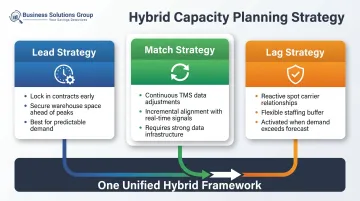
Three primary strategies govern how logistics operations respond to anticipated demand changes. The right choice depends on demand predictability, risk tolerance, and cost structure — and most mature operations blend elements of all three.
The Lead Strategy
The lead strategy means scaling up capacity before demand arrives — securing warehouse space, hiring drivers, or locking in carrier contracts ahead of peak season. It's the right call when your demand curve is predictable: seasonal surges, e-commerce holiday peaks, or confirmed contract wins give you enough lead time to negotiate from strength rather than desperation.
The downside is carrying idle capacity if projections fall short. That trade-off is acceptable when the cost of being caught unprepared — spot rates, service failures, lost accounts — outweighs the cost of moderate overcapacity.
The Lag Strategy
The match strategy tracks demand signals continuously and makes incremental capacity adjustments to stay aligned with actual conditions. In freight and parcel environments where TMS, WMS, and carrier portal data provide near-real-time visibility, this approach offers the best balance between cost control and service level. Strong data infrastructure is the prerequisite — and in most operations, it delivers measurable ROI once in place.
Most mature shippers don't choose a single strategy. Instead, they build a hybrid structure that draws on all three:
- Lock in contract capacity ahead of known peaks (lead)
- Maintain active spot carrier relationships as a reactive buffer (lag)
- Use TMS data to make ongoing incremental adjustments (match)
This combination protects service levels during surges without overcommitting resources when volume drops.
How to Create a Logistics Capacity Plan: Step-by-Step
Logistics capacity planning is a continuous cycle, not a one-time deliverable. Revisit it monthly or quarterly — conditions change faster than annual plans can accommodate.
Step 1: Forecast Demand
Build your demand forecast from multiple inputs:
- Historical shipment volumes by lane, SKU, or customer
- Seasonality patterns and known calendar events
- Customer-provided volume forecasts
- External factors: market trends, new contract wins, supply chain disruptions
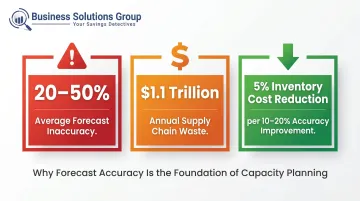
Forecast accuracy is the foundation — mistakes ripple through every downstream decision. The average company experiences 20–50% forecast inaccuracy (Gartner), contributing to an estimated $1.1 trillion in global supply chain waste annually. A 10–20% improvement in accuracy can trim inventory costs by approximately 5%.
Step 2: Assess Current Capacity
Evaluate actual versus effective capacity across all three dimensions:
- Warehouse: Space utilization, throughput rates, dock scheduling conflicts
- Fleet: Lane-level utilization, driver availability, contract coverage versus spot dependency
- Labor/Equipment: Headcount versus scheduled volumes, maintenance schedules, cross-training gaps
The goal of this step is uncovering real bottlenecks — not cataloguing theoretical maximums.
Step 3: Identify Gaps and Prioritize
Once you have both a demand forecast and a capacity baseline, the gaps become visible. Not all of them carry equal weight:
- Prioritize shortfalls in highest-volume and highest-margin lanes first
- Flag where excess capacity could be monetized — leasing unused warehouse space or offering carrier capacity to partner shippers
- Separate structural gaps (require investment) from seasonal gaps (require flexible arrangements)
Step 4: Select a Strategy and Allocate Resources
Match your strategy to the nature and timing of each gap:
- Lead gaps (predictable, high-volume): Lock in carrier contracts, arrange additional warehouse space, hire ahead of season
- Lag gaps (uncertain demand): Establish pre-qualified spot carrier relationships, maintain staffing flexibility
- Match gaps (ongoing fluctuation): Use TMS data to make continuous adjustments
Carrier contract negotiations are where this step pays off most visibly. Businesses that enter negotiations with clear volume forecasts and lane-level data can secure better rates, commit to realistic minimums, and avoid the accessorial charges that quietly inflate freight costs.
Data-driven negotiation consistently outperforms reactive approaches — parcel spend reductions of 20–40% and LTL savings of 20–25% are achievable when shippers bring structured analysis to the table rather than estimated volumes.
Step 5: Monitor KPIs and Adjust in Real Time
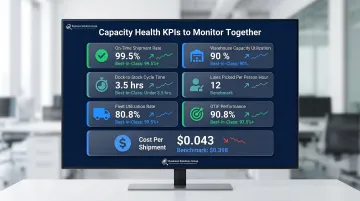
Establish metrics that reflect true capacity health. Based on the 2025 WERC DC Measures Report, the top operational metrics warehouse professionals track include:
- On-time shipment rate (best-in-class: 99.5%+)
- Average and peak warehouse capacity used
- Dock-to-stock cycle time (best-in-class: under 3.5 hours)
- Lines picked and shipped per person hour
- Overtime hours to total hours
Add fleet utilization rate, OTIF performance, cost per shipment, and carrier capacity fill rate to get a complete picture. No single metric tells the full story — monitor them together, and treat any sustained drift as the trigger for re-forecasting and re-allocation.
Logistics Capacity Planning Best Practices
Build Cross-Functional Alignment
Capacity planning fails when it's siloed. Operations, procurement, sales, and finance need to work from the same demand picture — because a sales team that oversells capacity the warehouse or fleet can't reliably support creates downstream failures that erode customer relationships.
Regular SIOP (Sales, Inventory, and Operations Planning) cadences synchronize capacity decisions across functions. When finance understands the cost implications of capacity decisions and sales understands the operational limits, planning becomes far more accurate and executable.
Move from Periodic Reviews to Continuous Monitoring
Organizations relying on quarterly spreadsheet reviews are structurally behind. By the time a quarterly review surfaces a capacity problem, the bottleneck has already affected service levels.
Integrating TMS, WMS, and ERP data into a unified planning model gives teams the ability to spot constraints early, model scenarios, and adjust strategies before service fails. A TMS alone typically saves 5–10% of total transportation spend, with ROI achievable in the first year.
Use Spend Intelligence to Find What You Can't See Internally
For parcel shippers and freight businesses, one of the fastest paths to better capacity outcomes is understanding exactly where current spend is misaligned with actual capacity usage. Most companies that haven't benchmarked their carrier contracts in the past 2–3 years are overpaying by 15–30%. The culprits are usually the same:
- Miscategorized freight classes inflating base rates
- Unchallenged accessorial fees added without scrutiny
- Rate structures that no longer reflect the actual shipping profile
Business Solutions Group's spend intelligence software addresses this directly — analyzing overspend across more than 25 cost categories at the shipment level. The benchmark analysis identifies exactly where carrier agreements no longer match actual usage, and what restructured contracts could deliver. Clients typically see 15–40% in net savings, averaging 23.6% year-to-date, without switching carriers.
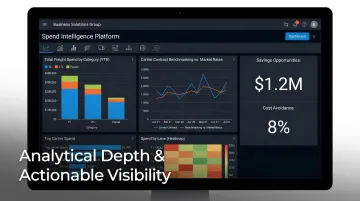
Operational planning without cost visibility leaves real money on the table. Pairing the two gives logistics teams a complete picture — one that supports better decisions on capacity allocation, carrier selection, and contract timing.
Frequently Asked Questions
What is capacity planning in logistics?
Logistics capacity planning is the process of ensuring fleet, warehouse, and labor resources are sized and aligned to meet current and forecasted shipment demand. The goal is to avoid costly bottlenecks during surges and wasteful idle capacity during slow periods — treated as a continuous process, not a one-time exercise.
What are the three types of capacity in logistics?
The three types are warehouse capacity (space and throughput), transportation/fleet capacity (lane coverage and carrier availability), and labor/equipment capacity (staffing and operational readiness). A constraint in any one area will bottleneck overall performance.
What are the three steps of capacity planning?
The core cycle is: (1) forecast demand using historical data, seasonality, and external factors; (2) assess current capacity across warehouse, fleet, and labor to identify real gaps; and (3) implement the right strategy (lead, lag, or match) and monitor performance. The process repeats continuously.
What are the 4 types of capacity planning?
The four types are: workforce/labor, tools and equipment, transportation/fleet, and warehouse/facility capacity planning. Each requires its own planning approach and KPIs to track performance effectively.
What is the difference between capacity planning and resource planning?
Capacity planning is strategic and forward-looking — it determines whether sufficient resources will exist to meet future demand. Resource planning is tactical and short-term — it allocates existing resources to current tasks efficiently. Most logistics operations need both: capacity planning sets the ceiling; resource planning works within it.
How do you measure logistics capacity utilization?
Key metrics include warehouse space utilization rate, fleet utilization rate, OTIF (on-time in-full) performance, cost per shipment, and carrier fill rates. Analyze them together — strong warehouse utilization alongside poor OTIF typically signals a transportation or labor constraint, not a facility issue.