A telecom expense audit is the structured process that fixes this. It's a formal review of your invoices, contracts, services, and usage data — designed to surface billing errors, stranded services, and above-market pricing before they quietly drain your budget for another year.
This guide covers what a telecom audit is, what it typically finds, when your business needs one, how the process works step by step, and how it differs from ongoing telecom expense management.
Key Takeaways
- A telecom audit is a line-by-line review of invoices, contracts, and usage — not a casual bill check
- Common findings include stranded services, billing discrepancies, and auto-renewed contracts locked at above-market rates
- Any business paying multiple carriers is exposed — not just large enterprises
- The audit follows five defined steps — an advisory partner handles the heavy lifting
- An audit resets your baseline; ongoing TEM keeps it optimized over time
What Is a Telecom Expense Audit?
A telecom expense audit is a formal, line-by-line review of an organization's carrier invoices, service contracts, usage data, and service inventory. It's designed to answer four core questions:
- What are you paying for?
- What are you actually using?
- Is your pricing market-competitive?
- Are there billing or contract errors creating hidden waste?
What "Telecom" Actually Covers
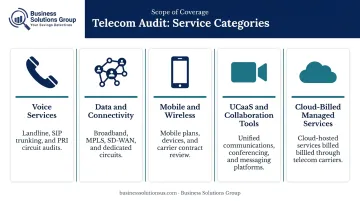
The scope surprises most businesses. A thorough audit covers:
- Voice services — POTS lines, SIP trunks, PRI circuits, hosted voice
- Data and connectivity — broadband, dedicated internet access, MPLS, SD-WAN
- Mobile and wireless — device plans, roaming, mobile data pooling
- UCaaS and collaboration tools — hosted platforms, video conferencing, cloud communications
- Cloud-billed managed services — any service billed as a communications charge
According to AOTMP research, wireless alone represents 35% of total enterprise telecom spend — which means mobile plans and devices aren't a footnote; they're a major audit category in their own right.
Why Internal Teams Miss What Auditors Find
An informal internal review — one person scanning invoices — is not the same as a structured audit. Internal teams face real structural disadvantages:
- Carrier invoices use proprietary formats that obscure specific charges
- Most finance and IT teams lack access to current market benchmark data
- Multiple carriers mean fragmented billing across different systems and portals
- Years-old addenda often bury contract terms that no one has revisited since signing
A third-party audit addresses all of this directly. As No Jitter notes, telecom advisors bring current market rates, carrier capability knowledge, and negotiation leverage that most organizations don't have in-house — and can't build while also managing daily operations.
Who Needs an Audit
Those structural gaps aren't limited to large enterprises. Any business paying for multiple lines, data circuits, mobile plans, or carrier services faces the same billing complexity — and the same exposure to errors, unused services, and off-market pricing.
What a Telecom Expense Audit Typically Finds
Audits across organizations of all sizes tend to surface findings in the same categories. The specific dollar amounts vary, but the patterns are consistent.
Stranded and Ghost Services
These are lines, circuits, and platform seats a business is still paying for but no longer using. Common examples include:
- Services tied to office locations that closed but were never formally disconnected
- Phone lines or mobile plans assigned to employees who left months or years ago
- Legacy POTS lines from systems that were migrated to VoIP but never cancelled
- UCaaS seat licenses for users who were offboarded without deprovisioning their accounts
AOTMP treats identifying and recovering credits for unused services as a core telecom management task. The No Jitter enterprise case study of ballooning telecom expenses traces the problem directly to management transitions where missed disconnects continued to accrue charges for services with zero active users.
Billing Errors and Invoice Discrepancies
Carrier invoices are long, formatted in carrier-specific notation, and frequently contain errors. Common billing issues include:
- Charges that don't match contracted rates
- Duplicate service billing across billing cycles
- Incorrect tax and surcharge calculations
- Mathematical errors in usage-based fee calculations
AOTMP's training resources on correcting invoice errors and obtaining credits for overcharges treat this as a standard, recurring telecom management task. These errors persist because most businesses don't have the time or tools to perform line-level invoice-to-contract comparisons every billing cycle.
Above-Market Pricing from Evergreen Contract Rollovers
Most telecom contracts include auto-renewal clauses. When a contract renews without a competitive benchmarking review, pricing locks in at whatever rates were negotiated — which may now be significantly above current market rates. Carriers don't proactively offer better pricing at renewal; that conversation only happens when the customer initiates it with current market data in hand.
This is a passive form of overspend that compounds over time. A contract that made sense three years ago may now carry pricing that renegotiation (backed by benchmark data) could reduce meaningfully.
Over-Subscription and Feature Misconfigurations
Businesses frequently pay for:
- Bandwidth tiers well above actual peak usage
- Mobile data pools sized for a headcount that no longer exists
- UCaaS seat counts that include departed employees
- Add-on features enabled by default but never activated by users
Business Solutions Group's benchmark analysis capabilities are built to identify these gaps. They compare what clients are paying against current market pricing for equivalent services and flag where renegotiation would deliver measurable improvement.
Compliance and Security Gaps
Audits regularly surface orphaned accounts and unmanaged devices that represent both cost exposure and security risk. For regulated industries:
- HIPAA requires technical safeguards for electronic protected health information — orphaned UCaaS accounts with access to patient communication channels create real compliance exposure
- PCI DSS guidance requires revoking access for terminated users and disabling inactive accounts within 90 days
- NIST SP 800-53 includes account management controls requiring that accounts be disabled when no longer needed
A telecom audit that identifies and documents orphaned accounts directly supports these access-control requirements.
Signs Your Business Needs a Telecom Audit Now
Trigger Indicators to Watch For
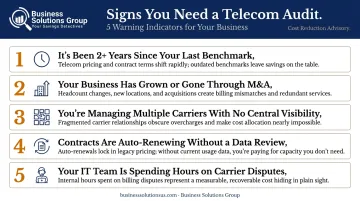
If any of these apply to your organization, an audit is overdue:
- Invoices haven't been benchmarked in 2+ years. Without a periodic market comparison, pricing quietly drifts above competitive rates and no one flags it.
- The business has grown, added locations, or gone through M&A without a formal telecom review. Every structural change adds complexity and creates potential for stranded or misconfigured services.
- Multiple carriers are managed without unified visibility. Fragmented billing across providers makes errors nearly impossible to catch manually.
- The last contract negotiation happened at renewal without independent pricing data. Auto-renewals without benchmarking are a common source of above-market pricing.
- IT teams are spending significant hours on carrier disputes instead of core priorities. That's a clear signal invoice management has outgrown internal capacity.
Waiting until costs become visibly painful means absorbing months of unnecessary spend. The most effective audits happen before a budget crisis forces the issue — when there's still time to recover overpayments and renegotiate from a position of strength.
How a Telecom Expense Audit Works: Step by Step
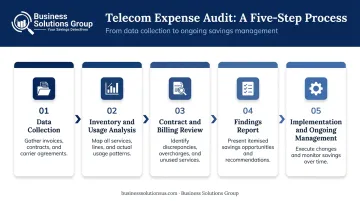
Step 1: Data Collection
The audit starts with gathering 90 days of carrier invoices, all active contracts, and a full inventory of telecom services and devices. A reputable audit partner handles carrier outreach and document collection on your behalf using a Letter of Agency — minimizing internal workload. Most of the elapsed time in this phase is waiting on carrier documentation, not analysis.
Step 2: Inventory and Usage Analysis
Each service is mapped against actual usage. Auditors identify:
- Which lines and circuits are active versus stranded
- Whether data and voice plans are right-sized for real consumption patterns
- Whether seat counts in UCaaS or hosted voice platforms match actual current users
- Which mobile plans have zero or near-zero usage in recent billing cycles
Step 3: Contract and Billing Review
Every invoice line is compared against the contracted rate for that service. The review surfaces:
- Rate discrepancies between billed amounts and contracted terms
- Billing errors and duplicate charges
- Tax and surcharge miscalculations
- Contract compliance issues
Alongside the invoice review, a benchmark pricing analysis compares current rates against market pricing for equivalent services across comparable carriers. Business Solutions Group's benchmark analysis identifies which services are fairly priced and which represent clear renegotiation opportunities — giving you specific leverage before you ever call a carrier.
Step 4: Findings Report and Recommendations
A quality findings report includes:
- Each documented discrepancy with a specific dollar amount attached
- Optimization recommendations: what to cancel, what to renegotiate, what to right-size
- A prioritized action plan organized by savings impact
- A confirmation of services where pricing is already market-competitive
That last item is a credibility signal. An advisory partner who only flags problems gives you an incomplete picture — knowing which services are already well-priced helps you prioritize where to push and where to hold.
Step 5: Implementation and Ongoing Management
The execution phase involves negotiating with carriers to correct billing errors, secure credits for overcharges, and execute improved contract terms. Stranded services get formally disconnected. Over-provisioned plans get right-sized.
The difference between a one-time audit and sustained savings is what comes next: ongoing telecom expense management that maintains visibility, catches new errors as they appear, and manages renewals before rates creep back up.
Benefits Beyond Cost Savings
Cost recovery gets the attention, but the operational benefits of a telecom audit run deeper than the first invoice credit.
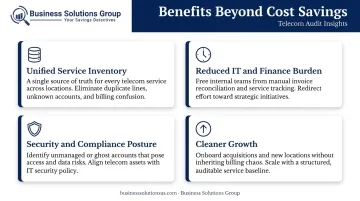
A completed audit delivers advantages across four areas:
- Unified service inventory: Produces an accurate record of every carrier, contract, and service — giving multi-location businesses a single view they can use for budget planning and contract management.
- Reduced IT and finance burden: Carrier disputes, invoice audits, and renewal tracking consume hours. Shifting this to an advisory partner returns that time to higher-priority work.
- Security and compliance posture: A current telecom inventory makes it possible to identify and close orphaned accounts, reducing unauthorized access risk and supporting HIPAA, PCI, and NIST account-management requirements.
- Cleaner growth: With right-sized services and clean contracts in place, opening new locations or integrating an acquisition doesn't mean layering new spend on top of existing waste.
An IBM/Emptoris white paper on wireless mobility governance found that enterprises with formal wireless governance spend 40% less per user on mobile voice services — a benchmark for what structured oversight can deliver over time.
Telecom Audit vs. Telecom Expense Management: Understanding the Difference
These two disciplines are complementary, not competing.
| Dimension | Telecom Expense Audit | Telecom Expense Management (TEM) |
|---|---|---|
| Time horizon | Periodic — typically every 1–2 years | Continuous, ongoing |
| Primary goal | Find errors, validate rates, recover credits | Maintain inventory, process invoices, manage renewals |
| Best trigger | Renewal, M&A, office closure, rapid growth | Multi-carrier, multi-location, ongoing complexity |
| Output | Findings report with action plan | Ongoing visibility platform and managed workflow |
Think of it as a two-stage approach: the audit corrects and validates what you have, while TEM keeps that accuracy intact over time. That distinction matters, because more organizations are committing to both.
The global TEM market is forecast to grow from $4.09 billion in 2024 to $9.41 billion by 2035 at a 7.87% CAGR — a sign that businesses increasingly treat telecom management as an ongoing operational discipline rather than a one-time cleanup effort.
When to start with an audit: If you don't have a current, accurate telecom inventory or a recent contract benchmark, start here. The audit establishes the foundation.
When to move directly to TEM: If you already have a clean baseline and need ongoing multi-carrier invoice management, reporting, and renewal oversight, TEM is the right structure.
Many organizations benefit from both in sequence — the audit first, then TEM to sustain the results.
Frequently Asked Questions
What is the average cost of a telecom audit?
Most telecom advisory engagements use a carrier-commissioned model, where the advisor earns compensation from carriers on placed or renegotiated services, meaning no direct cost to the client. Fee-based and hybrid models also exist for large enterprise engagements. Always clarify the compensation structure upfront.
What does a telecom expense audit include and how is it performed?
An audit covers invoice review, contract compliance, usage analysis, inventory mapping, and market pricing benchmarking. It involves collecting 90 days of carrier documents, comparing them against contracted rates, and delivering a findings report with prioritized recommendations.
What are the different types of telecom audits?
The main types are: (1) billing audits focused on invoice accuracy and contract compliance, (2) usage audits focused on right-sizing services, (3) contract/market audits focused on benchmarking current rates against market pricing, and (4) comprehensive audits combining all three. Most businesses benefit most from the comprehensive approach.
How long does a telecom expense audit take?
For a typical small-to-mid-market business, a full audit takes approximately two to three weeks from invoice submission. Larger multi-location organizations may require four to six weeks. Most of that time is spent waiting on carrier documentation, not on analysis itself.
How much can a telecom audit save my business?
Savings depend on your contract age, inventory accuracy, and time since your last benchmark — businesses with outdated contracts or post-M&A complexity typically see the largest recovery. An advisory partner can provide a no-obligation estimate based on your specific environment.
How often should a telecom expense audit be conducted?
Every 24 months is a reasonable baseline cadence, aligned with typical contract renewal cycles. Annual audits make more sense for businesses experiencing rapid growth, opening new locations, or integrating acquisitions — situations where telecom complexity compounds faster than a two-year cycle can adequately manage.