Introduction
Most businesses pay their telecom invoices on time every month without questioning them. The totals look roughly consistent with last month, the carriers are recognizable, and AP moves on. What they don't realize is that they're often systematically overpaying — not by rounding errors, but by meaningful percentages of total spend. For a company running $500K/year in telecom, that's $60K–$100K left on the table annually.
Industry analysts and procurement research consistently point to enterprise telecom invoice error rates in the range of 7–12%, with some vendor-facing audits surfacing recoverable overcharges approaching 20% of total spend. A Crown Commercial Service white paper on telecom audit cites approximately 12% as a benchmark for recoverable billing errors in enterprise accounts.
That figure compounds every billing cycle an error goes uncaught.
Carrier billing systems are complex, contract changes are slow to propagate, and nobody at the carrier validates your invoice against your negotiated rates before it goes out. The errors are structural — and they recur.
This guide breaks down the five most common billing error types, explains why they stay hidden, and gives you a practical framework for finding and recovering the overcharges.
Key Takeaways
- Telecom billing errors affect the majority of enterprise invoices, with recoverable overcharges commonly running 7–20% of total spend
- The five error types that drive most overcharges: billing for disconnected services, duplicate charges, contract rates not applied, incorrect taxes, and phantom services
- Errors stay hidden because invoices are complex, multi-carrier, and AP teams approve on prior-month consistency rather than contract validation
- Detection requires a full service inventory, centralized invoices, and monthly reconciliation against contracted rates
- Prevention requires automation, centralized contract management, and proactive MACD tracking
What Are Telecom Billing Errors? The 5 Most Common Types
A telecom billing error is any charge on a carrier invoice that doesn't match what was contracted. That's a broader definition than most finance teams work with, and these errors are rarely intentional — they arise from system lag, manual handoffs between provisioning and billing teams, and the sheer complexity of carrier billing environments.
Billing for Disconnected Services
When a circuit or line is cancelled, the disconnect order goes through the carrier's provisioning system. The billing system is a separate process — and it often doesn't update in sync. Services continue to appear on invoices for months, sometimes years, after a legitimate disconnect was submitted and confirmed.
This is one of the most common recoverable error categories. The catch: most carrier agreements impose strict dispute windows, and financial exposure grows the longer errors go undetected. Carrier-specific windows vary:
- Lumen (Master Service Agreement): written dispute required within 90 days
- Verizon Business Digital Voice: written notice required within 60 days
- Verizon mobile: 180-day dispute window
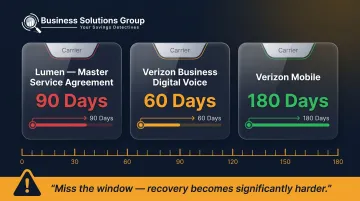
Miss the window, and recovery becomes significantly harder.
Duplicate and Overlapping Charges
Service migrations create billing risk. Moving from legacy PRI lines to SIP trunking, for example, often leaves both the old and new service appearing on invoices well past the intended cutover date. Product rebranding and multi-account billing structures compound the problem — the same service can appear under two different names in two different billing records.
Contract Rates Not Applied
Negotiated rates, volume discounts, and promotional pricing exist in your signed agreement. They don't automatically appear in the carrier's billing system — someone has to manually code them. When that coding is wrong at the outset, the error persists indefinitely across every subsequent invoice.
A single miscoded rate tier cascades across dozens or hundreds of service lines — a systemic problem, not a one-off. Companies often discover this during a first structured audit, years after the contract was signed.
Incorrect Taxes, Surcharges, and Regulatory Fees
Telecom tax compliance spans roughly 60,000 jurisdictions, 686+ tax bases, and 300+ unique tax types, according to Avalara's communications tax research. Common error patterns include:
- Tax exemption certificates filed with one carrier division never applied enterprise-wide
- Internet and data services incorrectly taxed at voice service rates
- Federal regulatory fees (USF, TRS) not updated promptly when rates change
A single jurisdiction misclassification affects all associated usage charges, not just a single line item.
Phantom Services Not Matched to Known Inventory
These are charges for circuits, POTS lines, or devices that can't be traced to any active business need or physical location. Temporary project services, test circuits, and legacy lines from acquired companies that were never decommissioned all become phantom charges — undetectable without a current inventory to reconcile against.
Why These Errors Stay Hidden and Keep Compounding
Enterprise telecom invoices arrive from multiple carriers in inconsistent formats — dozens of pages, hundreds of line items, carrier-specific service codes. Several structural gaps allow errors to pass through undetected:
- Finance teams approve payment because the total looks close to prior months
- IT lacks visibility into what was actually contracted
- No one systematically checks line-level charges against contract terms before payment clears
These gaps don't produce one-time mistakes. Errors recur every billing cycle until someone actively looks for them.
The Compounding Math
Consider a straightforward example. A business spending $500,000 annually on telecom with a 12% error rate is overpaying $60,000 per year. At a 20% error rate, that's $100,000. Those figures compound across years — and portions become permanently non-recoverable once carrier dispute windows close.
A real-world audit profiled by Digital Direction found that a workers' compensation insurer reduced its annual telecom spend by 52% — from roughly $1.49M to $706K — and recovered $346,158 in one-time credits after a full billing audit. That's not unusual for organizations that haven't validated invoices against contracts.
Why Annual Audits Fall Short
An annual review can surface some errors and recover some credits. But it cannot:
- Prevent eleven months of incorrect charges from clearing before they're found
- Preserve dispute eligibility for errors already 12+ months old
- Stop errors from recurring in future billing cycles without structural fixes
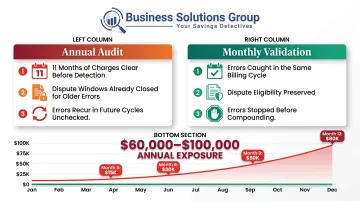
Monthly or continuous validation isn't a higher standard — it's the minimum standard for maintaining dispute eligibility and preventing compounding losses.
How to Detect Telecom Billing Errors: A Practical Framework
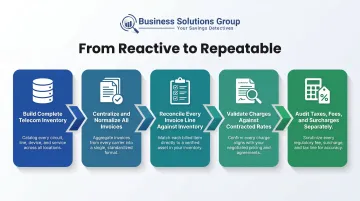
Step 1 — Build a Complete Telecom Inventory
You cannot validate what you don't know you have. A full inventory should include:
- All circuits (MPLS, internet, point-to-point, SD-WAN)
- Voice services (SIP, PRI, analog, toll-free)
- Mobile devices and data plans
- UCaaS platforms and cloud connectivity
- Equipment under lease
This inventory becomes the single source of truth against which every invoice line item is reconciled. Without it, phantom service detection is impossible.
Step 2 — Centralize and Normalize All Invoices
Pull invoices from all carriers, business units, and locations into a single repository. Then standardize what you have:
- Convert PDF and paper invoices into structured data
- Normalize carrier-specific terminology and service codes into a common framework
- Tag each charge by location, cost center, and service type
This step alone surfaces many duplicates and overlapping charges that stay invisible when invoices are siloed by department.
Step 3 — Reconcile Every Invoice Line Against Your Inventory
Match each billed service to a known inventory record. Flag:
- Billed services with no corresponding inventory entry (phantom services)
- Inventory services with no billing (potential missed disconnects or service issues)
- Services billed to closed or incorrect locations
- Duplicate service identifiers within the same billing period
Step 4 — Validate Every Charge Against Contracted Rates
Maintain a contract rate database separate from carrier-provided invoices. For every recurring charge:
- Compare the billed rate against the contracted rate for that service, location, and volume tier
- Flag any variance above a defined threshold (5% is a standard threshold; some teams also set a fixed dollar floor)
- Verify that volume discounts and promotional pricing are correctly calculated and applied
This is where systematic rate errors surface — miscoded tiers and misapplied discounts that carriers rarely catch on their own.
Step 5 — Audit Taxes, Fees, and Surcharges Separately
Tax errors require their own reconciliation pass:
- Verify the taxing jurisdiction for every service location
- Cross-reference applied tax rates against current published state and local rates
- Confirm exemption certificates are active across all carrier accounts — not just the primary carrier
- Validate federal regulatory fees (USF, TRS) against current FCC-published rates
The USF contribution factor is updated quarterly; the TRS fund year factors are set annually by FCC order. Schedule regulatory fee audits on a recurring basis — quarterly at minimum — rather than treating them as a one-time cleanup.
Running all five steps consistently converts billing review from a reactive scramble into a repeatable process that catches errors before they compound.
How to Prevent Telecom Billing Errors Going Forward
Detection recovers past losses. Prevention stops future ones. These four structural measures close the gap that allows errors to persist.
Automate Invoice Auditing Before Payment
The most effective time to catch a billing error is before payment clears — not during a quarterly review. Automated invoice validation checks every line item against contracted rates and inventory records in the same billing cycle the invoice arrives.
An effective auditing workflow includes:
- Anomaly detection against prior billing periods
- Contract rate matching at the line-item level
- Exception flagging that routes discrepancies to human review before approval
Business Solutions Group's telecom expense management platform provides exactly this — automated validation across wireless, wireline, and cloud services, with monthly verification designed to catch problems before they accumulate rather than after.
Centralize Contract and Inventory Management
Billing errors persist because contracts live in one place (a PDF or email), inventory lives somewhere else (a spreadsheet), and billing data arrives from carriers in a third system with no reconciliation between them. When a contract term changes, that change has to manually propagate to rate validation. It often doesn't.
Centralizing contracts, inventory, and billing data into a single system of record — where a contract term change immediately updates rate validation rules — closes that gap. Business Solutions Group's SaaS platform consolidates telecom assets, contracts, vendors, invoices, and lifecycle data into one interface, giving your team the visibility to run continuous validation as a routine process.
Track Every MACD Event Against Billing
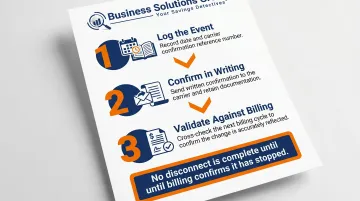
Moves, Adds, Changes, and Disconnects are the most common trigger for billing errors. Every change to your telecom environment should be:
- Logged with a date and carrier confirmation reference
- Confirmed in writing with the carrier
- Validated against the next billing cycle to confirm the change is reflected
One practical rule: no disconnect is complete until billing confirms it has stopped. MACD tracking prevents orphaned service charges from accumulating invisibly between provisioning confirmation and billing system update.
Monitor Contract Expiration Dates and Renewal Terms
Auto-renewals at expired promotional rates or outdated pricing tiers are a common source of invisible overbilling. Set calendar alerts 90–180 days before renewal dates to allow time for:
- Invoice and usage analysis against current contract terms
- Benchmarking current rates against market pricing
- Renegotiation before the auto-renewal window closes
Entering a renewal with accurate spend data and market benchmarks typically means lower rates and avoided auto-renewal overcharges — outcomes that don't happen when you let contracts roll over unchecked. BSG's carrier contract optimization includes benchmark analysis against market rates — clients who haven't renegotiated in 18+ months, or who have hit their minimal annual revenue commitment (MARC), typically find meaningful room in their existing agreements.
Tips for Long-Term Telecom Cost Control
- Audit monthly, not annually — errors caught in the same billing cycle are fully recoverable. Wait twelve months and dispute windows are already closed.
- Keep inventory current. Every new service order and every disconnect should update the inventory record before the next billing cycle closes.
- Standardize dispute documentation. Log the invoice reference, the contract term being violated, the financial impact, and the calculation — carriers require that detail to process credits.
- Treat renewals as optimization events. Use actual usage data and benchmark pricing to negotiate, and bring in someone with carrier pricing expertise to ensure renewed terms reflect current market rates.
- Consider ongoing TEM if your spend warrants it. Organizations spending more than $25,000/month on telecom and IT typically have recoverable savings that a structured expense management program will uncover.
Frequently Asked Questions
What percentage of telecom invoices contain billing errors?
Enterprise telecom invoices carry error rates of 7–12%, with recoverable overcharges sometimes reaching 20% of total spend depending on audit depth. Error rates climb in organizations with multiple carriers, frequent service changes, or no structured invoice validation process.
How far back can I recover credits for telecom billing errors?
Most carrier agreements limit disputes to 60–180 days from the invoice date — Lumen requires written disputes within 90 days, Verizon Business Digital Voice within 60 days, and Verizon mobile agreements allow 180 days. Beyond those windows, recovery typically requires escalation and is often unsuccessful.
Do telecom billing errors affect small and mid-sized businesses, or only large enterprises?
Billing errors affect businesses of all sizes. Carrier billing systems apply the same complex, error-prone processes regardless of account size. SMBs are often more exposed because they lack dedicated telecom management resources and are less likely to have structured invoice validation in place.
How often should telecom invoices be audited?
Monthly — where every invoice is checked against contracted rates in the billing cycle it arrives. Annual audits can surface historical errors but cannot prevent compounding charges or preserve dispute eligibility for errors that have already aged past carrier dispute windows.
What documentation do I need to dispute a telecom billing error?
You'll need three things: the specific invoice line item in error (with invoice date and reference number), the contracted term being violated (with the relevant contract section or rate schedule), and a calculation showing the correct amount versus what was billed. More complete documentation leads to faster resolution and higher recovery rates.
What is the difference between a telecom audit and telecom expense management (TEM)?
A telecom audit is a point-in-time review to identify errors and recover credits. TEM is an ongoing program — combining inventory management, continuous invoice auditing, MACD tracking, and contract oversight — designed to prevent errors from recurring rather than just recovering past overcharges.