Introduction
Most businesses have no idea what they're actually paying for on their telecom bills. Lines assigned to employees who left two years ago. Internet contracts that auto-renewed at rates nobody approved. Conferencing services still billing monthly for a platform the company replaced last spring.
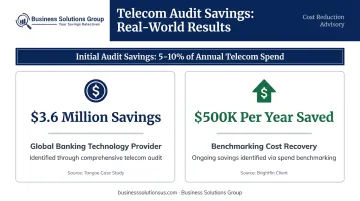
Telecom bills quietly accumulate waste because no one is assigned to scrutinize them. According to Tangoe's telecom expense management research, initial invoice auditing and reconciliation typically generates 5–10% savings on total annual telecom spend. For companies with significant telecom budgets, that's real money sitting unclaimed.
A structured telecom audit changes that. It brings visibility to what you're actually buying, eliminates services you're not using, and gives you the data you need to push back on carriers at renewal time.
This guide walks through exactly how to do it: gathering your bills and contracts, building a service inventory, identifying billing errors and unused lines, and using your findings to renegotiate carrier agreements.
Key Takeaways
- A telecom audit is a systematic review of invoices, contracts, and usage data to find overcharges, unused services, and renegotiation opportunities
- Orphaned lines (including those tied to former employees) are among the most common and recoverable sources of waste
- Effective audits follow six stages — from document gathering and contract review through benchmarking, renegotiation, and ongoing monitoring
- Initial audits typically surface 5–10% savings on annual telecom spend, with lower but sustained savings in subsequent years
- Professional advisory support accelerates results and keeps carrier negotiations off your internal team's plate
What Is a Telecom Audit?
A telecom audit is a systematic examination of a company's telecom invoices, service agreements, usage data, and carrier contracts. The goal: confirm you're paying only for what you actually use, at the rates you actually negotiated.
What Falls Under a Telecom Audit
The scope is broader than most people expect. A complete audit covers:
- Fixed-line phone systems and voice services
- Mobile and wireless plans across all devices and users
- Internet and broadband connections (all locations)
- Conferencing and collaboration tools
- Cloud communications platforms
- Bundled IT-telecom services and data network contracts
Any service billed by a telecom or communications vendor belongs in the review.
One-Time Audit vs. Ongoing TEM
These two approaches serve different purposes at different stages of your telecom management.
A one-time telecom audit is a point-in-time review — reactive, focused on recovering past overcharges and identifying immediate savings. It's the right starting point for any company that hasn't reviewed its telecom environment recently.
Telecom Expense Management (TEM) is the ongoing discipline that follows. TEM means continuously monitoring invoices, tracking contract renewal timelines, and ensuring services stay aligned with actual usage. The global TEM market was valued at $4.10 billion in 2024, projected to reach $11.55 billion by 2033 — reflecting how deeply embedded continuous telecom oversight has become in how cost-conscious businesses operate.
The audit gives you an accurate baseline; TEM keeps that baseline from drifting back into overspend.
Why a Telecom Audit Is Critical for Your Business
As businesses grow, so does telecom complexity — more locations, vendors, device types, and contracts layered on top of each other. Each addition creates another opportunity for billing errors and wasteful spending to go undetected, sometimes for years.
The business case for a regular audit is concrete:
- Uncovers billing errors — charges that don't match contracted rates, misapplied discounts, fees on inactive lines
- Eliminates orphaned lines — Mindglobal estimates approximately 3–7% of enterprise telecom lines contain orphaned charges, with departed-employee lines among the most common culprits
- Surfaces contract misalignments — services billed at rates that don't match signed agreements or SLAs
- Creates renegotiation leverage — benchmarked market rates give you documented grounds to demand better pricing
- Flags unauthorized usage — unusual call patterns or data usage that may indicate fraud
- Improves budget forecasting — accurate spend visibility makes future planning more reliable
The savings potential scales with complexity, and the numbers bear that out. Tangoe's case study portfolio includes a $3.6 million savings identification for a global banking and commerce technology provider. Brightfin documented a client saving approximately $500,000 per year after benchmarking revealed pricing outside normal market range and that data was presented to the carrier. In both cases, the savings came from holding existing vendors accountable — not from switching providers.
How to Conduct an Effective Telecom Audit – Step by Step
A telecom audit requires methodical execution. The biggest mistake companies make is treating it as a quick bill review rather than a full lifecycle evaluation of every service, contract, and usage pattern they're paying for.
Here's the process that produces real results.
Step 1 – Gather All Telecom Documents and Invoices
Collect at minimum 12 months of invoices from every telecom vendor — voice, mobile, internet, and conferencing. Also pull:
- All current contracts and service agreements
- Equipment rental agreements
- Tariff cards or rate schedules
Don't underestimate this phase. Companies with multiple office locations frequently discover they have far more active agreements than anyone realized. That discovery alone can surface significant redundancy before the formal analysis begins.
Step 2 – Review All Telecom Contracts
Contract review isn't just about rates — it's about alignment between what was agreed and what's actually happening. Look for:
- Rate discrepancies — contracted rates vs. what appears on invoices
- Expired contracts — services continuing month-to-month after a term ends often default to unfavorable rates
- SLA gaps — promised service quality not reflected in actual delivery
- Auto-renewal traps — contracts that rolled over without review, locking the business into suboptimal terms
Contract end dates are particularly important to document. Many businesses auto-renew simply because no one was tracking when agreements were set to expire.
Step 3 – Conduct a Line-by-Line Invoice Analysis
This step typically produces the most immediate, quantifiable findings. Scrutinize every line item for:
- Charges on services or lines no longer in use
- Unexplained fees — regulatory surcharges, equipment fees, administrative charges
- Bundled service packages where components go unused
- Overage charges that suggest plan misalignment with actual usage
Small recurring charges add up fast. A $45/month charge on a dormant line costs $540 per year. Multiply that across multiple locations and vendors, and the number becomes material quickly.
Step 4 – Benchmark Rates and Identify Optimization Opportunities
Once billing accuracy is verified, the next question is whether current rates are competitive — even without billing errors.
Benchmarking compares your actual rates against current market pricing for equivalent services. It often reveals above-market pricing on contracts that were negotiated years ago and never revisited.
Optimization actions from this step typically include:
- Canceling unused services and lines confirmed during invoice analysis
- Consolidating vendors where services overlap
- Right-sizing data and mobile plans to actual usage patterns
- Building a prioritized list of renegotiation targets with specific rate improvement goals
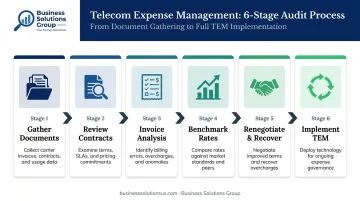
Step 5 – Renegotiate Contracts and Recover Credits
Audit findings and benchmarked rates support two parallel actions.
Dispute billing errors — formally request credits for documented overcharges. Many carrier service guides limit disputes to six months by default; negotiated enterprise contracts can extend that window. Check your specific terms before assuming past overcharges are unrecoverable.
Renegotiate agreements — carriers are more open to renegotiation than most businesses expect, especially when presented with structured data showing competitive alternatives. Documented overpayments and benchmarked market rates shift the negotiating dynamic.
Step 6 – Implement Telecom Expense Management for Ongoing Control
A one-time audit without ongoing monitoring will gradually let overspending return. TEM prevents that by establishing:
- Regular invoice review (quarterly at minimum)
- Contract renewal tracking with advance notice for renegotiation windows
- Ongoing usage monitoring to catch plan misalignment early
- Periodic benchmarking to verify rates remain competitive
Without this structure in place, the same billing errors and contract drift tend to resurface within 12–18 months.
A Telecom Audit in Action – Example Walkthrough
Consider a mid-sized US business with five locations, a mix of mobile lines and fixed-line voice, and several internet service contracts across different carriers. The finance team hasn't reviewed telecom in over two years.
Document collection phase: The team pulls 14 months of invoices and all carrier contracts. During collection alone, they identify:
- 12 active mobile lines assigned to employees who departed over a year ago
- Three internet service contracts that auto-renewed after their term dates without review
- A conferencing platform still billing monthly — even though the company migrated to a different tool eight months prior
Invoice analysis findings: Line-by-line review surfaces:
- Billing rate discrepancies on two vendor invoices where current charges don't match contracted rates
- Regulatory fees still accruing on the inactive mobile lines flagged during collection
Optimization and renegotiation outcome: Acting on the findings, the team:
- Formally disputes inactive line charges and recovers billing credits
- Cancels the unused conferencing service immediately
- Approaches one internet carrier with benchmarked pricing data showing their rate is above market — the carrier adjusts terms
Combined, these changes typically reduce monthly telecom spend by 15–25%, with the exact figure depending on total spend volume and how long issues went unaddressed.
TEM implementation: Contract end dates are entered into a tracking system. Invoice review is scheduled quarterly. Usage reports are reviewed monthly to catch plan misalignment before overage charges accumulate.
With a tracking system in place, the audit becomes a baseline — not a one-time fix.
How Business Solutions Group Can Help
For businesses that want to run a rigorous telecom audit without pulling significant internal resources off other priorities, Business Solutions Group provides advisory support from initial audit through ongoing monitoring.
BSG's telecom cost reduction approach includes:
- Spend intelligence tools that identify billing discrepancies, missed credits, and usage inefficiencies through detailed invoice and contract analysis
- Comprehensive benchmark analysis comparing current rates against market-appropriate pricing — identifying gaps that justify renegotiation
- Expert carrier negotiation handled directly by BSG's team on the client's behalf, covering contract terms, rate adjustments, and incentive structures
- Ongoing TEM support through continuous monitoring, cost compliance auditing, and regular reporting to sustain savings over time

BSG works on a performance-based model, meaning clients pay only when savings are delivered. Typical results across wireline, wireless, and cloud services range from 20–50%.
To explore what a telecom audit can uncover for your business, contact Business Solutions Group at (949) 525-7677 or visit businesssolutionsus.com to request a complimentary savings analysis.
Conclusion
A telecom audit works best as an ongoing discipline, not a one-time event. Companies that review their telecom environment regularly catch errors before they compound, renegotiate from a position of documented strength, and keep spend aligned with what the business actually needs.
The process outlined here: document collection, contract review, invoice analysis, benchmarking, renegotiation, and TEM implementation — is practical for businesses of any size. And the savings potential, especially in the initial audit phase, typically returns multiples of the effort invested to complete it.
Frequently Asked Questions
How often should a business conduct a telecom audit?
Most experts recommend a full audit annually, with quarterly invoice reviews in between. Companies with rapid headcount changes, multiple locations, or several vendor relationships may need more frequent reviews — particularly without formal contract tracking.
What is the difference between a telecom audit and telecom expense management?
A telecom audit is a point-in-time review that identifies billing errors and savings opportunities. TEM is the ongoing process of monitoring, managing, and optimizing telecom spend continuously. Audits typically feed into or initiate a TEM program.
How much can a telecom audit save my business?
Industry data suggests initial audit savings of 5–10% of total annual telecom spend, declining to around 2% in subsequent years once the environment has been cleaned up. Outcomes vary based on company size, vendor count, and how long since the last review.
Should I conduct a telecom audit in-house or hire a professional?
In-house audits work for simpler environments but often miss complex billing discrepancies or lack the market data needed for renegotiation. Professional advisors bring carrier knowledge, benchmarking data, and negotiating leverage. Many work on contingency, meaning the savings generated cover the engagement cost.
What types of telecom services should be included?
All of them: fixed-line voice, mobile and wireless plans, internet and broadband, conferencing and collaboration tools, cloud communications, and any data or network services from a telecom or communications vendor.
Can a telecom audit recover charges from past billing errors?
Yes, but the recovery window depends on your carrier contract. Most standard carrier service guides (the published terms governing billing disputes) default to a six-month lookback period, while negotiated enterprise agreements can extend that window. Review your contract terms before assuming older overcharges are unrecoverable.