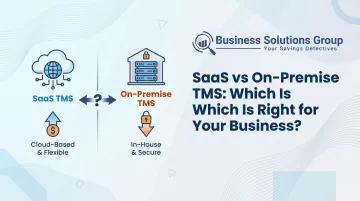
Both SaaS and On-Premise TMS solve the same core problem — managing freight, carriers, routes, and costs. But they do it in fundamentally different ways that suit very different business profiles. This guide breaks down how each model works, what it actually costs, and which one fits your operation.
Key Takeaways
- SaaS TMS is cloud-hosted, subscription-based, and vendor-managed — faster to deploy, lower upfront cost, and easier to scale
- On-Premise TMS lives on your servers, offering deep customization and full data control; expect significant IT infrastructure investment
- Your freight spend, IT capabilities, data sensitivity, and growth trajectory drive the decision
- SaaS fits small-to-mid-market shippers and 3PLs; On-Premise suits large enterprises and regulated industries
SaaS vs On-Premise TMS: Quick Comparison
| Dimension | SaaS TMS | On-Premise TMS |
|---|---|---|
| Deployment | Vendor-hosted, multi-tenant cloud | Customer-managed on-site servers |
| Upfront Cost | Low (subscription-based) | High ($10K–$500K+ licensing) |
| Ongoing Cost | $22.5K–$100K/year | $60K–$200K/year (plus IT staffing) |
| Customization | Limited configuration | Deep, code-level customization |
| Implementation | 2–6 weeks (SMB) to 6–12 months (enterprise) | 6–18+ months |
| Scalability | Scales with subscription tier | Requires hardware investment to scale |
| Data Control | Shared infrastructure, isolated data | Full customer control |
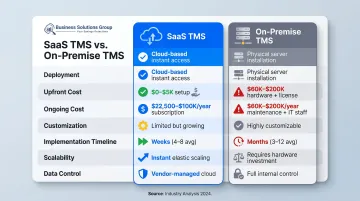
Worth clarifying before going further: "Cloud TMS" and "SaaS TMS" aren't the same thing. SaaS is a specific subset — multi-tenant, subscription-based, vendor-managed. A Cloud TMS can also mean software deployed on private cloud servers that the customer controls. The right choice comes down to three factors: how much IT infrastructure you own, how deeply you need to customize workflows, and how quickly you need to go live.
What Is a SaaS TMS?
A SaaS TMS is a transportation management system delivered over the internet on a subscription basis. The vendor hosts everything — servers, security, updates — in a multi-tenant architecture where multiple companies share infrastructure but maintain separate data environments.
Core Operational Benefits
- No hardware investment — you're up and running without buying servers or provisioning infrastructure
- Automatic updates — the vendor handles software patches, feature releases, and security improvements
- Predictable pricing — monthly subscriptions or per-shipment fees convert CAPEX into OPEX
- Anywhere access — accessible from any device with a browser or via API
Most SaaS TMS platforms include route optimization, carrier management, real-time shipment tracking, WMS/ERP integrations, and automated freight invoicing. Configuration is intentionally minimal — that works well for most buyers, but can feel restrictive for a handful.
That standardization has a cost: SaaS platforms are, by design, standardized. Businesses with highly unique workflows, proprietary carrier contracts, or non-standard rating requirements may hit a ceiling on what's configurable without custom development.
Who Should Use SaaS TMS
Cloud-based TMS now accounts for over 60% of TMS market revenue, and the reasons are practical. SaaS TMS delivers the most value for:
- Small-to-mid-market shippers with freight spend between $5M–$10M annually (SaaS has lowered the viability threshold from the historical $20M+ minimum)
- 3PLs managing multiple clients without dedicated IT teams
- E-commerce businesses with seasonal volume swings that need elastic capacity
- Companies in digital transformation that need fast deployment without a lengthy IT project
Business Solutions Group's TMS advisory specifically addresses shippers at the lower end of this spectrum, including a rate shopping TMS tool designed for companies spending $500,000 or less annually on parcel and freight — bringing professional-grade capability to businesses that previously couldn't justify the investment.
What Is an On-Premise TMS?
An On-Premise TMS is software installed and run on physical servers owned and maintained by the company itself, sitting behind the company's own network firewall. The business owns everything: hardware, maintenance, security patches, backups, and upgrade cycles.
Core Advantages
- Full data sovereignty: Data never leaves your servers or network
- Deep customization — code-level access means the software can be shaped to proprietary workflows
- Legacy integration: Connects at a deeper level with older ERP systems that don't support modern APIs
- No internet dependency — operations aren't subject to vendor uptime or connectivity interruptions
The Real Cost Picture
On-premise looks cheaper on paper when you skip the subscription line. In practice, the hidden costs compound quickly:
- Upfront licensing: $10,000–$500,000
- Annual platform maintenance: $60,000–$200,000/year
- Annual maintenance fees: typically 15–20% of license cost
- Hardware infrastructure, backup power, and refresh cycles
- Dedicated IT staff for upgrades, patches, and integrations
Complex enterprise on-premise rollouts can exceed $500,000 and 18 months in total cost and timeline, according to Sheer Logistics' implementation benchmarks. That's before factoring in the internal resource drag of a multi-department implementation project.
Who Should Use On-Premise TMS
On-premise is the right call in specific, well-defined scenarios:
- Regulated industries — defense contractors subject to ITAR and CMMC requirements, where ITAR violations carry fines up to $1M per instance and CMMC certification will be mandatory for all DoD contractors by 2026
- Large enterprises with freight budgets exceeding $10M and complex, customized multi-lane operations
- Companies with robust IT departments capable of managing upgrade cycles and security independently
- Operations where local processing speed matters and internet latency is unacceptable
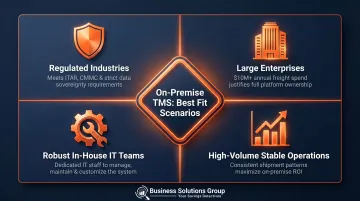
A large manufacturer with proprietary carrier contracts, complex multi-modal operations, and a team of in-house developers is a textbook on-premise candidate. A standardized SaaS platform can't replicate the custom rating logic and deep ERP hooks that operation requires.
One clarification worth noting: HIPAA does not inherently mandate on-premise deployment. Cloud solutions that meet encryption, access control, audit trail, and Business Associate Agreement requirements are fully compliant. The strongest regulatory case for on-premise is ITAR and CMMC — not healthcare broadly.
SaaS vs On-Premise TMS: Which Is Better for Your Business?
Five factors should drive this decision:
- Freight spend and operational scale — Under $10M annually? SaaS is almost always the right answer. Over $10M with complex workflows? Model both options carefully.
- Available IT resources — No dedicated IT team means on-premise is a liability, not an asset.
- Data sensitivity and regulatory requirements — ITAR, CMMC, or DFARS obligations push toward on-premise or private-hosted. Standard commercial operations don't require it.
- Customization vs. deployment speed — If you need it live in weeks, SaaS. If you need it to match proprietary processes exactly, on-premise.
- Long-term scalability trajectory — Growing fast or unpredictably? SaaS scales with you. Stable, predictable freight volumes? On-premise TCO may favor you long-term.
Situational Recommendations
Choose SaaS TMS if you:
- Need to go live in weeks, not months
- Have limited or no internal IT infrastructure
- Manage seasonal freight volume or are scaling quickly
- Operate as a 3PL onboarding new clients regularly
- Want to convert capital expenditure to predictable operating costs
Choose On-Premise TMS if you:
- Operate in a regulated industry with strict data sovereignty requirements
- Require deep customization of carrier contracts or rating logic
- Have an established IT team capable of managing upgrades independently
- Run a high-volume, stable freight operation with predictable workflows
TCO: The 3–5 Year Reality
SaaS appears cheaper upfront. On-premise appears cheaper long-term, but only under the right conditions.
For mid-market shippers, the math typically favors cloud when IT staffing and infrastructure costs are fully loaded. Annual platform costs run $22,500–$100,000/year for SaaS versus $60,000–$200,000/year for on-premise, before adding hardware refresh cycles and IT labor.
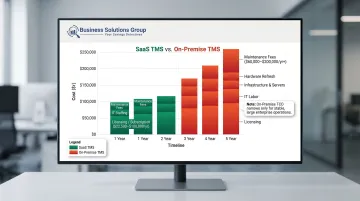
For large, stable enterprise operations with existing IT infrastructure, on-premise can become cost-competitive over a 5-year window once the subscription accumulation is modeled against sunk infrastructure costs. The key word is stable: if your freight volumes or business model are likely to shift, SaaS flexibility has compounding value that doesn't show up in a simple spreadsheet comparison.
Implementation Timeline
Cost analysis only tells part of the story. How long it takes to go live determines when savings actually start.
| Shipper Type | SaaS/Cloud TMS | On-Premise TMS |
|---|---|---|
| SMB | 2–6 weeks | Rarely selected |
| Mid-market | 3–6 months | 6–12 months |
| Enterprise | 6–12 months | 12–18+ months |
That timeline gap carries real internal resource costs, not just scheduling inconvenience.
Every month of implementation means delayed ROI. ARC Advisory Group benchmarks average freight cost savings from TMS implementation at 7.2%, with ROI typically achieved within 6–12 months of deployment. The faster you go live, the sooner those savings compound.
If you're working through this decision, Business Solutions Group's benchmark analysis can clarify the math before you commit. The process captures 6–12 months of shipment-level data to establish a financial baseline, model scenario savings, and identify which deployment model fits your freight spend and operational structure.
Real-World Context: How Businesses Are Making This Decision
Consider a mid-market distributor running $7M in annual freight spend across LTL and parcel. Their challenge: carrier selection is done manually via spreadsheet, invoices are reconciled by hand, and they have no real-time visibility into shipment status. Two people spend a combined 30+ hours per week on tasks a TMS automates.
Their IT team consists of one generalist. On-premise was never a realistic option.
After deploying a SaaS TMS, outcomes like theirs align closely with published benchmarks. Billerud, a packaging materials company, achieved a 60% reduction in labor hours and tendered loads 80% faster after TMS implementation, according to Infios. Freight cost reductions across the industry range from 5–15%, with ARC Advisory Group's widely cited average sitting at 7.2%.
For this distributor, three factors made SaaS the clear fit:
- No IT resources for ongoing maintenance
- Freight spend in the $5M–$10M SaaS sweet spot
- Urgent need to eliminate manual processes without an 18-month implementation
A different profile — a defense-adjacent manufacturer with ITAR-controlled data and a 15-person IT department — would reach the opposite conclusion for reasons just as sound.
The right answer depends on your freight profile, IT capacity, and data requirements. If you're working through that decision, Business Solutions Group offers a no-cost freight spend analysis that quantifies your savings opportunity, benchmarks your carrier contracts against market rates, and gives you a direct recommendation on TMS deployment.
Conclusion
There's no universal winner between SaaS and On-Premise TMS. The right answer depends on your freight spend, data requirements, IT maturity, and your growth trajectory over the next three to five years.
A well-implemented SaaS TMS at a mid-market shipper will outperform a poorly maintained on-premise system at a large enterprise every time. Deployment model is secondary to execution.
Before committing, work through these questions internally:
- What is our annual freight spend?
- Do we have the IT resources to own, maintain, and secure this system?
- What are our regulatory and data residency obligations?
- How quickly do we need this live?
Your answers will point toward the right deployment model more reliably than any vendor feature sheet.
Frequently Asked Questions
Is a transportation management system (TMS) offered as SaaS?
Yes. Many modern TMS platforms are delivered as SaaS — cloud-hosted, subscription-based, and fully managed by the vendor. Users access the system through a browser or API with no need for on-site servers or internal IT infrastructure to maintain the software.
What is a SaaS transportation management system?
A SaaS TMS is a cloud-delivered logistics platform that gives shippers access to freight management tools — carrier selection, routing, shipment tracking, and invoicing — without managing any underlying infrastructure. The vendor owns the software stack; you own the outcomes.
How does a TMS differ from ERP?
A TMS is purpose-built for transportation operations: routing, carrier selection, freight tracking, and invoicing. An ERP is a broader business management platform covering finance, HR, procurement, and operations. Most businesses integrate the two so order and shipment data flows between systems automatically.
What are the main disadvantages of an on-premise TMS?
The primary drawbacks are high upfront licensing costs ($10K–$500K+), the ongoing need for a dedicated IT team to manage upgrades and security patches, and limited scalability compared to cloud alternatives. These factors make on-premise a heavy commitment — in budget, headcount, and time.
How long does it take to implement a SaaS TMS vs. an on-premise TMS?
SaaS TMS deployments typically go live in 2–6 weeks for SMBs and 3–6 months for mid-market operations with ERP integrations. On-premise implementations run 6–12 months for mid-market environments and 12–18+ months for complex enterprise deployments.
Which type of TMS is better for small and mid-sized businesses?
SaaS TMS is the better fit for most SMBs. Lower upfront costs, minimal IT requirements, and subscription-based pricing mean smaller shippers can access professional-grade transportation management without the infrastructure burden that makes on-premise impractical at that scale.