Most companies invest in a Transportation Management System to optimize carrier selection and routing. Far fewer close the loop on the financial side — leaving invoice validation manual, disconnected, and reactive. The result is a persistent gap between contracted rates and actual payments that compounds quarter after quarter.
This article explains how integrating TMS with freight audit and payment processes closes that gap, and the specific operational and financial advantages that integration delivers.
Key Takeaways
- TMS integration turns freight audit from a post-payment chore into a real-time financial control
- Automated three-way matching (PO + BOL + Carrier Invoice) catches billing errors before payment
- Full spend visibility replaces fragmented data, manual GL coding, and end-of-month surprises
- Audited invoice data builds carrier scorecards that shift contract negotiations in your favor
- Without integration, you stay in the "pay and chase" cycle: cutting checks first, discovering problems weeks later
What Is TMS Integration with Freight Audit and Payment?
A TMS handles the execution side of freight: carrier selection, load tendering, route optimization, and shipment tracking across LTL, FTL, parcel, and multimodal operations. Freight audit and payment handles the financial side: validating carrier invoices and releasing payments against contracted rates.
TMS integration connects these two workflows so shipment data flows automatically into invoice validation — without manual re-entry, spreadsheet exports, or delayed reconciliation.
The integration applies wherever multiple carriers are billing against complex contracted structures, accessorial schedules, and fuel surcharges. The purpose is direct: every carrier invoice should be validated against real shipment data before a dollar leaves your organization.
Integration typically runs via:
- API — real-time exchange that matches invoices to shipment records as they arrive
- EDI — batch processing suited to high-volume, structured carrier invoice flows
- Flat file — a fallback method for legacy TMS or carrier systems without API capability
Business Solutions Group's TMS supports all major freight modes — Parcel, LTL, FTL, Air, Ocean, and Rail — and connects to ERP and accounting systems via open RESTful API. That direct connection is what makes automated invoice validation practical: shipment data and financial records live in the same pipeline rather than separate systems that require manual reconciliation.
Key Advantages of TMS Integration for Freight Audit and Payment
Each advantage below is operational and financial — tied to outcomes your business already tracks. They also compound: the data and process improvements in one area feed directly into the next.
Advantage 1: Automated Invoice Validation That Stops Billing Errors Before Payment
This is pre-payment audit: catching discrepancies between contracted rates and billed charges before invoices are approved, rather than chasing refunds afterward.
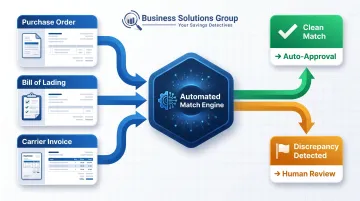
The integrated system cross-references three documents in real time — the Purchase Order, the Bill of Lading, and the Carrier Invoice. Clean invoices route to auto-approval. Mismatches flag automatically and go to human review. That's the three-way match methodology in practice.
Why it matters:
According to Transportation Insight, **3–6% of freight invoices contain billing errors** — misapplied accessorials, incorrect rates, missed discounts. At scale, that's a material number. Pre-payment audit prevents those charges from clearing; post-payment audit recovers only a fraction of what was lost, typically 0.5–2% of freight spend, with claim recovery rates of 60–80%.
The cost math is unfavorable for post-payment approaches: every dollar recovered after payment carries administrative overhead — staff time, carrier friction, claim processing — that a prevented charge never does. There's also a float problem; paying an incorrect invoice effectively loans that money to the carrier until the dispute resolves.
Automated matching also catches what manual review misses at volume: duplicate invoices, accessorial overcharges, and rate misapplications across dozens of carriers simultaneously.
KPIs impacted:
- Invoice error rate
- Overcharge recovery rate
- Accounts payable processing time
- Freight cost as a percentage of revenue
When this matters most: High-volume shippers managing multiple carriers across modes, companies with complex accessorial structures, and organizations currently relying on third-party post-payment review that delays visibility into actual spend.
That billing accuracy data doesn't stop at payment approval — it flows directly into real-time spend visibility, which is where the next advantage begins.
Advantage 2: Real-Time Freight Spend Visibility and Proactive Cost Management
This is a live, connected view of freight costs at every stage — from planned cost at booking through accrued cost in transit to invoiced cost at payment — replacing fragmented data across disconnected systems.
The TMS holds shipment execution data: routes, carrier assignments, delivery events, GPS timestamps. When integrated with freight audit, that data validates not just base rates but accessorials against actual documented conditions. GPS timestamps, for example, can be cross-referenced against carrier detention billing to verify whether claimed on-site time is accurate before the charge is approved.
Why it matters:
Without integration, finance teams typically see freight costs weeks after shipments move — often only after invoices are fully processed. APQC benchmarks cited by GEP show automated invoice cycle times of 3–4 days versus 7+ days for manual workflows. That gap translates directly into delayed accruals and blind spots during the financial close cycle.
When planned vs. billed comparisons are available in real time, finance can flag cost overruns as they emerge rather than discovering them at month-end.
Automated GL coding — assigning freight costs to the correct cost center, product line, or business unit based on shipment attributes — eliminates the manual reconciliation step that creates friction between logistics and finance.
KPIs impacted:
- Freight spend as a percentage of sales
- Month-end close cycle time
- Accrual accuracy
- Accessorial cost per shipment
When this matters most: Multi-division organizations allocating freight costs across business units, companies with high accessorial exposure, and any shipper whose finance team currently compiles freight spend reports manually.
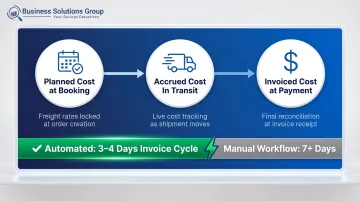
That accumulated spend data — audited, categorized, and timestamped — becomes the foundation for the third advantage: using carrier performance history to negotiate from a position of evidence.
Advantage 3: Carrier Performance Intelligence That Strengthens Contract Negotiations
Every audited invoice processed through an integrated system builds a historical dataset of actual carrier billing behavior — not just rates, but accuracy, exception frequency, and contract compliance. Over time, that becomes the foundation for smarter carrier decisions.
Integrated systems generate carrier scorecards tracking on-time delivery, billing accuracy, accessorial dispute rates, and contract compliance. This reveals the true total cost of each carrier relationship, not just the rate per mile. Business Solutions Group surfaces this data through dashboards that give logistics and finance teams ongoing visibility — not static reports reviewed once a quarter.
Why it matters:
Audit data reframes contract negotiations. When a carrier requests a rate increase, historical overbilling records provide objective counter-evidence. When you're evaluating carrier value, you can calculate actual total cost — including administrative overhead from disputes — rather than relying on rate-per-mile comparisons alone.
A carrier with the lowest rate but a high invoice error rate has a higher real cost when exception handling is factored in. That calculation is only possible with integrated audit data.
Business Solutions Group's benchmark analysis — provided at no cost to clients — compares current carrier rates and service levels against real market data to identify where costs exceed competitive benchmarks. Their carrier contract optimization process, which draws on 6–12 months of shipment data, has helped clients achieve typical savings of 15–40% on freight spend. Average savings identified through benchmark analysis this year have been 23.6%.
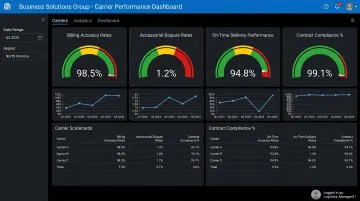
Lane-level and accessorial-level pattern analysis also informs network optimization — identifying where consolidation, carrier reallocation, or routing adjustments reduce spend without sacrificing service.
KPIs impacted:
- Carrier billing accuracy rate
- Contract compliance percentage
- Freight cost variance (contracted vs. actual)
- Rate negotiation outcome vs. target
When this matters most: Organizations approaching carrier contract renewals, shippers managing large carrier bases across multiple lanes and modes, and companies seeking to reduce roster complexity based on total cost and service reliability. ICC Logistics notes that carrier contracts should be renegotiated every 12–18 months, or sooner when volume, service levels, or surcharge structures shift materially.
What Happens When TMS Integration Is Missing
Disconnected TMS and audit systems produce a predictable operational pattern: the "pay and chase" cycle.
Invoices are processed based on carrier-submitted amounts. Discrepancies surface weeks or months later. Recovering overpayments means filing claims, waiting for carrier credit adjustments, and absorbing the relationship friction that comes with frequent disputes.
Meanwhile, the root cause of the error (a misconfigured rate, an accessorial that shouldn't apply) goes uncorrected and repeats across the next billing cycle.
The hidden costs accumulate fast:
- Billing errors recur because there's no mechanism to identify and fix root causes
- Accessorial overcharges and duplicate invoices accumulate without detection
- GL coding errors multiply as volumes grow, degrading the accuracy of freight spend reporting
- Finance teams lose the ability to produce reliable cost data — making it harder to defend transportation budgets or justify carrier decisions
Industry estimates put unaudited freight spend losses at 3–7% of total spend annually. At scale, that's a measurable, preventable drain.
The scaling problem compounds everything. Manual audit processes that barely hold at current volumes break down as freight activity grows — exception resolution slows, reporting reliability drops, and the gap between negotiated rates and actual payments widens with no systematic way to close it.
How to Get the Most Value from TMS Integration
Integration delivers maximum value when the technical connection is paired with clear operational configuration from day one:
- Digitize all contract terms — rate structures, accessorial schedules, and fuel tables must be fully loaded before go-live
- Define GL coding logic upfront — cost center mapping and product-line allocations should be configured before invoices start flowing
- Calibrate exception tolerance thresholds — auto-approval rules must be tuned to catch meaningful errors without flooding review teams with false positives
- Review configurations quarterly — carrier behaviors change, rate structures evolve, and accessorial rules shift with each contract renewal; tolerance logic needs to keep pace
The data integration generates is only as useful as the actions taken on it. Audit results should feed regular carrier performance reviews. Freight spend trends should inform renegotiation timelines. Exception patterns should trigger root cause investigations, not just one-off dispute resolutions.
Translating that audit data into a concrete cost reduction strategy is where many organizations stall. Business Solutions Group's supply chain optimization advisory and spend intelligence capabilities provide that analytical layer. Their proprietary parcel BI platform gives logistics and finance teams over 25 actionable insights through consolidated dashboards — no spreadsheet-based analysis required.
Their ongoing advisory model includes continuous monitoring and regular business reviews to surface new savings opportunities as carrier pricing and market conditions shift.
And the TMS itself is included at no additional cost as part of their Managed LTL Service engagement — a platform that typically represents a $150,000–$250,000 investment for companies building this capability independently.
Conclusion
TMS integration with freight audit and payment delivers three compounding advantages: invoice accuracy through automated pre-payment validation, real-time spend visibility that enables proactive financial management, and carrier performance intelligence that strengthens contract negotiations.
The practical value is straightforward: at any point, you know what freight actually costs, what carriers are billing, and whether payments match what was negotiated. That kind of visibility doesn't happen by accident — it requires systems that talk to each other.
Integrated freight audit works best as an ongoing financial discipline. Organizations that regularly review audit data, act on what it reveals, and refine their configurations over time consistently find ways to reduce freight spend — not just once, but quarter over quarter.
Frequently Asked Questions
How does a TMS improve freight audit processes?
A TMS provides real-time shipment data — routes, carrier assignments, delivery events — that the audit system uses to validate invoices against contracted rates and actual conditions. This enables automated pre-payment verification rather than manual post-payment review, catching errors before funds leave accounts payable.
What does TMS mean in freight?
TMS stands for Transportation Management System — software that manages carrier selection, load tendering, route optimization, and shipment tracking across freight modes including LTL, FTL, parcel, air, and ocean. It handles the execution layer of freight operations.
What are the benefits of freight audit?
Freight audit catches billing errors and overcharges before payment hits accounts payable, creates visibility into total freight spend, and surfaces data needed for carrier performance management and contract negotiations. Pre-payment audit consistently delivers higher net savings than post-payment recovery.
What are the benefits of TMS software?
A TMS optimizes carrier selection and routing, provides real-time shipment visibility, and improves load planning efficiency. When integrated with freight audit, it also validates carrier invoices against executed shipments — adding financial control to operational visibility.
What's the difference between TMS and WMS?
A TMS manages the movement of goods between locations — carrier selection, routing, and freight payment. A WMS (Warehouse Management System) manages operations within a facility, including inventory tracking, picking, packing, and receiving. They serve different operational layers and are often used together.
What are the two main categories of TMS systems?
On-premise TMS solutions run on company servers and offer deep customization, but require dedicated IT resources to maintain. Cloud-based (SaaS) TMS solutions deploy faster, cost less upfront, and integrate more easily with third-party audit and payment platforms — making them the go-to choice for most shippers today.