Introduction
Most enterprises assume their telecom invoices are accurate. They're not. According to data cited by Upland Cimpl referencing Gartner research, 85% of telecom invoices contain errors, and those errors translate to 12–20% in overspending for the businesses that pay them without a detailed review.
The math compounds quickly. A single billing error paid month after month, across a dozen locations and three carriers, isn't a minor discrepancy — it's a structural drain on margins that never appears on any exception report.
Budget visibility suffers. Cost allocation distorts downstream decisions. Because individual errors are small enough to blend into normal invoice variation, they rarely trigger alarms.
Telecom costs grow through accumulated oversight failures: contracts that drift from billing reality, services that outlive their business purpose, and invoices that go unreconciled long past the point of recovery. What follows covers the key cost drivers and the audit strategies that convert those failures into measurable, repeatable savings.
Key Takeaways
- 85% of telecom invoices contain billing errors, costing enterprises 12–20% in avoidable overspending.
- Ghost services, contract-to-invoice mismatches, and auto-renewal escalations produce the highest recoverable dollar amounts.
- Building an accurate service inventory from actual invoices (not internal records) is the prerequisite to every other strategy.
- Monthly variance tracking catches errors before they compound; an annual formal audit alone is insufficient.
- Benchmark analysis and carrier renegotiation deliver the largest recoverable savings, particularly on contracts untouched for 24+ months.
How Telecom Billing Costs Typically Build Up
Telecom overcharges don't arrive as a single, obvious line item. They accumulate through small, separate errors — each one minor enough to ignore, collectively significant enough to matter.
Consider how this plays out in practice:
- A circuit at a closed office continues billing at $300/month because no one submitted a formal disconnect order during the transition.
- A negotiated discount was agreed in writing but never updated in the carrier's billing system — so every invoice since has been calculated at the original rate.
- A contract auto-renewed with a rate escalation clause that no one tracked, locking in higher costs for another full term.
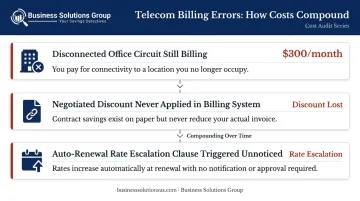
None of these errors is dramatic on its own. Together, across 18 months and multiple locations, they represent real money that's gone and unrecoverable once the carrier's dispute window closes.
The dispute window is shorter than most teams expect. Lumen's billing guidelines, for example, specify that billing requests must be submitted within 90 days of the invoice date — meaning long-undetected errors frequently can't be disputed even after they're found.
The organizations with the highest exposure are those managing telecom across multiple locations, carriers, and service types. As portfolio complexity grows, manual reconciliation becomes impractical. Errors that would be obvious in a single-carrier, five-location operation become invisible in a 50-location environment with six carriers and 200 invoices per month. That's precisely why a structured audit process — not periodic spot-checks — is the only reliable way to catch what manual review misses.
Key Cost Drivers for Telecom Billing
Understanding where overcharges originate determines which audit strategies actually recover money. There are five primary drivers — each requires a different detection method.
Contract-to-Invoice Mismatches
Carrier billing systems are not automatically updated when contracts are amended, rates are renegotiated, or promotional pricing expires. The result: organizations are frequently invoiced at outdated rates long after signing better terms.
Auto-renewal clauses compound this problem. When a contract renews without active management, the billing system continues at whatever rate applied before — including any escalation built into the renewal language.
Both Verizon and Lumen's master service agreements reserve the right to increase rates on renewed services with as little as 30 days' written notice. That notice is technically provided, but it's rarely formatted in a way that flags as urgent or actionable.
Ghost Services
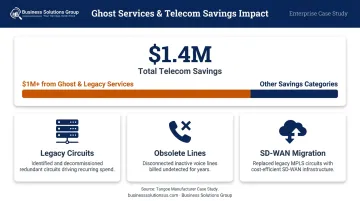
Ghost services are circuits, voice lines, SIP trunks, or backup connections that remain active and billable after the underlying business need disappears. Office closures, SD-WAN migrations, UCaaS deployments, and vendor switches all create conditions where disconnect orders simply don't get submitted.
The scale of this problem is documented. Tangoe's case study of a manufacturer operating across 100+ countries found more than $1M of the $1.4M in total telecom savings came from discovering legacy services that were obsolete or no longer in use following an SD-WAN modernization.
Rate and Tariff Errors
Carriers may apply incorrect service tiers, outdated tariff codes, or Type 2 (resold) access pricing at locations where Type 1 (direct) access is available. According to APX Net, Type 1 circuits carry more competitive pricing because only one network is involved — being billed at Type 2 rates when Type 1 access exists adds unnecessary markup that won't appear in a simple contract comparison.
This driver is difficult to catch because it requires external market data, not just a review of your signed agreement.
Cost Allocation Errors
When telecom charges are mapped to the wrong department, location, or GL code, the distortion travels downstream into budget decisions. A shared WAN circuit allocated entirely to one branch can make that location appear uneconomical — skewing staffing, real estate, and operational decisions.
Cost allocation errors don't reduce total spend directly, but cross-referencing telecom invoices against your GL coding structure on a quarterly basis is the most reliable way to catch them before they compound.
Usage-Based and One-Time Charge Anomalies
Several charge types can appear on a single invoice and blend into normal variation:
- Overages on burstable bandwidth
- Duplicate installation or activation fees
- Unauthorized non-recurring charges
- Late payment fees triggered by carrier billing errors
Month-over-month variance analysis is the primary — and often only — detection method for this category.
Cost-Reduction Strategies for Telecom Billing
Effective strategies depend on where in the billing lifecycle the cost originates. Recovering credits from a past error is a different process from preventing the next one, which is different again from changing the structural conditions that make errors possible. The sections below address all three.
Strategies That Change Decisions
Build a complete service inventory first. No audit strategy works without an accurate picture of every active service, carrier, location, and contracted rate. That inventory must be built from actual invoices, not internal records, which are almost always outdated. This is the prerequisite to everything else.
Benchmark contracted rates against current market pricing. Telecom pricing declines over time as infrastructure costs decrease and competition increases. IEEE ComSoc's summary of Gartner research shows fixed enterprise network service prices in developed markets have declined 5–20% annually since 2012, depending on service type and region. A rate that was competitive 30 months ago may now be substantially above market. Entering renegotiations with current benchmark data — rather than internal assumptions — is the difference between recovering real dollars and accepting outdated pricing.
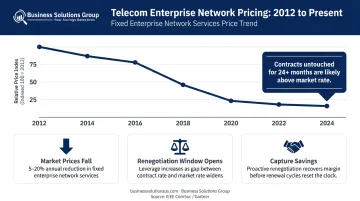
Challenge auto-renewal windows before they close. Most telecom contracts include 60–90 day notice windows for rate or renewal changes, windows carriers are not required to highlight. Organizations that miss these windows are locked into higher rates for another full term. Tracking renewal dates proactively and requiring written notification 90+ days in advance gives you the most negotiating leverage before talks even begin.
Right-size services during the renewal window. Organizations frequently retain bandwidth or service tiers provisioned for peak demand that never materialized, or hold legacy capacity after cloud migrations. The renewal window is the highest-leverage point to address utilization mismatches, since leverage drops significantly once a new contract is signed.
Strategies That Change How Billing Is Managed
Establish monthly variance tracking. Comparing each invoice against the prior month and contracted rates, with a defined threshold of 5–10% triggering a review, catches new billing errors before they compound across multiple cycles.
Build a formal dispute management process. Recovering overcharges requires documentation (contract references, invoice screenshots, a clear timeline), filing within the carrier's dispute window, and consistent follow-up. Assign ownership to a specific person or team — disputes that go untracked go unresolved.
Implement Quarterly Business Reviews with carriers. A regular governance cadence, covering billing snapshots, expiration dates, open tickets, and credit inquiries, creates accountability on both sides and surfaces issues before they escalate. QBRs also provide a natural setting for renegotiation conversations.
Use spend intelligence tools to automate what manual tracking can't sustain. As telecom portfolios grow across carriers, locations, and service types, spreadsheet-based tracking becomes a liability. Business Solutions Group's spend intelligence software automates invoice processing, flags anomalies, and tracks contract milestones across telecom and broader operational spend — at a scale internal headcount can't match.
Strategies That Change the Structural Context
Clean up legacy services after technology transitions. SD-WAN migrations, UCaaS deployments, and cloud moves consistently leave behind MPLS circuits, legacy PBX lines, and backup connections that continue billing because no one submitted a disconnect order during the transition. A formal decommissioning checklist tied to every technology transition prevents these post-migration orphan services from accumulating.
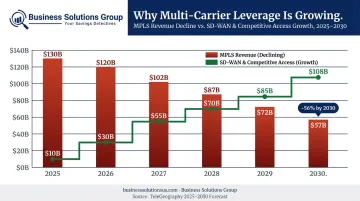
Leverage multi-carrier competition. SD-WAN and competitive access providers mean organizations are no longer locked into a single Tier 1 carrier. Introducing a credible alternative bid into a negotiation, even without intent to switch, gives the incumbent carrier a financial incentive to match current market rates. TeleGeography projects MPLS revenue to fall from $130B in 2025 to $57B by 2030, reflecting how thoroughly the alternative access market has matured.
Manage regulatory fees as a distinct category. USF fees, state communications taxes, and 911 surcharges add meaningfully to base telecom costs, and some are applied incorrectly to exempt service types or at wrong percentages. Avalara notes that enterprises with a national footprint may need to track across as many as 60,000 state and federal tax jurisdictions, making periodic fee reviews a real recovery opportunity.
Consolidate vendors strategically, not completely. Consolidating carriers serving the same locations simplifies billing management and unlocks volume pricing. But over-consolidation to a single vendor creates operational risk if that carrier experiences an outage at a critical site. The right structure is consolidation with retained redundancy at your most business-critical locations.
Conclusion
Reducing telecom billing costs requires knowing where those costs actually originate — whether that's a contract never updated in the carrier's billing system, an idle circuit no one decommissioned, or rates the market has long since moved past. Applying blanket cuts to telecom spend without that visibility risks eliminating services the business still needs while leaving the real waste untouched.
The organizations that sustain the deepest savings treat telecom billing discipline as an operational practice, not a one-time project. They assign clear ownership, build monthly controls into their financial cadence, and treat each contract renewal window as a structured opportunity to evaluate both what they're paying and what they still need. Done consistently, auditing shifts from a recovery exercise into a built-in mechanism for protecting margin — one that compounds in value each time a billing error is caught before it compounds for another year.
Frequently Asked Questions
What is a telecom billing audit?
A telecom billing audit is a structured review of carrier invoices against contracts, service inventory, and current market rates. It's designed to identify billing errors, ghost services, and contract mismatches before they accumulate across billing cycles.
How can telecom billing audits reduce costs?
Audits recover direct overcharges through billing disputes while also surfacing structural savings — unused service disconnections, contract renegotiation opportunities, and rate corrections that reduce ongoing costs rather than just recovering past ones.
How much do telecom expense management and billing audit services cost?
Tellennium reports that managed TEM services priced on a percentage-of-spend model typically range from 1–5% of aggregate telecom spend, with the rate decreasing as spend volume grows. Contingency audit models tie fees to recovered savings only. Recoveries typically exceed audit fees by a wide margin.
What are the most popular telecom billing systems?
Tangoe (recognized as a Representative Vendor in Gartner's TEM Market Guide), Calero, and Cass Information Systems are the most commonly referenced enterprise TEM platforms. The right fit depends on portfolio complexity, internal resources, and whether a managed service or software-only model suits the organization.
How often should a business conduct a telecom billing audit?
A formal audit at least annually, with monthly invoice variance reviews as a standard practice. Organizations managing 10+ locations or 3+ carriers benefit from continuous monitoring rather than relying on periodic audits alone.
What are the most common telecom billing errors businesses overlook?
Contract rate mismatches (where negotiated rates were never applied in the billing system), ghost services at vacated locations, auto-renewal rate escalations, and misapplied regulatory surcharges are the errors most overlooked in routine invoice reviews.