For CFOs and CIOs, the response has shifted from annual budget reviews to continuous spend governance — and increasingly, that requires outside expertise.
IT cost optimization consulting firms help organizations audit their technology spend, eliminate waste, renegotiate vendor contracts, and build frameworks to prevent cost creep from returning. But not every firm brings the same depth or focus. Some specialize in cloud FinOps. Others are stronger in IT governance or supply chain technology. Choosing the wrong partner means paying for recommendations that never get implemented.
This guide covers the top IT cost optimization consulting firms in 2026, what makes each one stand out, and the criteria that should drive your selection decision.
Key Takeaways
- IT cost optimization consulting covers cloud FinOps, SaaS rationalization, vendor contracts, infrastructure, and AI spend governance — far beyond simple software license audits.
- The best firms combine proprietary analytics tools with technology-agnostic advisory and a proven methodology for sustaining savings long-term.
- Firms range from global consultancies like Accenture and Deloitte to specialized boutiques like Business Solutions Group.
- In 2026, AI cost governance and SaaS rationalization have moved to the top of the optimization agenda alongside cloud FinOps.
- Performance-based engagement models — where the firm's compensation ties to your savings — are the clearest signal of a credible partner.
What Is IT Cost Optimization Consulting?
IT cost optimization consulting is the practice of identifying, analyzing, and reducing unnecessary or inefficient technology expenditure — across software licensing, cloud infrastructure, managed services, hardware, and vendor contracts — while preserving or improving business performance.
Unlike a one-time budget cut, Gartner defines cost optimization as a strategic, ongoing process that reduces low-value spend, improves efficiency, and reinvests recovered capital into future value. The FinOps Foundation frames the same discipline as creating financial accountability through collaboration between engineering, finance, business, and procurement.
Why 2026 Is a Critical Inflection Point
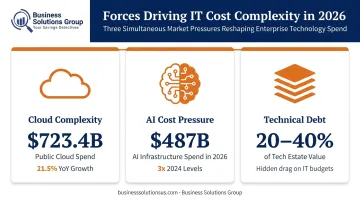
Three simultaneous forces have made IT spend governance harder than ever:
- Cloud complexity: Public cloud end-user spending hit $723.4 billion in 2025, up 21.5% from the prior year. Most organizations now manage multi-cloud environments with limited visibility into actual consumption.
- AI cost pressure: IDC projects AI infrastructure spending at $487 billion in 2026 — more than triple 2024 levels — creating an entirely new cost category that most IT governance models weren't designed to handle.
- Technical debt: McKinsey reports that CIOs estimate technical debt at 20% to 40% of their technology estate's total value, a hidden cost base that compounds over time.
SaaS proliferation and rising vendor contract complexity add further pressure. The firms below were selected based on their ability to deliver measurable outcomes across these categories — not just their advisory reputation.
Top IT Cost Optimization Consulting Firms in 2026
These firms were evaluated on advisory depth, proprietary tooling, client track record, and their ability to address 2026-specific cost pressures including cloud, AI, and SaaS sprawl.
Accenture
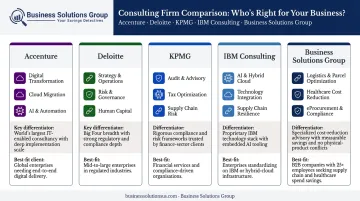
Accenture operates one of the largest technology consulting practices globally, with a dedicated FinOps and IT cost management capability that spans cloud, infrastructure, and enterprise software advisory. Its scale gives clients access to cross-industry benchmarking data that few firms can match. Seeing how your spend compares against sector peers is a concrete advantage during vendor negotiations, and Accenture's data depth makes that comparison credible.
What distinguishes Accenture is its strategy-through-execution model. Many large consultancies deliver a roadmap and leave. Accenture is structured to follow through on implementation, which matters because the gap between a savings recommendation and actual savings realized is where most engagements fail. Its multi-cloud FinOps approach, documented in client work with GOSP, reported 15% savings versus budget baseline in a managed cloud cost accounting and optimization engagement.
| Category | Detail |
|---|---|
| Focus Areas | Cloud FinOps, SaaS rationalization, IT vendor management, infrastructure optimization |
| Key Differentiators | AI-powered spend analytics, strategy-through-execution model, global benchmarking scale |
| Best Suited For | Large enterprises with complex multi-cloud environments and high-volume vendor portfolios |
Deloitte Consulting
Deloitte's technology cost advisory practice sits within a broader consulting platform that covers cloud financial management, digital transformation ROI, and IT portfolio governance. Its Cloud FinOps Services offering helps organizations build customized cloud financial management models, moving beyond reporting dashboards to embedding cost accountability into engineering and procurement decisions.
Deloitte Ascend, its AI-infused delivery platform, accelerates the pace of analysis and recommendation development without replacing the judgment of the advisory team. For regulated industries, Deloitte's integrated audit-advisory model stands apart: the same firm advising on cloud cost reduction also carries direct knowledge of the compliance and risk implications of those changes. Deloitte predicts $21 billion may be saved by companies implementing FinOps tools and practices. Actual savings depend heavily on organizational maturity and governance adoption, but the figure reflects just how much is still being left on the table.
| Category | Detail |
|---|---|
| Focus Areas | Cloud cost governance, IT portfolio rationalization, technology vendor risk, FinOps strategy |
| Key Differentiators | Integrated audit-advisory model, Deloitte Ascend delivery platform, compliance-linked cost lens |
| Best Suited For | Regulated industries and large enterprises needing IT cost optimization tied to governance and compliance |
KPMG Advisory
KPMG's technology advisory practice focuses on IT cost transparency, vendor contract optimization, and Technology Business Management (TBM): a discipline that aligns IT costs to business services and outcomes rather than treating technology as a black-box expense. This makes KPMG particularly strong when the primary challenge isn't finding savings, but building internal credibility around where the money goes and why.
Its benchmarking methodology compares client spend against industry norms, giving CIOs and CFOs external validation when pushing for internal budget changes. KPMG's cloud cost optimization and cyber cost optimization practices extend this framework into specific spend categories. What separates KPMG's delivery model is its focus on building internal cost governance capabilities that outlast the engagement — rather than creating reliance on continued external support.
| Category | Detail |
|---|---|
| Focus Areas | IT benchmarking, vendor contract renegotiation, technology portfolio assessment, cost transparency |
| Key Differentiators | TBM and cost transparency framework expertise, governance-focused delivery, strong public sector track record |
| Best Suited For | Mid-to-large enterprises seeking benchmarking validation and structured IT cost governance frameworks |
IBM Consulting
IBM Consulting occupies a unique position in this market: it is both a technology company and a consulting firm, which means its advisors have firsthand knowledge of the cost drivers behind enterprise IT, particularly in hybrid cloud, AI infrastructure, and legacy modernization. That insider understanding of infrastructure economics often surfaces savings that purely advisory firms miss.
IBM Consulting Advantage, its AI services platform powered by watsonx, equips consultants with assistants that accelerate analysis and recommendation development. Early adopter teams reported productivity improvements of up to 50% in application design and development pilots, translating into faster time-to-value for clients in complex modernization engagements. For organizations with significant legacy infrastructure, IBM's depth in application modernization often unlocks the largest cost savings available, since modernization and cost reduction are effectively the same initiative when legacy systems are the primary cost driver.
| Category | Detail |
|---|---|
| Focus Areas | Hybrid cloud cost optimization, AI infrastructure rationalization, legacy modernization, IT automation |
| Key Differentiators | IBM Consulting Advantage AI platform, combined tech-and-consulting model, modernization-linked cost reduction |
| Best Suited For | Enterprises with significant legacy infrastructure or complex hybrid cloud environments |
Business Solutions Group
Business Solutions Group is a specialized cost optimization firm headquartered in Mission Viejo, CA, with a focused track record in supply chain, logistics, and freight-intensive operations. Where the global consultancies listed above are built for broad enterprise IT advisory, Business Solutions Group is built around a specific problem: helping businesses with complex shipping and logistics spend recover margin they didn't know they were losing.
Engagements start with a complimentary benchmark analysis, completed in roughly one week, using a proprietary database of market-appropriate carrier rates to show exactly what a client should be paying versus what they actually pay. No upfront cost, no commitment required. If measurable savings exist, the engagement proceeds. If they don't, the client leaves with better data than they arrived with.
The firm's compensation is structured as a percentage of savings achieved monthly, which directly aligns its incentives with client outcomes. Clients have collectively saved over $1 billion in shipping costs through Business Solutions Group's carrier contract negotiations.
Typical savings by category:
- Parcel contracts: 15%–40% average savings
- Freight contracts: 20%–25% average savings
- Telecommunications costs: 10%–25% savings
- Payment processing fees, banking, and treasury expenses: addressed through spend analysis and renegotiation
Ongoing monitoring and a dedicated client success team sustain those savings after initial contracts are renegotiated.
| Category | Detail |
|---|---|
| Focus Areas | Supply chain IT cost optimization, eProcurement, carrier contract benchmarking, spend intelligence |
| Key Differentiators | Performance-based advisory model, proprietary rate benchmarking database, end-to-end cost reduction from carrier contracts to IT and procurement spend |
| Best Suited For | Small parcel shippers, freight companies, and logistics-driven businesses seeking integrated IT and operational cost reduction |
How We Chose the Best IT Cost Optimization Consulting Firms
The firms on this list were assessed on one primary question: can they deliver measurable, sustained IT cost reductions — not just a well-formatted report?
The most common mistake organizations make is selecting a firm based on brand name without verifying whether it has specific IT cost optimization expertise versus general management consulting capability. A firm that excels at digital transformation strategy may have limited experience in vendor contract renegotiation or SaaS license governance — two areas where the difference in outcomes is significant.
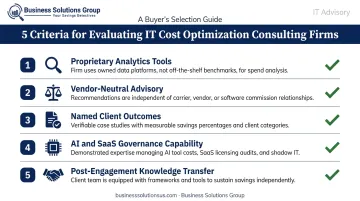
Core Selection Criteria
- Proprietary spend analytics platforms, benchmarking databases, or AI-assisted analysis — manual reviews routinely miss savings these tools surface
- Vendor-neutral advisory with no financial stake in the tools or platforms they recommend
- Named client outcomes with specific savings figures, not aggregate testimonials or vague case studies
- Active capability in AI spend governance, SaaS rationalization, and cloud FinOps — firms still focused on hardware refreshes and headcount cuts are working from an outdated playbook
- Post-engagement knowledge transfer that leaves your team with the processes and tools to prevent cost creep from returning
Before any engagement starts, ask the firm to walk through their methodology and show prior client results with hard numbers. If they can't do that, keep looking.
Conclusion
IT cost optimization in 2026 covers more ground than it did three years ago. Cloud FinOps, AI spend governance, SaaS rationalization, and supply chain technology efficiency have all moved into scope — and managing them effectively requires a partner with the right tooling and the right focus for your organization's specific cost profile.
Size and reputation matter less than methodology and fit. A global firm with a broad advisory practice may be the right fit for a large enterprise with multi-cloud complexity and regulatory exposure.
A specialized firm like Business Solutions Group may deliver faster, more measurable results for a logistics or freight business — particularly where carrier contracts and supply chain IT costs represent the largest optimization opportunity.
Evaluate firms on their benchmarking data, their proprietary analytics capabilities, and their willingness to stay engaged through implementation. A recommendation that stalls at the advisory stage delivers no return; execution accountability is what separates useful engagements from expensive ones.
For businesses with supply chain, logistics, or freight operations looking to reduce IT and operational costs without disrupting performance, Business Solutions Group offers a no-obligation spend assessment that benchmarks your carrier contracts, freight spend, and supply chain technology costs against current market rates. Contact the team at +1 949-525-7677 or visit businesssolutionsus.com to get started.
Frequently Asked Questions
What are the IT services consulting industry trends for 2026?
Three trends dominate: AI cost governance (worldwide AI spending is forecast at $2.527 trillion in 2026), cloud FinOps maturity moving from reporting to active policy enforcement, and SaaS rationalization entering the FinOps scope. The FinOps Foundation's 2026 survey found that 98% of respondents now manage AI spend, up from 63% the prior year.
What does an IT cost optimization consulting firm actually do?
These firms audit current IT spend across software, cloud, infrastructure, and vendor contracts; identify redundancy and overspend; renegotiate unfavorable agreements; and build governance frameworks to prevent waste from recurring. The best engagements don't end with a report — they end with internal processes and tools that sustain savings independently.
What is the difference between IT cost optimization and IT cost reduction?
Cost reduction is a one-time exercise focused on cutting spend in a specific period. Cost optimization is an ongoing discipline that balances eliminating waste with sustaining or improving technology performance and business value. Optimization treats IT spend as a continuous governance responsibility, not a crisis response.
How much can businesses typically save by hiring an IT cost optimization consultant?
Savings vary significantly based on cloud maturity, SaaS usage, vendor contract terms, and governance maturity. Accenture's GOSP engagement reported 15% savings versus budget baseline in multi-cloud FinOps; Deloitte estimates $21 billion in aggregate savings from FinOps adoption; Business Solutions Group clients average 15–40% on parcel contracts and 20–25% on freight. There is no universal benchmark — insist on scoped estimates tied to your specific spend profile.
What areas of IT spending are most commonly targeted for cost optimization?
The five primary categories are:
- Cloud infrastructure and compute workloads
- SaaS licensing and underutilized subscriptions
- AI infrastructure and GPU capacity planning
- Hardware refresh cycles and legacy modernization
- Vendor contracts and managed service agreements
How do I choose the right IT cost optimization consulting firm for my business?
Prioritize firms with relevant industry experience, proprietary analytics tools, and technology-agnostic advisory with no vendor conflicts of interest. Ask for prior client outcomes with specific savings figures, confirm they have a clear methodology before the engagement starts, and look for a compensation model where their success is tied to your results — not the delivery of a presentation.