Introduction
Gartner forecasts worldwide IT spending to reach $6.08 trillion in 2026, a 9.8% increase from 2025. For most organizations, that trajectory creates real pressure — not because technology is inherently expensive, but because spending tends to outpace the governance needed to manage it.
Uncontrolled IT costs compress margins, delay strategic investments, and force reactive cuts that hurt performance more than they help budgets. The typical response — a one-time spend review followed by across-the-board reductions — rarely holds. Costs creep back.
A more durable approach starts with diagnosing where costs actually originate — in purchasing decisions made before IT is deployed, in the operational habits that inflate costs once it's running, and in the governance structures (or lack of them) that allow both to persist unchecked.
This article examines each of those dimensions and the strategies that address them directly:
- How pre-deployment purchasing decisions set the cost baseline
- Why operational habits quietly drive up ongoing IT spend
- What governance structures prevent costs from creeping back
- Which optimization strategies deliver lasting results
Key Takeaways
- IT costs accumulate gradually through procurement, renewals, and usage patterns — rarely as one traceable expense
- The biggest cost drivers are overprovisioning, unused licenses, unmanaged vendor contracts, and lack of real-time visibility
- Effective optimization addresses decisions, management practices, and the surrounding vendor and infrastructure environment
- Cost optimization is continuous and strategic — not a one-time budget cut
- Building cost-conscious habits across IT and finance redirects savings toward growth — not just lower spend
How IT Costs Typically Build Up
IT budget overruns rarely announce themselves. They build up through ordinary decisions: a SaaS subscription added during a product evaluation, a server tier expanded ahead of anticipated demand, a software license that outlives the team that used it.
Each decision looks reasonable in isolation. Collectively, they compound. By the time the pattern becomes visible — usually during a financial review or audit — the costs are already embedded in operating budgets and difficult to unwind.
Three dynamics drive this buildup:
- Subscription sprawl: SaaS tools are easy to add and easy to forget. Zylo's 2025 SaaS Management Index found that organizations waste an average of $21M annually on unused SaaS licenses, up 14.2% year over year.
- Shadow IT: Employees and departments procure tools outside of IT's visibility. Zylo estimates that one in 15 employees expenses software independently, with shadow IT accounting for roughly 4% of total SaaS spend.
- Governance gaps: Without centralized visibility and spending policies, inefficiencies persist undetected across business units.
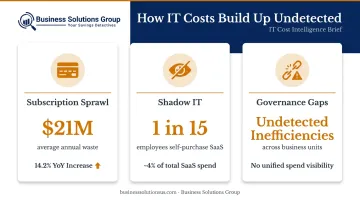
The underlying problem is a lack of ongoing oversight — without it, small purchasing decisions accumulate into embedded costs that are hard to reverse once they appear in an audit.
Key Cost Drivers for IT Spending
IT cost optimization fails when it starts with cutting rather than diagnosis. Three categories consistently account for the bulk of overspend, and the right fix depends on knowing which one applies to your environment.
Procurement Decisions
What you buy, at what tier, and under what contract structure sets your cost floor before IT is ever deployed. Overprovisioning is the most common default in IT budgeting: organizations spec for anticipated peak demand, then carry that overhead indefinitely.
Flexera's 2026 State of the Cloud Report estimates that 29% of IaaS/PaaS cloud spend is wasted, based on a survey of 753 cloud decision-makers. Poor sizing decisions at procurement are the primary driver of that waste.
Operational Usage Patterns
Even well-scoped purchases drift over time. Resources provisioned for peak workloads rarely get scaled back. Licenses assigned to employees stay active after turnover. Cloud instances continue running when the workloads they support have ended.
The same Flexera report found that **84% of organizations struggle to manage cloud spend**, with budgets exceeding limits by 17% on average. That gap is largely operational drift, not a procurement problem.
Governance and Visibility Gaps
The third driver is structural: when IT and finance lack shared visibility into spending, problems go undetected. Key failure patterns include:
- No centralized asset or license inventory
- Shadow IT procurement across departments
- Disconnected budgets between IT and business units
- Absent or infrequent spend review processes
Most organizations carry problems across all three categories — but one usually dominates. Identifying that primary driver determines where optimization effort should concentrate first.
Cost-Reduction Strategies for IT
Generic cost-cutting applied without diagnosis tends to degrade performance without delivering lasting savings. The strategies below are organized by where they intervene: before IT is deployed, after it's running, or in the surrounding environment that shapes both.
Strategies That Reduce Costs by Changing Decisions
These are the highest-leverage interventions because they shape cost structure before spending becomes locked in.
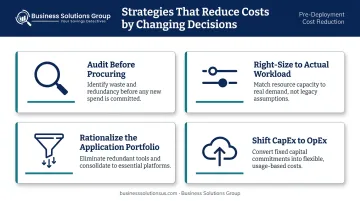
- Audit before procuring. Knowing what's already owned, actively used, and underutilized prevents redundant purchases. McKinsey found that systematic application simplification can reduce an application portfolio by 30–40% and cut total cost of ownership by 15–20%.
- Right-size to actual workload data. Resist provisioning for anticipated peak demand. Align specifications to verified usage, then build in deliberate headroom — not reflexive excess.
- Rationalize the application portfolio. Evaluate which tools deliver measurable value, which overlap with other systems, and which have outlived their purpose. Reducing sprawl cuts licensing costs and simplifies management at the same time.
- Shift from CapEx to OpEx where it makes sense. Cloud and SaaS arrangements let organizations pay for what they use and scale down as needs change — eliminating the sunk costs tied to underused long-term hardware commitments.
Strategies That Reduce Costs by Changing How IT Is Managed
Poor management of existing assets is frequently a larger cost problem than the original purchasing decision.
- Implement continuous cost monitoring. Without real-time visibility into usage and spend, inefficiencies accumulate undetected. Idle cloud instances, unused licenses, and unexpected charges routinely go unnoticed for months without automated alerting and dashboards.
- Automate repetitive IT processes. Provisioning, patch management, resource scaling, and routine reporting are all strong candidates. Forrester TEI studies have reported ROI figures of 195–204% for ITSM automation programs — the figures are case-specific, but the direction is consistent: removing labor-intensive manual tasks compounds savings quickly.
- Actively manage software license consumption. Track actual usage against purchased entitlements, reclaim unused licenses, and renegotiate volume agreements on verified data. Flexera's 2025 State of ITAM Report found that 45% of organizations paid software audit true-up costs of $1M or more — a direct consequence of unmanaged license positions.
- Build cost awareness across teams. When developers, procurement leads, and operations managers understand how their decisions affect IT spend, waste gets caught earlier. Shared visibility and clear accountability make this practical rather than aspirational.
Strategies That Reduce Costs by Changing the Context Around IT
In many cases, the surrounding environment — not the technology itself — is the primary cost driver.
- Consolidate vendors and negotiate from a position of knowledge. Organizations that understand their actual consumption patterns, benchmark pricing against industry norms, and consolidate spend with fewer strategic partners consistently secure better contract terms. Spend intelligence tools surface negotiation opportunities that internal teams often miss — particularly when they lack access to real-world contract benchmarks for comparison.
- Consolidate fragmented infrastructure. Reducing physical data center footprints lowers facility, power, cooling, and maintenance costs while improving utilization of remaining assets. McKinsey estimated that consolidating to enterprise standardization levels could yield savings of up to 50% in some environments.
- Match IT supply to actual demand cycles. Static provisioning means paying for peak capacity around the clock. When cloud and on-premise resources scale with business demand — up during high-use periods, down during low-use windows — costs fall without any reduction in service quality.
- Use benchmark analysis to make cost conversations evidence-based. Comparing IT spend against industry or peer-group norms shifts internal debates from opinion-driven to data-driven. Business Solutions Group's spend intelligence capabilities identify where optimization will yield the greatest return — across cloud, licensing, vendor contracts, and support. Benchmarking identifies where optimization will yield the greatest return across cloud, licensing, vendor contracts, and support.
Conclusion
Reducing IT costs starts with an honest diagnosis of where costs actually originate — in procurement decisions, operational habits, or the structural environment around IT. Blanket cuts applied without that diagnosis tend to trim capability along with waste, leaving organizations worse off on both dimensions.
Effective optimization is continuous, not periodic. Organizations that treat it as an ongoing discipline — rather than a response to budget pressure — are better positioned to redirect savings toward growth initiatives rather than just defending margin. Organizations that build this discipline early spend less time recovering from budget pressure and more time deploying capital where it generates returns.
Frequently Asked Questions
What is the difference between IT cost optimization and IT cost reduction?
Cost reduction is a one-time, reactive action focused on cutting spend quickly. Cost optimization is a continuous and strategic process focused on maximizing value and efficiency over time — without compromising performance or capability.
What are the most common drivers of IT cost overruns in organizations?
Overprovisioning, unused software licenses, unmanaged vendor contracts, shadow IT, and lack of real-time cost visibility are among the most frequent culprits. Each issue is manageable on its own, but together they add up fast — often going unnoticed until a financial review or audit surfaces the full picture.
How often should organizations conduct IT cost audits?
At minimum, annually. Organizations with significant cloud or SaaS spend benefit from quarterly reviews. Continuous monitoring tools make formal audits more targeted by surfacing anomalies in real time, so reviews can focus on decisions rather than discovery.
How can small and mid-sized businesses approach IT cost optimization without large IT teams?
Start with basic asset inventories, application rationalization, and vendor contract reviews. Business Solutions Group provides spend benchmarking and contract intelligence that smaller teams typically lack in-house, without the need for a dedicated procurement function.
What role does vendor management play in IT cost optimization?
Vendor contracts often represent a significant and negotiable portion of IT spend. Organizations that benchmark pricing, consolidate supplier relationships, and renegotiate based on actual usage data consistently reduce costs without changing their underlying technology stack.
How do you measure whether an IT cost optimization effort is working?
Meaningful metrics include cost per workload or per user, percentage reduction in unused licenses and idle resources, vendor contract savings, and the share of IT budget redirected toward growth initiatives — all tracked over time against a clear baseline established at the start of the program.