Most businesses treat TMS and WMS as separate tools with separate teams. That separation is the problem. The measurable value of both systems comes from their connection — shared data, automated handoffs, and a unified view of operations from warehouse shelf to customer doorstep.
This article breaks down what TMS–WMS integration actually changes on the ground: where the cost savings come from, why fulfillment speed improves, and what operational breakdowns you can expect when these systems stay siloed.
Key Takeaways
- A TMS manages freight logistics; a WMS manages warehouse operations — integration makes both faster and smarter by sharing live data between them.
- Connected systems eliminate manual handoffs, reduce data entry errors, and compress order cycle times.
- Key gains: real-time operational visibility, lower transportation and warehousing costs, and faster, more accurate fulfillment.
- Siloed systems create bottlenecks that compound as order volumes grow, turning today's inefficiencies into tomorrow's scaling constraints.
- ROI peaks when integration is tracked against clear KPIs and supported by real change management.
What Is TMS–WMS Integration?
TMS–WMS integration connects a Transportation Management System and a Warehouse Management System so they share data in real time. The result is a single operational view that spans from inventory on the warehouse shelf to freight in transit.
According to Gartner, a TMS supports multimodal transport planning and execution across carriers and geographies. A WMS, as described by ISM, functions as a control center for storage, labor, and order flow — coordinating inbound receipts, picking, packing, and shipping with real-time data.
When these systems operate independently, the gap between them is filled by manual processes: phone calls, spreadsheet reconciliation, and status updates that lag behind reality. Integration closes that gap.
Where integration typically applies:
- Distribution centers managing high outbound volumes
- 3PL operations where carrier performance drives client SLAs
- eCommerce fulfillment where speed and tracking accuracy are non-negotiable
- Manufacturing and retail businesses managing both inbound freight and outbound orders
The real objective is eliminating operational gaps — delayed handoffs, inventory mismatches, manual data entry — that occur when warehouse and transportation teams work from different data sets. Connecting two software platforms is the mechanism; removing friction across the full order lifecycle is the outcome.
That's where TMS advisory and integration services add measurable value. Business Solutions Group helps businesses implement TMS solutions that connect with WMS, ERP, and accounting software through open APIs and pre-built connectors, so order data flows accurately from sales through shipping to billing without manual re-entry.
Key Advantages of TMS–WMS Integration
The advantages below reflect outcomes that logistics and supply chain managers actively track — not theoretical efficiency gains. They also compound: the more consistently integration is applied, the stronger the results across cost, speed, and service quality.
End-to-End Operational Visibility and Real-Time Data Sharing
When TMS and WMS share live data, both systems work from the same source of truth. Inventory levels, order status, carrier availability, and dock schedules update in real time across both platforms.
In practice, this means that when a warehouse confirms an order as picked and packed in the WMS, the TMS automatically initiates the next step — carrier scheduling, route planning, shipment confirmation — without a person manually triggering it. That automation removes the lag time that accumulates at every manual handoff.
Why the cost of manual coordination is real:
Supply chain operations typically see manual data entry error rates of 2–4%, with each error costing between $15 and $150 to correct. At scale — 10,000 orders per month with a 4% error rate and $50 average correction cost — that's $240,000 per year spent fixing mistakes that integrated systems would prevent entirely.

Real-time visibility also changes how managers respond to disruptions. Inventory shortages, dock congestion, and carrier delays become visible as they happen — not after the fact. According to McKinsey data cited by FourKites, a 5–10% improvement in On-Time In-Full (OTIF) delivery can translate to a 1% increase in total revenue — a meaningful number at any scale.
KPIs directly impacted:
- Order processing time
- Shipment scheduling lead time
- Dock utilization rate
- Data entry error rate
- Workforce productivity per order
This advantage matters most for businesses managing multiple warehouse locations, high SKU counts, or scaling order volumes where manual coordination simply can't keep pace.
Reduced Transportation and Warehousing Costs
Integrated systems give freight planners something they can't get from siloed tools: accurate, real-time data on what's actually ready to ship. When the TMS draws directly from WMS data on outbound volumes and inventory readiness, it can consolidate partial loads, avoid sending trucks with unused capacity, and select the most cost-efficient carrier for each lane — before freight is staged, not after. That changes how loads are built, how routes are planned, and which carriers get selected.
The empty miles problem is significant. According to FreightWaves, trucks with dry van or reefer trailers drive approximately 34% of their miles empty. At an average operating cost of $2.26 per mile (ATA, 2024), those empty miles represent direct, recoverable waste that better freight planning addresses.
On measurable cost savings: ARC Advisory Group's TMS market research found that companies using a TMS achieve an average of 8% freight cost savings, with 60% of users reporting that TMS costs consume less than 10% of net savings. Facil, for example, achieved 12% annual freight cost avoidance after integrating LTL rating into their TMS.
Business Solutions Group's client data reflects similar outcomes. Across logistics optimization engagements, clients have achieved 20–25% reductions in LTL and freight spend, with small parcel shipping costs down 15–40%. The company's spend intelligence software surfaces specific cost levers: carrier performance by lane, mode shift opportunities, billing discrepancies, and route inefficiencies — all drawn from consolidated transportation and warehouse data.
KPIs directly impacted:
- Freight cost per unit shipped
- Load factor and fill rate
- Empty miles as a percentage of total mileage
- Carrier contract compliance rate
- Warehousing cost per square foot
Faster Order Fulfillment and Stronger Customer Experience
Integration compresses the time between an order being confirmed in the warehouse and the customer receiving it. When picking is complete, the TMS schedules the carrier automatically and pushes tracking information to the customer — with no manual queue, no system switching, no delay.
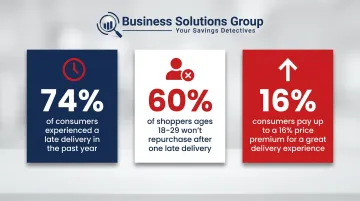
According to Narvar's 2025 State of Post-Purchase Report, 74% of consumers experienced at least one late delivery in the past year, and 60% of shoppers ages 18–29 say they won't buy from a brand again after a single late delivery. For eCommerce businesses, that churn risk is a direct revenue exposure — younger consumers defect fastest and carry the highest lifetime value.
The willingness-to-pay implications are equally significant. PwC research found that consumers will pay up to a 16% price premium for a great experience, and more than 40% would pay extra for same-day delivery. Falling short on either — even once — is enough to push buyers toward competitors who can deliver reliably.
For 3PLs, the stakes are structural: client SLAs are typically tied to on-time delivery benchmarks. A disconnected TMS and WMS means slower handoffs, less accurate tracking, and greater risk of SLA breach.
KPIs directly impacted:
- Order cycle time
- On-time delivery rate
- Shipment tracking accuracy
- Customer complaint and return rate
- Net Promoter Score (NPS)
What Happens When TMS and WMS Operate in Silos
When TMS and WMS run independently, operational costs compound quietly — and accelerate as order volume grows.
Common consequences of siloed TMS and WMS:
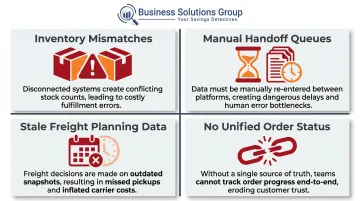
- Inventory mismatches — WMS data doesn't match TMS records, causing shipment delays and stock discrepancies that require manual correction before freight can move.
- Manual handoff queues — Orders sit waiting for a person to pass information from the warehouse team to transportation, inflating cycle times and creating fulfillment backlogs.
- Stale freight planning data — Transportation planning runs on estimated or outdated inventory snapshots, producing under-loaded trucks, missed consolidation windows, and avoidable premium carrier costs.
- No unified order status — Customer-facing support teams can't provide accurate delivery estimates because neither system holds the complete picture.
The financial cost of these gaps is documented. LeanDNA case studies show that Stanadyne achieved $2.1 million in inventory savings after breaking down siloed data systems, while a commercial kitchen equipment manufacturer realized a $7.2 million working capital improvement through the same approach.
Both outcomes trace back to the same root cause: decisions made on incomplete information. That lag shows up as expedited freight charges, excess buffer inventory, and missed consolidation opportunities — costs that are avoidable once the data gap closes.
At low volumes, these inefficiencies are manageable. At scale, they become severe constraints — turning integration from a nice-to-have into a hard operational requirement.
How to Get the Most Value from TMS–WMS Integration
Integration delivers its greatest ROI when it's implemented strategically, not just technically. The architecture matters, but so does how teams use the data once it's flowing.
Conditions where integration performs best:
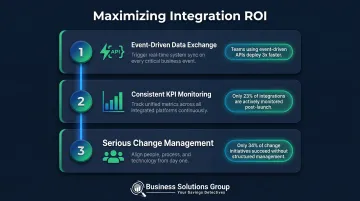
Event-driven data exchange — Systems connected via APIs or EDI should trigger automated workflows in real time, not batch timers. Gartner's research confirms this architecture shares granular data faster than batch file processing — a difference that compounds in high-volume operations where minutes translate to missed carrier windows.
Consistent KPI monitoring — Track metrics like freight cost per unit, order cycle time, and on-time delivery rate on a regular cadence. ARC Advisory Group found that companies continuing to refine their integration approach improved average freight savings by 2 percentage points over time — incremental gains that add up.
Serious change management — Only 34% of change management initiatives succeed (Gartner, 2025), and digital transformation failure rates reach 70–80%. The primary risk here is organizational readiness, not technical feasibility. Warehouse and transportation teams need training, aligned goals, and clear accountability from day one.
For businesses without internal expertise to audit their tech stack or benchmark carrier performance, a supply chain advisory partner can surface cost reduction opportunities that technology alone won't reveal.
Business Solutions Group offers a no-cost savings analysis, typically completed within 3–5 business days, that reviews 6–12 months of shipment data and establishes a clear financial baseline before any technology decisions are made.
Conclusion
TMS–WMS integration isn't a technology project for its own sake. Its value lies in the control, clarity, and coordination it gives businesses across warehouse and transportation operations — and the compounding financial and service improvements that follow when it's consistently maintained.
Real-time visibility reduces error costs, coordinated freight planning cuts transportation spend, and automated order handoffs compress fulfillment cycles. Each advantage reinforces the others. They grow stronger over time when integration is reviewed against KPIs and supported by teams who know how to act on the data.
Businesses that treat integration as a one-time implementation miss what it actually offers: a continuous improvement engine embedded in their operations. Those that treat it as a living part of their supply chain strategy build a lasting operational advantage: faster fulfillment, lower costs, and customer experiences that hold up as order volumes grow.
Frequently Asked Questions
What are WMS and TMS systems?
A WMS (Warehouse Management System) manages internal warehouse operations — inventory tracking, order picking, packing, and fulfillment. A TMS (Transportation Management System) manages the movement of goods outside the warehouse, covering carrier selection, route optimization, and shipment tracking.
What is TMS and WMS integration?
TMS–WMS integration connects both systems so they share real-time data, enabling automated handoffs between warehouse fulfillment and transportation scheduling. This eliminates manual processing, disconnected workflows, and the delays they create at every order handoff.
What is the difference between TMS, WMS, and ERP?
A WMS manages warehouse-level operations, a TMS manages transportation logistics, and an ERP (Enterprise Resource Planning) system manages broader business functions including finance, HR, and procurement. TMS and WMS are specialized execution tools; ERP provides enterprise-wide data management that may integrate with both.
What are the main types of warehouse management systems?
The three primary types are:
- Standalone WMS — dedicated systems with deep warehouse functionality
- ERP-integrated WMS modules — built into broader enterprise platforms
- Cloud-based WMS — SaaS solutions offering scalability and easier API-based integration with TMS and other logistics tools
Is TMS–WMS integration only for large enterprises?
No. Large enterprises often see faster ROI due to volume, but small and mid-sized businesses benefit significantly as order volumes grow and manual coordination becomes a bottleneck. Integrating earlier builds operational maturity that scales with the business.
What is the ROI of integrating a TMS with a WMS?
ROI varies by business size and baseline inefficiency. ARC Advisory Group data points to an average of 8% freight cost savings from TMS adoption, with individual cases like Facil reaching 12% annual freight cost avoidance. Labor productivity, shorter order cycles, and improved customer retention add further financial return on top of freight savings.