LTL is a shipping mode. A TMS is a management tool. They aren't alternatives — they work together. This article breaks down what each one is, how they differ, and how pairing the right LTL strategy with the right technology can meaningfully reduce freight spend.
Key Takeaways
- LTL shipping moves partial loads by sharing trailer space, covering freight between 150–15,000 lbs that doesn't require a full truckload
- A TMS automates carrier selection, rate shopping, shipment tracking, and freight audit across all modes, including LTL
- LTL and TMS work together — a TMS makes LTL shipping smarter, faster, and more cost-efficient
- Booking LTL manually limits rate visibility and lets billing errors go unchecked
- The right combination of LTL strategy and TMS access can reduce freight spend by 15–35%
What Is LTL Shipping and How Does It Work?
Less-than-truckload (LTL) shipping is freight transport for shipments that don't require a full trailer. Multiple shippers share space in a single truck, with each paying only for the portion they use. According to FreightWaves, LTL covers freight loads typically between 150 and 15,000 lbs — making it the go-to mode for businesses shipping more than a few parcels but far less than a full truckload.
How LTL Freight Actually Moves
LTL carriers use a hub-and-spoke model, not point-to-point delivery. Here's how a typical shipment moves:
- Pickup — Freight is collected from the shipper's location
- Local terminal — Shipment arrives at the nearest regional terminal
- Consolidation — Multiple shippers' freight headed the same direction is loaded into one trailer
- Linehaul — Combined freight moves between regional hubs
- Deconsolidation — Freight is sorted at the destination terminal
- Final delivery — Shipment is delivered to the consignee
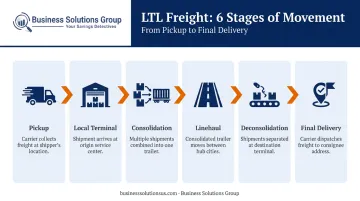
Each stop adds time — LTL transit typically runs 2–7 business days depending on distance and the number of hubs involved. That slower pace is the trade-off for cost efficiency: you pay only for the trailer space your freight actually occupies.
How LTL Pricing Is Calculated
LTL rates aren't a simple per-pound calculation. According to Old Dominion Freight Line, accurate LTL pricing requires:
- Shipment weight and dimensions/density
- Freight class (NMFC classification — standardized by the NMFTA)
- Origin and destination ZIP codes
- Accessorial charges (liftgate, residential delivery, inside pickup, etc.)
- Fuel surcharge
Rates vary significantly between carriers on the same lane. A shipper locked into a single carrier relationship often overpays by 15–30% compared to the market rate — which is where systematic rate management, and tools like a TMS, start to show their value.
What Is a Transportation Management System (TMS)?
A TMS is software that helps businesses plan, execute, and optimize freight shipments across multiple carriers and transportation modes. Gartner defines it as software supporting multimodal sourcing, planning, and execution of physical transport across the supply chain.
Core Capabilities of a Modern TMS
A well-built TMS does more than book shipments. Key capabilities include:
- Automated carrier selection — ranks carriers by cost, transit time, and service level
- Rate shopping — queries multiple carriers simultaneously for real-time comparisons
- Shipment tracking — centralized visibility across all carriers and modes
- BOL generation — automated documentation, eliminating manual entry
- Freight bill audit — catches invoice errors before payment
- Reporting and analytics — lane-level cost data, carrier performance metrics, and trend reporting
- ERP/WMS integration — connects logistics data to broader business systems
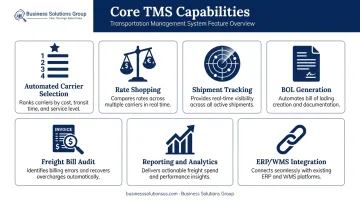
A single TMS platform can manage LTL, FTL, air, rail, parcel, and ocean freight — replacing the patchwork of carrier portals and spreadsheets most mid-market shippers still rely on.
The Shift to Cloud-Based TMS
Historically, TMS implementations required heavy IT infrastructure and six-figure budgets — which is why adoption remained low outside large enterprises. Cloud deployment has changed that equation. According to Mordor Intelligence, cloud-based TMS solutions captured 61.23% of market revenue in 2025 and are growing at a 9.61% CAGR, with SME adoption advancing at 9.67% CAGR.
Still, TMS remains underpenetrated in the mid-market. FreightWaves reported Gartner estimates showing TMS adoption at just 10% among small shippers and 25% among medium-sized shippers, compared to 50% for large shippers. Mid-market shippers still managing freight through carrier portals and spreadsheets are absorbing costs — overbilling, missed savings, and time lost — that a TMS would systematically eliminate.
LTL Shipping vs. TMS: Key Differences at a Glance
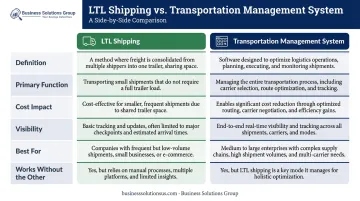
The most important thing to understand: LTL is a shipping mode, not a technology. A TMS is a management tool that helps you use LTL — and every other mode — more effectively.
| LTL Shipping | Transportation Management System (TMS) | |
|---|---|---|
| Definition | A freight transport mode for partial loads | Software for planning, executing, and optimizing freight |
| Primary Function | Move freight cost-effectively without filling a full truck | Manage carriers, rates, visibility, and billing across all modes |
| Cost Impact | Reduces per-shipment cost vs. FTL for partial loads | Reduces total freight spend through rate shopping, audit, and optimization |
| Visibility | Limited to individual carrier portals | Centralized dashboard across all carriers and shipments |
| Best For | Shipments 150–15,000 lbs not suited for FTL | Any business managing multiple carriers, modes, or origin points |
| Works Without the Other? | Yes — but manually and inefficiently | Yes — but LTL becomes significantly more expensive and opaque |
Where the Confusion Comes From
Most shippers start with LTL — they contact a carrier, get a rate, and book. At low volume, that process holds up. As shipment frequency grows and carrier relationships multiply, the cracks appear quickly: rates go uncompared, billing errors go unnoticed, and no one has a clear picture of what freight actually costs by lane, by customer, or by product line.
A TMS addresses all of those gaps. It sits on top of your existing carrier relationships — including LTL — and gives you the data, automation, and controls to manage freight spend at any volume.
How a TMS Enhances LTL Shipping Operations
Automated Rate Shopping
Without a TMS, rate shopping means calling or emailing multiple carriers and manually comparing quotes. With a TMS, that process is automated — the system queries your carrier network simultaneously and ranks results by cost, transit time, and service level. Every shipment gets the best available rate, not just whatever the carrier your team called first happened to quote.
Freight Audit and Billing Error Recovery
LTL billing errors are more common than most shippers realize. Transportation Insight reports that typical freight bill audits find 3% to 6% of invoices contain errors — often from incorrect accessorial charges or misapplied discounts. AFS Logistics found 4.5% of audited LTL invoices contained errors across nearly 12,000 reviewed shipments.
A TMS with freight audit capabilities catches these discrepancies before payment. For companies shipping frequently, that recoverable spend compounds quickly across a full year of invoices.
Business Solutions Group's freight audit and recovery service covers LTL specifically — reviewing every invoice to confirm clients pay only legitimate, agreed-upon charges, and working directly with carriers to recover overcharges when discrepancies are found.
Shipment Consolidation Opportunities
One of the highest-value features of a TMS is cross-shipment visibility. When the system sees all outbound shipments at once, it identifies when multiple LTL loads headed to the same region can be consolidated into a partial or full truckload — often cutting per-unit freight cost by 20% or more.
That kind of optimization is invisible when shipments are booked one at a time through separate carrier portals.
Carrier Performance Management
A TMS tracks on-time delivery rates, damage claims, and service consistency by carrier — giving logistics teams the data they need to make objective decisions about carrier relationships. Which LTL partners deserve more volume? Which contracts are underperforming against what was negotiated?
Answering those questions accurately requires more than a dashboard — it requires translating performance data into a negotiation strategy. Business Solutions Group's spend intelligence and carrier contract advisory services do exactly that: capturing 6–12 months of shipment-level data, building a financial baseline, and running side-by-side carrier comparisons with advanced analytical bid tools. For clients across their LTL programs, that process has delivered 15–35% savings.
Lane-Level Cost Reporting
A TMS generates the reporting that logistics and finance teams actually need: freight spend broken down by lane, by carrier, by customer, or by product line. That visibility makes it possible to align freight decisions with margin targets — not just operational convenience. Common outputs include:
- Freight spend per lane, flagging where rates have drifted above benchmark
- Carrier cost comparisons across similar origin-destination pairs
- Customer- or SKU-level freight cost allocation for accurate margin analysis
- Trend reporting to identify seasonal cost spikes before they hit the P&L
When Does Your Business Need a TMS for LTL?
Recognizing the Manual-Management Ceiling
Low-volume LTL shippers can often manage with carrier portals and spreadsheets — at least for a while. But several signals indicate that manual processes are becoming a liability:
- Freight costs are rising with no clear visibility into why
- Billing disputes with carriers are consuming staff time (Transportation Insight notes AP teams may spend up to 20% of their time managing invoice disputes)
- **Customers are asking for shipment tracking** your team can't provide in real time
- Multiple carriers and origin points are creating reporting gaps and data silos
- Manual BOL entry is introducing errors that cause service failures or compliance issues
There's no universal shipment volume threshold that triggers TMS ROI — the right moment depends on your freight profile, carrier count, and how much time your team spends managing exceptions manually. If your freight process is reactive rather than strategic, it's time to evaluate a TMS.
Build vs. Partner: What's Right for Your Business?
Not every company needs to implement its own standalone TMS. The decision depends on several factors:
| Factor | Standalone TMS | Managed TMS Partnership |
|---|---|---|
| Upfront investment | $150,000–$250,000+ | Often included in engagement |
| Internal IT requirement | Moderate to high | Minimal |
| Implementation timeline | 3–6+ months | Faster deployment |
| Strategic guidance | Software only | Advisory + technology |
| Best for | Large shippers with logistics staff | Mid-market, growing shippers |
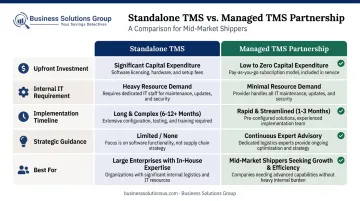
Business Solutions Group's managed logistics model is structured around this gap: clients receive a full TMS platform — typically a $150,000–$250,000 standalone investment — at no additional cost as part of the engagement. That covers real-time execution, automated routing, freight audit, claims management, and reporting across all modes, managed by a dedicated team that handles daily execution.
For mid-market shippers, that means enterprise-grade TMS capability without the 3–6 month implementation timeline or internal IT overhead.
Frequently Asked Questions
What are the 4 types of logistics?
The four types are inbound logistics (moving goods from suppliers to production), outbound logistics (delivering finished products to customers), reverse logistics (handling returns, repairs, and recycling), and third-party logistics (3PL), where an external provider manages one or more supply chain functions on your behalf.
What is the best TMS for trucking companies?
The best TMS depends on company size, freight modes, and integration needs. Evaluate platforms on carrier network breadth, automation depth, ease of use, cloud deployment, and support for your specific mode mix — LTL, FTL, parcel, or multimodal.
Can a TMS manage LTL shipments specifically?
Yes. Most modern TMS platforms support LTL as a core mode — including rate shopping, BOL generation, carrier tendering, freight class management, and post-shipment audit — with multimodal LTL support considered standard across leading platforms.
Is LTL shipping cost-effective for small businesses?
LTL is typically the most cost-effective option for small businesses shipping freight too large for parcel carriers but insufficient to fill a full trailer. Accessing LTL through a 3PL or TMS platform — rather than booking directly with a carrier — generally yields better rates through pooled volume and negotiating leverage.
What is the difference between LTL and FTL shipping?
LTL shares trailer space among multiple shippers, offering lower cost but longer transit times. FTL (Full Truckload) reserves the entire trailer for one shipper — faster and better suited for high-volume or time-sensitive freight. The right choice depends on shipment size, urgency, and budget.
Do I need a TMS if I only ship LTL freight?
Not for very low volumes — but a TMS adds measurable value even for LTL-only operations through automated rate comparisons, billing audits, and consolidated reporting. As shipment frequency grows, the ROI compounds quickly: billing errors alone can represent 2–5% of total freight spend.