Introduction
Freight budgets don't lie — but they do hide. For most businesses, LTL shipping is treated as a fixed cost: something to budget around rather than actively manage. That passive approach is costing them more than they realize.
The LTL rate-per-pound index hit a record high in Q3 2025, sitting 65.1% above its January 2018 baseline across eight consecutive quarters of year-over-year growth. Meanwhile, over 80% of LTL invoices contain at least one accessorial charge, and a study of nearly 250,000 invoices found that 4.5% contained outright billing errors.
Those numbers add up fast — and most of them are recoverable. The businesses that treat LTL as a manageable cost center, not a fixed line item, consistently outperform competitors on margin.
This guide covers what's actually driving your LTL costs, why freight consolidation is the most underused savings lever available, how smarter carrier negotiations work, and where technology creates lasting efficiency. Whether you're shipping $300K or $30M in freight annually, there's real margin to recover — if you know where to look.
Key Takeaways
- LTL rates are at record highs; treating freight as a fixed cost puts your margins at risk
- Accessorial charges and billing errors silently inflate invoices for most shippers
- Freight consolidation converts LTL economics into FTL savings, typically cutting costs 20–40% on qualifying lanes
- Carrier negotiations require benchmark data; discounts off inflated base rates don't equal real savings
- TMS adoption delivers 8–10% freight cost savings on average — Business Solutions Group includes TMS at no added cost to clients
What Is LTL Freight and When Does It Make Sense?
LTL (Less-than-Truckload) shipping moves freight that doesn't fill an entire trailer. Your shipment shares space with other companies' cargo, and you pay only for the portion of the truck you use. It sits between parcel shipping (small, individual packages) and FTL (Full Truckload), which dedicates an entire trailer to one shipper.
Where LTL Fits
LTL is the right choice when:
- Shipments weigh roughly 150 to 15,000 pounds — too heavy for parcel, too light to justify a full truck
- Shipping volumes are irregular and don't consistently fill trailers
- You need regional or national carrier reach without paying for dedicated capacity
- Freight urgency doesn't require time-definite expedited service
Where the Complexity Comes In
The flexibility has a cost. LTL shipments pass through multiple carrier terminals before reaching their destination — each transfer point is a new handling touchpoint and a new damage risk. LTL damage rates run 2–5%, compared to 0.5–2% for FTL.
Pricing adds another layer. Four factors typically drive LTL rates — and accessorial fees alone catch most shippers off guard:
- Freight class — assigned via NMFC codes based on density, stowability, handling, and liability
- Dimensional weight — carriers charge based on space consumed, not just actual weight
- Accessorial fees — liftgate, residential delivery, inside pickup, redelivery, and more
- Fuel surcharges — applied as a percentage and updated weekly by most carriers
Key LTL Cost Drivers You Can't Afford to Ignore
Freight Classification and Reclassification Risk
The NMFC system assigns 18 freight classes from 50 to 500. Density — weight divided by cubic feet — is the primary determining factor. Misclassify a shipment, intentionally or not, and carriers will reclassify it at the terminal.
Reclassification fees typically run $25 to $150+ per shipment. With automated dimensioning technology now standard at carrier terminals, the days of estimates slipping through are over. If your freight classes haven't been reviewed recently, that's a real exposure.
Accessorial Charges
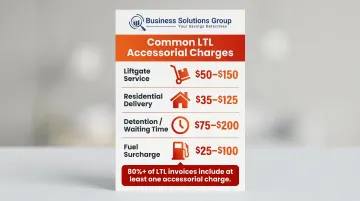
These are the silent budget killers. Common charges include:
- Liftgate fees: $40–$150 per use
- Residential delivery: $50–$150 per shipment
- Detention: $50–$100 per hour
- Fuel surcharges: 15–40% of base freight rate
Over 80% of LTL invoices include at least one accessorial charge, and they can represent 10–40% of the total freight bill. Many are avoidable with better upfront planning — specifying delivery requirements accurately at booking eliminates most surprise charges.
Dimensional Weight Pricing
More than 70% of LTL shipments are now priced using density-based logic, even when freight classes still appear on documents. Bulky, low-density freight gets penalized. Oversized boxes, excess void fill, and inefficient palletization all translate directly to higher costs. Accurate dimensioning at the warehouse is now a core cost control function, not an afterthought.
Freight Invoice Errors
A study of nearly 250,000 LTL invoices found 4.5% contained billing errors, with nearly half attributed to incorrect accessorial charges. Industry-wide estimates put the error rate at 5–8%. A systematic freight bill audit process — covering LTL, FTL, parcel, air, and ocean — catches these discrepancies before they compound. Business Solutions Group runs this process for clients across all modes, identifying billing errors that quietly inflate freight spend month after month.
Without a systematic audit process, you're funding your carrier's billing errors.
Freight Consolidation: The Most Powerful LTL Optimization Strategy
What Consolidation Actually Means
Freight consolidation combines multiple smaller shipments into a single, larger load, either within one company's shipping operation or across multiple shippers through a 3PL. The goal is to convert LTL economics into FTL economics for the primary movement.
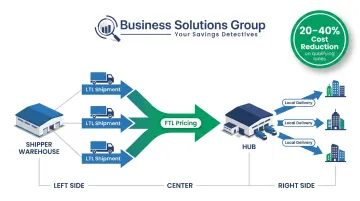
LTL-to-FTL consolidation typically saves 20–40% on qualifying lanes. ODW Logistics documented a consolidation program that produced 12.4% freight savings while cutting average transit time by 1.2 days.
A Concrete Example
A manufacturer ships to three regional distribution centers weekly. Each destination receives an individual LTL shipment. After analyzing the lanes, the company identifies that all three DCs fall within the same geographic corridor.
Those individual LTL moves consolidate into a single FTL shipment to a central hub, where freight breaks out for local delivery. The trunk movement shifts from LTL pricing to FTL pricing, and the savings on that leg cover the breakout cost with room to spare.
LCL vs. LTL Consolidation
These terms get confused often. The distinction matters:
| Term | Mode | Application |
|---|---|---|
| LTL Consolidation | Domestic truck freight | Combining shipments within a trailer for US land transport |
| LCL (Less than Container Load) | International ocean freight | Sharing container space across multiple shippers for cross-border moves |
Both involve shared capacity, but they apply to entirely different modes, geographies, pricing structures, and risk profiles. Using LCL logic to evaluate a domestic consolidation opportunity — or vice versa — leads to flawed decisions.
The Benefits Beyond Cost
Consolidation doesn't just reduce freight spend. Fewer carrier touches mean:
- Lower damage risk (each terminal transfer is an exposure point)
- Simpler invoicing and reconciliation
- Higher volume commitments that create real negotiating leverage with carriers
- More predictable transit times
Carrier Selection and Smarter Rate Negotiation
Evaluating Carriers Beyond Price
Rate is one factor. These matter just as much:
- On-time delivery: Industry average runs 93–95%; any carrier consistently below 90% is a service risk. Top performers like Old Dominion maintain 99% on-time rates.
- Claims ratio: Top-quartile carriers run below 0.3% claims. The industry average for Q1 2025 was 0.345% — down nearly 50% from 2020 but still representing significant exposure at volume.
- Technology capabilities: Real-time tracking, electronic BOL, and EDI connectivity reduce administrative burden and improve visibility.
- Service area coverage: Regional carriers often outperform nationals on specific lanes for both price and transit time.
How LTL Pricing Actually Works
Carriers publish standard tariff rates, and shippers negotiate a percentage discount off those rates. The mistake most shippers make: focusing on the discount percentage while ignoring the base rate.
A 60% discount off an inflated base rate often costs more than a 45% discount off a realistic one. Carriers apply General Rate Increases (GRIs) — typically once or twice per year — to base rates. Your negotiated discount percentage stays the same, but your net cost rises with every GRI.
Negotiating from a Position of Strength
This is where most companies leave money behind. Without knowing how your current rates compare to market rates for your specific lanes, freight classes, and shipment weight bands, you're negotiating on feel rather than data.
Business Solutions Group's benchmark analysis captures 6–12 months of shipment-level data (covering tariff structures, lane behavior, accessorial patterns, and carrier mix) and compares it against proprietary market-rate intelligence. The analysis is provided at no cost with no commitment required.
What that process typically delivers:
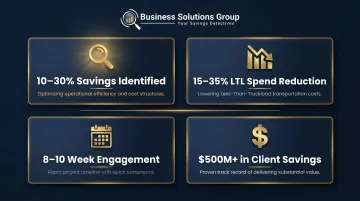
- 10–30% in actionable savings opportunities identified through the initial benchmark
- 15–35% reductions in LTL spend once contracts are implemented
- 8–10 week engagement from initial data collection to signed carrier agreements
- $500M+ in collective savings delivered across clients ranging from $300K to $100M+ in annual freight spend
All carrier agreements are negotiated in the client's company name, not through a broker model. Clients retain full ownership of their carrier relationships.
Using Technology to Streamline LTL Operations
Transportation Management Systems
A TMS automates the operational functions that otherwise consume hours of manual work: carrier selection, rate shopping, load planning, shipment execution, and freight audit. Organizations that implement TMS solutions report freight cost savings of 8–10% on average, according to ARC Advisory Group.
Business Solutions Group includes a TMS platform as part of their Strategic LTL Services engagement, with no additional licensing cost. A standalone TMS implementation typically runs $150,000–$250,000 before factoring in integration and training. The platform covers:
- Quote, book, ship, track/trace, and BOL functions
- Post-shipment audit for rate compliance
- Automated routing and least-cost carrier selection
- Integration with WMS, ERP, and accounting systems
- Executive dashboards and performance analytics
Spend Intelligence and Freight Analytics
A TMS captures shipment data — but that data only becomes actionable when you can interpret it at the lane, carrier, and mode level. Business Solutions Group's spend intelligence platform surfaces real-time analytics showing which carriers, modes, and lanes perform best and where cost overruns occur.
This visibility converts reactive freight management ("why did this cost so much?") into proactive optimization ("here's where to consolidate, renegotiate, or shift modes next quarter").
AI and Predictive Visibility
LTL visibility has historically been a weak point — shipments move through multiple terminals with limited tracking between hubs. Platforms like project44 and FourKites use machine learning to generate predictive ETAs for LTL movements, accounting for hub-and-spoke routing complexity and flagging delays before they cascade into stockouts or missed service commitments. Fewer "where is my freight?" calls. Earlier intervention when things go sideways.
How eCommerce and Warehouse Operations Shape Your LTL Strategy
eCommerce's Impact on LTL Demand
eCommerce has reshaped freight flow patterns. As online sales grew from 7.5% of retail in 2016 to 12.5% by 2021, businesses shifted from large, infrequent FTL shipments to smaller, more frequent LTL moves feeding regional hubs and last-mile points.
The global LTL market is projected to grow by $110.7 billion between 2025 and 2029, largely driven by this eCommerce expansion. For shippers, that growth means tighter capacity, rising lane competition, higher consolidation complexity, and real pressure on margins.
Warehouse Operations and LTL Efficiency
Poor warehouse practices create freight problems downstream. Specifically:
- Inconsistent packing standards produce inaccurate dimensions, leading to reclassification fees
- Uncoordinated shipping schedules fragment shipments that could consolidate
- Poor slotting slows outbound operations and causes missed carrier pickup windows
Efficient warehouse operations are a prerequisite for LTL optimization — you can't consolidate shipments you haven't staged properly, and you can't avoid reclassification if dimensions aren't measured accurately at pack.
Network Optimization: The Strategic Layer
Logistics network optimization evaluates warehouse locations, carrier lane assignments, and freight flow patterns to minimize total transportation cost. For LTL-heavy operations, this typically surfaces two opportunities: lanes where volume has crossed the threshold for FTL conversion, and distribution center placements that shorten average haul distances.
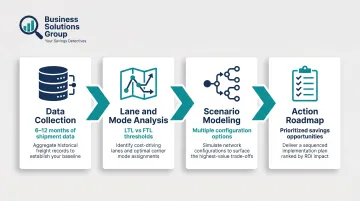
Business Solutions Group's network optimization engagements start with 6–12 months of shipment data and model multiple scenarios to quantify savings across current and alternative configurations. The output is a cost baseline with identified gaps and a prioritized action roadmap — giving operations leaders a concrete starting point, not just a directional suggestion.
Frequently Asked Questions
What is freight load consolidation?
Freight consolidation is the practice of combining multiple smaller shipments into a single, larger load to reduce per-unit shipping costs and improve carrier efficiency. It can be executed within a single company's operation or across multiple shippers through a 3PL or consolidation program.
What is an example of freight consolidation?
A retailer shipping weekly orders to five stores in the same region combines those individual LTL moves into one FTL shipment to a regional distribution hub, then breaks it out for local delivery. The primary leg converts from LTL pricing to FTL pricing, typically saving 20–40% on that movement.
What is the difference between LCL and consolidation?
LCL (Less than Container Load) is an ocean freight term for sharing international shipping container space across multiple shippers. LTL consolidation is a domestic land freight strategy. Both involve shared capacity, but they apply to different modes, geographies, and pricing structures.
What is logistics network optimization?
Logistics network optimization analyzes and redesigns warehouse locations, transportation lanes, and carrier mix to minimize total supply chain cost and transit time. For most shippers, it reveals opportunities to shift between LTL and FTL modes or restructure distribution flows based on actual shipment data.
What is warehouse logistics management?
Warehouse logistics management coordinates receiving, storage, order picking, packing, and outbound shipping operations. Its efficiency directly impacts LTL costs — shipping schedules, load quality, and accurate dimensioning at the warehouse all determine whether consolidation opportunities are captured or lost.
What is the role of eCommerce in supply chain management?
eCommerce has increased demand for faster, more frequent, and smaller shipments, pushing supply chains toward greater LTL and parcel reliance. Businesses must optimize freight consolidation, carrier networks, and last-mile strategies to stay cost-competitive as order volumes fragment and delivery expectations rise.