According to Descartes' 2025 Transportation Management Benchmark Survey, transportation management has reached record strategic importance, with more businesses citing TMS adoption as a top operational priority. Yet many implementations underdeliver because buyers evaluate features without a clear framework.
This guide covers what TMS software actually does, the essential features that drive measurable results, and a practical checklist for evaluating vendors before you commit.
Key Takeaways
- TMS software centralizes and automates freight planning, execution, and monitoring across carriers and modes
- Evaluate these core features: route optimization, carrier management, real-time tracking, load planning, automated billing, and analytics
- The right TMS reduces freight spend, improves on-time delivery, and eliminates manual errors
- Deployment model, integration depth, and scalability are just as important as the feature list itself
- Matching TMS capabilities to your actual shipping volume and carrier mix drives faster, more measurable ROI
What Is TMS Software?
A Transportation Management System (TMS) is a technology platform that manages the planning, execution, and optimization of physical goods movement. It replaces manual, spreadsheet-based logistics management for shippers, carriers, freight brokers, 3PLs, and distributors.
Three main TMS types exist, each with different feature priorities:
- Shipper TMS — focused on order and carrier management for companies moving their own goods
- Broker/3PL TMS — manages multi-carrier operations and client shipments across a network
- Carrier TMS — handles fleet management and load execution on the carrier side
Core Components of a TMS
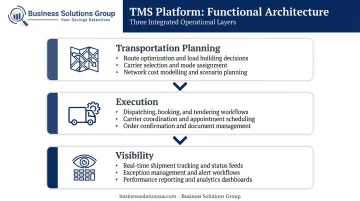
A TMS operates across three functional layers:
- Transportation planning — route decisions, load building, and carrier selection
- Execution — dispatching, booking, tendering, and shipment coordination
- Visibility — real-time tracking, exception management, reporting, and performance analysis
Most enterprise platforms are modular. Organizations implement the components most relevant to their operations and integrate the rest with existing ERP, WMS, or accounting systems. That flexibility is part of what makes TMS adoption practical — teams can start with the functions they need most and expand from there.
Benefits for Shippers and Logistics Teams
The operational case for TMS adoption is straightforward:
- Reduced freight spend through route and carrier optimization
- Fewer manual errors via workflow automation
- Improved on-time delivery rates
- Better carrier relationships through data-driven performance tracking
- Faster invoice reconciliation and fewer billing disputes
Research from FreightWaves indicates that TMS implementation consistently boosts shipper productivity. Organizations regularly report freight cost reductions of 10–15% following deployment.
Essential TMS Software Features: The Checklist
Not every TMS includes all of these features. Use this list as a structured evaluation tool when comparing vendors — the goal is to identify which capabilities your operation actually needs, not to find the platform with the longest feature list.
Route Optimization and Planning
Route optimization calculates the most cost-efficient delivery paths using algorithms that factor in distance, traffic patterns, delivery windows, and vehicle constraints. The direct result: lower fuel costs and shorter transit times.
Advanced modules go further:
- Real-time re-routing for delays and disruptions
- Freight consolidation (grouping smaller shipments headed to nearby destinations)
- Empty-mile reduction (minimizing deadhead runs between loads)
Empty miles are a significant cost driver. Uber Freight's network optimization research found that up to two-thirds of empty miles can be eliminated through smarter routing and load matching. For high-volume shippers, that represents real money.
Carrier Management
Carrier management centralizes everything in one place: rates, contracts, service areas, compliance documentation, and historical performance. Instead of selecting carriers based on habit, logistics teams make decisions based on cost, reliability, and service level.
Key capabilities to look for:
- On-time rate and claims frequency tracking
- Automated contract renewal alerts
- Tender management strategies (least-cost, auto-award, or service-based)
- Rate adherence monitoring across contracted lanes
The performance tracking piece matters long-term. Carriers that consistently miss delivery windows or generate billing discrepancies are easy to spot — and easier to renegotiate with — when the data is centralized.
Real-Time Shipment Tracking and Visibility
Real-time tracking via GPS, EDI, and IoT integrations gives continuous visibility into shipment location and status. The operational shift this enables is significant: exception management becomes proactive rather than reactive.
This feature touches every stakeholder in the chain:
- Dispatch teams receive automated alerts for delays or deviations
- Customer service can answer status questions without calling carriers
- End customers receive ETA updates automatically
A 2022 shipper survey from Talk Business found that pricing and shipment visibility are consistently the top two priorities for shippers evaluating logistics technology — reinforcing that tracking isn't a nice-to-have, it's a competitive requirement.
Load Planning and Order Management
Load planning optimizes how cargo is organized across vehicles using dimension data, weight limits, and compliance rules — including axle weight restrictions and HOS regulations. The goal is maximum space utilization with minimum trips.
Order management handles the upstream side:
- Captures transport requests from ERP, eCommerce, and manual entry
- Consolidates orders into a unified planning view
- Flags duplicates and routing conflicts
- Generates carrier assignment recommendations automatically
Together, these two capabilities reduce planning time and cut order errors before they become shipment problems.
Automated Billing, Invoicing, and Freight Audit
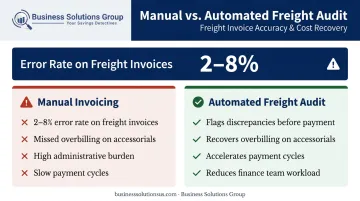
Automated billing pulls data directly from shipment records and pre-set pricing agreements to generate accurate invoices. Freight audit capabilities use OCR and rule-based validation to match incoming carrier invoices against contracted rates — flagging discrepancies before payment is processed.
The financial impact is direct:
- Faster, accurate invoicing accelerates payment cycles
- Fewer disputes with carriers
- Lower administrative burden on finance teams
- Recovery of overbilling on accessorial charges
Manual freight invoicing remains a persistent problem. Industry estimates consistently show that 2–8% of freight invoices contain billing errors. For any business processing significant shipment volume, that error rate translates to recoverable costs that go unnoticed without automated audit.
Reporting, Analytics, and Integration Capabilities
TMS dashboards surface the KPIs that drive decisions: on-time delivery rate, cost per mile, carrier performance scores, and route efficiency. These aren't just operational metrics — they're the data behind carrier contract renegotiations and network restructuring decisions.
Integration capabilities determine how well TMS data flows across the organization. A TMS without strong integration support creates data silos that limit everything downstream: analytics, billing, inventory planning, and customer service.
Look for:
- Pre-built connectors to ERP, WMS, CRM, and accounting platforms
- Open API support for custom integrations
- EDI compatibility for carrier connectivity
- Compatibility with spend intelligence tools that extend analytics into procurement optimization
Business Solutions Group's spend intelligence software integrates with TMS platforms to surface parcel insights that standard reporting modules typically don't capture — including over 25 actionable data points aimed at identifying cost-saving opportunities across carrier spend. It's worth evaluating alongside your TMS selection if eliminating manual spreadsheet reporting is a priority.
Key Factors to Consider When Choosing TMS Software
Features alone don't determine fit. The right TMS must align with your shipping volume, carrier mix, existing tech stack, and operational complexity. These four factors bridge feature specifications to real business outcomes.
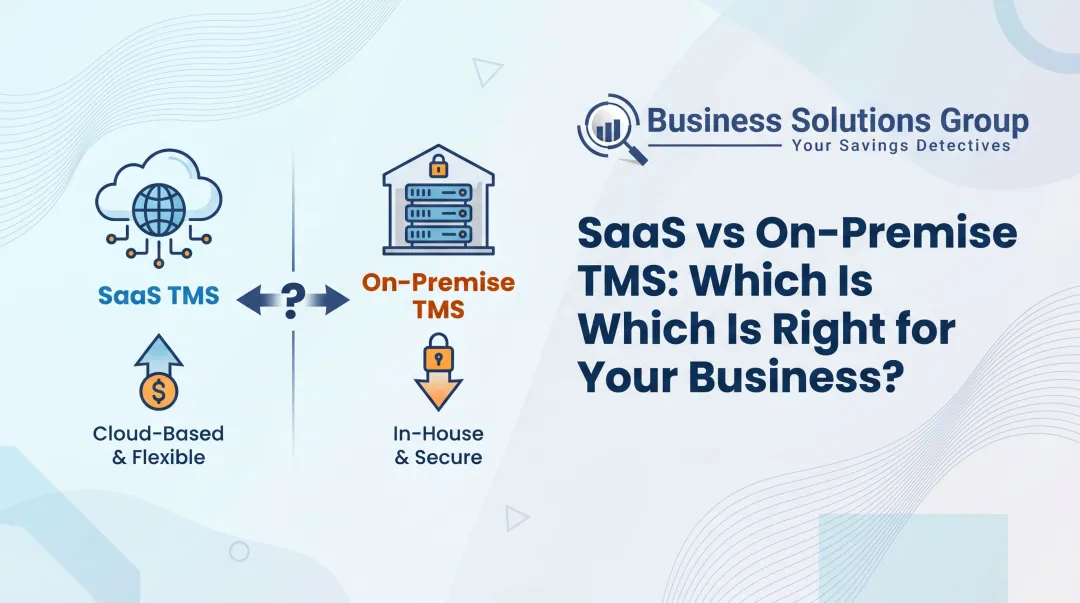
Deployment Model: Cloud vs. On-Premise
| Factor | Cloud-Based | On-Premise |
|---|---|---|
| Upfront cost | Low | High |
| Implementation speed | Faster | Slower |
| Customization control | Limited | Extensive |
| IT requirements | Minimal | Significant |
| Scalability | High | Moderate |
Cloud-based TMS is the default choice for most mid-market shippers. Lower upfront costs, automatic updates, and faster time-to-value make it practical. On-premise suits large enterprises with complex customization needs and dedicated IT resources.
On pricing: Forbes coverage of TMS implementation costs notes that cloud TMS implementations typically run $50,000–$200,000+ for mid-to-large enterprises, while on-premise systems carry higher capital costs plus ongoing IT overhead. Total cost of ownership over 3–5 years often favors cloud for companies without existing infrastructure investments.
For organizations working with Business Solutions Group, TMS technology is included at no additional cost as part of their managed logistics engagement — a platform investment of $150,000–$250,000 that's absorbed within the advisory engagement rather than billed separately.
Integration with Existing Systems
A TMS must connect cleanly with your ERP, WMS, and accounting tools. Poor integration is one of the most common causes of TMS underperformance post-implementation. The problem is rarely a missing feature; it's a connectivity gap between systems that should be talking to each other.
During vendor evaluation, ask specifically:
- What native integrations are available out of the box?
- Is EDI support included, and for which carrier types?
- What does API documentation look like for custom connections?
- How long does a typical integration implementation take?
Business Solutions Group's TMS solutions include open RESTful API capabilities and pre-built integrations with major ERP and WMS platforms, so sales, shipping, and billing teams are working from the same data rather than reconciling across disconnected systems.
Scalability and Total Cost of Ownership
Two questions matter most for long-term fit: Can the platform handle growth — more shipment volume, new geographies, additional carriers — without forcing a platform switch? And can workflows and routing rules adapt to your operation without expensive custom development each time something changes?
A platform that forces workaround processes as your business grows will erode efficiency gains over time. Evaluate both factors against your 3–5 year growth projections, not just current state.
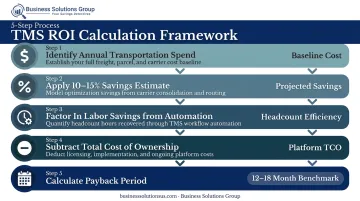
That growth projection also drives the ROI case. Use this framework to build yours:
- Identify your annual transportation spend
- Apply a conservative 10–15% savings estimate from route optimization and freight audit
- Factor in labor savings from automation (billing, dispatch, tracking)
- Subtract total cost of ownership (licensing, implementation, training, support)
- Calculate payback period — most well-matched TMS implementations show payback within 12–18 months
How Business Solutions Group Can Help
Selecting and implementing a TMS addresses operational execution. It's one layer of transportation cost optimization, though — and rarely the highest-leverage one.
Business Solutions Group helps freight shippers go further by combining advanced spend intelligence software with expert advisory services. Their benchmark analysis captures 6–12 months of shipment-level data and compares client carrier rates against proprietary market intelligence to 1/10th of a percent precision. The result is a clear picture of where you're overpaying and what a renegotiation should realistically deliver.
BSG's key differentiators for freight shippers:
- Delivers $500M+ in collective LTL savings, with typical freight cost reductions of 15–35%
- Surfaces 25+ actionable parcel insights beyond what standard TMS reporting provides
- Runs competitive multi-carrier bidding across LTL, FTL, ocean, air, and rail through its eProcurement platform
- Includes TMS technology as part of managed engagements — no add-on fees
- Charges no upfront fees; compensation is tied to verified savings
Their clients include PING Golf, Columbia Sportswear, Dexcom, Levi Strauss, and SC Johnson — companies that have used BSG's combination of technology and advisory to reduce freight spend materially and build lasting visibility into carrier costs.
Conclusion
The right TMS isn't the one with the longest feature list — it's the one that fits your shipping volume, carrier relationships, and operational complexity. The checklist in this guide gives you a structured starting point, but the evaluation only works if you're honest about what your operation actually needs today and where it's headed in three years.
Beyond selection, a TMS is not a set-it-and-forget-it decision. Transportation costs shift, carrier performance changes, and business requirements evolve. Companies that treat their TMS as a living tool tend to see the most sustained results. That means:
- Reviewing analytics regularly to spot cost and performance trends
- Renegotiating carrier terms when performance data supports it
- Integrating new capabilities as your shipping complexity grows
Done consistently, that approach produces measurable improvements in carrier costs and operational control — well beyond what the initial implementation delivers.
Frequently Asked Questions
What is TMS software used for?
TMS software plans, executes, and monitors the physical movement of goods. It automates carrier selection, route planning, shipment tracking, load tendering, and freight billing — replacing manual processes to reduce costs and improve delivery performance across the supply chain.
What are common TMS features?
The most common features include route optimization, carrier management, real-time shipment tracking, order management, load planning, automated invoicing and freight audit, reporting and analytics, and ERP/WMS integration capabilities.
What is the difference between TMS and WMS?
A TMS manages the movement of goods between locations — transportation planning, carrier selection, route optimization, and freight billing. A WMS manages operations inside a warehouse — inventory, picking, packing, and storage. The two systems are frequently integrated to coordinate shipping and fulfillment.
How much does TMS software typically cost?
Cloud-based TMS platforms typically range from $50,000 to $200,000+ for mid-to-large enterprise implementations, priced as subscriptions or per-load fees. Total cost of ownership should factor in implementation, training, and integration expenses — not just licensing.
Is cloud-based TMS better than on-premise?
Cloud-based TMS is generally preferred for faster deployment, lower upfront cost, and easier scalability — making it the practical choice for most shippers. On-premise may suit large enterprises with complex customization requirements and dedicated IT infrastructure.
How does TMS software help reduce transportation costs?
TMS reduces costs through route optimization (less fuel and miles), carrier rate comparison (lowest-cost compliant carrier per load), freight audit automation (catching overbilling), load consolidation (fewer trips), and data-driven carrier contract renegotiation based on performance analytics.