Introduction
Global SaaS spending is on track to hit $299 billion in 2025, according to Gartner's public cloud forecast. A significant portion of that figure never delivers any value. Zylo's 2026 SaaS Management Index puts the average organization's unused-license waste at $19.8 million per year — the result of hundreds of small, recurring charges that accumulate undetected across departments.
The operational impact lands on finance teams expected to control costs they can barely see. A tool purchased by one team gets duplicated by another. Licenses auto-renew for employees who left months ago. By the time the overage shows up in a budget review, six more billing cycles have passed.
The fix isn't a single audit or a one-time vendor renegotiation. Sustainable cost control requires changes at three levels: how tools get purchased, how usage gets monitored, and who has authority over both. This guide addresses each in turn.
TL;DR
- SaaS waste accumulates invisibly through auto-renewals, idle licenses, duplicate tools, and unsanctioned purchases
- The biggest cost drivers are misaligned purchasing decisions, weak usage oversight, and decentralized procurement
- Reducing spend requires changing what you buy, how you manage subscriptions, and who owns procurement decisions
- Sustained savings come from consistent governance, not periodic cleanups; the habits matter more than the initial audit
How SaaS Costs Typically Build Up
SaaS costs rarely appear as one large, visible expense. They accumulate gradually through small recurring charges that collectively become significant — often unnoticed until a budget review surfaces them.
Three overlapping patterns drive this buildup:
- Subscription sprawl: teams add new tools without retiring old ones, expanding the portfolio without reviewing it
- Seat creep: licenses get assigned beyond actual need during onboarding, then never reclaimed
- Renewal drift: contracts auto-renew without review, locking in spend another cycle by default
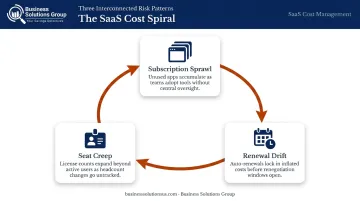
Each reinforces the others. A team adds a tool (sprawl), licenses everyone just in case (seat creep), and the contract renews automatically the following year without anyone noticing (renewal drift).
According to BetterCloud, 69% of software contracts carry auto-renew clauses with cancellation windows of just 30 to 90 days. Miss that window and you're locked in for another full year.
These patterns stay hidden until something forces visibility. Rapid headcount changes, a departmental restructuring, or a finance-led audit can suddenly expose waste that has been compounding for months. By that point, the duplicate tools have multiplied, the unused seats are deeply embedded in billing cycles, and the renegotiation leverage has narrowed.
What the Numbers Show
Productiv's research found that 53% of SaaS licenses go unused. Zylo puts the figure at 44% wasted or underutilized. Both numbers describe the same reality: organizations paying for capability they aren't using, on a recurring monthly or annual basis.
Key Cost Drivers for SaaS Spend
SaaS cost drivers fall into three categories: decisions made at procurement, conditions during active use, and changes over time.
Procurement Decisions
What gets purchased, at what price, and under what contract terms sets the cost floor for everything that follows. Most organizations accept vendor pricing at face value. Gartner reports that enterprise SaaS renewal costs often rise 10% to 20% or more — a range that far exceeds typical IT budget growth, and one that compounds annually when renewals go uncontested.
Usage Versus Licensing Mismatch
Usage-based and tiered pricing models drive up costs when tools are poorly matched to actual behavior. Two patterns account for most of the waste:
- Overprovisioned tiers: Premium plans purchased for entire teams, with active use concentrated in a small fraction of those users
- Unmonitored consumption: Usage-based models that spike without governance guardrails, producing surprise invoices each billing cycle
Both patterns are hard to catch from a basic headcount or login report alone.
Organizational Structure
Decentralized purchasing is itself a cost driver. Zylo's data shows that business units own 81% of SaaS spend, with nearly 87% of applications purchased by lines of business and individual employees. Without a unified view across departments, duplicate tools, unauthorized subscriptions, and missed renewal windows become recurring problems built into the purchasing process — not one-off oversights.
Cost-Reduction Strategies for SaaS Spend
Effective strategies operate at three leverage points: the decisions made before or around purchasing, the practices used while subscriptions are active, and the organizational and vendor conditions shaping the cost environment.
Strategies That Reduce Costs by Changing Decisions
The highest-leverage moment in the SaaS cost cycle is before money is committed. These strategies work at that point.
Build a complete subscription inventory first. Many organizations do not have a current, accurate list of all active subscriptions across departments. Tools purchased on corporate cards, individual expense reports, or departmental budgets routinely stay invisible to IT and finance. No optimization decision is reliable without this baseline.
Evaluate actual need before renewing or upgrading. SaaS purchases are often justified by anticipated usage that never arrives. A lightweight pre-renewal process — reviewing usage data, gathering team feedback, confirming ROI expectations — prevents lock-in to tools that deliver marginal value and reduces the risk of paying for premium tiers that go unused.
Use benchmark pricing data in vendor negotiations. Most businesses accept the first number a vendor offers, unaware that rates vary significantly based on organization size, contract length, and market conditions. Entering negotiations with current market rate benchmarks changes the dynamic entirely. Business Solutions Group's proprietary spend intelligence capabilities and benchmark analysis give organizations the pricing context needed to push back with specifics rather than assumptions — a structural advantage in any vendor negotiation.
Leverage trials before committing. Committing to an annual contract without validating fit is a common source of wasted spend. Free trials, sandbox environments, and phased rollouts allow teams to confirm actual utility before financial commitment is made.
Strategies That Reduce Costs by Changing How SaaS Is Managed
Most SaaS waste accumulates quietly in the management layer — after purchase, between renewals, and across teams that aren't talking to each other. These strategies target that gap.
Rightsize licenses based on feature-level usage, not just logins. Knowing a user "logged in" is not the same as knowing they actively use the tool. Organizations that review feature-level engagement can identify seats that should be downgraded, reassigned, or reclaimed. Rightsizing is often the fastest path to immediate cost reduction without eliminating any tools outright.
Assign a named owner for every active subscription. Without ownership, renewals go unreviewed, underuse goes unaddressed, and governance decisions stall. A named owner — even informally assigned — creates a decision point for usage reviews, renewal negotiations, and elimination recommendations.
Establish team-level budgets and approval workflows. Decentralized purchasing without spend limits is the root cause of most duplicate tool proliferation. A simple approval process for purchases above a defined threshold surfaces functional overlap before it is purchased, not after.
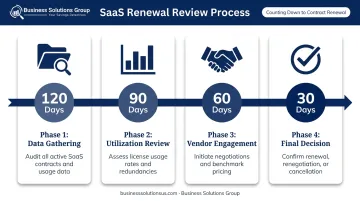
Track renewals with a 90-day lead window. The weakest negotiating position is discovering a contract has already auto-renewed. A renewal calendar with 90-day advance alerts gives organizations time to review utilization, prepare counter-proposals, and negotiate from a position of choice rather than obligation. Zylo recommends a phased 120/90/60/30-day approach for major contracts — starting the review process four months out to allow adequate time for data gathering and vendor engagement.
Strategies That Reduce Costs by Changing the Context Around SaaS
These strategies address the structural environment in which SaaS operates. In many situations, the surrounding setup drives costs more than the tools themselves.
Consolidate overlapping tools. Multiple teams independently adopting tools for the same function — project management, communication, document editing — is extremely common. The result is fragmented spend, duplicate data, and weakened negotiating leverage. An application rationalization pass identifies functional overlap and standardizes on best-fit tools, reducing per-seat costs while improving workflow coherence.
Govern shadow IT before it compounds. Unsanctioned purchases represent a double cost: the direct spend itself, plus the security and compliance exposure from unvetted vendors. A lightweight intake process for SaaS requests, paired with a visible approved-tool catalog, redirects demand toward governed options. Productiv found that 51% of SaaS apps remained shadow IT in 2023 — that's not a rounding error, it's most of the portfolio.
Tie tool retention to measurable outcomes. Organizations that evaluate SaaS purely on cost miss a critical discipline. Connecting tool retention to outcomes — hours saved, pipeline influenced, tickets resolved — creates an ongoing governance rationale that supports eliminating weak tools and reinvesting in high-performing ones. Cost alone is incomplete; value delivered relative to cost is the right measure.
Conclusion
Reducing SaaS spend requires knowing where costs originate — whether in purchasing decisions, active management gaps, or structural conditions. Uniform cuts eliminate value alongside waste. Targeted reductions, built on visibility and usage data, protect what's working while cutting what isn't.
The organizations that sustain savings over time build the habits: renewal calendars, ownership assignments, benchmark-informed negotiations, and structured intake processes.
For businesses that want external expertise to accelerate this work, Business Solutions Group offers advisory and eProcurement solutions backed by spend intelligence software and benchmark analysis — giving procurement teams the data and negotiation support needed to make reductions stick.
Frequently Asked Questions
What is SaaS spend management?
SaaS spend management is the practice of tracking, controlling, and optimizing an organization's investment in cloud-based software subscriptions — covering usage monitoring, contract oversight, renewal governance, and license rightsizing. The goal is ensuring every dollar spent delivers measurable value, not unreviewed recurring cost.
What is the Rule of 40 for SaaS?
The Rule of 40 is a financial benchmark for evaluating SaaS vendor health: a company's combined revenue growth rate and profit margin should equal or exceed 40%. For buyers, it signals whether a vendor has the financial stability to maintain pricing, support quality, and long-term reliability in contract terms.
How much do companies typically waste on SaaS?
Gartner projects that organizations without centralized SaaS visibility will overspend by at least 25% through 2027. Zylo puts average annual unused-license waste at $19.8 million per organization, driven primarily by idle licenses, duplicate tools, and auto-renewed contracts that were never reviewed.
What is shadow IT and how does it affect SaaS spend?
Shadow IT refers to software purchased outside IT and finance visibility, inflating costs through duplicate subscriptions and bypassing security reviews. It also makes total spend nearly impossible to track. Productiv found 51% of SaaS apps fell into this category in 2023.
How often should businesses review their SaaS subscriptions?
At minimum, run a quarterly review of usage and license utilization, with a dedicated review triggered 90 days before each major contract renewal. Organizations with larger or decentralized stacks benefit from continuous monitoring to catch issues between formal cycles.
What is license rightsizing in SaaS management?
License rightsizing aligns the number and tier of software licenses to actual usage — identifying seats assigned to inactive users, licenses on premium tiers that only warrant a standard plan, and orphaned accounts from former employees. Reclaiming or downgrading those licenses eliminates recurring costs without disrupting active users.