The problem most businesses face isn't a lack of awareness that modernization is needed. It's a lack of external expertise to turn that awareness into measurable change. Internal teams manage day-to-day operations well, but they rarely have the benchmark data or strategic bandwidth to identify where money is leaking, where risk is concentrated, or which technology investments will actually deliver returns.
This article explains why supply chain advisory services are a practical driver of modernization — and what specific advantages businesses can expect when advisory support is applied consistently.
Key Takeaways
- Advisory services provide external benchmark data and strategic guidance internal teams can't generate alone
- They shift organizations from reactive firefighting to proactive, data-driven decision-making
- Three core advantages: benchmark-driven cost reduction, proactive risk identification, and a structured modernization roadmap
- Businesses without advisory support fall progressively behind on cost, resilience, and technology capability
- ROI compounds over time through consistent engagement, not a one-time project
What Is Supply Chain Advisory
Supply chain advisory services provide expert guidance that helps businesses assess, optimize, and modernize their supply chain operations — with measurable outcomes as the deliverable, not strategy documents.
In practical terms, advisory is applied across:
- Carrier contract negotiation — across parcel, LTL, truckload, ocean, air, and rail
- Freight and parcel spend analysis — identifying cost leakage across surcharges, accessorials, and rate structures
- Benchmark analysis — comparing current contracts against current market rates
- eProcurement and technology selection — replacing manual procurement with competitive, data-driven sourcing
- Vendor performance and spend intelligence — consolidating data to produce reliable reporting
What separates advisory from consulting is accountability to results. Business Solutions Group, for example, starts every engagement with a no-cost benchmark analysis of 6–12 months of shipment data — before any commitment is required. The output is lower carrier spend, improved cash flow, and a supply chain built to scale.
Key Advantages of Supply Chain Advisory Services for Modernization
The advantages below are grounded in outcomes that operations and finance leaders track: cost, margin, risk exposure, and scalability.
Advantage 1: Benchmark-Driven Cost Reduction Across Freight and Carrier Spend
One of the most direct advantages advisory services deliver is identifying where a company's carrier rates diverge from current market benchmarks — gaps that internal teams almost never have the data to detect on their own.
Advisors conduct comprehensive spend analysis by comparing existing contracts and rate structures against proprietary market-rate intelligence, then use that data to renegotiate carrier agreements, restructure freight terms, or consolidate shipping programs. The analysis itself takes roughly a week and typically surfaces cost leakage in:
- Accessorial fees and fuel surcharge tables
- Dimensional weight calculations
- Zone increments and minimum charges
- Annual General Rate Increases (GRIs) that were absorbed without pushback
- Billing errors and incorrectly applied rebate credits
U.S. business logistics costs totaled $2.4 trillion in 2023, representing 8.7% of GDP. For individual shippers, that macro pressure translates to real margin erosion, particularly for companies that haven't renegotiated carrier terms in two or more years.
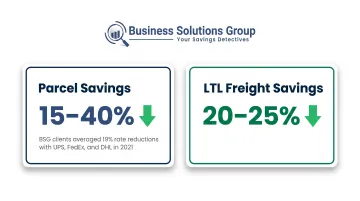
Benchmark analysis regularly identifies companies overpaying on parcel contracts by 15–30% — a gap that persists simply because they have no external comparison point. In 2021, Business Solutions Group clients averaged 19% rate reductions on small parcel shipments with UPS, FedEx, and DHL.
Across all engagements, typical savings range from 15–40% on parcel and 20–25% on LTL freight.
KPIs impacted: freight cost per unit, shipping cost as a percentage of revenue, carrier contract compliance rate, cash flow margin
When it matters most: Highest impact for businesses that ship at volume but haven't renegotiated in two-plus years, or companies entering new markets where legacy contract terms no longer reflect actual shipping patterns.
Advantage 2: Proactive Risk Identification and Supply Chain Resilience
Most supply chain disruptions don't hit businesses without warning — they hit businesses that weren't looking. Advisory services shift organizations from reactive disruption management to proactive risk identification, where vulnerabilities are mapped and contingency plans exist before a crisis materializes.
The financial case for this shift is stark. According to the BCI Supply Chain Resilience Report 2023:
- 84.6% of organizations reported increased operating costs during disruptions
- 77.6% reported direct revenue loss
- 15.5% had no formal business continuity arrangements at all
- 11.5% experienced 10 or more supply chain disruptions in a single year
And nearly two-thirds of supply chains are currently classified as fragile — with only about 8% considered fully resilient.
Reactive supply chain management creates predictable hidden costs: emergency sourcing premiums, expedited freight charges, and customer service failures that erode relationships. Advisory services reduce these costs by building resilience into normal operations.
That means diversifying carrier networks, mapping supplier dependencies, and developing decision protocols before a disruption forces improvisation.
Business Solutions Group builds multi-carrier networks that balance cost efficiency with contingency capacity, ensuring freight keeps moving when markets tighten or a primary carrier can't perform. Their visibility tools integrate data from carriers and fulfillment partners, giving leadership the ability to adjust routing or sourcing before problems reach customers.
KPIs impacted: supplier diversification rate, on-time delivery performance, emergency freight spend, disruption recovery time
When it matters most: Businesses with concentrated supplier networks, high-volume seasonal shipping, or significant exposure to geopolitical trade risk — where a single disruption can cascade quickly.
Advantage 3: A Clear Modernization Roadmap Tied to Business Outcomes
Most businesses recognize they need to modernize their supply chain technology. Fewer have a structured plan for doing it in a sequence that actually delivers returns. Advisory services translate business goals into a prioritized modernization roadmap, identifying which changes deliver the fastest ROI and which require longer-term investment.
The common failure mode is technology adoption without strategic context: platforms get implemented, adoption is low, and the cost savings never appear. Scoping and sequencing investments before money is committed is where advisory services earn their place in the process.
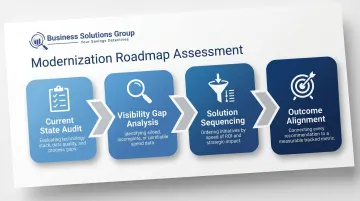
A typical roadmap assessment covers:
- Current state audit — evaluating the existing technology stack, data quality, and process gaps
- Visibility gap analysis — identifying where spend data is siloed, manual, or unreliable
- Solution sequencing — prioritizing initiatives by speed of ROI (carrier contract work first, then process automation, then longer-horizon platform integration)
- Outcome alignment — ensuring every technology recommendation connects to a tracked KPI, not just a capability
Business Solutions Group's proprietary spend intelligence software consolidates data from ERP systems, WMS, and carrier portals into a single automated reporting environment. It replaces the manual spreadsheet workflows most companies still rely on, giving clients drill-down parcel data and real-time KPI dashboards without custom reporting overhead.
Their eProcurement solution operates similarly: it replaces manual RFP processes with a competitive, pre-qualified carrier bidding environment across LTL, truckload, ocean, air, and rail — shortening procurement timelines and eliminating errors that traditional spreadsheet-based processes introduce.
KPIs impacted: technology adoption rate, procurement cycle time, cost per transaction, reporting accuracy, supply chain visibility score
When it matters most: Companies currently relying on manual processes, disconnected systems, or spreadsheets that can't produce reliable spend data — the advisory layer ensures modernization happens in a logical order rather than piecemeal.
What Happens When Advisory Services Are Missing
Businesses without advisory support don't simply maintain the status quo. They fall progressively further behind while competitors modernize — and the financial gap compounds.
Common consequences include:
- Absorbing annual GRIs and new surcharges without question — no external benchmark means no pushback
- Missing carrier billing errors that compound monthly; most companies don't realize how frequently invoices contain overcharges
- Reacting to disruptions after customers are already affected, with no contingency plans or supplier alternatives in place
- Underutilizing platforms implemented without advisory guidance, leaving cost and efficiency gains on the table
- Hitting a growth ceiling where supply chain infrastructure limits scale rather than enabling it
These consequences tend to compound quietly — and the billing issues are often the most expensive. The businesses paying the most are consistently those that have never had an outside expert review their contracts. Business Solutions Group regularly sees clients uncover payments for unused services, incorrectly applied discounts, or obsolete rate structures that had been in place for years, with no internal mechanism to catch them.
How to Get the Most Value from Supply Chain Advisory
Advisory services deliver the most value when treated as a continuous function — not a one-time fix. Three conditions tend to separate engagements that keep generating returns from those that stall after the initial findings:
1. Keep it consistent, not episodic Regular spend reviews, carrier contract renegotiations on cycle, and periodic benchmarking updates — not a one-off engagement. Business Solutions Group conducts weekly post-audits of prior shipments and provides weekly or monthly savings reports so clients have continuous visibility into performance rather than periodic snapshots.
2. Set KPIs before implementation begins Advisors and internal teams should align on KPIs before implementation begins, with both sides establishing clear baselines upfront. BSG's managed services track every dollar saved, validate it, and report it.
3. Act on findings — delays cost real money Advisory findings only create value when they lead to operational decisions. Businesses that receive recommendations and delay implementation leave savings on the table. Carrier contract renegotiations, for example, run 6–10 weeks from benchmarking to implementation — and savings begin almost immediately after the new contract takes effect.
Conclusion
Supply chain advisory services matter for modernization because they provide the external expertise, benchmark intelligence, and strategic direction that internal teams can't generate alone. Cost reduction, risk resilience, and a clear technology roadmap each build on one another — but only when the underlying strategy stays consistent.
Most supply chain investments fail not from lack of effort but from lack of direction — tools get deployed without connecting to measurable outcomes. Businesses that treat advisory as an ongoing operational practice, not a one-time project, are the ones that build supply chains capable of absorbing disruption and holding competitive cost structures year after year. That's a durable advantage worth building deliberately.
Frequently Asked Questions
What is the difference between supply chain advisory and supply chain consulting?
Advisory implies an ongoing strategic partnership — continuous benchmarking, contract optimization, and spend analysis across the supply chain. Consulting is typically scoped to a specific problem or implementation with a defined end date. Advisory carries a longer-term, continuous improvement orientation.
When should a business bring in a supply chain advisor?
Key triggers include rising freight costs, upcoming carrier contract renewals, a planned technology upgrade, or a disruption that caught the business unprepared. If your internal team lacks external benchmark data to confirm whether current rates are competitive, that alone is sufficient reason to engage.
How do supply chain advisory services support modernization specifically?
Advisors assess the current state of technology, processes, and spend, then build a sequenced roadmap connecting modernization investments to specific cost and efficiency outcomes. That includes eProcurement, spend intelligence, and logistics optimization — prioritized by business impact, not technology novelty.
What KPIs typically improve after engaging supply chain advisory services?
The most commonly tracked metrics include freight cost per unit, carrier contract compliance rate, procurement cycle time, on-time delivery performance, and supply chain cost as a percentage of revenue.
How long does it take to see results from supply chain advisory?
Carrier contract renegotiation savings can be realized within 6–10 weeks of engagement. Broader modernization outcomes — process efficiency gains and technology ROI — typically compound over 6–18 months of consistent advisory partnership.
Can small or mid-sized businesses benefit from supply chain advisory services?
Advisory services are often more impactful for smaller businesses that lack dedicated internal supply chain strategy teams. They gain immediate access to benchmark data and market expertise that would otherwise require significant internal investment to develop on their own.