The deeper problem: logistics teams are buried in invoice volume. When hundreds or thousands of bills arrive each month across multiple carriers and modes, manual verification isn't just slow — it's incomplete by design. Errors that slip through aren't edge cases. They're budget leakage that compounds every billing cycle.
This article covers what freight audit and payment actually means, the most common billing errors to watch for, why the process matters beyond simple cost recovery, and how to decide whether to manage it internally or hand it off to a specialist.
Key Takeaways
- Freight audit verifies that carrier invoices match contracted rates before (or after) payment is released
- Common errors include duplicate billing, incorrect accessorial charges, rate mismatches, and detention overcharges
- Pre-payment audits catch errors at nearly 100% recovery; post-payment drops to 60–80%
- Shippers without systematic auditing lose an estimated 3–5% of annual freight spend to billing errors
- Outsourced auditing typically runs $0.05–$1.10 per invoice, compared to $6–$13 for internal processing
What Is Freight Audit and Payment?
What a Freight Audit Actually Checks
A freight audit is the process of examining, adjusting, and verifying freight invoices for accuracy — confirming that every billed charge matches the contracted or quoted rate for that shipment.
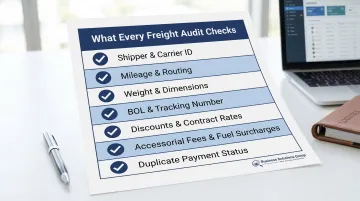
Auditors typically check the following on each invoice:
- Shipper and carrier identification
- Mileage and routing
- Shipment weight and dimensions
- Bill of lading (BOL) and tracking number
- Applicable discounts and contract rates
- Accessorial fees and fuel surcharges
- Duplicate payment status
Rate tolerance is a related concept worth knowing. Because invoice volume is high, most companies set an acceptable variance threshold — often $5–$10 per invoice — below which exceptions aren't investigated. Small errors knowingly pass through in exchange for operational efficiency at scale; it's a deliberate triage decision.
The Freight Bill and How Payment Works
A freight bill is the invoice a carrier issues to a shipper itemizing all charges for moving a shipment from origin to destination. This typically includes:
- Base transport cost
- Fuel surcharges
- Accessorial fees (lift gate, residential delivery, detention, etc.)
Freight payment is the accounts payable function for transportation. Once the audit confirms an invoice is accurate, payment is processed to the carrier — by check, ACH, or wire transfer — either by the shipper's internal team or a third-party provider on their behalf.
Pre-Payment vs. Post-Payment Audit
These two models define when errors get caught:
| Model | When It Catches Errors | Recovery Rate |
|---|---|---|
| Pre-payment audit | Before funds are released | ~100% |
| Post-payment audit | After payment has been made | 60–80% |
Pre-payment auditing is the preferred standard because it stops overpayments before they hit the books. Post-payment auditing still has value — especially for identifying systemic patterns or recovering historical overcharges — but the recovery math is less favorable.
Legal deadlines make timing especially critical. For U.S. domestic motor freight, shippers have just 180 days to contest an invoice amount under 49 USC 13710. Ocean freight is tighter still — COGSA imposes a one-year statute of limitations from delivery.
The Most Common Freight Billing Errors
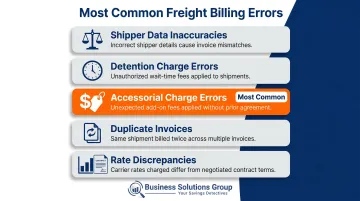
Understanding where errors concentrate helps prioritize audit resources. Five categories drive the majority of freight invoice disputes:
- Shipper data inaccuracies — Incorrect weight, dimensions, or destination entered by the shipper's team. The carrier bills based on that data, so the discrepancy lands on the shipper.
- Detention charge errors — Carriers may apply the wrong hourly rate, bill for more hours than elapsed, or charge detention when the delay was their fault. Disputing these requires driver logs, appointment records, and timestamps, which is why they often go unchallenged.
- Accessorial charge errors — The highest-error category in freight billing. Lift gate fees, inside delivery, residential surcharges, and re-consignment charges are frequently applied when the service wasn't requested or billed at an off-contract rate. Nuvocargo's 2026 research identifies accessorials as the single most common source of overbilling.
- Duplicate invoices — Carriers submit the same invoice more than once, often across multiple billing systems or when the original appears unprocessed. Without duplicate-detection, these get paid twice unnoticed.
- Rate discrepancies — The billed rate doesn't match the contracted rate. Causes include outdated tariffs, miscalculated fuel surcharges, or unapplied discounts. Rate mismatches affect an estimated 10–15% of invoices even among shippers with active contract management.
Why Freight Audit and Payment Matters
Direct Cost Savings and Labor Reduction
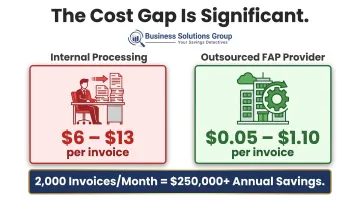
The cost of doing nothing is measurable. Shippers without systematic auditing lose roughly 3–5% of annual freight spend to billing errors. The internal cost to process a single freight invoice manually runs $6–$13, depending on the benchmark — IOFM puts paper-based invoice processing at $12.90 per invoice. Outsourced freight audit and payment providers handle the same invoice for $0.05–$1.10, with the low end applying to high-volume shippers.
For a company processing 2,000 invoices per month, that gap in per-invoice cost translates to $250,000+ annually in labor savings — before error recovery is even factored in.
Cost Savings vs. Cost Avoidance
These two outcomes are often conflated, but they land very differently on financial statements:
- Cost savings reduce current spend — they appear directly on the P&L
- Cost avoidance prevents future overpayments — it never shows up as a line item
When evaluating an audit program, push for providers that demonstrate actual recoveries, not just process improvements. Avoidance is valuable, but it's harder to measure and easier to overstate.
Data Visibility as a Strategic Asset
A rigorous freight audit generates something shippers rarely have: a clean, centralized dataset of all shipment and cost activity across modes, lanes, and carriers. Supply chain leaders use this data to:
- Identify spending trends and seasonal patterns
- Pinpoint high-cost lanes or underperforming carriers
- Enter carrier contract negotiations backed by hard data
- Develop accurate freight budgets based on actual rather than estimated spend
Business Solutions Group's spend intelligence software converts raw shipment data into dashboards that show exactly where costs are concentrated. Through benchmark analysis, clients typically identify 10–30% in savings opportunities they weren't previously tracking.
Carrier Relationships and Shipper of Choice Status
Paying accurate invoices on time has a direct impact on carrier relationships. According to FreightWaves, carriers may add $100–$200 per load in informal "inefficiency costs" for shippers who are difficult to work with — and during tight capacity markets, they allocate their best equipment to reliable payers first.
Shippers of Choice see real operational advantages: better load acceptance rates, rate protection during peak seasons, and first priority on equipment when capacity tightens. Consistent, accurate payment is one of the fastest ways to earn that status.
Insource vs. Outsource: How Businesses Manage Freight Audit
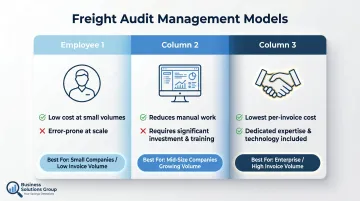
Three models exist for managing freight audit and payment:
- Fully manual in-house processing — manageable at low shipment volumes, but error-prone and labor-intensive as volume grows
- In-house TMS software — reduces manual work but requires upfront investment, staff training, and ongoing maintenance
- Outsourced third-party FAP provider — offloads the entire function at a fraction of internal cost, with dedicated audit expertise and technology included
When Outsourcing Makes Sense
The tipping point varies by company, but three factors consistently drive the decision:
- Invoice volume: When monthly bills number in the hundreds or thousands, internal teams can't verify each one thoroughly
- Contract complexity: Multiple carriers across multiple modes means more rate schedules to manage and more potential for discrepancies
- Internal bandwidth: Staff time spent on invoice verification is time not spent on strategic logistics work
For most mid-size to large shippers, the math favors outsourcing. The cost differential between internal processing ($6–$13 per invoice) and outsourced processing ($0.05–$1.10) is substantial even before recovered errors are counted.
One Risk to Watch
Some FAP providers use the shipper's payment float — delaying carrier payments after receiving funds from the shipper to earn interest on the held balance. This damages carrier relationships and can affect capacity access.
Ask any provider directly: how quickly are carrier payments made after funds are received? A vague or evasive answer suggests float-based practices are in play.
One example of a transparent alternative is the Off-Bill Incentive (OBI) model used by Business Solutions Group. Under this structure, compensation is paid by carriers rather than clients, so there's no P&L impact for the shipper and no financial incentive to delay carrier payments.
What to Look for in a Freight Audit and Payment Partner
Audit Methodology
Not all providers audit the same way. Key questions to ask:
- Do you audit pre-payment or post-payment?
- How are exceptions managed — flagged for manual review or resolved automatically?
- When a recurring error is identified, is it corrected invoice-by-invoice or addressed at the root cause with the carrier?
The difference between an invoice-level fix and a root-cause correction is significant. The former reduces one overcharge; the latter prevents dozens.
Reporting and Data Capabilities
Payment confirmation is the minimum. Strong reporting turns freight spend data into decisions — which lanes are underperforming, which carriers are slipping on service, and where contract rates have drifted from market. Look for:
- Lane-level cost breakdowns
- Carrier performance scoring
- Benchmark comparisons against market rates
- Data export compatibility with your ERP or TMS
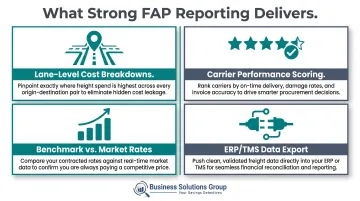
Business Solutions Group, for example, offers benchmark analysis that identifies savings opportunities at a granular level, with a spend intelligence platform that integrates directly with ERP and WMS systems for consolidated reporting.
Carrier Reputation and Payment Speed
The audit provider's reputation with carriers becomes the shipper's reputation. When evaluating providers, confirm:
- Carrier references (do carriers view them as reliable payers?)
- Accepted payment methods (ACH, check, wire)
- Typical payment timelines and dispute resolution processes
A provider known for slow or contested payments creates friction in the carrier relationships you've worked to build.
Frequently Asked Questions
What is the freight audit process?
Freight audit begins when carrier invoices are received. Each is checked against the shipment record — verifying weight, mileage, rates, accessorials, and duplicate status. Any errors are disputed directly with the carrier; only verified invoices proceed to payment.
Why is freight bill auditing important?
Invoice errors are common across the industry — shippers without a systematic review process routinely overpay, draining margins and distorting the transportation cost data used for budgeting and carrier negotiations.
What does freight bill mean?
A freight bill is the invoice a carrier issues to a shipper itemizing all charges for moving a shipment, including base transport rates, fuel surcharges, and accessorial fees for additional services.
What is a prepayment audit?
A prepayment audit reviews and validates freight invoices before payment is released, catching errors at the source rather than pursuing refunds after the fact. It's the more proactive model — most providers report higher recovery rates compared to post-payment audits because disputes are resolved before funds leave the account.
What is a parcel audit?
A parcel audit is freight auditing focused specifically on small parcel shipments sent via UPS, FedEx, or USPS. It catches billing errors — dimensional weight miscalculations, misapplied surcharges, and refundable service failures. Up to 5% of UPS and FedEx invoices contain errors, making it a high-ROI function even for moderate shippers.
How much does freight auditing cost?
Outsourced freight audit typically runs $0.05–$1.10 per invoice depending on volume, compared to $6–$13 per invoice processed internally. Pricing models vary — per-transaction fees or contingency pricing at 15–25% of recovered savings are common. Business Solutions Group uses an Off-Bill Incentive model, meaning clients pay nothing out of pocket.