: Real Impact & Savings](https://file-host.link/website/businesssolutionsus-mg3rtz/assets/blog-images/4bae7f8c-9098-4e44-abbe-b96c60fdfe47/1779913452217074_927d081b10994f2592969a9d33e9c24e/360.webp)
Introduction
U.S. business logistics costs hit $2.58 trillion in 2024 — equal to 8.8% of GDP, according to the 2025 CSCMP/Kearney State of Logistics Report. For individual companies, that translates differently by sector: McKinsey benchmarks put logistics at roughly 10% of sales in chemicals, 7.5% in consumer goods, and 5% in retail.
The uncomfortable reality is that a meaningful share of that spend isn't necessary. McKinsey estimates that up to half of outbound logistics and distribution costs go unmanaged — absorbed through inertia rather than necessity.
For parcel and freight shippers specifically, this shows up as carrier rates that haven't been benchmarked against market reality, accessorial fees no one is tracking, and forecasting gaps that force expensive last-minute decisions. None of these are fixed costs. They're decision failures.
This article examines how AI reduces logistics costs across three layers: pre-shipment decisions, execution-layer management while freight is in motion, and the structural factors that determine how efficiently logistics operates in the first place.
TL;DR
- U.S. logistics costs equal 8.8% of GDP — and a significant portion is avoidable, not inherent
- The biggest cost drivers aren't just fuel and labor: they include poor carrier selection, billing errors, demand forecasting gaps, and fragmented visibility
- McKinsey found that early AI supply-chain adopters improved logistics costs by 15% compared to slower-moving competitors
- AI's primary mechanism is improving decision quality — carrier selection, rate negotiation, and routing decisions that compound into measurable savings
- Durable savings require AI tools that work across your supply chain — not point solutions that optimize one function while creating blind spots elsewhere
How Logistics Costs Build Up
Logistics overspend rarely appears as a single line item. It accumulates — across carrier selection, routing, warehousing, and exception handling — with each layer adding cost that feels small individually but compounds at volume. Most of it stays invisible until someone actually measures it.
Where the Waste Hides
Business Solutions Group's audits consistently surface the same patterns when first reviewing a new client's freight spend:
- Accessorial fee drift — fuel surcharges, liftgate fees, detention charges, and reclassifications add 10–15% to invoiced costs
- Annual GRI absorption — carriers issue General Rate Increases of 5–6% annually; most shippers absorb them without pushing back
- Billing errors — Hyland cites research showing 80% of carrier invoices contain discrepancies, with overcharges running 8–10% above the correct amount
- LTL shippers overpay when freight classes are miscategorized or carriers mark up third-party charges
- Shipping data spread across invoices, carrier portals, and spreadsheets makes it nearly impossible to catch errors or spot trends in real time
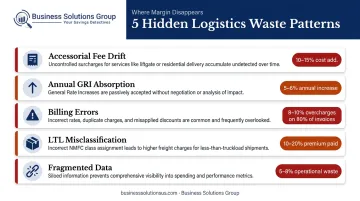
None of these patterns surface without benchmarks — and that's precisely where AI-driven visibility starts to change the equation.
Key Cost Drivers in Logistics
Four cost drivers account for the majority of avoidable logistics spend — and most businesses are actively bleeding through at least two of them.
Carrier rates disconnected from market reality : Most companies that haven't independently benchmarked their parcel contracts in the last two to three years are overpaying by 15–30%. Without comparative market data, there's no basis to challenge what carriers charge — and carriers don't volunteer that information.
Demand forecasting failures : Poor forecasting doesn't just cause stockouts. It creates inventory imbalances that force expedited freight, generates warehouse overflow, and pushes costs into expensive reactive decisions. The downstream cost of a single planning failure rarely gets traced to its source.
Failed and repeated deliveries : Loqate reports that 8% of U.S. first-attempt deliveries fail. Every failed attempt can effectively double the cost of that shipment — and consumes warehouse space and customer service time on top.
Operational fragmentation : Running separate tools for routing, tracking, carrier management, and freight audit without a unified data layer generates coordination overhead and blindspots. Schneider's analysis of an American HVAC manufacturer found that siloed business units were creating significant freight inefficiencies — inefficiencies that vanished once the team consolidated and analyzed shipment data in one place.
Each of these drivers is addressable — and AI-based tools are now doing exactly that, systematically, at scale.
Cost-Reduction Strategies for Logistics with AI
AI-driven cost reduction depends on where cost is actually originating. The strategies below are organized by the layer of the operation they address.
Strategies That Change Decisions
These approaches reduce cost by changing choices made before or around a shipment — targeting rate agreements, mode selection, procurement cycles, and inventory positioning.
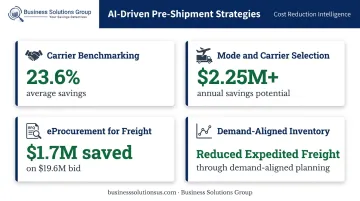
Carrier Benchmarking and Contract Negotiation. AI analyzes shipping spend against market rate data to identify where carriers are overcharging relative to comparable lanes, volumes, and service types — shifting renegotiation from a relationship position to a data position. Business Solutions Group's spend intelligence platform benchmarks 6–12 months of shipment history against thousands of pricing agreements and surfaces over 40 actionable savings opportunities. Their parcel clients have averaged 23.6% savings year-to-date, with $1 billion saved collectively.
Mode and Carrier Selection at the Shipment Level. AI evaluates cost, transit time, and reliability across carriers and modes for each individual shipment — eliminating the default-carrier habit. Schneider's analysis of an HVAC manufacturer found optimized mode selection showed $2.25M in annual savings potential, with multi-stop consolidation adding over $4M.
eProcurement for Freight Sourcing. Automated procurement tools cut the cost and duration of freight sourcing cycles by replacing manual spreadsheets with a structured RFQ/RFP process. Business Solutions Group's eProcurement solution puts incumbent carriers in direct competition with pre-qualified alternatives across all modes globally. Central Garden & Pet ran a $19.6M LTL bid using analytics-enabled sourcing and saved $1.7M versus historical averages, per SMC3 case data.
Demand-Aligned Inventory Positioning. Better forecast accuracy reduces the frequency of expedited and emergency freight — by fixing the conditions that create those decisions, not just the decisions themselves. Business Solutions Group's demand and inventory planning software integrates with ERP systems and uses over 250 algorithms to improve forecast accuracy, reducing how often expensive shipping decisions have to be made.
Strategies That Change How Logistics Is Managed
These approaches reduce cost by improving control and consistency during active operations — covering routing, maintenance, exception handling, and customer communication.
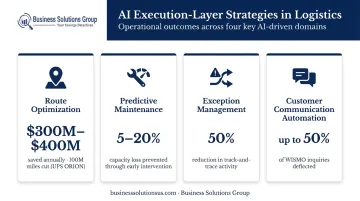
Route Optimization. Analyzing traffic, weather, stop density, and delivery windows in real time, AI reduces miles driven per stop at scale. UPS ORION optimized routes for 55,000 drivers and saved $300M–$400M annually at full deployment — cutting 100 million miles, 10 million gallons of fuel, and pushing driver productivity from 110 stops per day to 115–118.
Predictive Maintenance. Monitoring vehicle health and usage patterns, AI enables condition-based servicing before breakdowns occur. Deloitte notes poor maintenance strategies can reduce an asset's productive capacity by 5–20% — a loss preventable when systems flag issues ahead of unplanned downtime.
Exception Management and Real-Time Rerouting. Much of logistics cost comes from exceptions — carrier misses, delays, mechanical failures — handled too slowly to prevent downstream cascades. Tgroup, operating 950 vehicles daily across 44 logistics platforms, used real-time visibility to double driver-pool management efficiency and cut manual track-and-trace activity by 50%.
Customer Communication Automation. "Where is my order?" inquiries can represent up to 50% of inbound customer service contacts during peak periods, with each call costing $3–$7 to handle. AI-powered automation deflects a substantial share of that volume without adding headcount — cutting support costs while improving response times.
Strategies That Change the Operational Context
These approaches address the structural conditions under which logistics operates — visibility, delivery performance, and the overhead required to manage it all.
End-to-End Spend Visibility. Without unified visibility across small parcel, LTL, FTL, and last mile, shippers can't benchmark, can't detect rate creep, and can't negotiate from an informed position. Business Solutions Group's spend intelligence platform consolidates data across all modes into a single reporting structure — surfacing duplicate charges, accessorial overcharges, misapplied discounts, and mid-year rate adjustments that would otherwise go unnoticed. The platform manages over $3 billion in parcel spend and has helped clients recover more than $350 million in annual savings.
First-Attempt Delivery Rates. Repeated delivery attempts are among the most avoidable cost layers in logistics. AI-driven route accuracy, predictive ETAs, and proactive customer communication reduce failed deliveries — which cost an average of $17.20 each and, when repeated, can double the effective cost of a shipment.
Scaling Without Proportional Headcount Growth. AI lets logistics operations absorb higher volumes without equivalent growth in dispatch, operations, or customer service staff. Business Solutions Group's TMS platform automates order management, carrier selection, shipment execution, and claims management. Their Managed Logistics (4PL) model provides full lifecycle management with no added headcount and no internal lift required from the client's team.
Conclusion
AI doesn't reduce logistics costs by cutting indiscriminately. It reduces costs by improving the quality of decisions — who carries freight, at what price, via which route, under what conditions. The source of the cost matters more than the size of the line item.
What separates durable savings from one-time wins is continuity. Business Solutions Group's advisory model reflects this: after initial benchmarking and renegotiation (which typically delivers measurable savings within 6–8 weeks), the engagement shifts into ongoing optimization cycles:
- Weekly reporting against established benchmarks
- Periodic re-benchmarking as market rates shift
- Regular freight audits to catch billing errors and contract drift
- Continuous KPI tracking to confirm savings hold over time
Businesses that combine AI-powered tools with expert advisory — with clear benchmarks, carrier leverage, and gaps in visibility identified — consistently outperform those deploying technology without a structured cost-reduction framework.
Frequently Asked Questions
Does AI really reduce logistics costs?
Yes. McKinsey found that early AI supply-chain adopters improved logistics costs by 15% compared to slower competitors. Individual application areas show wider ranges — the key is applying AI to the right cost drivers.
What logistics functions benefit most from AI cost reduction?
Carrier selection, route optimization, demand forecasting, and freight audit deliver the highest individual impact. The greatest gains come when improvements in these areas are connected rather than deployed independently — each function reinforces the others.
How much can a small or mid-sized shipper realistically save with AI?
Meaningful savings are achievable regardless of scale. Business Solutions Group's clients shipping as few as 500 packages per month have accessed spend benchmarking, TMS tools, and contract negotiation support. Average results include 23.6% savings on parcel spend and 20–25% on LTL, with no upfront costs.
How does AI help negotiate better carrier contracts?
AI analyzes historical shipping spend against market rate benchmarks to identify where rates exceed comparable lanes or volumes. This gives shippers the data to challenge existing contracts and negotiate from an informed position rather than a relationship one, eliminating the carrier's information advantage.
What is the biggest mistake companies make when applying AI to logistics costs?
Deploying AI in isolated functions. Improving routing without touching carrier rates, or improving forecasting without connecting it to procurement, means local gains are frequently offset by inefficiencies elsewhere. Integration across functions is what produces durable results.
How long does it take to see ROI from AI in logistics?
Early savings from carrier benchmarking can surface within weeks. Business Solutions Group's parcel engagements typically show results in 6–8 weeks and LTL optimization in 8–10 weeks. Deeper gains from renegotiated contracts build through the first 6–12 months.