The challenge is that route optimization is often framed as a technology feature — something a TMS does automatically in the background. In practice, its value shows up in specific, trackable outcomes: fuel spend, cost per delivery, fleet utilization, and on-time rates. Understanding where that value comes from is what separates businesses that see compounding improvements from those that plateau after initial gains.
This article breaks down the three measurable advantages route optimization delivers, what happens when it's ignored, and how to capture its full value across both owned fleet and third-party carrier operations.
Key Takeaways
- Route optimization finds the most efficient delivery paths using distance, stop sequence, vehicle capacity, traffic, and time windows
- The core payoffs: lower fuel and operating costs, more reliable deliveries, and higher fleet capacity utilization
- Failed deliveries cost $17–$18 per package on average — optimized routing reduces re-delivery attempts directly
- Carriers ran 16.7% of total miles empty in 2024 — a capacity drain that smarter routing directly reduces
- Spend intelligence tools like Business Solutions Group's PSI platform surface hidden carrier inefficiencies before route optimization is applied
What Is Route Optimization in Logistics?
Route optimization is the process of algorithmically determining the most efficient set of routes for vehicles or shipments to reach their destinations. The inputs that matter: distance, stop sequence, vehicle capacity, traffic conditions, and customer time windows. The goal is minimizing total cost and time across the entire operation — not just shortening one driver's day.
It applies across a range of operations:
- Last-mile delivery fleets
- Freight carrier networks
- Small parcel shipping
- Multi-stop B2B distribution
- Field service routing
The foundational logistics problem it solves is the Vehicle Routing Problem (VRP) — formally defined as an optimization problem that determines the most efficient routes for serving customers using a fleet of vehicles. Academic research published in Transportation Research Interdisciplinary Perspectives identifies 31 distinct VRP variants, including models that account for time windows, vehicle capacity constraints, and real-time traffic changes.
That academic depth translates into a practical point: route optimization is a means to specific business outcomes — lower cost per delivery, higher on-time rates, reduced fuel spend, and better operating margin. The technology is the mechanism; the business case is what justifies the investment.
The Three Key Advantages of Route Optimization
Advantage 1: Fuel and Operational Cost Reduction
Route optimization cuts the two largest variable cost drivers in delivery — fuel consumption and driver hours — by eliminating unnecessary mileage, reducing idle time, and removing inefficient stop sequences.
Optimization algorithms calculate the lowest-cost stop sequence given real-world constraints — time windows, vehicle capacity, and traffic — reducing total miles driven across the entire fleet, not just individual routes.
Why this moves the needle financially:
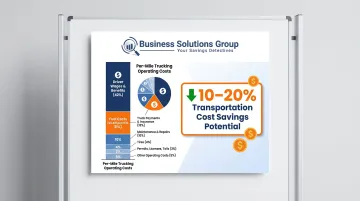
According to ATRI's 2025 operational costs report, fuel costs approximately $0.481 per mile, representing roughly 21% of total per-mile operating costs for trucking operations in 2024. Driver wages add another $0.743 per mile (33% of total costs), with benefits bringing combined driver compensation to approximately 42% of total per-mile costs.
Route optimization addresses both simultaneously. Fewer miles means less fuel burned. More efficient stop sequences mean drivers cover more deliveries in fewer hours, reducing overtime and improving labor cost per delivery.
McKinsey's research on analytics-based transportation optimization cites 10–20% savings on transportation costs as achievable through route optimization — meaningful in a trucking sector where operating margins averaged below 2% in 2024.
KPIs directly impacted:
- Fuel cost per mile
- Cost per delivery
- Total miles driven per day
- Driver hours per route
- Overtime rate
Best suited for: High-volume delivery operations, businesses with large owned or leased fleets, and operations where fuel market volatility creates unpredictable cost exposure.
Advantage 2: Faster, More Reliable Delivery Performance
Route optimization improves delivery speed and consistency by sequencing stops optimally, reducing backtracking, and enabling accurate ETAs. Drivers can execute routes that hold up under real-world conditions, not just look clean in planning software.
The financial case for delivery reliability:
Failed first-time deliveries cost an average of $17.20 to $17.78 per package in extra labor, fuel, and operational costs. Each failed delivery also triggers approximately 2.3 customer service interactions at $12–$25 per contact to resolve.
The customer retention impact compounds the cost:
- 10–15% of B2B customers are lost after a single late delivery, escalating to 35–40% after a second failure
- For a mid-market distributor with 300 accounts averaging $15,000 in annual spend, that first-late-delivery churn rate puts $450,000 in annual revenue at risk
- WISMO ("where is my order") inquiries account for up to 50% of all customer service tickets in delivery-dependent businesses
- Accurate ETAs — a direct output of route optimization — can reduce those contacts by up to 80%
KPIs directly impacted:
- On-time delivery rate
- First-attempt delivery success rate
- Re-delivery rate
- Customer satisfaction score (CSAT)
- SLA compliance rate
When this matters most: Time-sensitive freight, perishable goods, B2B deliveries with strict receiving windows, and peak season when volume surges make manual route planning impossible to scale reliably.
Advantage 3: Fleet Capacity Optimization and Scalability
Route optimization lets businesses do more with their existing fleet. By consolidating stops geographically, sequencing pickups and deliveries efficiently, and matching shipment size to vehicle capacity, it reduces empty miles and partially-loaded runs.
The current baseline for how much capacity is being wasted: ATRI's 2025 data shows empty miles averaged 16.7% of total miles driven in 2024. That's roughly one in six miles generating zero revenue — a direct capacity cost that better routing can reduce.
Why this matters for growth:
A well-optimized fleet absorbs volume growth without proportional increases in vehicles or headcount. That's a capital expenditure story, not just an efficiency story. Businesses that optimize fleet capacity can bid on new contracts without adding overhead.
For operations managing a mix of owned fleet and third-party carriers, routing alone doesn't capture the full picture. Spend analysis often reveals businesses are paying for excess carrier capacity or running inefficient splits that consolidation could address. Business Solutions Group's Parcel Spend Intelligence (PSI) platform surfaces more than 25 categories of hidden spend inefficiencies — including accessorial charges, service-level mismatches, and billing errors — before any routing changes are applied. Managing over $3 billion in parcel spend, BSG's PSI has helped clients recover more than $350 million in annual savings.
KPIs directly impacted:
- Vehicle load factor (capacity utilization %)
- Empty miles as a percentage of total miles
- Deliveries per vehicle per day
- Fleet size relative to volume
- Carrier spend per unit
What Happens When Route Optimization Is Ignored
Unoptimized routing bleeds cost in ways that rarely show up as a single line item — which is exactly why it persists.
Without systematic route optimization, drivers follow habit-based or manually planned routes that ignore traffic patterns, load sequencing, and geographic clustering. Each individual run may be only slightly off. Multiply that across dozens of drivers and hundreds of daily stops, and the gap between actual and optimal performance grows substantial — often without anyone knowing how large it's become.
Three compounding failure modes drive this outcome:
- No scaling path: As order volume grows, manual planning breaks down. Businesses face a costly either/or — over-hire drivers and vehicles, or miss delivery windows and lose accounts.
- Reactive dispatch loop: Teams spend their time firefighting late drivers, missed stops, and re-deliveries rather than fixing the underlying system. That cycle compounds as volume increases.
- Hidden inefficiency: Because waste is distributed across many small route decisions, no single failure triggers a review. The losses accumulate undetected.
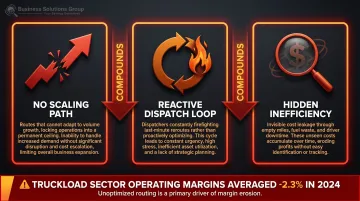
With truckload sector operating margins averaging -2.3% in 2024, routing inefficiency that adds even small percentages to cost per mile can push an operation from breakeven into loss. At those margins, there's no budget for waste that a better system would eliminate.
How to Get the Most Value from Route Optimization
Route optimization delivers its full value when applied consistently — not selectively — and reviewed against real performance outcomes regularly. Businesses that treat it as a one-time setup rather than an ongoing operational practice see results plateau quickly.
Four practical steps to maximize return:
Establish a baseline first — Document current route performance (miles per delivery, fuel per route, on-time rate) before optimizing. Without a baseline, you can't measure improvement or identify where the biggest gaps are.
Apply optimization consistently across all routes — Selective optimization leaves cost reduction on the table and creates inconsistent delivery data that's hard to act on.
Integrate actual constraints, not ideal conditions — Vehicle types, driver schedules, customer time windows, and real traffic patterns all need to feed the optimization model. Routes built on idealized assumptions fail in execution.
Review route assumptions regularly — Customer locations shift, traffic patterns change, and fleet composition evolves. Optimization parameters that were accurate six months ago may no longer reflect current operations.
For businesses managing both owned fleet and third-party carrier spend, route optimization works best when paired with a broader carrier strategy. Contract benchmarking and spend analysis ensure routing decisions align with the actual cost of delivery — not just the shortest path.
Business Solutions Group's advisory engagements take this broader view — pairing TMS integration with freight spend analysis across LTL, truckload, parcel, and multimodal to identify total cost reduction opportunities. Benchmark analysis is included at no cost at the outset of each engagement.
Conclusion
Route optimization's value compounds across three outcomes that directly affect margin and competitive position: lower fuel and operating costs, more reliable delivery performance, and better use of fleet capacity. Each of these outcomes is measurable — tracked through specific KPIs that show clear improvement when optimization is applied consistently.
The businesses that see the most sustained improvement treat route optimization as an ongoing practice, not a one-time configuration event. They baseline performance before making changes, revisit assumptions as conditions shift, and connect routing decisions to broader carrier strategy.
For operations managing both owned fleet efficiency and third-party carrier spend, route optimization is one piece of a larger cost reduction picture. Hidden inefficiencies in carrier contracts, billing, and service utilization often go undetected by routing software alone — spend intelligence tools that analyze contract terms and billing patterns frequently surface savings that routing improvements miss entirely.
Frequently Asked Questions
What is route optimization in logistics?
Route optimization is the process of determining the most efficient delivery paths using algorithms that factor in distance, stop sequence, vehicle capacity, traffic, and time windows. The goal is minimizing total cost and time across all routes — not just individual trips.
What are the benefits of route optimization for shipping?
Key benefits include reduced fuel costs, lower cost per delivery, improved on-time delivery rates, and better fleet utilization. Optimized routing also lets businesses grow delivery volume without adding vehicles or drivers at the same rate.
How does route optimization reduce fuel consumption?
By eliminating unnecessary mileage, reducing backtracking, and sequencing stops more efficiently, route optimization reduces total miles driven across the fleet. Since fuel cost is directly tied to miles driven, cutting even 10–15 miles per route per day adds up to thousands of dollars in annual fuel savings across a fleet.
What cost-saving opportunities does route optimization offer beyond fuel?
Route optimization cuts costs in driver overtime, vehicle maintenance (fewer miles means less wear), and failed delivery re-attempts. It can also surface carrier consolidation opportunities when paired with spend analysis — reducing third-party costs without sacrificing service levels.
What factors influence the efficiency of shipping routes?
The main factors: vehicle load capacity, traffic and road conditions, customer delivery time windows, stop density and geographic clustering, driver availability and shift constraints, and shipment type (time-sensitive goods require different routing logic than standard freight).
What is the Vehicle Routing Problem (VRP)?
The VRP defines the challenge of assigning delivery stops to vehicles and sequencing those stops to minimize total distance or cost. Route optimization software is built to solve VRP variants at real-world scale, accounting for constraints like capacity, time windows, and traffic.