Introduction
U.S. business logistics costs hit $2.58 trillion in 2024 — equal to 8.8% of GDP, according to CSCMP's State of Logistics Report. That figure sits well above pre-pandemic baselines of roughly 7.4–7.8% of GDP, signaling a structurally higher cost environment, not a temporary blip.
Fuel volatility compounds the problem. Carrier pricing power shifts unpredictably between tight and loose market cycles. And when routing guides break down, shippers often end up in the spot market paying 25–35% premiums over contracted rates with little leverage to push back.
Traditional freight management wasn't built for this. Static routing, manual carrier selection, and siloed data leave money on the table every single day.
AI addresses this directly. Rather than reacting to cost spikes after they happen, AI-powered freight tools continuously optimize routing, carrier selection, and load planning — cutting spend before it compounds.
This guide covers the core AI mechanisms that reduce freight costs and what separates effective platforms from ones that just add complexity.
TLDR
- U.S. logistics costs equal 8.8% of GDP — structural reduction requires more than fuel savings
- Spot market exposure carries a 25–35% rate premium vs. contracted lanes
- AI reduces logistics costs by 5–20% through smarter routing, load consolidation, and carrier selection
- Effective platforms go beyond visibility — they prescribe corrective actions before costs escalate
- Pairing AI platforms with advisory support — contract renegotiation, benchmark analysis, spend intelligence — typically drives deeper savings than software alone
Why Traditional Freight Management Leaves Money on the Table
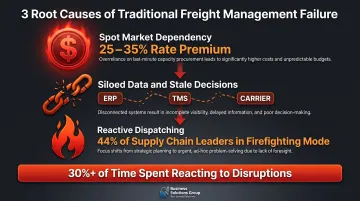
Most freight cost problems share the same three root causes.
Spot Market Dependency
When routing guides fail — or when shippers lack rate benchmarks for infrequently used lanes — they default to spot. DAT data shows the dry-van spot-to-contract spread peaked near $0.69/mile in November 2022, and spot loads routinely carry 25–35% premiums when booked last-minute. Without a defensible "should-be cost," procurement teams have no basis to challenge carrier quotes — so they accept them.
Siloed Data and Stale Decisions
ERP systems hold order data. TMS platforms track execution. Carrier systems store rate cards. When these don't talk to each other in real time, routing and carrier decisions get made on stale exports and tribal knowledge. The result: suboptimal load planning, missed consolidation opportunities, and empty miles that go unmeasured and unfixed.
Reactive Dispatching
Static plans built at the start of a shift don't survive contact with reality. Traffic shifts, weather hits, and late orders arrive without warning. Without the ability to reoptimize mid-shift, teams absorb those variables as cost:
- Longer routes from unplanned detours
- Missed delivery windows that damage service levels
- Emergency carrier upgrades that erode margin
Gartner research found that 44% of supply chain leaders operate in firefighting mode, with over a third spending 30%+ of their time reacting to disruptions rather than managing proactively. Those numbers point to a systemic gap in the tools teams are given to work with.
How AI Optimizes Freight Costs: The Core Mechanisms
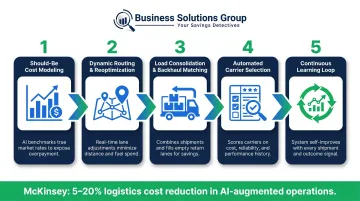
Predictive "Should-Be Cost" Models
AI builds cost benchmarks by training on historical shipment data, regional economic indicators, and carrier rate trends. The output is a defensible, lane-level "should-be cost" — not a guess, but a data-backed figure procurement teams can put in front of a carrier.
Carrier negotiating advantage is real: carriers see pricing patterns across thousands of shippers simultaneously. Without aggregated market data, shippers negotiate blind. AI closes that information gap before the conversation starts.
Dynamic Routing and Real-Time Reoptimization
Instead of locking in a route at dispatch, AI continuously evaluates traffic, weather, vehicle load weight, and stop sequencing throughout the active shift. When conditions change, the system recalculates — reducing fuel consumption and mileage without human intervention.
The compounding effect is real. Small routing improvements across hundreds of daily runs add up faster than any single contract negotiation.
Load Consolidation and Backhaul Matching
AI cross-references pending shipments against available capacity, grouping compatible loads before dispatch and flagging return-leg opportunities that reduce deadhead miles. The process runs continuously against every new order that enters the system, not just at dispatch.
Providers like Penske have documented AI-enhanced trailer cube utilization improvements that can eliminate an entire truck from the same shipment volume. Higher fill rates mean lower per-unit freight costs on every run — no contract renegotiation required.
Automated Carrier Selection and Tendering
Rather than defaulting to preferred carriers by habit, AI evaluates cost, historical SLA performance, and current capacity across all carrier relationships simultaneously — and tenders automatically to the best option. The result: no manual rate shopping, no margin leakage from suboptimal defaults, and savings captured without touching existing contracts.
The Continuous Learning Loop
AI models improve as they ingest new data. Delivery outcomes, market signals, seasonal patterns, and carrier behavior feed back into the model — making cost predictions and routing recommendations more accurate over time. Rules-based tools freeze at the moment they're configured. AI-driven systems keep refining — which means procurement teams gain accuracy without ongoing manual model maintenance.
McKinsey research, summarized by multiple logistics providers, cites 5–20% logistics cost reductions in AI-augmented operations, with the range reflecting differences in data quality, integration depth, and execution discipline.
Key AI-Powered Strategies to Reduce Your Freight Spend
Rate Benchmarking and Carrier Negotiation Leverage
AI-generated cost benchmarks are only as useful as the data behind them. Benchmarks built on aggregated regional data — Metropolitan Statistical Areas (MSAs), for example — outperform zip-code-level analysis on newer or less-traveled lanes where historical volume is thin. MSA-level aggregation provides statistically credible comparisons even when a specific lane has limited history.
The practical application:
- Identify lanes consistently exceeding benchmark — these are the highest-priority renegotiation targets
- Enter carrier negotiations with data, not just intuition — a defensible should-cost changes the conversation entirely
- Track post-negotiation performance to confirm new contract terms are actually being honored, not just agreed to
This is where spend intelligence software amplifies what any AI platform produces. Business Solutions Group's proprietary spend intelligence software provides this layer — benchmarking client freight rates against what comparable shippers in their market are actually paying, down to 1/10th of a percent. Their team of former UPS and FedEx senior-level pricing analysts brings the negotiation expertise to convert those benchmarks into contracted savings. Clients have averaged 15–40% cost reductions through this combined approach, with 23.6% being the average.
Modal and Load Optimization
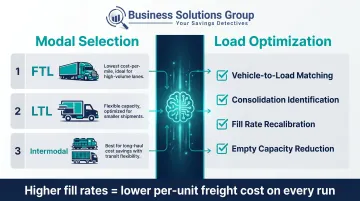
AI evaluates FTL, LTL, and intermodal options across the full shipment network rather than one load at a time. Manual planning optimizes each shipment in isolation. AI finds combinations across the entire order book — balancing cost, transit time, and sustainability targets — at a scale manual planning can't match.
Load consolidation follows the same logic. AI identifies which orders can ship together, matches vehicle type to load profile, and improves trailer fill rates continuously. Each incremental improvement in fill rate reduces the per-unit freight cost on every run, making it a compounding structural advantage rather than a one-time gain.
Key levers AI applies across modal and load decisions:
- Evaluates FTL vs. LTL vs. intermodal across the full order book simultaneously
- Matches vehicle type to actual load profile, reducing empty or underutilized capacity
- Identifies consolidation opportunities across orders that manual planners would miss
- Continuously recalibrates fill rate targets as order patterns shift
Demand-Driven and Predictive Planning
Last-minute spot booking is expensive. AI demand sensing captures shifts in order volume before they hit the transportation network, giving teams time to pre-position capacity and lock in carrier rates ahead of demand surges.
Predictive disruption modeling takes this a step further. By accounting for weather events, port congestion, geopolitical developments, and tariff changes, teams can reroute before disruptions reach the network. The reactive alternative — emergency shipments, carrier premiums, and service failures — costs far more than early action would have.
What to Look for in an AI Freight Optimization Platform
Not all platforms deliver equal value. These four capabilities separate tools that produce measurable savings from those that produce dashboards.
Automated Rate Management and Quoting
The platform should pull contracted, spot, and marketplace rates into a single engine, compare carrier options by cost and performance automatically, and generate accurate quotes in seconds. If rate shopping still requires a human pulling data from multiple sources, the platform isn't solving the problem — it's just digitizing it.
Real-Time Visibility and Decision Intelligence
Passive visibility — knowing where a shipment is — has limited value when disruptions hit. Decision intelligence goes further: it recommends corrective actions like rerouting or carrier swaps before delays cascade into service failures.
Gartner's research on supply chain disruption found that companies stuck in firefighting mode share a common trait: their tools show what's happening but don't say what to do about it. Platforms that prescribe actions — with financial impact attached — reduce disruption costs rather than just tracking them.
TMS and Systems Integration
A platform that can't access live order, inventory, and financial data will optimize on stale information. Evaluate whether the system connects natively to your existing ERP, WMS, and TMS without requiring a full migration. Prebuilt connectors matter — they compress implementation timelines and let freight optimization logic act on real data from day one.
Business Solutions Group's TMS integrates with WMS, ERP, and accounting software via open RESTful API, with out-of-the-box connectors for many common enterprise platforms, eliminating the need for custom development work before optimization can begin.
Spend Analytics and Reporting
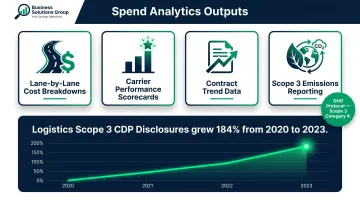
Operational dashboards tell you what happened. Spend analytics tell you why costs moved and where to act next. The platform should produce:
- Lane-by-lane cost breakdowns for procurement review
- Carrier performance scorecards against contracted SLAs
- Trend data for ongoing contract management
- Auditable emissions data aligned with GHG Protocol Scope 3 Category 4 requirements
That last point is increasingly non-negotiable. Logistics firms' Scope 3 disclosures to CDP grew 184% between 2020 and 2023. Platforms that can't produce auditable, shipment-level emissions data will create compliance gaps as sustainability reporting requirements continue to expand.
How to Evaluate and Select the Right Platform
Diagnose Before You Shop
Before evaluating vendors, identify where your cost leakage is actually concentrated. Is it routing inefficiency? Poor carrier selection? Absence of load consolidation? Lack of rate benchmarks? The answer determines which platform capabilities matter most, and keeps you from paying for features that don't address your actual cost drivers.
Business Solutions Group's engagement process starts here: a no-cost savings analysis that captures 6–12 months of shipment-level detail to establish a clear financial baseline. This diagnostic — completed in 3–5 business days — quantifies the savings opportunity before any platform decision is made.
Assess Integration and Scalability
Test whether the platform handles peak volume, not just average daily throughput. Confirm it connects to the specific ERP, TMS, and carrier systems already in your stack. Then ask vendors for:
- Documented implementation timelines (cloud TMS deployments typically run 2–6 months to stand-up, with 6–12 months to initial savings)
- ROI measurement methodology with auditable baselines from day one
- Clear KPIs: savings vs. should-cost, routing guide compliance lift, premium miles avoided
Vague ROI projections from vendors are a red flag. Require auditable baselines from day one — without them, you have no reliable way to measure what the platform actually delivers.
Consider an Advisory Partner
Platform evaluation gets complicated fast when in-house logistics technology expertise is thin. For businesses in that position, an advisory partner shortens the selection timeline and ensures AI-generated data translates into actual contract savings — not just dashboard metrics. Business Solutions Group pairs spend intelligence software with hands-on cost reduction work: validating ROI projections, renegotiating carrier contracts based on what the data surfaces, and delivering weekly management reporting to confirm savings hold over time.
Their performance-based model requires no upfront cost, with compensation tied to verifiable savings. For smaller shippers exploring AI-powered optimization, that structure removes the financial risk of a wrong platform decision.
Frequently Asked Questions
How can AI-powered freight optimization platforms reduce shipping costs?
AI platforms analyze real-time carrier rates, route conditions, and historical lane performance simultaneously to recommend the lowest-cost, highest-efficiency option for each shipment. This replaces manual, reactive decisions with continuous automated optimization that compounds savings across every load.
What is the difference between AI freight optimization and a traditional TMS?
A traditional TMS records and executes transportation decisions — carrier tracking, rate auditing, invoice management. AI freight optimization actively prescribes what to do next, recommending reroutes, carrier swaps, and load consolidations before costs escalate or service failures occur. The distinction is operational: one stores decisions, the other drives them.
How long does it take to see ROI from AI freight optimization?
Most platforms deliver first measurable insights within 8–12 weeks when connected to existing systems, with savings tracked against auditable baselines from day one. Business Solutions Group clients typically see measurable freight savings within 4–8 weeks of engagement, with the model continuing to improve as it ingests more shipment data over time.
What data does AI need to effectively optimize freight costs?
AI models perform best with historical lane data, carrier rates, shipment volumes, delivery outcomes, and regional economic signals. Broader market aggregations fill gaps on newer or lower-volume routes, keeping benchmarks statistically reliable across your network.
Can small and mid-sized shippers benefit from AI freight optimization?
Absolutely. Advisory-led approaches apply spend intelligence and benchmark analysis to existing carrier relationships without requiring a full platform overhaul. Business Solutions Group works with shippers regardless of volume, using a performance-based model with no upfront cost. Better carrier contracts and load planning typically deliver strong ROI even at lower shipment volumes.
How does AI support carrier contract negotiation, not just routing?
AI-generated cost benchmarks reveal what a lane should cost based on market data, giving logistics and procurement teams a defensible basis to challenge inflated carrier quotes. Business Solutions Group's spend intelligence software identifies which lanes consistently exceed benchmark costs, prioritizes them for renegotiation, and tracks whether new contract terms are honored after signing.