Introduction
Picture this: it's the final week of Q4, and your procurement team is reviewing annual vendor performance. You pull the numbers and discover you fell $47,000 short of a volume threshold with one of your top suppliers — a threshold that would have triggered a 3% retroactive rebate on your entire year's spend. That's a six-figure miss. And nobody saw it coming because nobody was watching.
This scenario plays out constantly across procurement teams managing rebates through spreadsheets and email threads. The agreements are signed, the money is theoretically available, and yet it never gets collected — because no one is tracking purchasing progress in real time.
According to Enable's 2025 State of Volume Rebates survey, 50% of businesses still manage rebates using spreadsheets. That figure explains a lot about why vendor rebate income remains one of the most underutilized levers in procurement.
AI-driven spend analysis addresses this directly by making rebate tracking continuous, automatic, and actionable — giving procurement teams the visibility they need before the period closes and the opportunity is gone.
Key Takeaways
- Half of businesses still track rebates manually, leaving real money uncollected each year
- AI monitors threshold progress in real time and flags purchasing adjustments before opportunities expire
- Automation removes the three biggest error points: transaction qualification, accrual forecasting, and reconciliation
- The result: more rebate income captured, lower admin costs, and stronger leverage at contract renewal
What Is AI-Driven Procurement Spend Analysis?
Spend analysis is the process of collecting, categorizing, and evaluating all purchasing data across an organization — who spends what, with which vendors, and under what contractual terms. As defined by APQC, the central questions are: How much are we spending? With which suppliers? Are we getting what was promised?
Traditional spend analysis answered those questions periodically — monthly or quarterly reports pulled together manually, often weeks after decisions were already made.
What AI Adds to the Picture
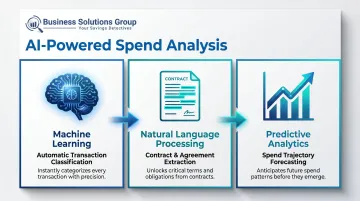
AI-driven spend analysis closes that gap by operating continuously on live transaction data. Three capabilities make it distinct from its predecessor:
- Machine learning classifies transactions automatically at scale, replacing manual categorization that takes weeks
- Natural language processing extracts structured data from contracts, rebate agreements, and amendment letters in any format
- Predictive analytics forecasts spending trajectories against active agreements, surfacing opportunities before they close
The Direct Link to Vendor Rebates
Vendor rebate agreements are structured financial arrangements tied directly to purchasing behavior. Three common triggers determine what you earn:
- Volume targets — cumulative spend must cross defined thresholds within the agreement period
- Product mix requirements — qualifying purchases must fall within specified categories or SKUs
- Growth milestones — year-over-year increases unlock tiered rebate rates
Without spend analysis tracking qualifying purchases in real time, companies can't manage their progress toward these thresholds. They find out what they earned — or forfeited — only after the period closes, with no opportunity to adjust purchasing behavior in time.
AI spend analysis changes that dynamic. When a company can see in real time that it's $40,000 short of a volume threshold with three weeks left in the quarter, procurement teams can act — consolidating orders, accelerating purchases, or redirecting spend to qualifying vendors before the window shuts.
Why Vendor Rebates Slip Through the Cracks
Most rebate leakage isn't the result of negligence — it's the result of complexity that manual processes simply can't handle at scale.
Fragmented Agreement Storage
Rebate terms live scattered across PDFs, email confirmations, amendment letters, and shared-drive spreadsheets. There's rarely a single source of truth. Teams overlook agreements, miss amendments, or can't locate terms when vendor disputes arise. With 50% of organizations still using spreadsheets for rebate management, that fragmentation is widespread.
Tiered Structures That Break Manual Math
Simple rebates are manageable. Tiered structures are not. A typical agreement might offer 1.5% on spend up to $500K, jumping to 3% retroactively on all spend once you cross $1M. Managing the calculation logic for a single vendor is tedious; managing it across 30+ vendors simultaneously is practically impossible to manage manually.
Enable documents over 300 distinct rebate types across modern supply chains — volume rebates, growth incentives, product-mix requirements, retroactive tiers, and multi-period agreements. No spreadsheet handles that complexity reliably.
Transaction Qualification Errors
Not every purchase from a vendor counts toward a rebate. Agreements commonly exclude:
- Specific product lines or SKU categories
- Sales channels (e.g., direct vs. distributor)
- Geographic locations or ship-to regions
- Certain transaction or payment types
Manually filtering thousands of transactions against those exclusion rules is where most classification errors occur — and where rebate leakage starts accumulating.
The Missed Threshold Problem
The most expensive failure is finishing a period just below a rebate tier. Industry estimates suggest 2–5% of rebate value is lost annually due to poor tracking and missed thresholds. For organizations managing tens of millions in vendor spend, that adds up fast. Chadwell Supply documented exactly this problem before implementing structured rebate tracking — they were "missing out on thousands of dollars due to failing to reach tier levels."
Reconciliation That Takes Days
Manual rebate accruals use simple linear projections that ignore seasonality and purchasing variability. At period-end, teams must then reconcile their calculations against vendor credit statements line by line. When discrepancies exist — and they often do — the process stretches across days or weeks, delaying cash collection and consuming days of staff time.
How AI Spend Analysis Captures Vendor Rebate Value
Agreement Ingestion and Structuring
AI reads rebate agreements in any format — scanned PDFs, email confirmations, contract amendments — and extracts structured fields: vendor name, effective dates, qualifying products, volume thresholds, tier breakpoints, and claim deadlines. The result is a searchable, centralized repository of all active rebate terms, with automatic flagging when agreement versions change.
This alone eliminates one of the most common failure modes: teams acting on outdated terms because an amendment was buried in an inbox.
Automated Transaction Qualification
AI applies the specific qualification rules for each rebate agreement across every transaction, continuously. Edge cases — ambiguous product categories, purchases near period boundaries, returns that affect qualifying volume — get flagged for human review rather than silently misclassified. That's where rebate leakage gets cut off.
Proactive Threshold Monitoring
This is where AI shifts rebate management from reactive to strategic. The system tracks real-time progress toward every active threshold and generates alerts when purchasing adjustments could capture a higher tier.
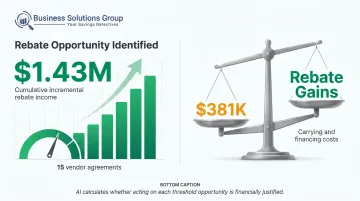
The system also calculates whether acting on each opportunity makes financial sense. A real-world implementation documented by Tim Dietrich identified $1.43M in incremental rebate income across 15 vendor agreements. It simultaneously modeled $381K in carrying and financing costs to determine which acceleration decisions were actually worth making. The math runs automatically; teams just act on the output.
Predictive Accrual Forecasting
Machine learning models estimate rebate accruals by incorporating historical purchasing patterns, seasonality, and current spend trajectory. For tiered agreements, the model produces probability-weighted outcomes — the likelihood of reaching each tier — rather than a single-point estimate that's frequently wrong. Finance teams get a defensible accrual range instead of a guess.
Reconciliation and Portfolio Analysis
At the transaction level, AI matches internal records against vendor statements using fuzzy logic and surfaces likely disputes before claims are submitted. At the portfolio level, the system delivers cross-vendor visibility that directly shapes renegotiation strategy:
- Flags date offsets, amount variances, and systematic exclusions in vendor statements
- Ranks agreements by rebate efficiency against their contractual potential
- Identifies which vendors consistently underperform on committed terms
- Prioritizes renegotiation targets based on recoverable value
Business Solutions Group's proprietary spend intelligence software delivers this portfolio view to procurement teams — connecting raw transaction data to rebate insights that drive contract renegotiations across parcel, freight, and broader supply chain agreements.
The Business Case for AI Spend Analysis
The performance gap between technology-enabled procurement organizations and manual ones is well-documented. The Hackett Group reports that Digital World Class procurement organizations operate at 21% lower cost and use 29% fewer FTEs than peer organizations — and top performers invest 38% more in procurement technology as a percentage of total spend.
That correlation matters: the technology investment is what creates the performance gap, not the other way around. Beyond cost reduction, AI spend analysis delivers three specific advantages:
- Proactive revenue management — procurement teams review threshold progress on a regular cadence and adjust purchasing before opportunities expire, turning rebate income from an afterthought into a planned revenue line
- Negotiation leverage — portfolio-level analysis showing which agreements underperform, where purchasing patterns have shifted, and which tier structures no longer fit gives teams data-backed evidence to restructure agreements at renewal
- Audit readiness — automatically generated documentation trails for rebate accruals (period-end summaries, variance analyses, calculation logs) ensure income is recognized correctly and in the right period, reducing compliance risk
These advantages translate into measurable results. AAH, a UK healthcare distributor, achieved a 35x return on investment after implementing structured rebate management — and eliminated approximately £2 million (roughly $2.5 million USD) in ineffective rebate agreements by gaining visibility into which ones were actually performing.
How to Start: A Practical Adoption Path
Most organizations don't need a full-scale AI transformation to start capturing rebate value. A phased approach works — and each phase delivers stand-alone ROI.
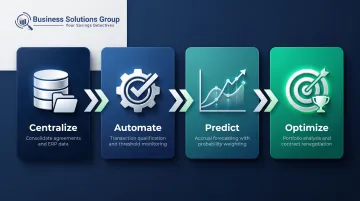
Centralize → Automate → Predict → Optimize
Centralize — Consolidate all active rebate agreements into a structured repository. Ensure transaction data from your ERP or procurement system flows into your analysis platform consistently. This is the prerequisite; AI can't work on data it can't access.
Automate — Deploy automated transaction qualification and threshold monitoring for your highest-value vendor agreements first. Even targeting the top 10 vendors delivers meaningful impact quickly.
Predict — Layer in predictive accrual forecasting once baseline transaction data is clean. This improves financial reporting accuracy and gives finance teams defensible accrual estimates.
Optimize — Use portfolio-level analysis to identify underperforming agreements, renegotiate tier structures, and build rebate income into forward purchasing plans.
The hardest part of this framework isn't the technology — it's knowing where your current program stands before you begin.
For businesses managing complex vendor relationships, particularly small parcel and freight shippers with multi-tier carrier agreements, Business Solutions Group offers a no-cost benchmark analysis as a starting point. It compares your current rebate capture rates against market standards, identifies your highest-value opportunities, and maps a deployment path that fits your existing data infrastructure.
Frequently Asked Questions
What is a spend analysis in procurement?
Spend analysis is the process of collecting, categorizing, and evaluating all purchasing data across an organization to understand spending patterns and identify savings opportunities. AI-driven spend analysis runs continuously and automatically — replacing the periodic, manual reviews that leave gaps in visibility.
How does AI improve vendor rebate management?
AI automates the most error-prone steps: extracting agreement terms from documents, qualifying transactions against contractual rules, tracking threshold progress in real time, and reconciling claims against vendor statements. This eliminates the manual spreadsheet work that leads to missed rebates and calculation errors.
What types of vendor rebates can AI help track?
AI handles volume-based rebates, tiered structures with retroactive provisions, growth-based incentives, product-mix rebates, and multi-period agreements — simultaneously, across dozens of vendors with different calculation structures and claim deadlines.
How much money do businesses lose by not tracking vendor rebates properly?
Industry estimates from rebate management specialists suggest 2–5% of rebate value is lost annually due to poor tracking and missed thresholds. For organizations with significant procurement operations, this can represent millions in uncollected income each year.
What is the difference between traditional and AI-driven spend analysis?
Traditional spend analysis is periodic and manual — it tells you what happened after the fact. AI-driven spend analysis runs in real time, flagging threshold gaps and surfacing which purchases to accelerate before the period closes.
How long does it take to implement AI-driven spend analysis?
Implementation timelines vary based on existing data infrastructure, but businesses can begin seeing value quickly by targeting threshold monitoring for their top vendors first. The phased approach — centralize, automate, predict, optimize — means ROI at each stage rather than waiting for full deployment.