Introduction
Business telecom has gotten genuinely complicated. The FCC reports over 2,265 providers offering business-grade voice services across the U.S. — and that's before you factor in UCaaS, SD-WAN, SIP trunking, and cloud connectivity options competing for your attention and budget.
Most businesses handle this one of two ways: they let internal teams manage it alongside everything else, or they rely on direct carrier reps. Neither approach gives you the full picture.
Carrier reps represent a single provider's interests. Internal teams rarely have the bandwidth or market data to benchmark rates accurately. The result? Misaligned contracts, services nobody uses, and costs that quietly drift upward with every auto-renewal.
This article covers the concrete advantages of working with a telecom consultant — specifically how that relationship translates to lower costs, sharper vendor decisions, and fewer contract surprises as your business grows.
Key Takeaways
- A telecom consultant is carrier-agnostic, working across providers to find the best fit for your business rather than a preferred vendor
- Telecom audits commonly uncover billing errors, unused services, and below-market contract rates
- According to ETMA research, optimizing and eliminating unused wireline services alone can yield 5% to 30% in potential savings
- The consulting relationship is ongoing, covering vendor management, escalation support, and continuous optimization
- Businesses that skip telecom consulting often overpay for years before the problem surfaces
What Is a Telecom Consultant?
A telecom consultant is an independent advisor who evaluates, recommends, and manages telecom solutions on your behalf — without being tied to any single carrier. Their scope typically covers voice, data, network connectivity, UCaaS, SD-WAN, SIP trunking, cybersecurity, and cloud services.
In practice, they handle:
- Auditing your current telecom invoices and contracts
- Benchmarking your rates against real market pricing
- Comparing solutions across multiple carriers and providers
- Managing procurement and implementation coordination
- Serving as an ongoing point of contact for vendor issues and optimization
Enterprises typically spend 2% to 4% of corporate revenue on telecom, according to the Enterprise Technology Management Association (ETMA) — yet most don't have a structured process for reviewing whether that spend is justified. A consultant brings market-level visibility that most internal teams simply don't have access to.
For businesses with multiple locations, growing bandwidth needs, or high monthly telecom spend, a consultant provides the accountability structure to ensure that spend is actively managed — not just renewed on autopilot.
Key Advantages of Working with a Telecom Consultant
Each advantage below ties directly to outcomes businesses track: cost, uptime, efficiency, and scalability.
Advantage 1: Carrier-Agnostic Objectivity
A telecom consultant represents no single carrier. They work across the full range of providers — from major carriers to cloud-based UCaaS and connectivity vendors — and recommend whatever solution actually fits the client.
The alternative is dealing with carrier sales reps who operate under very different incentives. Direct reps have quotas. Their job is to close deals on their carrier's products, which pushes toward upselling features you may not need or locking you into long-term contracts that serve the carrier's retention goals more than your operational ones.
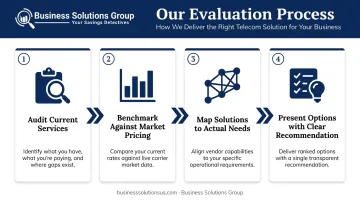
An independent consultant flips that dynamic. Their process typically looks like:
- Audit current services — review what you have, what you're paying, and what's actually in use
- Benchmark against market pricing — compare your rates to what's available across the carrier landscape
- Map solutions to your actual needs — not to a product catalog
- Present options with a clear recommendation — with trade-offs explained, not buried
KPIs this impacts: vendor selection accuracy, contract renewal costs, total telecom spend, unused services identified, time spent on carrier evaluation
This advantage is most critical during contract renewals, when evaluating new technologies like UCaaS or SD-WAN, or when your business has never formally reviewed its telecom stack.
Advantage 2: Cost Reduction and Spend Optimization
Telecom invoices are among the hardest business expenses to audit independently. They contain dozens of line items — some for services that are outdated, duplicated, or never fully activated. Without market data to benchmark against, most businesses have no way of knowing whether they're paying a fair rate.
This is where structured telecom consulting delivers direct financial value. The process involves:
- Reviewing invoices line by line to identify billing errors, duplicate charges, and zero-use services
- Benchmarking current rates against market pricing across carriers
- Negotiating better contract terms using multi-carrier relationships and volume leverage
- Identifying services that can be eliminated or renegotiated without disrupting operations
The potential savings are material. According to ETMA:
- Audit and billing error recovery: 2% to 15% potential savings
- Strategic sourcing and contract renegotiation: 5% to 25% potential savings
- Wireline optimization and unused service elimination: 5% to 30% potential savings
Business Solutions Group's approach uses proprietary spend intelligence software to benchmark telecom costs against real market data. This surfaces optimization opportunities that manual reviews typically miss. Their subscription and service optimization work targets zero-use lines and plan misalignment, with savings in the range of 10% to 25% according to their internal service documentation.
KPIs this impacts: monthly telecom spend, cost per line/seat/location, billing error recovery, pricing vs. market benchmark, total cost of ownership
This advantage has the highest immediate impact for businesses that haven't reviewed telecom contracts in two or more years, are scaling to new locations, or have shifted usage patterns due to remote work or system changes.
Advantage 3: Ongoing Partnership and Long-Term Adaptability
A telecom consultant isn't a one-time vendor selection exercise. Telecom needs change as businesses grow — and the ongoing relationship is where the real value builds.
As bandwidth requirements increase, new locations come online, and platforms need to integrate, a consultant who already knows your environment saves significant time. They don't need to re-learn your contracts, your carrier relationships, or your cost baseline every time something shifts.
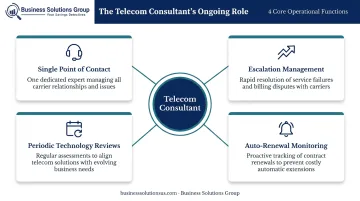
Operationally, this ongoing role includes:
- Acting as a single point of contact across multiple carriers and vendors
- Managing escalations when service issues arise — so your internal team doesn't spend hours on hold with carrier support
- Conducting periodic technology reviews to recommend upgrades or changes as your business evolves
- Flagging auto-renewal windows before they lock you into terms you haven't reviewed
The cost of getting this wrong isn't hypothetical. According to Uptime Institute's 2025 Annual Outage Analysis, 54% of respondents reported their most recent significant outage cost more than $100,000 — and one in five said it exceeded $1 million. Telecom-related outages and service disruptions are a real contributor to that exposure.
KPIs this impacts: mean time to resolve telecom issues, IT hours spent on carrier management, downtime incidents, service scalability lead time, technology refresh cycles
This advantage matters most for growing businesses, multi-location operations, and organizations where IT resources are stretched across competing priorities.
What Happens When You Skip the Telecom Consultant
Businesses that manage telecom entirely through direct reps or internal procurement tend to encounter the same predictable problems:
- Overpaying on contracts because they lack benchmark data to challenge carrier pricing
- Getting locked into multi-year terms with providers that don't scale with their needs
- Paying for services nobody uses — zero-use lines, legacy features, and duplicate accounts that accumulate over time
The compounding effect is the real problem. Without periodic review, telecom costs drift upward through auto-renewals, rate adjustments, and feature additions that don't show up as obvious line items on already-complex invoices. By the time the problem is visible, you may be two or three contract cycles into overpaying.
The financial bleed isn't the only cost. When telecom issues arise with no consultant managing vendor relationships, internal teams absorb the resolution burden — calling into carrier support queues, escalating tickets, and coordinating between multiple providers. That's time pulled away from actual business priorities.
All of it is avoidable — but only if someone is actively watching the bill, the contracts, and the renewal calendar.
How to Get the Most Value from a Telecom Consultant
Telecom consulting delivers more when treated as an ongoing strategic relationship rather than a one-time fix. These principles consistently improve outcomes:
Engage early. The best time to bring in a consultant is before a contract auto-renews, before you open a new location, or before you commit to a major platform change — not after you've already signed something that doesn't fit.
Share full context upfront. Business Solutions Group's methodology starts with a complete review of invoices, contracts, and usage data before any recommendations are made. The more a consultant knows — including growth plans and upcoming environment changes — the more accurate their benchmarking and negotiation strategy will be.
Follow through on recommendations. Identifying savings opportunities is only half the process. The financial and operational benefits actually materialize when recommendations are implemented and reviewed periodically as business conditions change.
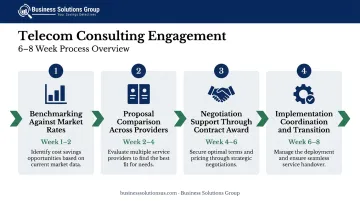
Business Solutions Group structures its engagement to take 6 to 8 weeks from initial analysis through contract award and implementation guidance — with savings beginning to appear on the P&L shortly after. That timeline covers:
- Benchmarking against current market rates
- Proposal comparison across providers
- Negotiation support through contract award
- Implementation coordination and transition guidance
Conclusion
The value of a telecom consultant comes down to three compounding advantages: objectivity that removes costly vendor bias from your decisions, spend optimization that directly improves operating margins, and an ongoing partnership that keeps your communication infrastructure aligned with how your business actually operates.
None of these advantages is a one-time event. They build over time as the consultant deepens their understanding of your environment, catches problems before they compound, and adapts your telecom stack as your business grows.
For businesses that haven't formally reviewed their telecom spend recently — or that are approaching a major contract renewal — the gap between what you're paying and what you should be paying is almost certainly larger than it appears.
Frequently Asked Questions
How does a telecom consultant save my business money?
Consultants audit current invoices for billing errors and unused services, benchmark your rates against real market pricing, and negotiate better contract terms using their multi-carrier relationships. These savings compound over the life of a contract, especially for businesses that haven't reviewed their telecom spend in the past two years.
Does working with a telecom consultant cost my business anything?
Telecom consultants are typically compensated by the carriers they place, not directly by the client. That means businesses receive advisory services, vendor management, and ongoing support at no out-of-pocket cost.
What is the difference between a telecom consultant and a direct carrier sales rep?
A direct rep represents one carrier and is incentivized to sell that carrier's products. An independent consultant is carrier-agnostic: they work across multiple providers and are motivated to recommend whichever solution genuinely fits the client's needs and budget.
What types of businesses benefit most from telecom consulting?
Any business with meaningful monthly telecom spend benefits, but the impact is highest for multi-location operations, companies approaching contract renewal, and organizations that haven't taken a close look at their telecom services in the past two years.
How do I know if my current telecom contract is costing me too much?
A telecom consultant can conduct a spend analysis or invoice audit to identify whether your rates are competitive and where savings opportunities exist. Without access to current market pricing, most businesses have no reliable way to make that call on their own.
How long does it take to see results from working with a telecom consultant?
Initial savings and contract improvements are typically identified within weeks of an audit. Business Solutions Group's full engagement , from analysis through implementation, runs approximately 6 to 8 weeks, with savings appearing on the P&L shortly after contract award.