The phrase "outsource your IT" gets thrown around constantly—but the real question is whether it delivers measurable, day-to-day value, not just theoretical savings. For many businesses, the answer is yes, but only when the arrangement is structured correctly.
This article breaks down the concrete advantages of outsourcing IT services, the operational risks of going without, and how to ensure your outsourcing relationship actually performs.
Key Takeaways
- Outsourcing IT shifts spend from unpredictable capital costs to a predictable monthly fee
- 56% of U.S. small businesses experienced a cyberattack in the past 12 months—outsourced security provides coverage most in-house teams cannot
- The global cybersecurity talent gap reached nearly 4.8 million unfilled roles in 2024, making in-house hiring increasingly difficult
- Scalability under an existing MSP contract is far faster than recruiting and onboarding new IT staff
- Small and mid-sized businesses gain enterprise-grade IT capabilities without the cost of a full internal department
What Is IT Outsourcing?
IT outsourcing is the practice of hiring a third-party firm to handle some or all of a company's technology-related functions. That scope can include network management, cybersecurity monitoring, cloud infrastructure, helpdesk support, data backup, and system maintenance.
The arrangement comes in two forms:
- Full outsourcing — the external provider replaces an in-house IT team entirely
- Co-managed IT — the provider supplements an existing department, filling gaps in expertise or coverage without replacing internal staff
The goal is access to stronger capabilities, more predictable costs, and operational stability that most businesses struggle to build on their own.
Key Advantages of Outsourcing IT Services
The advantages below are grounded in operational impact—the kinds of outcomes that show up in budgets, productivity metrics, and risk profiles. Each one connects to KPIs businesses actually track: cost per incident, system uptime, time-to-resolution, compliance status, and employee productivity.
Cost Reduction and Predictable IT Spend
One of the most direct advantages of IT outsourcing is the shift from volatile, often high capital expenditures to a structured monthly cost model.
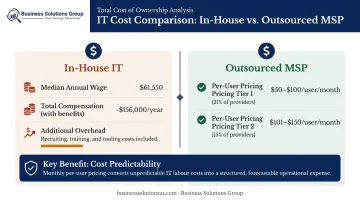
Instead of carrying the fully loaded cost of one or more internal IT employees—wages, benefits, recruiting, ongoing training, security tooling, and management overhead—businesses pay a flat or tiered fee covering a defined scope of services. According to the 2024 Kaseya MSP Benchmark Survey of 984 MSP respondents, common monthly rates run $50–$100 per user (21% of providers) and $101–$150 per user (15% of providers).
Compare that against what in-house IT actually costs. The Bureau of Labor Statistics reports a median annual wage of $61,550 for computer support specialists, with total compensation in professional and technical services reaching $75.15 per hour once benefits are included, roughly $156,000 annually before recruiting, training, tools, or management overhead are factored in.
KPIs most affected:
- IT cost per user per month
- Total IT spend as a percentage of revenue
- Frequency of unplanned IT expenditures
- Hardware refresh cycle predictability
The cost advantage is most pronounced for small and mid-sized businesses that cannot justify a full internal IT department, and for businesses in growth or contraction phases where fixed headcount-based IT models create unnecessary exposure.
Access to Specialized Expertise and Proactive Security
Outsourced IT providers employ specialists across cybersecurity, cloud architecture, compliance, and networking. Matching that coverage with in-house hires would cost most businesses far more than it's worth.
The security dimension here is not abstract. According to the Hiscox Cyber Readiness Report 2026, 56% of U.S. small businesses experienced at least one cyberattack in the prior 12 months, with an average of 2.38 attack attempts per business. Meanwhile, the global cybersecurity workforce gap rose 19% to nearly 4.8 million unfilled roles in 2024, meaning qualified in-house security talent is both scarce and expensive.
In-house IT generalists often lack the depth to handle advanced threats or compliance mandates like HIPAA, PCI-DSS, or SOC 2. When those employees leave, their institutional knowledge leaves with them.
Outsourced teams embed that knowledge within the vendor, providing continuity regardless of staff turnover.
The redundancy factor matters too. A single internal IT employee is a single point of failure for security monitoring. Outsourced providers offer team-based coverage, 24/7 monitoring, and proactive vulnerability identification.
KPIs most affected:
- Mean time to detect (MTTD) security incidents
- Mean time to respond (MTTR)
- Compliance audit pass rates
- Number of unpatched vulnerabilities
- System uptime percentage
For businesses in regulated industries, healthcare, finance, or legal, team-based security coverage isn't optional. Any company scaling into markets with new compliance requirements will feel this gap quickly if relying on a single generalist.
Scalability and Freed Capacity to Focus on Core Operations
Outsourcing IT lets businesses expand or reduce technology capacity in response to business conditions: new locations, seasonal demand spikes, headcount changes. None of that requires hiring or laying off staff.
Under an existing MSP contract, adding user accounts, endpoint coverage, or security monitoring happens through service workflows. Hiring an in-house employee, by comparison, adds recruiting time, onboarding, supervision, and retention risk before any actual IT work gets done.
Beyond scalability, outsourcing removes the IT management burden from leadership and internal teams. Microsoft's study of more than 3,000 SMBs found that 77% of businesses with internal IT staff have those staff primarily focused on maintenance rather than strategic or specialized work. That maintenance burden crowds out strategic work. The same study found 45% of SMBs already rely on external consultants or partners to manage technology, suggesting the shift is already well underway among businesses prioritizing cost efficiency.
KPIs most affected:
- Employee hours lost to IT-related disruptions
- System downtime as a percentage of working hours
- Time-to-provision new users or systems
- Internal productivity scores during IT incidents
Rapid growth, geographic expansion, and mergers all demand fast infrastructure changes. Outsourcing removes the management overhead that would otherwise slow those transitions down.
What Happens When IT Outsourcing Is Overlooked
Businesses that try to handle IT entirely in-house without adequate resources tend to settle into a reactive posture—technology gets addressed when something breaks, not before.
The consequences are predictable:
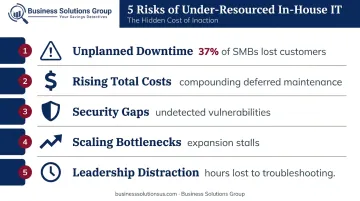
- Inconsistent performance and unplanned downtime — Infrascale's SMB survey found 37% of SMBs lost customers and 17% lost revenue directly due to IT downtime
- Rising total costs — emergency fixes, outdated hardware, and deferred maintenance compound over time; Microsoft found 47% of SMBs cite the cost of new solutions as a primary barrier to adoption, a cycle that only worsens as maintenance slips
- Security gaps — without continuous monitoring, vulnerabilities go undetected until an incident occurs; for small businesses, the fallout from a single breach—financially and reputationally—can outlast the incident itself
- Scaling bottlenecks — when IT can't keep pace with business growth, expansion stalls or creates operational fragility at exactly the wrong moments
- Leadership distraction — every hour leadership spends troubleshooting IT is an hour not spent on customers, strategy, or operations
These gaps don't announce themselves. A missed backup here, an unpatched system there—each one manageable in isolation, catastrophic when they converge. That's when businesses start asking whether there's a better way to manage IT entirely.
How to Get the Most Value from IT Outsourcing
IT outsourcing delivers sustained value when treated as a managed business relationship, not a one-time vendor contract. That means:
- Specify response time guarantees, uptime targets, security incident escalation procedures, and scope of services before signing
- Schedule monthly or quarterly check-ins against agreed KPIs to keep providers accountable and surface issues before they become incidents
- Document IT spending and operational performance before outsourcing — businesses that do this are far better positioned to measure ROI and hold providers accountable for real results
- Keep internal stakeholders engaged — leadership should review key metrics (uptime, response time, security incidents) regularly and communicate operational changes to the IT provider before they happen
- Let the scope evolve — new locations, compliance requirements, and systems should trigger proactive scope reviews, not emergency calls
Businesses that build defined accountability into the relationship from day one consistently extract more value — and avoid the reactive fire-fighting that erodes both trust and budget.
Conclusion
Outsourcing IT gives businesses access to specialized expertise, predictable cost structures, and scalable support that in-house teams rarely match at the same price point. The result is more control over technology outcomes, not less.
Businesses that establish strong outsourcing relationships, set clear performance benchmarks, and act on insights consistently will see IT shift from a recurring cost burden into a reliable operational foundation.
As technology complexity and cybersecurity risk continue to grow, the real decision is how to structure the arrangement — so every dollar spent on technology contributes to profitability and operational efficiency, rather than getting absorbed by unplanned crises.
Frequently Asked Questions
Who benefits most from outsourcing IT services?
Small and mid-sized businesses benefit most, gaining enterprise-level IT expertise and security without the cost of a full internal department. Businesses in regulated industries, those experiencing rapid growth, and companies with limited internal technical resources also see disproportionately high returns.
What IT functions are most commonly outsourced?
The most frequently outsourced functions include helpdesk and technical support, cybersecurity monitoring, cloud infrastructure management, network maintenance, and data backup and disaster recovery. Microsoft's SMB research also highlights demand for proactive technology guidance and business continuity planning from external partners.
What is the difference between managed IT services and IT outsourcing?
IT outsourcing is a broad term for any third-party management of IT functions. Managed IT services is a subset—a proactive, ongoing model where a provider monitors, maintains, and manages a company's systems under a defined service agreement, rather than handling only discrete or project-based tasks.
How much can a business save by outsourcing IT services?
Savings vary by business size, scope, and current IT setup. Start by comparing your fully loaded in-house cost—wages, benefits, recruiting, training, and tooling—against MSP pricing bands ($50–$150 per user per month, per Kaseya's 2024 survey). The shift to flat monthly fees typically delivers budget stability even when raw cost differences are modest.
What are the risks of outsourcing IT services?
Key risks include reduced direct control, vendor dependency, and data privacy exposure. Thorough due diligence, clearly defined SLAs, regular performance reviews, and explicit data handling agreements address most of these concerns before they become problems.
How do I choose the right IT outsourcing partner?
Evaluate providers on industry experience, security certifications, response time guarantees, and client references. The right partner proactively flags risks and adapts as your business grows—not just a break-fix vendor who appears after something fails.