
Introduction
Picture this: a mid-size company's finance team is reviewing quarterly spend and discovers it has been paying for two circuits at a location it vacated 14 months ago. A contracted discount negotiated two years prior was never loaded into the carrier's billing system. And a $340 monthly surcharge appeared on invoices with no explanation — flagged by nobody, paid every month.
None of these errors were obvious. They didn't trigger an alert. They passed through routine accounts payable without a second look.
This is how telecom billing waste works. It doesn't announce itself. According to research cited by multiple TEM advisory firms, approximately 85% of enterprise telecom invoices contain some form of billing error — and the average error goes undetected for 14.3 months.
For multi-location enterprises, industry data puts overpayment at 12–30% of total telecom spend, much of it attributable to the same five recurring error categories.
This playbook covers exactly that: where to look, how to recover what's owed, and what to put in place so it doesn't happen again.
Key Takeaways
- Telecom billing errors are systematic — the same five categories drive the majority of enterprise overpayments
- A structured audit compares every active invoice against contracts, inventory, and actual usage
- Dispute windows are carrier-specific (typically 60–180 days), making recent invoices the highest-priority targets
- Audit findings should feed contract renegotiation and service right-sizing, not just one-time credits
- Sustained savings require named ownership, automated variance tracking, and proactive contract renewal management
Why Telecom Billing Errors Drain More Than You Think
The Invoice Complexity Problem
A telecom invoice is nothing like a standard vendor bill. It combines recurring monthly charges, one-time fees, usage-based costs, regulatory surcharges, and contract-defined discounts, often across dozens of service lines formatted differently by every carrier.
Most accounting teams process these invoices at the total level. If the bill is close to last month's amount, it gets approved and paid. As Tellennium notes, "Finance approves payments because services are assumed necessary. IT manages upgrades and vendor relationships but rarely audits billing against actual usage."
The result: line-item errors pass through undetected, month after month.
The Compounding Math
A $50/month rate mismatch on a single circuit is easy to dismiss. Across 200 circuits, that's $120,000 in annual exposure — from one error category alone. The 14.3-month average detection window means most organizations are losing well over a year of overcharges before anything gets corrected.
And 27% of corrected billing errors reappear within six months without continuous monitoring. A one-time fix is not the same as a solved problem.
The Organizational Gap
No single team owns telecom billing accuracy end-to-end. Responsibility is typically split three ways:
- IT manages the services
- Finance pays the invoices
- Procurement negotiates the contracts
The reconciliation between all three rarely happens in any coordinated way. That gap is where billing errors live — and closing it is the core challenge of any serious telecom audit.
The Five Most Common Telecom Billing Errors
These five categories account for the vast majority of telecom billing waste across enterprises. Identifying which ones apply to your organization determines where audit effort should be concentrated.
Contractual Errors
Contractual errors occur when invoiced amounts don't match what the signed agreement specifies. They're often the largest per-line-item recovery opportunity in any audit.
Common forms:
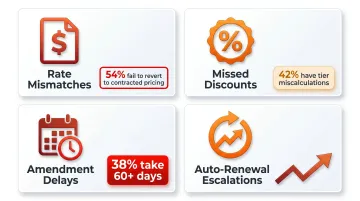
- Rate mismatches — billed MRC is higher than the contracted rate
- Missed discounts — volume or loyalty discounts negotiated but never loaded into the billing system
- Amendment delays — 38% of contract amendments take 60+ days to appear in carrier billing systems, meaning enterprises pay original rates despite signed changes
- Auto-renewal escalations — a carrier's 3–5% annual increase clause triggers without notice
54% of services with expired promotional rates fail to revert to contracted pricing, and 42% of volume-based enterprise agreements have tier miscalculations.
Ghost Services
Ghost services are charges for circuits, lines, or subscriptions that remain active in the billing system but serve no current business need.
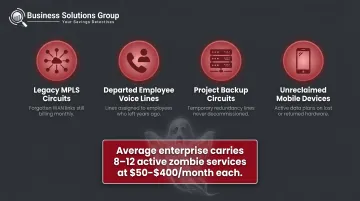
When a location closes or an employee leaves, the physical transition gets handled — but the formal carrier disconnect order never gets submitted. The average enterprise carries 8 to 12 active zombie services at any given time, each costing between $50 and $400 per month.
Common culprits:
- Legacy MPLS circuits left running after SD-WAN migrations
- Voice lines tied to departed employees
- Backup circuits provisioned for a specific project and never disconnected
- Mobile devices assigned to staff who left months ago
Rate and Tariff Errors
Rate and tariff errors involve services that are real and active but priced incorrectly — the wrong rate plan, an outdated tariff code, or a higher tier billed than what's provisioned.
Unlike contractual errors, there may be no signed agreement to compare against. The carrier is simply applying the wrong market-rate structure. Type 1 vs. Type 2 access is a common example: where direct (Type 1) access is available, paying resale (Type 2) markup is avoidable waste.
Spotting rate errors requires external benchmarking, which is why they persist longer than other error types. Enterprise telecom market rates decline approximately 10–15% annually — meaning a contract rate locked in three years ago may now be materially above current market pricing.
Cost Allocation Errors
Cost allocation errors don't inflate total telecom spend, but they corrupt the data used to make decisions.
When charges are mapped to the wrong department, location, or GL code, per-site and per-department cost analysis becomes unreliable. Budget planning, headcount decisions, and real estate evaluations all depend on clean cost data — and misallocated telecom charges quietly skew all three.
Common scenarios:
- Shared WAN circuits allocated entirely to one site
- New services provisioned without being mapped to a cost center
- M&A activity that brings in services never integrated into the existing allocation framework
Usage-Based and One-Time Charge Errors
Usage-based and one-time charge errors are the hardest to catch — they fluctuate month-to-month and blend into normal billing variation.
Main types:
- Overages on metered services — burstable bandwidth, international calling
- Duplicate NRCs for the same installation or MACD request
- Charges for expedited service that was never requested
- Late payment fees triggered by carrier billing errors, not actual late payment
Detection requires a different approach: rather than comparing to a contract, establish a baseline expected cost per service and flag monthly variances beyond a 5% threshold.
How to Conduct a Telecom Billing Audit: A Step-by-Step Playbook
The most common audit failure is starting with invoices instead of inventory. Without a baseline, there's nothing to compare against.
Step 1 — Build a Complete Service Inventory
The audit starts with inventory. The goal is a master list of every active telecom service: circuit ID, service type, location, monthly recurring cost, vendor, and contract term.
Internal records are often outdated. The most reliable inventory source is the invoices themselves — pull every active line item from the last 2–3 months of bills across all vendors. This becomes the baseline against which everything else is validated.
Business Solutions Group helps clients build this inventory foundation as part of its broader spend intelligence and cost reduction advisory work — ensuring no service goes unreviewed.
Step 2 — Gather and Organize Contracts
Locate the signed agreement for every vendor in the inventory, including amendments and addenda. Contracts often live across email archives, legal folders, and individual employees' files.
Extract from each contract:
- Contracted rate per service
- Discount structure and volume tiers
- Term start/end dates
- Auto-renewal provisions
- Dispute window timelines
Step 3 — Reconcile Invoices Against Contracts and Inventory
For every service in the inventory:
- Compare the invoiced MRC against the contracted rate
- Verify that active services map to real, current business locations and needs
- Flag any line item that can't be matched to a current contract or operational requirement
- Validate cost allocation mapping to correct departments and GL codes
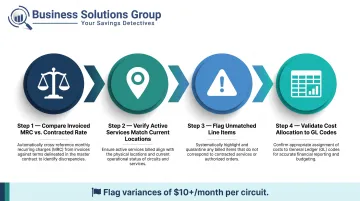
Set a variance threshold — even $10/month per circuit is worth flagging at scale across a large multi-location footprint.
Step 4 — File Disputes and Track Recovery Actively
Reconciliation findings feed directly into the dispute process. Most carriers define dispute windows between 60 and 180 days from the invoice date, so prioritize recent invoices and work backward.
Strong dispute documentation includes:
- Contract reference page with the applicable rate
- Invoice screenshot showing the discrepancy
- Clear timeline of when the error started
- Specific credit amount requested
Disputes must be tracked and actively followed up — many go unresolved simply because no one escalated after the initial filing. Assign a named owner to the dispute queue. Business Solutions Group manages this process on behalf of clients, handling carrier filings and following credits through to resolution.
Turning Audit Findings into Ongoing Optimization
An audit is a diagnostic snapshot. Optimization is the sustained system that prevents errors from returning. Companies that complete an audit without building that system typically see savings erode within 12–18 months as new errors accumulate and contracts auto-renew at higher rates.
Renegotiate Contracts Using Audit Data
Audit findings create leverage. Competitive quotes for comparable services — even without an intent to switch — give finance and procurement teams a factual basis for renegotiation.
A practical decision framework:
- Renegotiate mid-term when moderate savings are at stake and switching costs are high
- Switch at term-end when materially better pricing is available and service quality is comparable
- Consolidate when multiple vendors are serving the same locations with overlapping services
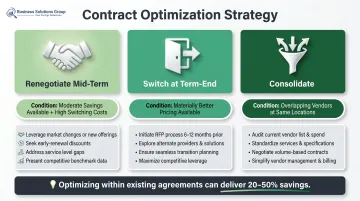
Push to eliminate auto-renewal traps: require written notice of rate changes at least 90 days before renewal. In most cases, cost reduction doesn't require switching carriers at all. Optimizing within existing agreements routinely delivers 20–50% savings without operational disruption.
Right-Size Services to Match Actual Usage
Pull utilization data across all circuits and flag:
- Over-provisioned circuits — paying for capacity that's never used
- Under-provisioned circuits — consistently running above 70–80% utilization, degrading performance
Organizations that migrated workloads to cloud platforms often find their on-premise DIA circuits remain sized for pre-migration traffic levels. SD-WAN adoption can deliver 20–40% cost savings versus traditional WAN spend. For lighter-traffic branch locations, business-class broadband may adequately replace dedicated access at a significant cost difference.
Benchmark Current Rates Against the Market
Telecom pricing trends downward as infrastructure costs amortize and competition increases. Knowing whether current rates are competitive requires systematic comparison against current market pricing, not carrier-provided reports. A reliable benchmark covers:
- Wireline and dedicated internet access rates by geography
- Wireless plan pricing versus comparable tier offerings
- Cloud connectivity costs against current market standards
Business Solutions Group's benchmark analysis delivers this comparison across all three categories, giving procurement teams data-backed leverage rather than carrier assurances.
Build a Continuous Monitoring Cadence
Without structure, savings from even a thorough audit will fade. The operational cadence that sustains results:
- Set automated alerts for contract renewals at least 6 months before term end
- Run monthly variance analysis comparing current invoices against contracted rates and prior-month charges
- Assign named ownership to telecom expense management so it doesn't depend on a single audit project
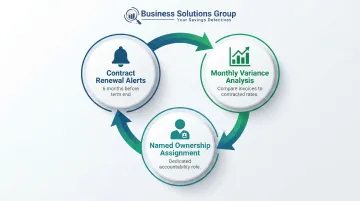
Automated invoice validation, direct carrier dispute management, and trend reporting are the operational backbone that keeps savings intact well beyond the initial audit.
In-House vs. Outsourced Telecom Auditing
Each approach to telecom auditing carries real trade-offs. Here's how the three main models compare:
| Model | Strengths | Watch Out For |
|---|---|---|
| In-House | Direct data control, no gain-share fees, integrates with internal finance workflows | Rarely fluent in carrier contract language; lacks benchmarking data; often stretched too thin |
| Outsourced | Carrier contract expertise, proprietary benchmarking, audit technology built for this work; most firms operate on contingency | Less direct oversight; requires clear scope and data-sharing agreements |
| Hybrid | Internal teams handle routine invoice processing; specialist partner handles deep-dive audits, disputes, and benchmarking | Requires coordination between internal and external stakeholders |
The hybrid model tends to work well for mid-to-large enterprises — it balances control with expertise without fully handing off oversight.
A useful decision point: if your organization spends more than $25,000/month on telecom and IT — and hasn't run a formal contract-to-invoice reconciliation in the past 18 months — outsourcing the audit function is likely to recover more than it costs. Business Solutions Group offers a free Savings Analysis to quantify the potential before any commitment is made.
Frequently Asked Questions
What is a carrier audit?
A carrier audit is a systematic review of telecom or shipping invoices that verifies every charge aligns with your signed contract, confirms billed services are actually in use, and flags unauthorized or duplicate fees. It focuses specifically on vendor billing accuracy at the line-item level — not general financial review.
What are the four types of audits in telecom billing?
The four main types are invoice/rate audits (contractual compliance), service audits (active and correct provisioning), usage audits (over-provisioned capacity and plan mismatches), and cost allocation audits (charges mapped to the right department or GL code). Each targets a different failure point in the billing chain.
How often should I audit my telecom invoices?
Aim for monthly variance analysis at minimum. A comprehensive contract-to-invoice reconciliation should happen at least annually — or whenever a significant contract is renewed, a location is added or closed, or a provider migration occurs. Organizations that haven't done a formal review in 18+ months should treat it as urgent.
What percentage of telecom spend can a billing audit typically recover?
Recovery varies by organization size, audit thoroughness, and how long errors have gone undetected. Industry benchmarks place typical overpayment at 12–20% of total telecom spend, with first-time audits often recovering 10–30% in unnecessary spend.
How long does a telecom billing audit take?
Timeline depends on vendor count, number of locations, and whether contracts are digitized. A focused mid-size enterprise audit produces initial findings within a few weeks; complex multi-vendor environments typically take 4–8 weeks for the diagnostic phase.
Should I dispute every billing discrepancy I find, or only large ones?
Log all discrepancies, but prioritize by dollar impact and urgency within the carrier's dispute window. Recurring small errors — even $10–20/month per circuit — are worth disputing because they compound across a large footprint and, if left unchallenged, signal to carriers that the discrepancy will go unnoticed.