Introduction
Freight spend is one of the largest variable costs on a company's P&L, and one of the most error-prone. U.S. business logistics costs reached $2.58 trillion in 2024, representing 8.8% of national GDP. For any individual shipper operating at volume, even a 3% overbilling rate compounds quickly into six- or seven-figure annual losses.
Most of those errors are recoverable — if you catch them. Freight billing breaks down at scale because rate structures are complex, accessorial charges vary by carrier and shipment, and invoice volumes quickly outpace what any manual review process can handle.
Freight audit platforms exist to recover that overspend automatically. Yet many shippers underutilize them — or choose the wrong platform — because they don't understand how cost identification actually works. This guide breaks down the full audit cycle, from data ingestion through spend analytics, showing exactly where savings surface at each stage.
Key Takeaways
- Freight audit platforms compare every invoiced charge against contracted rates to flag overcharges, duplicate payments, and billing errors
- Four stages drive cost identification: data ingestion, invoice validation, exception management, and spend analytics
- Common savings areas include accessorial overcharges, rate misapplication, duplicate payments, and missed contract discounts
- Automated audits cover 100% of invoices — manual reviews typically catch only a fraction
- Aggregated audit data enables smarter carrier renegotiation and lane optimization decisions
What Is a Freight Audit Platform?
Gartner defines freight audit and payment (FAP) as covering "invoice collection, preaudit, processing, payment and analytics of transportation invoices across multiple modes." Modern platforms go further than that definition suggests.
Freight audit platforms are active cost-identification engines. They automatically collect, validate, and analyze freight invoices against contracted terms, then flag discrepancies for resolution. They're distinct from TMS or ERP tools, which handle operations but skip line-item invoice validation.
Why Manual Processes Fall Short
That validation gap matters because freight billing is structurally error-prone. A single invoice may include:
- Base linehaul rates (carrier-specific and negotiated)
- Fuel surcharges tied to weekly index updates
- Dimensional weight and reweigh charges
- Accessorial fees for detention, residential delivery, liftgate, and more
- Service level adjustments and contract discounts
Accessorial charges alone can add 15–30% to base freight costs — each carrier calculates them differently. At any meaningful invoice volume, manual reconciliation cannot keep pace.
Pre-Audit vs. Post-Audit
Platforms vary in approach:
- Pre-audit: Validates charges before payment is released — prevents overpayment
- Post-audit: Reviews invoices after payment — recovers historical overcharges
- Many enterprise platforms offer both, along with multi-modal coverage across parcel, LTL, FTL, air, ocean, and rail
Business Solutions Group's audit and recovery service applies both approaches across all major transport modes, helping shippers recover overcharges and prevent future billing errors.
How Freight Audit Platforms Identify Cost-Saving Opportunities
Cost identification isn't a single event. It's a sequential pipeline where each stage surfaces a different category of savings.
Stage 1: Data Ingestion and Normalization
Before any comparison can happen, the platform needs clean, standardized data. Invoices arrive in a mix of formats (EDI, PDF, XML, email, paper scan) and each carrier structures them differently.
Modern platforms use AI-powered Intelligent Document Processing (IDP) to extract and normalize invoice data regardless of format. Current IDP solutions achieve extraction accuracy of up to 99%, pulling over 100 structured data fields from a single invoice. Without this foundation, automated comparison isn't possible — and inconsistent data is one of the most common reasons billing errors go undetected in manual environments.
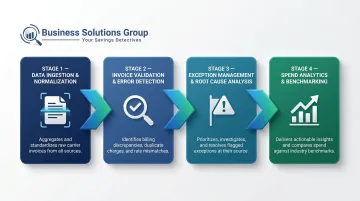
Stage 2: Invoice Validation and Error Detection
This is where the majority of billing errors get caught. The platform compares each line item against:
- The contracted rate card for that carrier and lane
- Applicable fuel surcharge tables (tied to the correct index date)
- Weight and freight classification records
- Agreed service levels and discount structures
Common errors surfaced at this stage:
- Incorrect rate application (public tariff billed instead of negotiated rate)
- Wrong freight classification or dimensional weight calculation
- Unapplied contract discounts
- Unauthorized service upgrades
- Mileage discrepancies on distance-based charges
Platforms apply a defined tolerance threshold to determine which variances get flagged as exceptions versus accepted as within range. Shippers can configure that threshold — high-volume operations often set tighter tolerances to capture more recoverable errors.
Stage 3: Exception Management and Root Cause Analysis
Flagging an error is useful. Understanding why it occurred is what prevents it from happening again.
When a discrepancy is flagged, the platform doesn't just identify the dollar variance — it pinpoints the specific contract clause or rate table that was violated. That documentation accelerates carrier dispute resolution and reduces back-and-forth.
More valuable is the pattern visibility. If a carrier consistently bills at an outdated rate following a renegotiation cycle, the platform surfaces that as a recurring exception rather than a one-off catch. That distinction matters: recurring errors can be corrected at the contract or carrier system level, eliminating the need to catch them invoice by invoice.
Early identification also affects how quickly disputes close. Duplicates typically resolve in 7–14 days; accessorial overcharges can take up to 45 days — so catching errors at intake, not after payment, directly shortens that timeline.
Stage 4: Spend Analytics and Benchmarking
The root cause work in Stage 3 generates something equally valuable: a clean, validated dataset. Platforms aggregate that data into spend dashboards where shippers can analyze freight costs by carrier, lane, mode, facility, or cost center.
This layer reveals strategic savings that individual invoice audits never would:
- High-cost lanes where mode shifting or carrier substitution could reduce spend
- Accessorial charge patterns that indicate process or classification problems
- Over-reliance on premium services that could be downgraded without SLA impact
- Carriers with recurring performance failures that justify contract renegotiation
Benchmark analysis adds another dimension. Comparing your contracted rates against market or industry data shows where you're overpaying at the contract level — not just the invoice level. Business Solutions Group applies this approach through its proprietary spend intelligence software, managing over $3 billion in parcel spend with benchmarking broken down to lane, mode, and accessorial level. That granularity gives shippers a concrete, data-backed position going into carrier negotiations.
Key Cost-Saving Areas Freight Audit Platforms Expose
Accessorial Overcharges
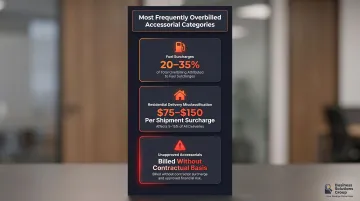
Accessorial fees are the most frequently overbilled category. Common culprits include:
- Fuel surcharges: Account for 20–35% of total overbilling
- Residential delivery misclassification: Triggers $75–$150 surcharges on an estimated 5–15% of deliveries
- Unapproved accessorials: Fees applied without contractual basis or billed at incorrect rates
Freight audit platforms flag each of these automatically, catching charges that would otherwise slip through unchallenged.
Duplicate Invoice Payments
Carriers sometimes resubmit invoices when payment confirmation is delayed — a common occurrence after carrier system migrations or shipment splits. Without unified tracking, shippers pay the same shipment twice. Platforms detect duplicates through PRO number and shipment ID matching and block payment automatically.
Rate Misapplication and Tariff Errors
After a contract renegotiation, new rates don't always get updated in carrier billing systems immediately. The carrier continues billing at public tariff rates while the shipper expects the negotiated discount. Audit platforms catch the variance by comparing every invoiced amount against the contracted rate, then trigger a credit request automatically. Manual processes rarely do this consistently at scale.
Missed Contract Discounts and Incentives
Volume incentives, promotional rates, and tiered discounts require cross-referencing contract documents against every invoice. That's impractical manually at scale. Automated verification ensures every qualifying shipment receives every eligible discount — recovering money that manual review routinely leaves on the table.
Carrier SLA Non-Compliance
Platforms track whether carriers are meeting contracted service levels. When a carrier charges for a premium service it didn't deliver, that charge is disputable. Key commitments audited include:
- Transit times: Whether shipments arrived within the guaranteed window
- Pickup windows: Whether the carrier showed up as scheduled
- Delivery commitments: Whether premium service tiers were actually fulfilled
This data does double duty — it supports dispute filings and informs carrier selection, shifting volume away from chronic underperformers.
Manual Auditing vs. Freight Audit Platforms: Why the Gap Matters
The core limitation of manual auditing is bandwidth. Human teams can only review a fraction of invoices — typically prioritizing high-dollar shipments — which means errors on lower-value bills accumulate undetected. Industry practitioners consistently report that somewhere between 5% and 22% of freight invoices contain billing errors, with the Ardent Partners 2025 State of ePayables report citing 22% of invoices requiring manual intervention. At $53.50 average resolution cost per error (per IOFM), the financial drag adds up quickly across high shipment volumes.
Software audits every invoice, every time, applying the same rules without fatigue. The processing cost difference reflects this:
- Best-in-class organizations have reduced invoice processing costs from $12.88 to $2.78 per invoice through automation
- Modern platforms handle up to 95% of the audit process automatically
- Consistent rule application eliminates the prioritization tradeoffs that leave lower-value errors unaddressed
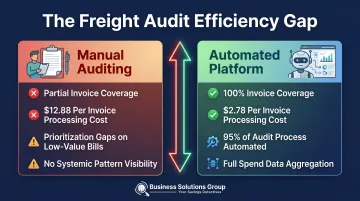
That efficiency gap extends beyond cost per invoice. Automated platforms centralize spend data in ways manual auditing never can — producing intelligence, not just corrections. Without that centralized view, shippers can't identify billing patterns, benchmark contracted rates against the market, or build the negotiation leverage that converts one-time audit findings into lasting cost reduction.
The visibility disparity is stark: a Hackett Group study found that only 41% of companies maintain line-item spend visibility, compared to 93% of top-performing organizations.
Conclusion
Freight audit platforms do two distinct jobs. At the transactional level, they catch and recover individual invoice errors — overcharges, duplicates, rate misapplication, missed discounts. At the strategic level, they convert validated spend data into negotiation leverage, network optimization insights, and benchmark analysis that identifies contract-level overpayment.
Understanding both functions changes how shippers approach platform selection and utilization. The invoice correction is the visible win. The benchmark data and pattern analysis are what drive sustainable cost reduction.
Shippers who combine audit technology with advisory expertise — the approach Business Solutions Group takes, integrating spend intelligence software with full-cycle carrier contract negotiation and rate benchmarking — get both. The result: freight spend that's visible, auditable, and actively optimized rather than passively accepted.
Frequently Asked Questions
How do freight audit platforms identify and implement cost-saving opportunities?
Platforms ingest and normalize invoice data from multiple sources, validate each charge against contracted rates, and flag discrepancies as exceptions for resolution. Aggregated spend data then reveals strategic opportunities — high-cost lanes, rate misalignment, accessorial patterns — that inform carrier renegotiation and network optimization.
What is freight audit and payment?
Freight audit and payment (FAP) is a process — managed by a platform or third-party provider — that reviews carrier invoices for accuracy against contracted terms, resolves discrepancies, and executes timely payment to carriers on the shipper's behalf. It can include pre-audit (before payment) or post-audit (after payment) review.
What does a freight auditor do?
A freight auditor compares billed charges to agreed-upon rates and contracts, identifies overcharges or billing errors, disputes incorrect charges with carriers, and documents findings for reporting and compliance. Modern platforms automate most of this process, with human review reserved for complex exceptions.
What types of 3PLs provide freight payment, auditing, and claims management services?
Managed transportation 3PLs and dedicated freight audit and payment (FAP) providers both offer these services. Some 3PLs bundle auditing with brokerage; dedicated FAP firms focus exclusively on invoice accuracy, payment processing, and claims resolution across all modes.
How does freight audit software differ from manual auditing?
Software audits every invoice automatically, applying contract rules without human bandwidth constraints. Manual auditing is typically limited to high-value invoices and produces corrections without the data aggregation needed to identify systemic billing patterns or build renegotiation leverage.
What percentage of freight invoices contain billing errors?
Industry studies consistently report error rates from 5% to over 20%, depending on shipment complexity and carrier mix — the Ardent Partners 2025 report puts exception handling at 22% of invoices. At scale, even a 5% error rate compounds quickly: one global manufacturer recovered $646,000 in billing errors through a single audit engagement.