The cost shows up in two places: the IT budget and the clock. Legacy infrastructure demands dedicated staff, hardware refreshes, and unplanned downtime that cascades into missed deliveries and frustrated customers. Meanwhile, the data that could drive better decisions sits locked in siloed systems.
Cloud platforms address this directly. By hosting shipping operations in a centralized, web-based environment, they eliminate most of the infrastructure burden while giving teams real-time access to the visibility, automation, and reporting they need. This article breaks down how that works in practice — and where the real financial case for making the switch sits.
Key Takeaways
- Cloud platforms replace on-premise servers with subscription-based, web-hosted tools — no local hardware or IT upkeep required
- Real-time shipment visibility becomes accessible across all locations and devices simultaneously
- Automated workflows handle rate shopping, label generation, and invoice auditing — reducing errors and manual labor
- Cloud systems scale automatically during seasonal volume spikes — no hardware purchases needed
- Centralized shipment data strengthens carrier contract negotiations and rate benchmarking
The Hidden IT Burden Shipping Companies Face
Most shipping companies don't set out to build complex IT environments. They accumulate them — one carrier portal here, a legacy TMS there, a spreadsheet to reconcile the two. Over time, this fragmented stack becomes expensive to maintain and nearly impossible to get useful data out of.
The burden is real. On-premise infrastructure requires capital investment upfront, dedicated IT staff to manage it, and scheduled (or unscheduled) downtime for upgrades and patches. When a server fails, shipments wait.
Small and Mid-Size Shippers Bear the Brunt
Enterprise logistics operations have large internal IT teams to absorb this overhead. Smaller shippers don't have that cushion — and the technology market has historically made that gap worse.
SMBs collectively spend roughly $32 billion annually on freight, yet most logistics technology has historically been designed for the enterprise market. That leaves smaller shippers managing complexity without the resources to manage it well — relying on low-tech workarounds that create visibility gaps and slow decision-making.
The fragmented IT stack creates specific blind spots:
- Shipment status requires manual checks across multiple carrier portals, delaying action on exceptions
- Warehouse counts fall out of sync across locations without real-time data sharing
- Carrier rate comparisons happen after booking, not at the moment a decision is made
- Finance, operations, and logistics teams pull from different data sets, forcing reconciliation after the fact
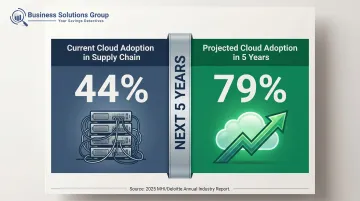
Cloud computing adoption among supply chain organizations is expected to grow from 44% to 79% over the next five years, per the 2025 MHI/Deloitte Annual Industry Report. For shippers still running fragmented on-premise stacks, that shift represents direct competitive pressure — from peers who are already moving faster with less overhead.
What Is Cloud Shipping?
Cloud shipping refers to internet-hosted platforms that manage, automate, and optimize shipping operations — from carrier selection and label generation to real-time tracking and reporting — without requiring locally installed hardware or software.
The underlying mechanism is straightforward: virtual servers hosted by cloud providers allow multiple users to access shipping tools and data simultaneously from any device. The provider handles all updates and maintenance — not the business.
The Four Service Models (and Which One Matters Most)
| Model | What It Is | Shipping Relevance |
|---|---|---|
| IaaS | Rented server infrastructure | Foundation layer; used by cloud providers themselves |
| PaaS | Development environments | Custom logistics app development |
| SaaS | Ready-to-use software via browser | What most shippers use daily |
| FaaS | Event-triggered automated code | Automated workflow execution |
For most shipping operations, SaaS is the relevant model. Platforms like ShipStation, Shippo, FreightPOP, and Easyship are SaaS products — the vendor manages the entire technology stack, and users access them through a browser.
That raises a natural question: who actually runs these platforms behind the scenes?
Who Provides the Infrastructure?
These SaaS platforms don't operate on thin air. Most are built on top of infrastructure from one of four dominant cloud providers: Amazon Web Services (AWS), Microsoft Azure, Google Cloud Platform (GCP), or IBM Cloud. AWS, Azure, and Google Cloud alone control 63% of worldwide cloud infrastructure. ShipStation, for example, has publicly documented its use of AWS infrastructure.
In practice, shippers benefit from the same high-availability infrastructure used by Fortune 500 companies — without managing a single server themselves.
How Cloud Platforms Simplify IT Management for Shipping
The IT simplification argument for cloud isn't theoretical. It comes down to six specific operational changes.
Centralized Data Management
Cloud platforms create a single source of truth accessible to all stakeholders simultaneously. Warehouse teams, logistics managers, and finance departments work from the same data — reconciling carrier portals, spreadsheets, and ERP exports against each other becomes unnecessary.
IBM describes this consolidation as establishing a foundation for "operational efficiency, data-driven decision-making, and enhanced data security."
Automated Shipping Workflows
Configurable business rules handle the repetitive work:
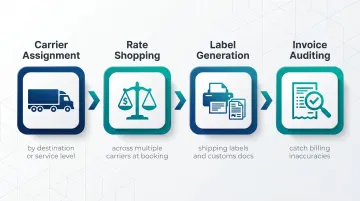
- Carrier assignment by destination or service level
- Rate shopping across multiple carriers at booking
- Shipping label generation and customs documentation
- Freight invoice auditing to catch billing inaccuracies
Manual data entry in supply chain operations is "inherently prone to errors — typos, misplaced digits, or skipped entries can have a ripple effect across supply chain operations." Automation removes those touchpoints.
Seamless System Integration
Cloud shipping platforms connect to existing tools through APIs, including:
- ERP systems
- Warehouse management systems
- Ecommerce platforms
Data flows automatically rather than requiring manual re-entry or batch uploads. This connected data flow gives sales, operations, and finance teams a unified view of logistics performance without additional IT work.
Automatic Updates, No Downtime
On-premise software requires IT teams to manually patch and upgrade systems — often during scheduled maintenance windows that take systems offline. Cloud platforms push updates automatically. Every user is always on the current version, with no operational disruption.
A cloud-based TMS can typically be implemented in days and accessed from any device immediately. On-premise TMS implementations often require months of integration work and significant hardware spend before a single shipment is processed.
Remote Access Across Locations
Because cloud platforms are web-based, shipping teams across multiple fulfillment locations, time zones, or remote work setups access the same tools and data simultaneously. The geographic bottleneck of server-tied software disappears.
Built-In Redundancy
Cloud providers maintain backup systems across multiple data centers. If one server fails, operations continue uninterrupted.
Single-location on-premise servers create a single point of failure: when they go down, everything stops. Unplanned downtime in logistics directly causes missed deliveries and rising costs. Most enterprise cloud providers maintain 99.9%+ uptime SLAs, which on-premise hardware rarely matches.
Cloud vs. Legacy IT: Understanding the Real Cost Difference
CapEx to OpEx: The Cash Flow Argument
On-premise systems require capital expenditure upfront: servers, hardware, licensing, installation. Cloud platforms operate on subscription models, converting large one-time investments into predictable monthly operating expenses.
For shippers watching cash flow, that shift matters. Rather than committing $150,000–$250,000 to a TMS infrastructure investment, cloud-based alternatives offer pay-as-you-go access to equivalent functionality. Business Solutions Group, for instance, provides clients with full TMS access at no additional cost as part of their managed logistics services — effectively eliminating what would otherwise be a six-figure capital commitment.
IT Labor Costs
On-premise environments need dedicated staff for maintenance, upgrades, and troubleshooting. Cloud providers take on that burden entirely. Research shows cloud-based TMS implementation can reduce transportation costs by 15–25%, with organizations that adopt disciplined cloud cost management typically seeing 20–50% overall savings.
Key drivers of those labor and infrastructure savings include:
- No on-site server maintenance or emergency hardware replacement
- Automatic software updates handled by the cloud vendor
- Reduced need for in-house IT headcount dedicated to TMS upkeep
Scaling for Peak Seasons
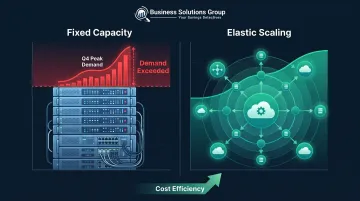
Seasonal volume spikes put on-premise operations in a difficult position: either over-invest in hardware that sits idle most of the year, or risk running short when demand arrives.
Cloud platforms sidestep this entirely. Capacity adjusts to actual demand, so shippers pay for what they use — not for what they anticipate needing in November. For businesses with Q4 surges, holiday campaigns, or unpredictable freight cycles, that flexibility translates directly into lower infrastructure costs and fewer capacity headaches.
Choosing the Right Cloud Platform for Your Shipping Operations
Key Evaluation Criteria
Not all cloud shipping platforms are equivalent. When evaluating options, prioritize:
- Multi-carrier support — ability to rate shop across USPS, UPS, FedEx, DHL, and regional carriers simultaneously
- Depth of analytics — detailed reporting on carrier performance, cost per shipment, and zone distribution
- Integration capability — API connections to your existing ERP, WMS, and ecommerce systems
- UI simplicity — non-technical staff need to use this daily without IT support
- Vendor track record — experience with businesses at your shipment volume and mode complexity
Match Platform to Business Complexity
Small parcel shippers typically prioritize rate shopping automation and label generation. Freight shippers need considerably more: load management, compliance documentation, multi-mode support (LTL, FTL, ocean, air, rail), and carrier contract tracking.
FreightPOP's buyer's guide identifies five must-haves across both segments:
- Flexibility to adapt to changing carrier relationships
- All-mode support for parcel and freight
- Workflow automation for routine tasks
- Easy onboarding for non-technical teams
- Powerful reporting tied to cost outcomes
Gartner's Magic Quadrant for Transportation Management Systems evaluates 16 vendors on these dimensions — worth reviewing during enterprise-level platform selection.
Turning Platform Data Into Negotiating Leverage
Selecting the right platform gets you accurate shipment data. Translating that data into cost reductions requires knowing what the numbers mean against real market benchmarks.
Business Solutions Group's carrier benchmarking service analyzes 6–12 months of shipment history against proprietary market-rate intelligence — covering discount tiers, minimum charges, fuel surcharge tables, and accessorial fees for both parcel and freight carriers.
Their Parcel Spend Intelligence solution manages over $3 billion in parcel spend and has helped clients achieve more than $350 million in annual savings. Businesses shipping anywhere from 500 to 50,000 packages per month have used this benchmarking approach to negotiate rate reductions averaging 19% on small parcel shipments.
Frequently Asked Questions
What is cloud shipping?
Cloud shipping is the use of internet-hosted software to manage and automate shipping processes — including carrier selection, rate comparison, label generation, and real-time tracking — without requiring locally installed systems or dedicated IT infrastructure. Users access these tools through any web browser, from any location.
Who are the big 4 cloud providers?
Amazon Web Services (AWS), Microsoft Azure, Google Cloud Platform (GCP), and IBM Cloud are the four dominant cloud infrastructure providers. Most shipping SaaS platforms are built on one or more of these networks, giving users enterprise-grade reliability without managing the infrastructure directly.
What are the main benefits of cloud platforms for shipping companies?
Cloud platforms deliver measurable operational advantages for shipping teams:
- Reduced IT overhead and infrastructure costs
- Real-time shipment visibility across carriers
- Automated workflows: rate shopping, label generation, invoice auditing
- Elastic scaling during peak shipping periods
- Centralized data access for all team members, regardless of location
How does cloud shipping software reduce IT costs?
Cloud platforms eliminate upfront server and hardware costs, reduce reliance on internal IT maintenance staff, and use subscription pricing that scales with actual usage. This shift from capital expenditure to operating expenses also makes costs more predictable month to month.
Is cloud shipping software suitable for small parcel shippers?
Cloud solutions are well-suited for small parcel shippers. They require no hardware investment, offer subscription-based pricing, and automate rate shopping and label generation tasks that would otherwise demand significant manual effort or dedicated IT resources.
Can cloud platforms help with carrier contract negotiations?
Cloud platforms generate detailed shipment data — carrier performance, cost per shipment, zone distribution, and accessorial fees (surcharges for fuel, residential delivery, and similar services) — that can be benchmarked against market rates. That data forms the factual foundation for carrier contract negotiations, especially when paired with expert benchmark analysis.