Introduction
Most finance and operations leaders treat telecom as a fixed overhead line — it gets paid, it gets renewed, and it rarely gets scrutinized. That's an expensive assumption.
According to Tangoe's 2026 IT Expense Management report, 15%–20% of telecom invoices contain billing errors — and they typically favor the carrier. Multiply that across a multi-location organization managing dozens of vendor invoices monthly, and you're looking at real margin erosion that accumulates steadily across every billing cycle.
Most organizations manage telecom reactively — renewing contracts without benchmarking, provisioning new services without deprovisioning old ones, and reviewing invoices without the tools to catch discrepancies at scale. Each gap is small in isolation. Together, they represent a significant and avoidable cost.
This guide breaks down where telecom overspend actually originates and which strategies address it at the source — whether the problem sits in procurement decisions, active service management, or organizational structure.
Key Takeaways
- Telecom costs compound quietly through unused lines, billing errors, and contracts that never get renegotiated.
- 15%–20% of telecom invoices contain errors, almost always in the carrier's favor.
- Enterprises typically overspend 15%–30% on mobility programs due to misaligned plans.
- Optimization only works once you have a full spending baseline — without visibility, savings don't stick.
- Sustained savings depend on governance and monitoring, not one-time audits.
How Telecom Costs Typically Build Up
Telecom overspend rarely announces itself. It accumulates gradually: one new mobile line here, one additional circuit there, until the aggregate becomes significant and no single person owns the full picture.
The Compounding Effect of Small Decisions
Each new device, service line, or vendor contract adds an increment that looks manageable in isolation. Spread across multiple locations, departments, and contract cycles, those increments compound into material waste. The problem is that most of these costs stay hidden until a formal audit surfaces them.
Common silent cost drivers include:
- Unused lines that continue billing month after month
- Promotional discounts that expire and silently revert to standard rates
- Overage charges left unquestioned because no one monitors consumption against contract terms
Organizational Change as a Cost Driver
Employee turnover, office relocations, and shifts to remote or hybrid work trigger new telecom provisioning — but rarely trigger corresponding deprovisioning of old services. The result is a ghost inventory: services tied to departed employees, decommissioned offices, or work patterns that no longer exist.
All of them still generating monthly invoices.
This is one of the most preventable sources of waste. The fix is straightforward: a process that connects HR and real estate changes directly to telecom service management.
Key Cost Drivers Behind Rising Telecom Expenses
Understanding where costs originate is what separates targeted reduction from indiscriminate cutting. Most telecom overspending traces back to the same structural problems — and they tend to compound quietly over time.
Vendor and Service Fragmentation
Most organizations work with multiple carriers, each running different contract terms, billing formats, and pricing models. Without centralized management, tracking total spend or identifying service overlap becomes nearly impossible. Fragmentation also weakens negotiating leverage — each carrier relationship is managed in isolation, removing the volume and consolidation arguments that produce better pricing.
Over-Provisioning and Plan Mismatch
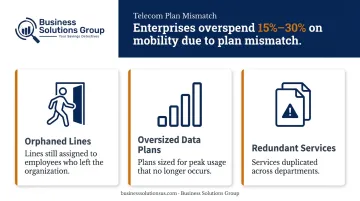
Mobile data plans, bandwidth allocations, and phone lines are typically selected based on anticipated usage — then never revisited. Tangoe reports that enterprises typically overspend 15%–30% on mobility programs due to misaligned services, with zero-use devices silently inflating expenses month after month.
The gap between provisioned capacity and actual consumption widens over time as usage patterns shift and plans stay static. Common signs of plan mismatch include:
- Lines assigned to employees who left the organization
- Data plans sized for peak usage that no longer occurs
- Redundant services duplicated across departments
Contract Terms and Vendor Lock-In
Long-term agreements with auto-renewal clauses give carriers little incentive to voluntarily offer better rates. Penalty provisions for early termination keep organizations locked into above-market pricing even when better options exist. Most renewals happen on autopilot — no benchmarking, no renegotiation, and no check that current terms reflect what comparable organizations are actually paying.
Cost-Reduction Strategies for Telecom Spend
The right strategy depends on where the cost is actually originating. Some organizations overspend at procurement. Others lose savings during active service management. Still others are constrained by structural factors no single department can fix alone. The strategies below are organized by where they intervene.
Strategies That Reduce Costs by Changing Decisions
These approaches intervene at procurement — before services go live or at the point of renewal.
Consolidate vendors and bundle services. Working with fewer carriers under unified contracts creates volume leverage and strengthens your negotiating position — especially where multiple locations or business units have been buying independently.
Benchmark contracts against market rates before renewal. Most organizations renew without knowing whether their pricing reflects current market norms. Conducting benchmark analysis against comparable businesses and industry pricing data reveals gaps and creates negotiating leverage. This is a core capability Business Solutions Group delivers using proprietary data and an outsider's perspective that internal teams often can't replicate. Tangoe's data suggests enterprises can achieve 20%–30% average savings through benchmarking-supported negotiation.
Right-size plans based on actual usage data. Review 90–180 days of usage across voice, data, and mobile before selecting or renewing any plan. This gives you the evidence to justify downgrades and prevents paying for capacity that will never be used.
Replace legacy voice infrastructure with cloud-based alternatives. Legacy POTS lines and traditional PBX systems carry high maintenance and per-minute costs that VoIP and SIP trunking can eliminate. Tangoe reports individual POTS line prices have risen from $20 to as much as $1,400 — and replacing them can reduce costs by up to 80%. Despite this, Metrigy reports that less than 40% of businesses worldwide have migrated to UCaaS, meaning most organizations are still carrying avoidable infrastructure costs.
Strategies That Reduce Costs by Changing How Telecom Is Managed
Once services are active, waste accumulates quietly. These approaches surface and stop it.
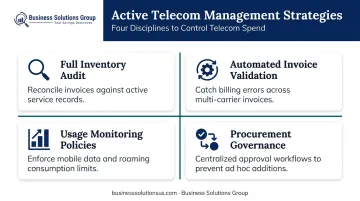
Conduct a full telecom inventory audit. Reconcile every invoice line item against an active service inventory. This surfaces unused phone lines, inactive SIM cards, decommissioned devices still being billed, and services tied to former employees — recoverable spend that often goes undetected for months.
Automate invoice validation to catch billing errors. Manual review can't keep pace with multi-carrier billing complexity. Automated validation against contract terms catches overbilling, unauthorized rate changes, and erroneous fees — with 15%–20% of telecom invoices containing errors in the carrier's favor, the ROI is direct. Business Solutions Group's cost compliance audits verify carriers are meeting contractual terms and flag incorrectly applied rebates, credits, and discounts.
Establish usage monitoring and mobile consumption policies. Documented policies for mobile data, roaming, and international calling — enforced through monitoring dashboards — prevent cost overruns driven by individual behavior rather than business need.
Implement governance and approval workflows for telecom procurement. Without structured workflows, department managers add services ad hoc, bypassing negotiated terms and creating duplicates. A centralized approval process keeps every new service aligned with existing agreements.
Strategies That Reduce Costs by Changing the Structural Context
Some cost drivers aren't operational — they're structural. These approaches fix the underlying setup.
Align telecom provisioning with hybrid and remote work policies. Organizations that haven't revisited their telecom footprint since shifting to hybrid or remote work are often funding overlapping services — office landlines, mobile plans, and cloud collaboration licenses — for the same employees simultaneously. Restructuring provisioning around actual work patterns eliminates this redundancy without cutting anything that's genuinely needed.
Reduce dependence on legacy infrastructure through phased modernization. Legacy on-premises infrastructure generates hidden costs through maintenance contracts, hardware refresh cycles, and integration friction with cloud systems. A phased migration plan removes these compounding cost layers while keeping operations stable.
Consolidate multi-vendor fragmentation across the organization. Fragmentation is usually a symptom of decentralized purchasing across departments or business units. A technology fix alone won't solve it. What's required is a policy mandate for centralized procurement — and that starts with mapping who is buying what, from which carriers, and under what terms across the organization. Business Solutions Group offers this kind of vendor landscape analysis as part of its broader spend intelligence work.
Conclusion
Sustainable telecom cost reduction starts with understanding where spend originates — a procurement decision, an unreviewed contract, an unused service, or a structural gap — and applying the right intervention at that level.
The organizations that sustain savings over time are the ones that build continuous monitoring, governance, and periodic benchmarking into how they operate. A one-time audit recovers cost; a repeatable process keeps it from returning.
Business Solutions Group works with organizations to build that foundation — whether telecom optimization is part of a broader indirect spend engagement or a focused cost reduction effort. The starting point is a complimentary savings analysis: a no-obligation review of your current telecom arrangements against market benchmarks.
Reach the team at (949) 525-7677 or through the contact page at businesssolutionsus.com.
Frequently Asked Questions
What is optimization in telecom?
Telecom optimization is the systematic process of aligning services, contracts, and spending with actual business needs — eliminating waste, renegotiating unfavorable terms, and establishing oversight mechanisms to prevent cost creep from returning. It covers everything from plan right-sizing to invoice auditing to contract benchmarking.
What are the biggest sources of wasted telecom spend in businesses?
The most common sources are unused or orphaned services still under active billing, billing errors that go unchallenged, over-provisioned plans, and expired promotional rates that have since reverted to standard pricing. Most go undetected simply because no formal review process exists.
How often should businesses audit their telecom expenses?
A full inventory and invoice audit should happen at least annually, with automated validation running on monthly invoices in between. Organizational changes — layoffs, office closures, or workforce model shifts — should also trigger an off-cycle audit.
What is telecom expense management (TEM) and do I need it?
TEM is a set of processes and tools for centralizing visibility, auditing invoices, managing contracts, and governing telecom procurement across an organization. Any business managing multiple carriers, locations, or mobile devices is likely losing money without some form of structured TEM practice.
Can small and mid-sized businesses benefit from telecom cost optimization?
SMBs often have the most to gain proportionally. Without dedicated telecom staff, billing errors, auto-renewals, and over-provisioning tend to go unnoticed far longer — making structured optimization especially valuable.
How do I know if my current telecom contracts are competitive?
Benchmarking current rates against market pricing for comparable services and usage volumes is the only reliable method. Business Solutions Group provides this analysis as part of its complimentary savings review — giving you a clear external reference point before any contract decision.