Introduction
Telecom spending is growing faster than most finance teams realize. According to Credence Research, the global enterprise telecom services market was valued at $824.8 billion in 2024 and is projected to exceed $1.36 trillion by 2032. That's a massive baseline — and for most organizations, a meaningful portion of it is wasted.
Telecom costs tend to accumulate invisibly: a circuit left active after an office move, a wireless plan assigned to a device no longer in use, a contract that auto-renewed at a higher rate six months ago. Each item looks minor in isolation. Over time, the compounding effect adds up to significant overspend.
Business Solutions Group works with organizations across the US to identify and eliminate exactly this kind of hidden spend — across telecom, shipping, healthcare, and other cost centers. The pattern is consistent: companies paying above-market rates for services they didn't know they still had.
This article covers 8 structured strategies for telecom cost reduction, organized by where cost originates and how to address each source.
Key Takeaways
- Telecom costs build silently across services, locations, and billing cycles — rarely visible until someone audits them
- The biggest cost drivers are unused services, billing errors, auto-renewing contracts, and fragmented vendor relationships
- Effective cost reduction requires a full inventory of current spend before cutting or renegotiating anything
- Strategies span procurement decisions, active spend management, and structural changes to your telecom environment
- Treating telecom cost reduction as an ongoing discipline, not a one-time project, delivers the most sustainable savings
How Telecom Costs Typically Build Up
Telecom expenses rarely appear as a single line item. They accumulate across voice lines, data circuits, wireless plans, hardware leases, and regulatory surcharges — spread across multiple locations and billing cycles, each managed by a different team or vendor.
The pattern is familiar:
- A circuit provisioned for a temporary project stays active after the project ends
- A wireless plan remains assigned to a former employee's device
- A contract hits its renewal date and automatically rolls over at a higher rate
- A billing error goes uncontested for six months because nobody compared the invoice to the contract
According to Pure IP, organizations often catch telecom billing errors only after three, six, or even twelve months of incorrect charges have already been paid — and by then, the dispute window with the carrier may be closing.
Most telecom overspending stays hidden until a formal audit surfaces it — and without centralized inventory, there's nothing to compare the invoice against.
Key Cost Drivers in Telecom
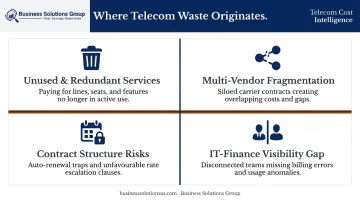
Understanding where cost comes from is the prerequisite for addressing it. Four drivers account for the majority of enterprise telecom waste:
- Unused and redundant services: Phone lines for former employees, circuits left active after location changes, and wireless plans on inactive devices all generate charges without delivering value. Business Solutions Group's telecom practice targets "zero-use grooming" — identifying and removing these services before they compound.
- Multi-vendor fragmentation: Working across multiple carriers creates inconsistent pricing, overlapping services, and limited negotiating leverage. No single vendor sees the full spend picture, so none has reason to compete aggressively for it.
- Contract structure: Auto-renewal clauses, evergreen terms, and vague rate-adjustment provisions lock businesses into above-market pricing for years. Miss the renegotiation window and you pay the penalty automatically.
- The IT-finance visibility gap: IT understands what services do but doesn't review invoices. Finance reviews invoices but doesn't understand the services. That gap is where billing errors live.
Tangoe data shows that most telecom invoices contain errors — approximately 9% on average. Common categories include rate misapplication, charges for disconnected services, duplicate billing, and unapplied discounts.
Cost-Reduction Strategies for Telecom
Reducing telecom costs requires matching the right strategy to the right source of waste. The eight strategies below are organized into three categories: changing procurement decisions, improving active management, and restructuring the environment around telecom.
Strategies That Change Procurement Decisions
These strategies target the upstream choices that determine what services are purchased, on what terms, and at what price.
Strategy 1: Conduct a Full Telecom Inventory and Audit
Cost reduction has to start here. Without a complete inventory of every circuit, phone line, wireless plan, device, and vendor across all locations, every other strategy is working blind.
An audit does three things:
- Validates active use — confirms which services are actually being used versus simply being billed
- Uncovers billing errors — compares contracted rates against invoiced charges to identify discrepancies
- Creates the baseline — establishes the foundation required for right-sizing, renegotiation, and vendor consolidation
Tangoe estimates that auditing and invoice reconciliation saves **5–10% of total annual telecom spend** in the first year, with roughly 2% annually after that. For a company spending $5 million on telecom, that's up to $500,000 recovered in year one from a single audit cycle.
Business Solutions Group's telecom engagements begin with a no-cost savings analysis — typically completed within 3–5 business days — that identifies immediate opportunities before any commitment is made.
Strategy 2: Right-Size Service Plans and Bandwidth
Over-provisioning and under-provisioning both inflate costs, just in different ways. Paying for bandwidth that goes unused is waste. Running on insufficient capacity generates upgrade fees, outage costs, and workarounds that are often more expensive than the original provisioning gap.
A usage assessment at each location helps businesses:
- Downgrade excess capacity at sites that are consistently under-utilizing provisioned bandwidth
- Upgrade constraining circuits where performance gaps are generating indirect costs
- Replace legacy technologies (MPLS, ISDN, T1 lines) with more cost-efficient options where available
Wireless plans deserve specific attention. Managed pooled plans are often more cost-effective than unlimited individual plans for business use — especially once headcount exceeds 20–25 lines. Business Solutions Group's usage alignment service matches telecom services to actual and forecasted usage, helping clients avoid both over-buying and overage charges.
Strategy 3: Benchmark Costs and Renegotiate Contracts Proactively
Most businesses accept carrier pricing at face value because they have no reference point. Benchmarking changes that by establishing what comparable organizations pay for the same services.
With benchmark data in hand, the negotiating position shifts. Carriers know when a client has done the homework, and pricing discussions move accordingly.
Three things matter most in this process:
- Renegotiations should start 90–180 days before auto-renewal windows close — after that, leverage drops significantly
- Benchmarking should cover all components: base rates, discount structures, minimums, and surcharges
- Advisory services with access to comparative pricing data — like Business Solutions Group's telecom practice, which offers 20–50% savings targets through carrier contract optimization — give negotiators access to market intelligence that typical IT or finance teams can't independently gather
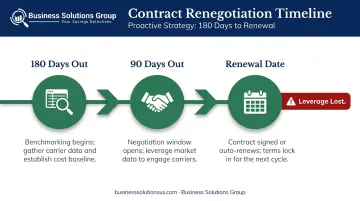
Tangoe's advisory services report average savings of 20–30% on renegotiated contracts, backed by a benchmarking database representing $34 billion in tech spending — the kind of market intelligence that makes carriers take renegotiation seriously.
Strategies That Improve Active Management
These strategies reduce cost by tightening control over telecom services while they're running — addressing the management gaps that allow errors and waste to persist after procurement decisions are made.
Strategy 4: Centralize Expense Visibility Across IT and Finance
The IT-finance visibility gap is structural, not just a communication failure. When invoice data lives in finance systems and service inventory lives in IT systems, errors survive by falling between the two.
Shared dashboards or unified expense platforms give both teams a single view of:
- All active services and their contracted rates
- Invoice data for each billing cycle
- Approaching contract renewal dates
- Usage data by location and service type
Business Solutions Group's centralized SaaS platform consolidates wireless, wireline, cloud services, hardware, and vendor contracts into a single interface — giving CFOs and CIOs a unified view of their technology and telecom environment rather than disconnected spreadsheets.
When renewal dates and unusual charges are visible before they become expensive, the organization can act instead of react.
Strategy 5: Actively Identify and Dispute Billing Errors
Billing errors are routine, not exceptions. Carriers regularly invoice for disconnected circuits, apply incorrect rates, or charge for features that were cancelled months earlier.
Common error types include:
- Services billed after confirmed disconnection
- Incorrect rate applied to a renegotiated contract
- Taxes and surcharges applied to exempt services or locations
- Discounts not applied after a contract amendment
- Duplicate charges for the same service
The critical issue with disputes is timing. Carriers impose dispute windows — errors that go uncontested long enough become effectively irrecoverable. Establishing a monthly process for comparing contracted rates against billed charges is the only reliable way to catch errors before they expire.
At ~9% average invoice error rates, a $2 million annual telecom spend is likely generating $180,000 or more in annual billing errors. Most of that goes unchallenged.
Strategy 6: Implement Telecom Expense Management (TEM)
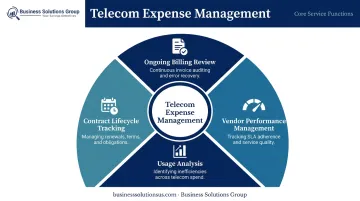
TEM systematizes the audit, inventory, dispute, and contract lifecycle management functions that most internal teams don't have the bandwidth to handle consistently.
For multi-location businesses, TEM delivers:
- Ongoing billing review against contracted rates every cycle
- Vendor performance management with accountability against agreed terms
- Usage analysis for continuous right-sizing opportunities
- Contract lifecycle tracking so renewal windows don't get missed
The global TEM market was valued at $3.16 billion in 2022 and is projected to reach $7.76 billion by 2030, growing at 11.9% CAGR — reflecting the scale at which organizations have decided this function needs dedicated management.
Without TEM, most organizations audit reactively — only after a budget spike or a missed renewal triggers a review. TEM makes that discipline continuous rather than reactive, catching problems in the billing cycle where they occur rather than months later.
Strategies That Change the Context Around Telecom
The prior strategies focus on what you buy and how you manage it. These two focus on the underlying architecture — because for many organizations, the way telecom is structured is the primary cost driver, not how it's managed.
Strategy 7: Consolidate Vendors and Simplify the Telecom Stack
Operating across multiple carriers creates fragmented contracts, inconsistent support, and no consolidated leverage for negotiation. Each vendor relationship is managed separately, invoiced separately, and disputed separately — multiplying administrative overhead and minimizing competitive pressure on any one provider.
Consolidating to fewer vendors, or managing all carrier relationships through a single point of contact, produces several benefits:
- Simplified billing across fewer invoices and billing cycles
- Economies of scale that strengthen negotiating position
- Clearer accountability when service levels aren't met
- Reduced administrative load on internal IT and finance teams
Research from Forrester Consulting (commissioned by RingCentral) found that a single-vendor approach made setup and operations demonstrably more efficient than environments where multiple vendors managed several components. RingCentral's own analysis puts the TCO advantage of a single-vendor strategy at 56% lower than a multi-vendor approach.
Business Solutions Group's telecom practice can serve as a single point of contact for managing multiple carrier relationships — giving clients consolidated leverage without requiring them to navigate each carrier relationship independently.
Strategy 8: Migrate from Legacy Infrastructure to Cloud-Based and VoIP/SIP Solutions
Aging on-premise PBX systems and traditional landline infrastructure carry costs that don't show up in a single line item: hardware refresh cycles, maintenance contracts, per-line charges, per-minute fees, and limited scalability that creates expensive workarounds for hybrid and remote work.
Migrating to cloud-based communications or adopting VoIP and SIP trunking addresses several of these at once:
- Eliminates capital expenditure cycles for hardware
- Consolidates voice and data onto a single network
- Removes per-line and per-minute charges associated with legacy systems
- Scales for remote and hybrid work without proportional infrastructure investment
Metrigy reports the global SIP trunking market reached $12.4 billion in 2024, growing 8.9% year-over-year — driven largely by enterprises replacing legacy voice infrastructure. Currently, 46.8% of respondents use SIP trunks to on-premises PBXs, while 43.9% obtain PSTN connectivity bundled through their UCaaS provider, reflecting the range of migration paths available.
A Forrester Consulting TEI study found that migrating to cloud communications delivered 211% ROI, an NPV of $11.96 million, and a payback period of under six months — with $2.68 million in avoided legacy system costs over three years.
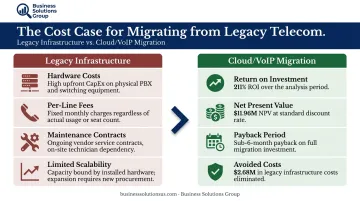
Business Solutions Group advises on SIP trunking, UCaaS, and CCaaS options as part of its telecom cost reduction practice, helping clients identify which migration path delivers the best cost outcome for their current environment.
Conclusion
Effective telecom cost reduction starts with knowing where cost actually originates — unused inventory, billing errors, missed contract windows, fragmented vendors, and legacy infrastructure each require a different response. Unused inventory, billing errors, missed contract windows, fragmented vendors, and legacy infrastructure each require a different response.
The businesses that achieve lasting savings are those that build recurring audit, visibility, and renegotiation practices into how they operate — not those that run a one-time cleanup and move on. Costs accumulate steadily as services are added, contracts renew, and teams turn over. Staying ahead of that drift requires the same ongoing attention as any other operational function.
If your organization hasn't reviewed its telecom spend recently, a no-cost savings analysis is a practical place to start. Business Solutions Group works with businesses across the US to identify exactly these kinds of hidden costs — in telecom, shipping, healthcare, and other expense categories — with no fees until savings are confirmed in hand.
Frequently Asked Questions
How to reduce cost in the telecom industry?
Start with a full inventory and audit to establish exactly what you're paying for. From there, eliminate unused services, dispute billing errors, renegotiate contracts using benchmark data, and consolidate vendors. Ongoing expense management keeps those savings from eroding over time.
What are telecom costs?
Telecom costs include all charges associated with voice lines, data circuits, wireless plans, hardware leases, and regulatory fees — such as universal service fees, E911 charges, and administrative surcharges. Some are fixed and unavoidable; others arise from contract terms, usage patterns, or billing errors.
What is telecom expense management (TEM) and how does it reduce costs?
TEM is a structured approach to controlling telecom spend through audits, invoice review, inventory tracking, and vendor negotiations. It helps businesses catch overcharges, cut waste, and maintain visibility across all locations on an ongoing basis.
How often should businesses conduct a telecom audit?
At minimum annually, and ideally quarterly for multi-location businesses. Billing errors and unused services accumulate continuously, so infrequent audits let avoidable costs compound before anyone catches them.
Can small and mid-sized businesses benefit from telecom cost reduction strategies?
Yes — and often more so than at larger organizations. Telecom bills at smaller businesses rarely get reviewed in detail, so even basic steps like inventorying active lines, disputing errors, and consolidating vendors tend to deliver outsized savings relative to total spend.
What is the first step a business should take to reduce telecom costs?
A complete inventory and audit. No other cost-reduction strategy can be applied accurately without first knowing what services are active, what's being billed, and whether contracted rates are actually honored.