At that level, supply chain spend isn't a line item. It's a margin issue. For companies without clear visibility into where costs originate, that 6% compounds through budget overruns, price volatility, and reactive decisions that fix symptoms rather than causes.
The good news: supply chain costs aren't inherently excessive. They become excessive when information gaps allow waste to accumulate unseen — in procurement decisions, inventory buffers, carrier invoices, and compliance failures. Information systems address this at the root.
This article breaks down where supply chain costs come from, what drives them, and which IS tools reduce them at each stage.
Key Takeaways
- Supply chain costs compound quietly across procurement, inventory, logistics, and administration
- The primary cost drivers are data fragmentation, reactive inventory management, carrier pricing opacity, and contract compliance gaps
- IS-driven cost reduction operates at three levels: pre-operational decisions, real-time management, and structural process design
- Core tools span spend intelligence software, eProcurement platforms, and integrated ERP/WMS/TMS systems
- Sustainable savings require systematic IS deployment — one-time audits won't hold
How Supply Chain Costs Typically Build Up
Supply chain costs rarely appear as a single line item. They accumulate across procurement, inventory management, transportation, and administration — often unnoticed until stress or audit forces the issue.
Many of the most expensive cost categories are hidden by design:
- Ghost assets that appear in records but don't physically exist
- Excess safety stock carried because demand forecasting is unreliable
- Uncompetitive carrier rates that never get reviewed because no benchmark exists
- Compliance gaps that only surface when a regulator or auditor goes looking
Without the right data infrastructure, these costs remain invisible during normal operations — buried in routine processes rather than flagged as avoidable spend.
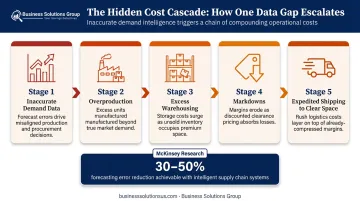
That invisibility compounds fast. A single upstream information gap — say, inaccurate demand data — doesn't just affect procurement. It triggers a downstream chain reaction: overproduction leads to excess warehousing, which leads to markdowns, which leads to expedited shipping to clear space.
McKinsey research on Supply Chain 4.0 found that predictive analytics can reduce forecasting errors by 30–50% — which means the cascade above is largely preventable with the right IS infrastructure in place.
Key Cost Drivers in Supply Chain Operations
Understanding where costs originate is a prerequisite for reducing them. Four drivers account for the majority of avoidable supply chain spend.
Information Fragmentation
When procurement, logistics, warehousing, and finance run on disconnected systems, no single team sees the full picture. Decisions get made on incomplete data, and every gap between systems is a gap in spend control.
Gartner's research on supply chain decision quality identifies decision delays, excess inventory, and missed savings as the direct cost consequences of poor information quality. This frames fragmented IS not as an IT inconvenience, but as a measurable margin problem.
Reactive Rather Than Predictive Management
Without forecasting tools, businesses face two costly outcomes:
- Over-ordering to buffer uncertainty, which drives up carrying costs
- Under-ordering and paying premium expediting fees to avoid stockouts
Both are preventable with better forecasting data.
As ASCM notes, safety stock exists specifically to protect against forecast errors and demand fluctuation. The more reliable your forecasting data, the less safety stock you need to carry.
Carrier and Supplier Pricing Opacity
Businesses without benchmark data have no way to evaluate whether their current carrier or supplier rates are competitive. Without that context, companies have no leverage to negotiate — and they keep overpaying, contract renewal after contract renewal.
U.S. business logistics costs reached $2.3 trillion in 2025, according to CSCMP — equivalent to 8.7% of GDP. Even marginal rate improvements across that cost pool translate to significant dollar savings at the company level. That same pricing opacity problem extends beyond carriers into compliance and process gaps.
Compliance and Process Inefficiencies
Undocumented workflows, missed maintenance windows, and regulatory non-compliance generate fines, legal fees, and operational downtime. These costs rarely appear in carrier invoices or procurement reports — by the time they surface, the financial damage is already done.
Cost-Reduction Strategies: How Information Systems Drive Down Supply Chain Costs
IS-driven cost reduction works at three distinct leverage points: the decisions made before operations begin, the management of costs while operations are running, and the structural context around the supply chain. Each requires different tools.
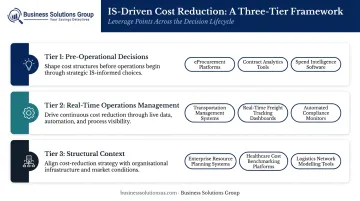
Strategies That Reduce Costs by Changing Decisions
The highest-leverage opportunity in supply chain cost reduction is improving decision quality before procurement, contracting, or production begins. Better information at the decision stage prevents the need for expensive corrections later.
Spend intelligence and benchmark analysis
IS platforms that aggregate and analyze historical spend data allow procurement teams to identify overpayment relative to market benchmarks, evaluate supplier performance objectively, and enter contract negotiations with data-backed leverage.
Business Solutions Group's proprietary spend intelligence software is built specifically for this. The platform analyzes parcel and logistics spend in detail — down to 1/10th of a percent — benchmarking it against market-appropriate rates to show exactly what a business should be paying versus what it currently pays.
That data feeds directly into negotiation strategy, not a report that sits on a shelf.
The Hackett Group's procurement benchmarking shows that Digital World Class procurement organizations achieve 2.6x higher ROI and operate at 19% lower cost as a percentage of spend than peers — a gap driven largely by better data infrastructure.
eProcurement platforms
Digital procurement systems replace manual, error-prone purchasing with rules-based workflows that enforce preferred suppliers, apply volume discount triggers automatically, and eliminate maverick spend (uncontrolled, off-contract purchasing). Lower unit costs and fewer costly exceptions follow directly.
Business Solutions Group's Global RFP eProcurement solution places incumbent carriers into competitive, apples-to-apples bidding situations with pre-qualified carriers globally — across LTL, truckload, ocean, air, and rail. Clients typically see 15–25% cost savings through this competitive procurement process alone.
Demand forecasting systems
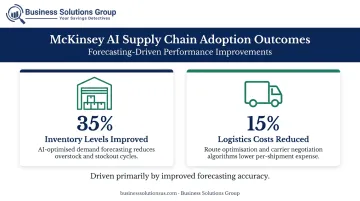
IS tools that integrate historical sales data, seasonal patterns, and supplier lead times allow procurement to align order quantities with actual need. McKinsey's research on AI-enabled supply chains found that early adopters improved inventory levels by 35% and logistics costs by 15% — both driven primarily by better forecasting accuracy.
SKU rationalization via data analytics
IS platforms surface which product variants or components have low turnover or high handling costs relative to revenue contribution. Rationalizing the product mix based on this data reduces complexity across procurement, warehousing, and fulfillment.
Strategies That Reduce Costs by Changing How Supply Chains Are Managed
These approaches reduce costs during active operations by improving real-time control and visibility. The goal is catching problems while they're still small, not after they've triggered rework, penalties, or lost revenue.
Real-time inventory tracking
IS-enabled inventory systems eliminate ghost assets, expose excess safety stock, and flag slow-moving SKUs continuously. Carrying costs drop, unnecessary replenishment orders decrease, and working capital utilization improves across the board.
APQC defines inventory accuracy as the absolute variance between physical and perpetual inventory. Closing that gap directly reduces the buffer stock businesses carry to compensate for uncertainty.
Transportation spend analytics
IS platforms that categorize spend by carrier, mode, lane, and route expose inefficiencies that aggregate invoices obscure entirely. Consolidation opportunities, carrier contract renegotiation triggers, and mode-shift decisions all become visible — and each translates directly to lower per-unit shipping costs.
Business Solutions Group's TMS provides real-time carrier rates, dynamic pricing through API-powered technology, and centralized shipment tracking — giving logistics teams the data to make smarter routing decisions and catch billing discrepancies before they're paid.
Predictive maintenance systems
IS tools that monitor equipment utilization and trigger maintenance before failure reduce emergency repair costs, prevent production downtime, and extend asset life cycles. Deloitte estimates that unplanned downtime costs industrial manufacturers $50 billion annually — a figure that reflects what reactive maintenance actually costs at scale.
KPI monitoring dashboards
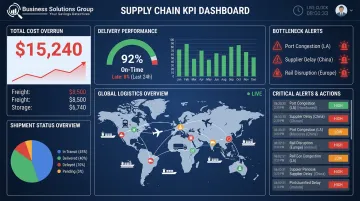
Real-time operational dashboards give supply chain managers the visibility to catch bottlenecks, delivery delays, and cost overruns before they escalate. Deloitte's supply chain control tower practice cites examples of $30M+ material-cost opportunities and $200M+ in cost savings identified through this type of early-warning visibility — though results vary significantly by organization size and complexity.
Strategies That Reduce Costs by Changing the Operational Context
These approaches address the structural inefficiencies that no single-function tool can solve — changing the environment in which the supply chain operates rather than optimizing within it.
System integration across ERP, WMS, and TMS platforms
When enterprise resource planning, warehouse management, and transportation management systems share a unified data layer, the friction between them disappears. Redundant processes get eliminated. Manual data reconciliation drops. Cross-functional decisions become faster and more accurate.
The cost savings come not from any single system but from closing the gaps between them. McKinsey describes digitally connected supply chain ecosystems as enabling lower costs, smaller inventories, and shorter lead times — benefits that only materialize once each function stops operating on incomplete data.
Supplier collaboration portals and automated communication
IS tools that create a shared information channel between a business and its suppliers reduce ordering errors, miscommunication, and last-minute change costs. Consistent communication also builds the operational predictability required for just-in-time inventory strategies and volume discount negotiations.
Compliance and documentation automation
IS systems that automatically log delivery confirmations, chain-of-custody data, temperature conditions, and regulatory parameters reduce the cost risk of non-compliance. Businesses can prove adherence without manual documentation burdens — and without the legal exposure that comes from gaps in the record.
Conclusion
Effective supply chain cost reduction depends on knowing where costs actually originate — across decision, management, and context layers — and matching the right IS tools to each source. Broad cuts without that visibility tend to shift costs rather than eliminate them.
Information systems make that process strategic, continuous, and scalable. Organizations that embed supply chain visibility into their core operations — rather than treating it as a one-time initiative — tend to maintain tighter margins even when freight markets or supplier conditions shift.
Business Solutions Group helps organizations build that visibility layer through: proprietary spend intelligence software, eProcurement solutions, TMS deployment, and comprehensive benchmark analysis. If your supply chain costs feel difficult to control, the gaps are usually in the data — not the operations. Start with a free savings analysis to identify exactly where they are.
Frequently Asked Questions
What is the role of information systems in the supply chain?
Information systems collect, process, and distribute data across procurement, inventory, logistics, and production functions. They enable the visibility and coordination that allow teams to make faster, more accurate decisions — reducing waste, avoiding costly exceptions, and improving operational efficiency at scale.
How can supply chain costs be reduced?
Start by identifying where costs originate — in procurement decisions, inventory management, transportation, or compliance. Then deploy IS tools that provide the data visibility and process control needed to address each driver directly. Broad cost-cutting without that diagnostic step typically misses the highest-impact opportunities.
What types of information systems are used in supply chain management?
The core categories are ERP systems, warehouse management systems (WMS), transportation management systems (TMS), demand forecasting platforms, spend intelligence software, and eProcurement solutions. Each addresses a different cost layer, which is why most organizations see the greatest returns when these systems share data rather than operate in isolation.
How does spend intelligence software help reduce supply chain costs?
Spend intelligence software aggregates procurement and logistics spend data and benchmarks it against market rates — revealing where a business is overpaying, which suppliers are underperforming, and where contract renegotiation can deliver immediate savings. The result is negotiators walking into supplier conversations with specific numbers rather than assumptions.
What are the 4 C's of supply chain management?
The 4 C's are commonly described as Cost, Customer service, Coordination, and Communication. This is an informal framework rather than a formal standards-body model, but each element maps directly to decisions that affect supply chain efficiency and financial performance.
What are the 5 pillars of supply chain management?
The five pillars — Plan, Source, Make, Deliver, and Return — are derived from SCOR-style supply chain process thinking (the current ASCM SCOR DS framework uses updated terminology). Information systems create visibility and process control at each stage, making them central to any serious cost reduction effort.