Introduction
Global inventory distortion — excess stock sitting in warehouses and empty shelves where product should be — costs businesses an estimated $1.73 trillion annually, according to IHL Group. That figure alone should stop any operations leader mid-sentence.
But these losses don't arrive as a single catastrophic event. They accumulate quietly: a forecast that's 30% off, a carrier invoice no one audited, a safety stock level set two years ago and never revisited. Each misstep looks manageable in isolation. Multiplied across thousands of SKUs, dozens of carriers, and months of operations, the damage becomes structural.
AI is now addressing those structural losses directly — deployed across demand planning, procurement, inventory management, and logistics by organizations looking for measurable results, not pilot programs.
This guide examines three dimensions of AI-driven cost reduction: the upfront decisions that shape cost exposure, how AI performs during live operations, and the systemic context that determines whether AI investments translate to measurable savings.
Key Takeaways
- Supply chain costs compound gradually through poor forecasting, idle inventory, carrier rate drift, and unaudited invoices — not sudden failures
- AI improves decision quality before money is spent, catching cost leaks at the source rather than after the fact
- McKinsey research shows early AI adopters reduced logistics costs by 15%, inventory levels by 35%, and improved service levels by 65%
- ROI depends on which cost areas are targeted and how well AI implementation fits your existing data infrastructure
How Supply Chain Costs Silently Accumulate
Most supply chain cost problems aren't visible on any single report. They live inside line items that look normal until someone runs a year-over-year comparison and notices margin has compressed without a clear trigger.
The pattern is consistent across industries:
- Over-ordering driven by inaccurate demand forecasts ties up working capital in inventory that moves slowly or not at all
- Static safety stock levels set during a different demand cycle continue consuming warehouse space long after conditions change
- Carrier rate creep occurs when contracted rates go unmonitored and above-market pricing goes unchallenged through renewal cycles
- Warehouse inefficiencies from poor slotting, suboptimal pick paths, and misaligned labor schedules add up incrementally every shift
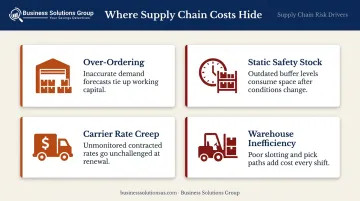
The costs stay hidden until scale or stress forces them into view: a budget review, a stockout crisis, or a margin compression event that triggers a serious audit. By then, most businesses have already been carrying significant avoidable costs for months.
The source of accumulation also varies by business type:
- Freight-heavy shippers typically lose through transportation mismanagement and unaudited invoices
- Inventory-driven businesses absorb the cost in excess stock and slow-moving SKUs
- Complex multi-supplier networks pay in variability: expedite fees, emergency sourcing premiums, and disruption absorption costs
Key Cost Drivers That AI Can Address
AI delivers the most value when it targets the right cost drivers. These are the four areas where supply chain spend leaks most — and where AI-powered tools have the clearest ROI.
Inaccurate Demand Forecasting
Demand forecasting error is the upstream cause of most expensive supply chain problems. When forecast accuracy fails, the downstream consequences cascade: over-ordering, excess stock, emergency expedites, and markdowns.
McKinsey reports that AI-driven forecasting can reduce forecast errors by 20–50% and cut lost sales from product unavailability by up to 65%. ISM data puts median forecast error at 25% in food and beverages and 50% in durable consumer products — figures that illustrate how significant the baseline problem is before AI is applied.
Supplier Variability
Unpredictable lead times and price fluctuations force reactive procurement decisions. Each reactive move carries steep cost premiums that rarely surface as a labeled line item:
- Rush orders at above-contract pricing
- Premium shipping to cover lead time gaps
- Last-minute alternative sourcing with no negotiating leverage
These costs get absorbed into general operational spend, making them difficult to isolate — and even harder to eliminate without visibility tools.
Transportation and Carrier Cost Mismanagement
Without benchmark data and ongoing spend intelligence, businesses routinely pay above-market carrier rates or miss consolidation opportunities that could reduce per-unit freight cost.
For small parcel and freight shippers, the problem is especially acute. Pricing structures are complex, surcharges change frequently, and contract terms often obscure the true cost per shipment — leaving money on the table with every invoice.
Warehouse and Labor Inefficiency
Poor inventory slotting, suboptimal pick paths, and misaligned labor scheduling inflate operational costs steadily. Each of these is a recurring expense baked into daily operations. Without a benchmarked baseline, there's no way to know how much is being lost — or where to start fixing it.
Cost-Reduction Strategies for Supply Chain Management Using AI
AI cost-reduction strategies work across three distinct levers: decisions made before operations begin, how supply chain processes are managed in real time, and the systemic environment — infrastructure, supplier relationships, data quality — that sets baseline cost exposure.
Strategies That Reduce Costs by Changing Decisions
These approaches cut costs by improving the quality of decisions made before inventory is ordered, contracts are signed, or routes are planned.
- AI-powered demand forecasting at the SKU level replaces gut-based order quantities with models that incorporate seasonality, external market signals, and product lifecycle data — reducing over-orders and excess safety stock.
- AI-based inventory segmentation (dynamic ABC analysis) classifies inventory by value and velocity more accurately than manual methods, giving high-priority items precise oversight without over-investing in low-velocity stock.
- AI-driven spend intelligence at the procurement stage evaluates carrier pricing, supplier contracts, and freight rates against current market data before contracts are signed.
- AI network design simulation models warehouse locations, distribution strategies, and supplier proximity before infrastructure decisions lock in costs that are difficult to reverse.
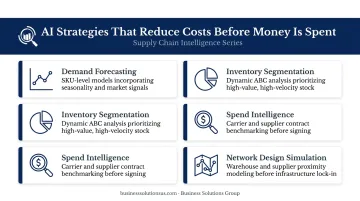
Business Solutions Group's proprietary spend intelligence software supports this kind of pre-commitment analysis — modeling proposed carrier pricing across all rates, fees, and surcharges to show their true cost impact before anything is signed.
Strategies That Reduce Costs by Improving Real-Time Visibility
These approaches catch problems while operations are active, before they escalate into expensive emergencies.
- Dynamic safety stock recalculation uses real-time demand signals and lead time variability to continuously adjust buffer levels, preventing both excess accumulation and unexpected stockouts.
- AI-powered supplier performance monitoring tracks lead times, fill rates, and pricing compliance in real time, flagging underperformance early enough for procurement teams to renegotiate or redirect orders.
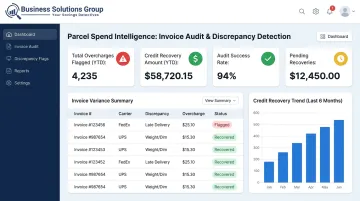
- AI freight bill auditing automatically validates carrier invoices against contracted rates before payment is released.
- Unified AI dashboards combining ERP and logistics data replace periodic snapshots with near-real-time visibility into spend, inventory value, and service levels.
According to a CSCMP-hosted report citing American Shipper, 80% of carrier invoices contain some kind of discrepancy, with 15–20% representing actual overcharges. Business Solutions Group's parcel spend intelligence platform identifies these variances and ensures clients recover 100% of credits owed.
Strategies That Reduce Costs by Addressing Systemic Risk
The environment where AI operates often determines whether it delivers ROI or creates new complexity. These approaches address the systemic factors that set baseline cost exposure.
- **Combining AI route optimization with freight consolidation and carrier contract management** captures savings that route analysis alone cannot — but only when contracts are structured to reward volume and flexibility.
- AI predictive disruption modeling simulates the cost of disruptions before they occur, letting organizations build contingency playbooks rather than respond reactively.
- AI supply chain mapping for sub-tier visibility identifies vulnerabilities beyond first-tier suppliers, changing the exposure profile for organizations currently blind to tier-3 risks.
- Aligning AI tools with existing ERP, TMS, or WMS systems before implementation prevents data integration failures that create new cost layers rather than eliminating old ones.
The stakes here are significant. McKinsey data shows companies can expect disruptions lasting a month or longer every 3.7 years, with a 100-day shutdown capable of wiping out 30–50% of one year's EBITDA. Yet BCG reports only 10% of companies are truly prepared. McKinsey also found only 2% of executives have visibility into tier-3 suppliers — and PwC's 2026 Digital Trends in Operations Survey found 87% of operations leaders report poor data quality has undermined the value of their digital initiatives.
Conclusion
AI delivers real supply chain cost reductions when it's applied where costs actually originate — whether in flawed procurement decisions, poor operational visibility, or structural vulnerabilities in the supply chain network. Broad deployment without that targeting rarely moves the needle.
The results among companies that have applied AI this way are well-documented:
- McKinsey found AI supply chain early adopters achieved 15% logistics cost reduction, 35% inventory level improvement, and 65% service level gains over slower-moving competitors
- BCG linked advanced digital supply chain adoption to a 2–4 percentage point EBITDA boost and 10–20% overall cost decline
Business Solutions Group combines advisory expertise with proprietary technology — including spend intelligence software and eProcurement solutions — that has helped clients save over $1 billion in shipping costs, with average parcel savings of 15–40% and freight savings of 20–25%.
For businesses looking to reduce supply chain costs in a measurable, structured way, BSG offers a no-obligation savings analysis as a starting point.
Frequently Asked Questions
How does AI reduce costs in supply chain management?
AI reduces costs by improving decision accuracy across forecasting, inventory management, procurement, and transportation — replacing reactive, intuition-based choices with data-driven ones. The highest-impact reductions come from preventing costs before they occur rather than identifying them after the fact.
What are the biggest cost drivers in supply chain management?
The main drivers are inaccurate demand forecasting, supplier variability, unmanaged carrier rates, and warehouse inefficiency. Most stay hidden until a budget review or margin compression event forces them into view.
Is AI in supply chain management expensive to implement?
Implementation costs vary based on scope and existing infrastructure. AI-as-a-Service models and advisory-led deployments lower the barrier to entry considerably, and ROI in high-spend areas like transportation and inventory typically outweighs upfront costs.
How does AI improve demand forecasting accuracy?
AI-powered forecasting incorporates real-time market signals, seasonality patterns, geographic demand variations, and product lifecycle factors that standard ERP tools don't model dynamically. The result is SKU-level accuracy that McKinsey estimates can reduce forecast errors by 20–50% compared to traditional approaches.
Can small and mid-sized businesses benefit from AI in supply chain management?
Smaller businesses often see the fastest returns in freight spend optimization and carrier contract benchmarking, where AI-powered spend intelligence tools surface above-market pricing without requiring large-scale technology implementations. Business Solutions Group's parcel spend intelligence platform, for example, is designed specifically for businesses of varying sizes and shipment volumes.
What is the ROI of implementing AI in supply chain management?
McKinsey's research on early AI adopters shows 15% logistics cost reductions, 35% inventory improvements, and 65% service level gains. BCG cites a 10–20% overall cost decline and 15–30% working-capital reduction for advanced implementations. Results vary based on which cost areas are targeted and the quality of underlying data.