The frustrating part? Most of that excess spend isn't inevitable. Freight costs become expensive through poor decisions, absent benchmarking, and reactive management—not because shipping itself is inherently uncontrollable.
This article examines how intelligent logistics systems address freight cost at three distinct leverage points: the decisions made around freight, how freight operations are managed, and the structural environment in which freight moves.
Key Takeaways
- Freight costs accumulate across base rates, fuel surcharges, accessorial fees, and billing errors—not just the rate card
- Intelligent logistics systems surface hidden cost drivers before, during, and after each shipment
- The highest-impact reductions come from changing procurement decisions, improving operational control, and restructuring carrier contracts
- Sustained freight savings depend on continuous visibility and ongoing benchmarking, not a single round of negotiations
How Freight Shipping Costs Typically Build Up
Most shippers think of freight cost as a rate. It isn't. It's a stack.
Every shipment carries a base rate, a fuel surcharge, and a variable layer of accessorial charges—delivery area fees, weight reclassifications, dimensional adjustments, address corrections. UTS defines freight cost as the sum of all three components, and that third layer is where cost creep hides.
The inflation in accessorials has accelerated sharply. In 2025, AlixPartners reported:
- Ground fuel surcharges running around 20.5%
- UPS Delivery Area Surcharges up 62% to 69%
- FedEx adding 136 ZIP codes to its DAS coverage
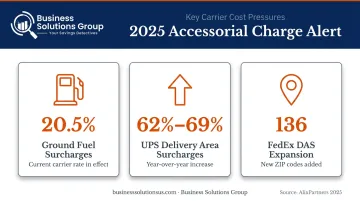
None of these are base rate changes. They don't appear in headline rate comparisons and rarely trigger contract reviews.
Two Patterns of Cost Build-Up
Cost accumulation follows two distinct patterns, both of which are avoidable with the right visibility:
- Gradual drift: repeated suboptimal carrier selections, unaudited invoices, and misapplied discounts compounding across thousands of shipments
- Episodic spikes — demand surges or capacity crunches that force expensive expedited shipping, often at two to three times standard rate
Most shippers only discover the full scale of their inefficiency when they benchmark against peers or undergo a freight audit. By that point, months—sometimes years—of avoidable cost have already cleared the books. Addressing both patterns starts with visibility into where the charges originate.
Key Cost Drivers in Freight Shipping
Freight cost is shaped by two categories of factors. One you can't fully control. The other you can.
Market-driven factors include fuel prices, carrier capacity, lane rates, and spot market volatility. These fluctuate with conditions outside any shipper's control.
Internal operational factors include:
- How carriers are selected and under what contract terms
- How shipment data is captured and validated
- Packaging accuracy and dimensional compliance
- How frequently invoices are audited
- Whether mode selection is driven by data or habit
Internal factors are where intelligent systems deliver the clearest return. A shipper can't dictate fuel prices. But they can eliminate duplicate invoice charges, identify above-market contract rates, and stop defaulting to air freight when ground expedite meets the same deadline.
The weight of each driver varies by volume, geography, and freight mode. Generic benchmarks miss that distinction. Effective cost reduction requires analysis calibrated to a specific shipper's actual spend profile — this is what Business Solutions Group's proprietary spend intelligence software produces.
Cost-Reduction Strategies for Freight Shipping
Where inefficiency originates determines which strategy applies. Some cost problems require changing the decisions made around freight. Others require improving how freight is actively managed. Still others require restructuring the external conditions—contracts, carrier mix, network geography—that set the cost ceiling.
Strategies That Reduce Costs by Changing Decisions
These are the earliest intervention points, and typically the most impactful.
Use benchmark data to evaluate carrier pricing. Businesses without benchmarking data routinely overpay on contracted rates because they have no visibility into what comparable shippers pay for equivalent lanes and volumes. Business Solutions Group's spend intelligence software addresses this directly—providing benchmark-driven analysis that identifies where a client's freight spend sits above market, and by how much, before any negotiation begins.
Choose shipping mode based on data, not habit. Many shippers default to FTL when LTL would adequately cover the load, or to air freight when ground expedite would hit the same delivery window. Intelligent systems model cost-per-mode against urgency and volume, redirecting spend to the right service tier without sacrificing service.
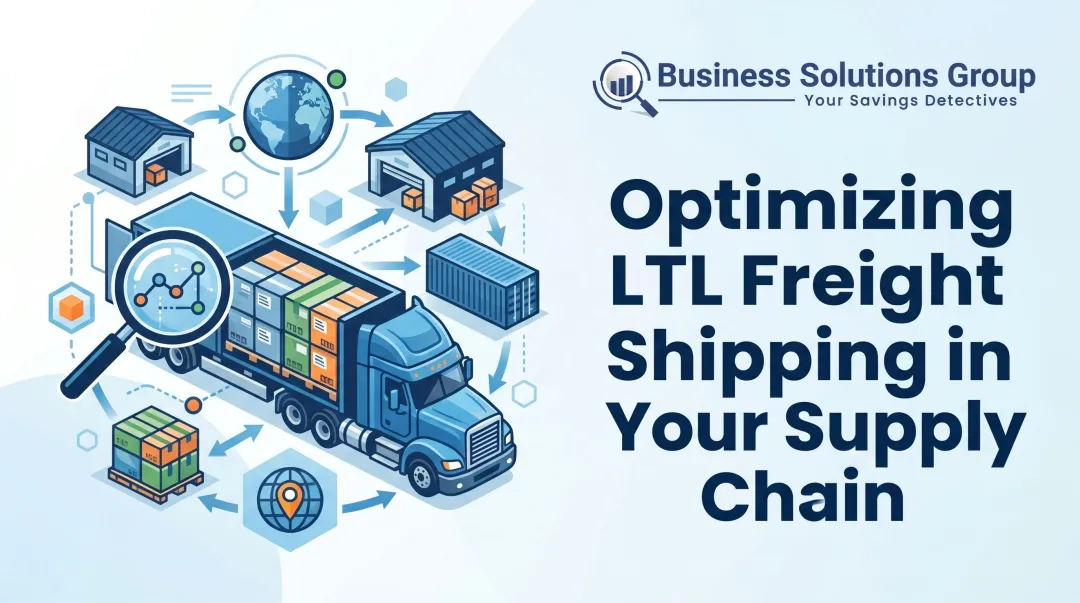
Consolidate shipments strategically. Grouping LTL shipments into FTL loads, or batching small parcels moving to the same region, reduces per-unit transportation cost significantly. ODW Logistics documented a consolidation case where this approach produced 12.4% freight savings and moved shipments 1.2 days faster on average. The catch: consolidation windows are only visible when shipping patterns are fully mapped.
Analyze total landed cost before procurement decisions. Rate shopping on base freight cost alone misses the actual cost of a shipment. Accessorials, fuel surcharges, transit time penalties, and compliance costs can collectively exceed the base rate in certain lanes and profiles. Intelligent logistics platforms surface these hidden components so decisions are made on complete data—not just the line that appears in the carrier's headline rate.
Strategies That Reduce Costs by Changing How Freight Is Managed
Operational control reduces cost through visibility, consistency, and exception management.
Deploy a Transportation Management System (TMS) to centralize freight execution. Without a TMS, carrier selection, booking, tracking, and invoice reconciliation happen in disconnected silos. Billing errors go undetected. Exception handling is reactive.
Without a TMS, carrier selection, booking, tracking, and invoice reconciliation happen in disconnected silos. Billing errors go undetected. Exception handling is reactive.
ARC Advisory's managed transportation research—surveying 119 primarily shipper respondents—found that many would see freight costs rise by 12% or more if they discontinued managed transportation, with savings above 12% almost always tied to TMS implementation. A TMS creates a single source of truth that enables real-time decisions and automated exception flagging.
Apply AI-powered route optimization. AI evaluates traffic patterns, lane capacity, weather, and carrier performance simultaneously to recommend the most cost-efficient route for each shipment. This reduces fuel consumption, minimizes empty miles, and avoids unplanned transit delays that drive up total freight cost.
Audit freight invoices systematically. Freight invoices frequently contain billing errors—incorrect weight classifications, unauthorized accessorial charges, duplicate fees. Transportation Insight notes that 3% to 6% of freight invoices typically contain errors, with 1% to 5% of total freight spend recoverable through disciplined audit processes. Intelligent billing audit tools flag discrepancies automatically rather than relying on manual review cycles that rarely catch everything.
Use predictive analytics to get ahead of exceptions. Systems that forecast delivery delays, capacity shortfalls, or cost spikes based on historical and real-time data let logistics teams reroute, replan, or resequence shipments before problems escalate. Logility reports that top-performing supply chains spend roughly 3% of freight budget on expediting, while bottom performers spend around 10%. That gap is mostly a planning problem—one that predictive visibility directly addresses.
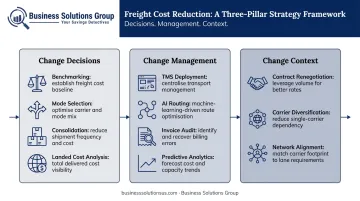
Strategies That Reduce Costs by Changing the Context Around Freight
These are structural adjustments that set the cost ceiling within which all operational decisions occur.
Renegotiate carrier contracts using current market benchmark data. Carrier contracts establish the pricing floor for every freight activity. Businesses that renew contracts without updated market intelligence consistently overpay—often without knowing it. Armed with benchmark data and volume analysis, shippers can renegotiate rates, eliminate unfavorable minimum charges, and secure tiered pricing that improves as volume grows. BSG's former senior-level UPS and FedEx pricing analysts bring exactly this kind of market intelligence to carrier negotiations.
Diversify the carrier base. Over-reliance on a single carrier creates cost exposure the moment that carrier tightens capacity. During a capacity crunch, single-carrier shippers face spot rate surcharges with no competitive alternatives. Maintaining relationships across multiple carriers and modes creates pricing competition and ensures service continuity without paying emergency-rate premiums.
Align fulfillment locations with demand geography. When warehouses and distribution points are misaligned with where freight actually needs to go, businesses pay for longer hauls, more expensive lanes, and higher last-mile costs on every shipment. Freight data analytics can identify these misalignments—revealing whether repositioning inventory closer to demand zones would materially reduce average shipping distance and cost. Deloitte cautions that distribution redesign should balance cost reduction against lead time and resilience risk, which makes the analytical foundation here particularly important.
Conclusion
Reducing freight shipping costs isn't achieved by cutting spend indiscriminately. It requires identifying precisely where costs originate—whether in procurement decisions, operational execution, or structural carrier and network conditions—and applying intelligent systems that address each layer specifically.
The businesses that consistently outperform on freight cost treat logistics visibility as an ongoing discipline. They benchmark continuously, revisit carrier strategies as market conditions shift, and audit invoices before problems compound into budget overruns.
Business Solutions Group's advisory and technology services are built around this model: proprietary spend intelligence, carrier contract expertise, and TMS capabilities working together to make fact-based freight management practical for businesses at any shipping volume.
Frequently Asked Questions
How can a logistics intelligence system cut freight spend and reduce logistics costs?
Intelligent logistics systems reduce freight spend by surfacing hidden cost drivers—above-market carrier rates, billing errors, and inefficient routing—and enabling data-driven decisions across carrier selection, mode optimization, and contract negotiation. Savings compound across every shipment rather than appearing as a single one-time event.
Can AI and logistics intelligence systems take over logistics operations?
AI and intelligent systems augment logistics operations rather than replace them—automating routine tasks like route optimization, invoice auditing, and exception handling. Human expertise remains essential for strategic decisions, carrier relationship management, and complex problem-solving that falls outside standard parameters.
What is an intelligent logistics system?
An intelligent logistics system is a technology platform that combines data analytics, automation, and AI to improve visibility, decision-making, and cost control across freight procurement and transportation execution. Most platforms unify TMS capabilities, spend intelligence, benchmarking, and invoice audit tools in a single environment.
What are the biggest hidden costs in freight shipping?
The most common sources of hidden freight cost are accessorial charges, invoice billing errors, inefficient mode selection, above-market contracted rates due to poor benchmarking, and expedited shipping triggered by reactive rather than proactive management.
How does real-time freight visibility reduce shipping costs?
Real-time visibility allows logistics teams to catch delays before they trigger expedited freight events, reroute shipments proactively, and maintain accurate data that prevents billing disputes and accessorial overcharges.
When should a business invest in an intelligent logistics platform?
Invest when freight spend is outpacing revenue, carrier invoices are hard to reconcile, or you lack visibility into whether contracted rates reflect current market pricing. Companies with high accessorial exposure or frequent expedited shipments typically see the fastest ROI.