Logistics costs aren't fixed. They accumulate across transportation rates, carrier contracts, inventory carrying costs, and warehousing — and the overages compound quietly across each category. Most companies only notice the problem during audits or margin reviews, by which point the damage is already done.
This guide walks through how data mining and analytics expose the real drivers behind logistics cost accumulation — and what structured, practical steps companies can take to address them.
Key Takeaways
- Most logistics cost overages hide in billing errors, suboptimal carrier contracts, and poor demand forecasting — not obvious line items
- Data mining surfaces patterns that manual reporting and standard dashboards miss entirely
- The four analytics types — descriptive, diagnostic, predictive, and prescriptive — each target different cost reduction opportunities
- Cost reduction requires changes at three levels: upfront decisions, day-to-day operations, and the data infrastructure that supports both
- Businesses without in-house analytics teams can access these capabilities through specialized advisory and technology partners
How Logistics Costs Build Up Without Data Visibility
Logistics costs rarely arrive as a single, identifiable expense. They accumulate across fragmented channels — carrier invoices, missed volume thresholds, idle inventory, repeated expedited shipments, and billing discrepancies that each seem minor but compound over time.
Volume changes, seasonal shifts, carrier rate adjustments, and contract renewals all create opportunities for cost to creep in undetected. Without systematic data tracking, these accumulations sit unreviewed until an audit or margin compression finally surfaces them.
Those unreviewed gaps feed a predictable set of cost drivers — ones that rarely appear in standard operational dashboards:
- Overbilling and duplicate charges on carrier invoices
- Underused contract lanes that were negotiated but never fully utilized
- Inefficient modal choices that persist by default rather than by analysis
- Accessorial fee patterns that inflate invoices well beyond the base rate
- Demand forecast errors that trigger expensive expedited moves unnecessarily
This plays out differently depending on the operation. A parcel-heavy e-commerce shipper is most exposed to accessorial creep and carrier invoice errors, while an LTL freight shipper is more likely to bleed through underutilized contract lanes. The exposure differs — the root cause doesn't: costs accumulate where data isn't reviewed.
The Four Types of Analytics and What They Uncover in Logistics
Before addressing specific strategies, it helps to understand what each analytics layer actually does — and where most logistics operations currently sit on that spectrum.
Harvard Business School Online defines the four types as:
| Analytics Type | Core Question | Logistics Application |
|---|---|---|
| Descriptive | What happened? | Invoice summaries, shipment reports, spend dashboards |
| Diagnostic | Why did it happen? | Root cause of cost overruns by carrier, lane, or process |
| Predictive | What will happen? | Demand spikes, capacity constraints, lead time variability |
| Prescriptive | What should we do? | Routing recommendations, carrier mix, inventory positioning |
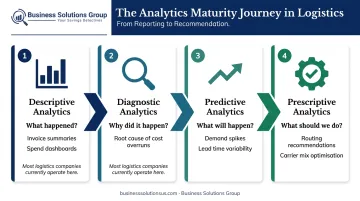
Most logistics operations rely almost entirely on descriptive analytics — reports and dashboards that show what already happened. The higher-value layers go unused.
Diagnostic analysis is where real cost drivers get exposed. Which specific carriers, lanes, or shipment types are systematically generating overruns? That question doesn't get answered by a spend summary. It requires structured analysis of historical data across multiple variables.
Predictive models do something different: they shift decisions upstream. Instead of reacting to a demand spike with emergency carrier bookings, a company using predictive analytics positions capacity and inventory before the spike arrives, paying standard rates rather than expedited premiums.
McKinsey research found that digital logistics tools produce 10–20% performance improvements in the short term and 20–40% within two to four years. That gap reflects the difference between companies using only descriptive reporting and those operating across all four analytics layers.
Key Cost Drivers That Data Mining Can Expose
Transportation Spend and Contract Deviations
Transportation represents 64.4% of total U.S. business logistics costs, making it the single largest target for cost reduction. Yet much of the overpayment within that category isn't visible in standard reports — it's buried in the gap between contracted rates and what carriers actually bill.
Data mining surfaces several specific exposure points:
- Rate discrepancies between contracted and billed charges
- Accessorial fees applied inconsistently or outside contract terms
- Weight and dimensional billing errors on parcel shipments
- Lane-level overpayment relative to current market benchmarks
Billing Errors — The Category Most Operations Overlook
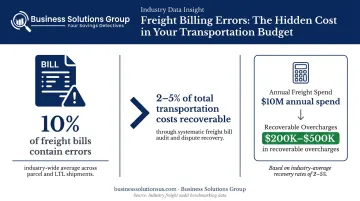
Carrier invoice errors are more common than most shippers assume. According to SupplyChainBrain citing the National Shippers Strategic Transportation Council, errors appear in up to 10% of freight bills — and comprehensive freight bill audits can recover 2–5% of total transportation costs.
For a company spending $10 million annually on transportation, that's $200,000–$500,000 in potentially recoverable overcharges sitting in invoices that no one has flagged.
Spend intelligence tools are built for exactly this problem. Business Solutions Group's spend intelligence software, for instance, identifies billing discrepancies, tracks accessorial charge patterns, and flags rate deviations between contracted and billed amounts — giving finance and logistics teams a clear picture of where money is leaking.
Historical Patterns Locked in Contracts
Billing errors are one layer of the problem. A deeper one is structural: cost drivers locked into carrier contracts and supplier relationships that haven't been benchmarked against current market rates in years. Mining historical freight spend data by lane, mode, and carrier reveals which relationships are systematically underperforming relative to market, and exactly where renegotiation leverage exists.
Cost-Reduction Strategies Using Data Mining and Analytics
Analytics-driven cost reduction works differently depending on where cost originates — upstream sourcing decisions, in-motion operations, or the data infrastructure holding everything together. Each level requires a distinct approach.
Strategies That Reduce Costs by Changing Decisions
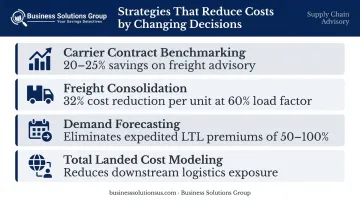
Carrier contract benchmarking: Mine historical shipment data across lanes, weight breaks, service levels, and mode types, then compare against current market pricing. Overpayment only surfaces when this analysis is run — not from year-over-year contract comparisons. Business Solutions Group's benchmark analysis clients typically achieve 20–25% savings on freight advisory engagements through this approach.
Freight consolidation via association rule mining: Identify shipments that share destination proximity, timing windows, or product categories. Consolidating these moves reduces total shipment count and per-unit transportation cost. Academic modeling shows that improving vehicle load factor from 40% to 60% produces roughly a 32% cost reduction in transportation cost per unit.
Demand forecasting to reduce expedited shipping: Regression analysis on historical order patterns, seasonality, and lead times lets you anticipate volume before it forces emergency decisions. Expedited LTL runs 50–100% above standard rates — reducing reliance on it directly improves margin. Business Solutions Group's Demand and Inventory Planning service uses 280+ algorithms to identify these opportunities before they become cost events.
Total landed cost modeling on sourcing decisions: Mine supplier and vendor data to identify which sourcing choices are creating downstream logistics cost. Long lead times, unreliable fulfillment, and suboptimal origin points all drive transportation spend. Adjusting sourcing decisions based on total landed cost — not just unit cost — can reduce logistics exposure significantly.
Strategies That Reduce Costs by Changing How Logistics Is Managed
These strategies apply once freight is moving — where real-time data and performance tracking create the leverage to cut waste at the operational level.
Automated carrier invoice auditing: Use automated data matching between contracted rates and billed charges to flag discrepancies at scale. Manual review of high-volume invoices misses patterns that algorithms catch consistently. Business Solutions Group's invoice audit and recovery service covers parcel, LTL, FTL, air, ocean, rail, and 3PL — with clients retaining 100% of identified recoveries.
Carrier performance monitoring: Tracking on-time delivery rates, damage frequency, accessorial charge patterns, and claim rates by carrier reveals which partners are quietly adding cost. Classify carriers by performance profile and reallocate volume away from underperformers before service failures trigger chargebacks, expediting, and inventory adjustments.
Predictive inventory positioning: Use demand signals, lead time variability, and regional sales data to right-size safety stock. Inventory carrying costs run 20–30% of inventory value annually — excess stock is expensive to hold, while stockouts force costly expedited replenishment. Static reorder points can't account for this variability; predictive models can.
Lane clustering by cost-efficiency profile: Segment shipping lanes by cost relative to service output. Lanes that are chronically expensive compared to their service level are candidates for targeted renegotiation or mode-switching — a far more effective use of negotiating resources than blanket rate reviews.
Strategies That Reduce Costs by Changing the Context Around Logistics
Upstream decisions and in-motion operations both depend on a data foundation that most businesses haven't fully built. These structural moves create the conditions for everything else to work.
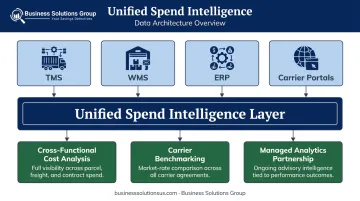
Integrate data sources into a unified spend intelligence layer: Fragmented data across TMS, WMS, ERP, and carrier portals drives most visibility gaps. Integration enables cross-functional cost analysis — without it, each system produces isolated reports that no one can act on together.
Establish carrier benchmarking as an ongoing practice: Rate markets shift continuously. Companies that benchmark their spend against current market pricing on a regular cycle identify renegotiation leverage that reactive shippers miss entirely. Business Solutions Group's benchmark analysis and eProcurement solutions are built to operationalize this as a standing practice rather than a one-time project.
Partner with a logistics advisory or spend intelligence provider: For businesses without in-house analytics capability, building internal data infrastructure often costs more than it saves — particularly for small and mid-sized shippers. Managed analytics partnerships provide access to enterprise-grade analysis without the overhead. Business Solutions Group works with businesses across this model, offering a complimentary savings analysis as a starting point, with compensation structured as a percentage of savings identified.
Conclusion
Effective logistics cost reduction through data mining starts with diagnosis — identifying where cost actually originates, whether in pre-shipment decisions, day-to-day operational choices, or the carrier relationships and infrastructure surrounding the logistics function. Cutting spend without that grounding risks undermining service levels in the process.
The most durable cost reduction programs treat analytics as an ongoing operational discipline rather than a one-time audit. Companies that embed this into their decision-making cycle consistently outperform those relying on periodic manual reviews. The gap is rarely access to tools or data — it's structured execution. That's where working with an experienced logistics advisory partner, like Business Solutions Group, can accelerate what internal teams take months to build.
Frequently Asked Questions
How do you minimize logistics costs?
Start by identifying where costs actually originate — transportation rate inefficiencies, carrier billing errors, poor demand forecasting, or suboptimal routing. Then apply the appropriate data mining or analytics method to each driver. Cutting spend broadly without that diagnosis tends to hurt service levels rather than improve margins.
What are the four types of data analytics?
Descriptive (what happened), diagnostic (why it happened), predictive (what will happen), and prescriptive (what action to take). Logistics cost reduction benefits from all four, but most companies currently rely only on descriptive reporting — missing the higher-value layers above it.
What is data mining in logistics?
Data mining in logistics means analyzing large volumes of operational and transactional data — shipment records, carrier invoices, inventory levels, routing history — to identify hidden patterns, cost anomalies, and optimization opportunities that standard reporting would not surface on its own.
How does predictive analytics reduce transportation costs?
By anticipating demand surges, capacity constraints, and lead time variability before they force expensive decisions. Carriers booked in advance move at standard rates; the same volume moved reactively often carries expedited premiums of 50–100% above standard LTL rates.
What data should logistics companies collect to reduce costs?
Four categories matter most:
- Carrier invoice records — for billing audits and error recovery
- Historical shipment data by lane and mode — for rate benchmarking
- Inventory movement data — for demand forecasting
- Real-time tracking data — for carrier performance management
Each feeds a different layer of the analytics framework.
Can small businesses benefit from logistics data analytics without an in-house data team?
Yes. Third-party logistics advisors and spend intelligence platforms handle data collection, analysis, and benchmarking on a managed basis. This allows small and mid-sized businesses to access the same cost reduction strategies as enterprise shippers without building internal data infrastructure.