Introduction
Every inventory decision carries a hidden double risk: order too little and you lose sales; order too much and you lock up cash in goods that may never move. Most businesses aren't struggling with just one of these problems — they're losing on both sides at once.
According to IHL Group's research reported by Chain Store Age, inventory distortion — the combined cost of stockouts and excess inventory — costs businesses $1.73 trillion annually, representing 6.5% of global retail sales. North American losses alone account for $415 billion.
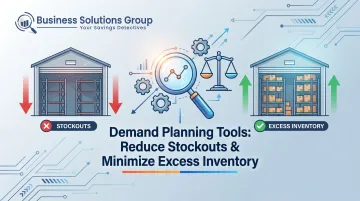
Demand planning tools address this directly. They use algorithms, real-time data, and AI-driven forecasting to get orders right before stock runs out or piles up.
This article covers what demand planning tools do, five concrete ways they reduce both stockouts and excess inventory simultaneously, and what to look for when choosing one.
Key Takeaways
- Inventory distortion costs $1.73 trillion globally — demand planning tools are the primary defense
- Stockouts push 31% of customers to competitors; excess inventory drains cash and inflates holding costs by 20–30% of inventory value annually
- Effective tools combine AI forecasting, dynamic safety stock, automated reorder points, and real-time supply chain visibility
- Choosing the right tool means evaluating integration, scalability, forecasting depth, and implementation support alongside price
Why Inventory Balance Is Harder Than It Looks
Most inventory problems don't start with bad products or poor suppliers. They start with reactive decision-making.
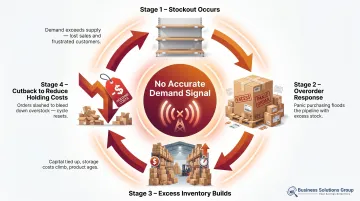
When a business experiences a stockout, the natural response is to overorder. That leads to excess inventory. To avoid holding costs, planners cut back — and then stock out again. This oscillation trap repeats indefinitely because the underlying problem (no accurate demand signal) is never fixed.
The Real Cost of Stockouts
Stockouts feel like a temporary inconvenience. They're not.
The foundational Gruen and Corsten study, published in Harvard Business Review, found that 31% of customers leave to buy from a competitor when they encounter an out-of-stock item. Only 45% substitute with something else. The rest delay or abandon the purchase entirely.
That means every stockout event risks:
- Lost immediate revenue on the item in question
- Customer churn to a competitor — often permanently
- Reputational damage when poor availability becomes a pattern
- Operational costs from emergency replenishments, rush orders, and expedited freight
The average out-of-stock rate across retail sits around 8%, meaning roughly 1 in 12 items a customer looks for isn't available. At that rate, stockouts aren't occasional accidents — they're a predictable, measurable drag on revenue.
The Real Cost of Excess Inventory
Excess inventory feels like a safety net. In practice, it's a cost center hiding in plain sight.
McKinsey reported that US retailers held approximately $740 billion in unsold goods — a figure that climbed $78 billion in a single year. Beyond the sheer scale, carrying that inventory isn't free.
Industry data consistently puts inventory carrying costs at 20–30% of total inventory value per year, covering warehousing, insurance, capital costs, and obsolescence.
In even well-managed companies, 20–30% of inventory is dead or obsolete stock. And dead inventory doesn't just sit quietly — it:
- Ties up working capital that could fund growth
- Clutters warehouses, slowing fulfillment and increasing picking errors
- Makes it harder to identify which items actually move
- Accumulates hidden costs that often exceed the original unit price by 25–30%
What Demand Planning Tools Do — And How They Work
Demand planning tools are specialized software platforms that aggregate historical sales data, seasonal patterns, promotional calendars, supplier lead times, and external signals to generate forward-looking demand forecasts.
That's a meaningful distinction from how most businesses currently plan. Spreadsheets and basic ERP reorder triggers look backward — they tell you what happened, not what's coming. When demand is volatile, that backward view creates a cycle of stockouts and overstock that compounds with every planning period.
Key Technologies Powering Modern Demand Planning Tools
Machine learning and predictive analytics are what separate purpose-built demand planning tools from legacy ERP modules. These algorithms continuously refine forecasts by learning from the gap between what was predicted and what actually sold. The more data fed in, the more accurate they become over time.
McKinsey's research on AI-driven forecasting found that AI reduces supply chain errors by 20–50% compared to traditional spreadsheet-based methods, and can cut product unavailability by up to 65%.
Three additional capabilities complete the picture in modern platforms:
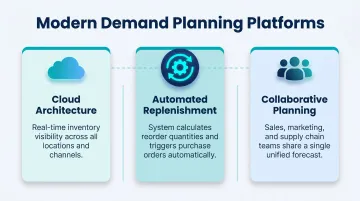
- Cloud architecture — enables real-time inventory visibility across warehouses, distribution centers, and sales channels from a single dashboard
- Automated replenishment — once a forecast is generated, the system calculates reorder quantities and triggers purchase orders automatically, removing manual guesswork
- Collaborative planning — sales, marketing, and supply chain teams work from a shared forecast, so promotions and new product launches are factored into inventory decisions before they happen
When Business Solutions Group implements demand planning for clients, the solution is built on the Avercast platform — incorporating over 280 advanced forecasting algorithms and connecting directly to each client's existing ERP system. The result: forecasts that draw from live operational data, not manual exports or stale spreadsheets.
5 Ways Demand Planning Tools Reduce Stockouts and Minimize Excess Inventory
1. Accurate Demand Forecasting Aligns Orders to Reality
The foundation of avoiding both stockouts and excess is forecast accuracy. By analyzing historical sales trends, seasonality, and market signals simultaneously at the SKU level, demand planning tools generate forecasts that reflect actual likely demand — not category averages or last year's numbers.
This precision matters because different SKUs behave very differently. A fast-moving item and a slow-moving one sitting in the same warehouse category require entirely different ordering logic. SKU-level forecasting surfaces that difference so businesses can order with confidence rather than applying blanket rules.
2. Optimized Safety Stock Protects Against Uncertainty Without Overstocking
Safety stock is necessary — but flat, uniform buffers consistently fail in practice.
Traditional approaches set a single buffer (say, two weeks of stock) applied across all SKUs. That buffer ends up either too high or too low, and often both at once across a mixed catalog.
Demand planning tools calculate safety stock dynamically for each SKU based on:
- Demand variability for that specific item
- Supplier lead time variability
- Target service level
ASCM's data illustrates the sensitivity here: dropping a service-level target from 98% to 90% can reduce required safety stock by approximately 38%. Dynamic calculation lets businesses set precise targets rather than guessing — resulting in leaner overall inventory while maintaining fill rates.
3. Automated Reorder Points Prevent Stock From Running Out
A reorder point is the inventory level that triggers a replenishment order. Set it too high and you overstock; set it too low and you stock out. Static reorder points, set manually once or twice a year, fail because demand patterns shift.
A product that moved slowly in January may accelerate by March. Demand planning tools update reorder points continuously using real-time demand signals and current supplier lead times — catching demand spikes before they become stockouts.
4. Real-Time Inventory Visibility Enables Proactive Decisions
A major driver of both stockouts and excess is inventory blindness — not knowing what's on hand across locations, what's in transit, or which items are trending in either direction.
Demand planning tools provide a unified, real-time view across the entire operation. That visibility means:
- At-risk items are flagged before they stock out, not after
- Slow-moving stock is identified before it becomes a holding cost problem
- Planners can reallocate inventory across locations rather than ordering new stock unnecessarily
5. ABC Analysis and the 80/20 Rule Focus Attention Where It Counts
Real-time visibility tells you what's happening — ABC analysis tells you where to act first. Across most businesses, roughly 20% of SKUs drive 80% of revenue. Demand planning tools use ABC analysis to segment inventory by impact:
| Tier | Characteristics | Planning Approach |
|---|---|---|
| A items | High-value, high-velocity | Tight safety stock controls, frequent reorder reviews |
| B items | Moderate value/velocity | Balanced policies, regular monitoring |
| C items | Low-value, slow-moving | Lean buffers, less frequent review |
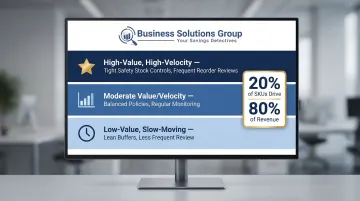
Without this segmentation, businesses routinely over-invest in low-impact items while under-serving the SKUs that drive most of their revenue. ABC analysis directs both attention and capital toward the inventory positions that move the needle.
What to Look for When Choosing a Demand Planning Tool
Not every demand planning tool fits every operation. The right platform for a 500-SKU distributor is different from what a multi-warehouse manufacturer needs.
Evaluate these criteria before committing:
- Forecasting sophistication — does it go beyond simple moving averages? Can it handle intermittent or seasonal demand patterns?
- ERP and WMS integration — can it pull live data from your existing systems without manual exports?
- Scalability — can it handle growing SKU counts and additional distribution channels as you expand?
- Ease of use — will your planners actually adopt it, or will it require constant IT support to operate?
Implementation Support Matters as Much as the Software
This is where many businesses underestimate the challenge. Gartner predicts that by 2027, more than 70% of recently implemented ERP initiatives will fail to fully meet their original business case goals — with a quarter failing outright. The most common cause isn't bad software; it's treating the implementation as an IT project rather than a business transformation.
Demand planning tools require configuration, model tuning, and change management to deliver results. Businesses that self-implement complex platforms without experienced guidance see poor adoption and minimal ROI.

Business Solutions Group helps clients match tool capability to their specific operational needs by pairing technology implementation with advisory services. The approach starts with diagnosing the actual problem — demand volatility, data gaps, integration limitations — before recommending a configuration, not after.
Evaluate TCO Against Expected ROI
Understanding where implementation costs come from makes it easier to build a realistic business case. Software subscription cost is only part of the picture. Total cost of ownership includes implementation services, data integration, user training, ongoing model tuning, and change management. Weigh those costs against measurable improvements in:
- Inventory turnover rate
- Stockout frequency
- Carrying cost as a percentage of inventory value
A tool that costs more upfront but reduces carrying costs by even 5% across a $10M inventory generates $500K annually in direct savings — before counting recovered revenue from avoided stockouts.
Frequently Asked Questions
How do you plan replenishment to avoid stockouts and excess inventory?
Effective replenishment planning uses demand forecasts to determine when and how much to reorder, sets reorder points based on lead times and demand variability, and sizes safety stock buffers to the target service level. Done well, stock arrives before it runs out — without ordering beyond what projected demand requires.
How do you minimize excess inventory?
Start with better forecast accuracy so orders reflect actual demand rather than assumptions. Apply ABC analysis to avoid over-investing in slow-moving items, and replace flat safety stock buffers with dynamic calculations tied to individual SKU variability.
Which inventory system minimizes stockouts and overstocking simultaneously?
Purpose-built demand planning platforms outperform basic ERP inventory modules by combining AI-driven forecasting, automated reorder points, dynamic safety stock, and real-time visibility — and by updating continuously rather than on a fixed schedule. Static, backward-looking ERP rules can't match that responsiveness.
What are the four methods of inventory control?
The four primary methods are:
- ABC analysis — prioritizes inventory by value and velocity
- Just-in-Time (JIT) — orders to match immediate demand, minimizing holding costs
- Economic Order Quantity (EOQ) — calculates the cost-optimal batch size
- Safety stock management — maintains a buffer against demand and supply variability
What are the four types of demand patterns?
The four types are trend (consistently rising or falling demand), seasonal (predictable peaks tied to time of year), cyclical (demand driven by broader economic conditions), and intermittent/irregular (sporadic, unpredictable demand). Modern demand planning tools detect and model each — important because most B2B catalogs include a mix of all four.
What is the 80/20 rule in inventory management?
The 80/20 rule states that roughly 20% of SKUs account for 80% of sales or revenue. Demand planning tools apply this principle through ABC analysis, directing tighter forecasting controls and safety stock investment toward high-velocity items while applying leaner policies to low-demand stock — preventing over-investment where it matters least.