The fix seems obvious: connect the two. But execution is far more nuanced. A McKinsey survey of 54 senior executives found only 1 in 4 believed their planning processes effectively balanced cross-functional trade-offs—which tells you that most organizations haven't cracked this yet.
This article covers exactly how to link demand planning and S&OP using software: the four-step configuration process, what must be in place before you start, the variables that determine whether the integration holds, and the mistakes that derail even well-resourced teams.
Key Takeaways
- Demand planning generates the consensus forecast that feeds the S&OP demand review step—software makes that handoff structured and repeatable
- Linking the two requires a shared data layer, a configured demand planning module, and a cadence aligned to the S&OP cycle
- Governance failures—undefined roles, no data freeze policy, missing cross-functional input—derail more implementations than technology does
- Unified platforms (SAP IBP, Anaplan, Oracle) integrate tighter; point solutions offer flexibility but add synchronization overhead
- Four variables determine success: data granularity, integration architecture, consensus design, and stakeholder participation
How to Link Demand Planning and S&OP Using Software
This is not a one-time IT setup. It's an ongoing operating model where software enables a monthly handoff between demand planning outputs and S&OP decision inputs. Get that framing right before touching any configuration.
Step 1: Establish a Centralized Data Foundation
Start here—everything downstream depends on it. Fragmented source data is the most common reason the demand-to-S&OP link breaks down before it starts.
- Consolidate your data sources: Sales history, inventory records, and ERP data need to flow into a single accessible layer—either natively within your planning platform or through an integration layer
- Enforce master data standards: Product hierarchies, customer segmentation, and time horizons must be identical across the demand planning module and the S&OP model—inconsistencies create manual reconciliation that compounds monthly
- Set a data freeze date: Configure a cutoff in your software—typically aligned to month-end close—after which the demand plan locks for S&OP input; without this, late-breaking sales adjustments destabilize the supply review
Business Solutions Group's Business Performance Solution addresses this consolidation step by connecting ERP, WMS, and order management data into one reporting environment—giving demand planning tools access to complete inputs before each S&OP cycle.
Step 2: Configure the Demand Planning Module for S&OP-Ready Outputs
Your demand planning software needs to produce outputs that S&OP can actually consume—not just a number, but a structured, documented forecast package.
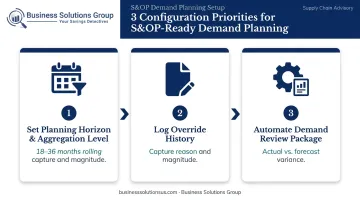
Three configuration priorities:
- Set the right planning horizon and aggregation level: Generate an unconstrained consensus demand plan at product family/region/channel level, covering 18–36 months rolling. ASCM guidance on S&OP consistently positions tactical planning at 18 months or more—if your demand plan only covers 6 months, it will create gaps in the outer months of the S&OP horizon
- Log override history: When a sales rep or demand planner adjusts a statistical forecast, capture the reason and magnitude automatically. Undocumented adjustments frequently damage accuracy rather than improving it
- Automate the demand review package: Configure reporting to generate actual vs. forecast variance, forecast accuracy metrics, and key assumption flags—this becomes the input document for the pre-S&OP meeting, assembled by the system rather than by a planner each month
Step 3: Map the Demand Review Output to the S&OP Workflow
Once the demand plan is configured correctly, the handoff to S&OP needs to be automatic—not a spreadsheet export.
Within your S&OP platform (or unified tool), configure the demand review stage to pull the finalized consensus plan directly from the demand planning system via an automated feed. Then build a structured comparison view that surfaces:
- Demand plan vs. supply plan
- Demand plan vs. financial budget
- Gap analysis and identified trade-offs
Make this view available during the pre-S&OP step—before the executive meeting—so the team arrives with decisions to make, not data to sort through.
Step 4: Enable Scenario Planning and Cross-Functional Collaboration
Static demand plans break down when reality changes. Configure your platform so that changes to the demand plan—a lost customer, a promotional uplift, a supply disruption—automatically flow through to supply capacity models and financial projections.
- What-if scenario functionality: Changes should propagate across the full model in the same software environment, not require re-exports to separate tools
- Role-based access: Sales, operations, and finance stakeholders should all be able to view, annotate, and contribute without overwriting each other's inputs—this drives parallel collaboration rather than slow sequential handoffs
What You Need Before You Begin
The quality of demand-to-S&OP integration is a direct function of the inputs and infrastructure already in place. Skipping a readiness assessment leads to expensive rework after go-live.
Software and System Requirements
Before any configuration work begins, verify:
- Confirm your data architecture supports shared data models — whether through a unified platform, API-based connectors, or a middleware layer — so no manual translation is required between systems
- Evaluate platform fit against your ERP environment: SAP IBP, Oracle Fusion Cloud S&OP, and Anaplan offer native modules; Kinaxis and Blue Yonder provide documented integration layers for broader ERP connectivity
- Validate API availability and support for any point solutions before committing to an architecture
If your current tech stack creates integration uncertainty, a structured advisory engagement — like those offered by Business Solutions Group — can audit your environment and validate your architecture approach before you invest in configuration work.
Process and Organizational Readiness
Software can't substitute for an absent process. Before implementation:
- Confirm that a monthly S&OP cadence is already defined—or actively being defined—including meeting structure, freeze dates, and escalation paths
- Identify who owns the demand plan and who owns the S&OP output; if those roles are undefined, software configuration alone won't create accountability
- Consider a structured advisory engagement at this stage to audit your current tech stack, identify integration gaps, and validate your configuration approach before investing in changes
Key Variables That Determine Integration Success
Even a well-configured integration can underperform if these four variables aren't actively managed throughout the S&OP cycle.
Data Granularity and Planning Horizon Alignment
Demand planning typically operates at SKU/week level. S&OP consumes data at product family/month level. The software must be configured to aggregate correctly; mismatched granularity creates distortion that undermines executive decision-making.
Peer-reviewed research on cross-sectional aggregation confirms that SKU-level forecasts serve inventory control, while product-family forecasts are required for master production scheduling. These two levels serve different decisions and must be explicitly mapped in your configuration. Excess disaggregation without reconciliation adds noise and bias rather than precision.
Planning horizons must match too. If demand planning produces a 6-month rolling forecast but S&OP requires 18 months, the integration will produce blank cells in the outer periods of every S&OP cycle.
Integration Architecture: Unified vs. Point Solutions
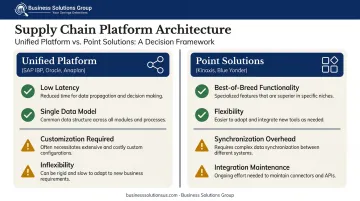
| Architecture | Advantages | Watch Points |
|---|---|---|
| Unified platform (SAP IBP, Oracle, Anaplan) | Low latency, no synchronization errors, single data model | Significant customization required; can be inflexible for non-standard processes |
| Integrated point solutions (Kinaxis + ERP, Blue Yonder + S&OP tool) | Best-of-breed functionality, flexibility | Synchronization overhead, version-control risk, integration maintenance burden |
Each manual data transfer step between disconnected systems introduces both error risk and delay. A McKinsey case study of an Asian food and beverage company found that cycle time to generate a demand plan exceeded five days before integrated planning was implemented, a delay that cascades directly into S&OP timeliness.
Consensus Mechanism Design
The software must be configured to support a structured consensus process: tracking who approved the demand plan, what assumptions underpin it, and when it was last reviewed. Without this audit trail, the demand plan entering S&OP lacks the credibility needed to drive supply and financial commitments.
A poorly documented demand plan produces supply plans built on shaky assumptions. This typically surfaces as excess inventory in slow periods or service failures during demand spikes.
Governance: Roles, Ownership, and Cadence
Software cannot enforce accountability. Define:
- Who owns the demand plan (typically the demand planning team or S&OP manager)
- Who owns the S&OP output (typically the supply chain director or VP of Operations)
- A binding monthly calendar with freeze dates loaded into shared tools
Getting these roles and cadences in place matters more than most teams expect. The IBF S&OP Maturity Model evaluates capability across People, Process, Analytics, and Technology, and consistently identifies governance gaps as the primary barrier to maturity, not technology gaps. McKinsey's research on mature IBP practitioners found they achieved 1–2 additional percentage points of EBIT and 5–20 percentage points higher service levels than less mature peers, a gap driven as much by governance discipline as by software capability.
Common Mistakes When Linking Demand Planning and S&OP
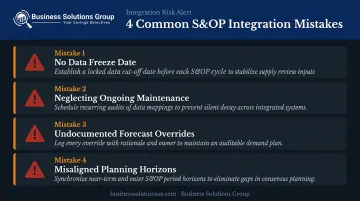
- Without a locked data cutoff date, late sales adjustments destabilize supply review and finance reconciliation, turning your S&OP cycle reactive rather than structured
- The demand-S&OP link degrades over time if process owners stop maintaining data mappings, updating product hierarchies, and recalibrating statistical models — the software requires ongoing active management, not a single setup
- Automated forecasts improve speed, but without a structured override workflow, planners make undocumented adjustments that leave the demand plan un-auditable by the time it reaches S&OP
- If demand planning runs a 6-month rolling forecast while S&OP requires 18 months, the integration will generate gaps in outer periods. Set consistent horizon requirements across both processes before configuring the software
Conclusion
Linking demand planning and S&OP using software requires three things working together: a centralized, clean data foundation; a software configuration that automates the handoff between the two processes; and governance that makes the monthly cycle accountable and repeatable.
Most failures at this integration point come from skipping readiness steps, misaligning data structures, or treating software deployment as a substitute for process design. The four-step configuration process outlined here addresses the technical side—but the governance variables (roles, freeze dates, consensus documentation) determine whether the integration actually holds under real operating conditions.
Organizations that invest in both sides—configuration and governance—consistently report faster consensus cycles, higher forecast accuracy, and fewer last-minute production adjustments. The readiness assessment stage is where that investment pays off most: getting data structures and process ownership right before configuration begins prevents the rework that derails most integrations.
Frequently Asked Questions
Is demand planning part of S&OP?
Demand planning is a foundational input to S&OP—it generates the consensus demand forecast that feeds the demand review step. S&OP is the broader cross-functional process that reconciles demand, supply, and financial plans into a single operating plan.
What are the 6 steps of the S&OP process?
The six steps are: product review, demand review, supply review, finance review, pre-S&OP meeting, and executive S&OP. Demand planning outputs are central to step two—the demand review—and cascade into every subsequent step.
Is demand planning part of inventory management?
They serve different functions. Demand planning forecasts future demand to set safety stock levels and replenishment targets; inventory management is the execution layer that acts on that forecast.
What is the difference between demand planning and S&OP?
Demand planning builds the forward-looking forecast. S&OP takes that forecast and balances it against supply capacity, financial targets, and operational constraints to produce a reconciled business plan.
What software tools are commonly used to connect demand planning and S&OP?
Unified platforms like SAP IBP, Anaplan, and Oracle Fusion Cloud S&OP combine both capabilities natively. Best-of-breed alternatives like Kinaxis and Blue Yonder can integrate with separate S&OP workflows via documented API connectors.
How often should demand planning feed into the S&OP process?
The consensus demand plan should be finalized and fed into S&OP on a monthly cadence, aligned to the S&OP review cycle. Demand sensing updates can occur weekly or daily to adjust short-term execution without disrupting the monthly planning rhythm.