Introduction
Most operations leaders can describe what supply chain planning is. Far fewer understand how it actually works — and that gap is expensive.
According to a Sphera survey of 200 COOs and CFOs, 44.5% of organizations lose 3–4% of annual revenue to supply chain disruption. The global supply chain management software market sits at $36.39 billion in 2026, growing at a 9% clip — a clear signal that enterprises are investing heavily in planning capability.
Enterprise supply chain planning coordinates hundreds of decisions simultaneously: raw material sourcing, production scheduling, warehouse allocation, and carrier dispatch — across manufacturing, retail, pharmaceutical, and logistics networks.
The challenge is that most organizations struggle to move beyond surface-level understanding. Without grasping the internal mechanics, teams end up with misaligned forecasts, reactive decisions, and cost-reduction opportunities left on the table.
This guide breaks down how enterprise supply chain planning actually works in practice — its stages, components, and common failure points — and what distinguishes it from general supply chain management.
Key Takeaways
- Enterprise supply chain planning (ESCP) aligns demand, supply, production, and distribution across multiple business units to match operations with business goals.
- Four sequential stages drive it: demand sensing, supply alignment, S&OP coordination, and execution monitoring.
- The five core components are demand planning, supply planning, production planning, inventory management, and network/distribution design.
- Poor ESCP costs real money — global inventory distortion alone reached $1.77 trillion in 2023.
- Done well, ESCP reduces excess inventory, shortens lead times, and keeps fulfillment costs from eroding margins.
What Is Enterprise Supply Chain Planning?
Enterprise supply chain planning is the process of coordinating and optimizing the flow of goods, information, and resources across a large organization — from supplier sourcing through final customer delivery — with the goal of balancing supply and demand at scale.
Understanding what makes enterprise SCP distinct — and where it fits within the broader supply chain landscape — is the first step to getting the planning function right.
Why "Enterprise" Changes the Equation
Small-business supply chain management is largely linear: one location, a handful of suppliers, a predictable customer base. Enterprise SCP operates at a fundamentally different level of complexity.
At enterprise scale, planning spans:
- Multiple legal entities and geographies
- Dozens of product lines and SKUs
- Cross-functional teams across sales, finance, operations, and procurement
- ERP systems, warehouse management tools, and third-party data feeds that often don't communicate cleanly
This complexity is why cross-functional alignment, not just operational execution, sits at the center of enterprise planning.
What Enterprise Supply Chain Planning Is NOT
Three related disciplines are frequently confused — here's how they actually differ:
| Term | Scope | Focus |
|---|---|---|
| Supply Chain Management (SCM) | End-to-end discipline | Strategy, partnerships, and the full value chain |
| Supply Chain Planning (SCP) | Strategic layer within SCM | Demand/supply coordination and optimization |
| Supply Chain Execution (SCE) | Operational fulfillment | Purchase orders, warehouse ops, carrier dispatch |
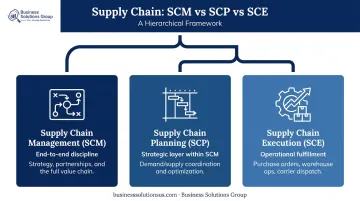
Enterprise SCP is one strategic layer within the broader SCM discipline — not a synonym for it, and not the same as execution.
Two Planning Horizons
Enterprise planning teams operate across two timeframes simultaneously:
- Strategic horizon: Covers long-term decisions — network capacity, facility footprint, and sourcing strategy — typically looking 12 to 36 months out
- Tactical/operational horizon: Focuses on near-term demand and supply balancing, running on monthly or weekly cycles
Most enterprises need both running in parallel. Strategic decisions constrain tactical options; tactical outcomes inform strategic adjustments.
How Does Enterprise Supply Chain Planning Work?
Enterprise SCP operates through a defined sequence of interconnected stages. A breakdown at any one stage propagates downstream, surfacing as a service failure, an inventory problem, or a margin hit.
Stage 1: Demand Sensing and Forecasting
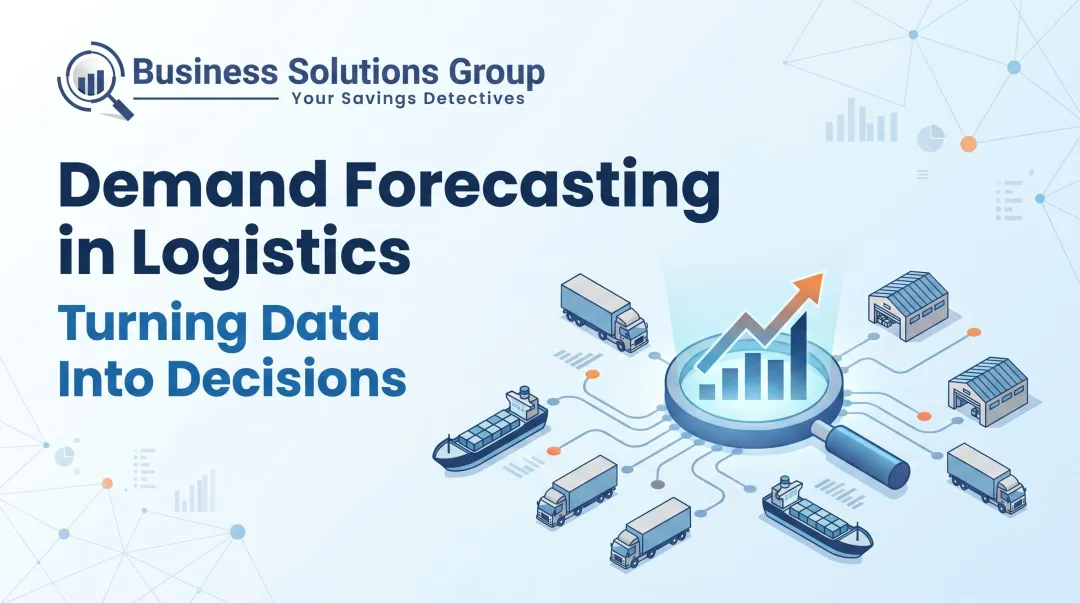
The planning process begins by aggregating demand signals: sales history, customer orders, POS data, seasonal patterns, promotional calendars, and market intelligence. The output is a forward-looking forecast across SKUs, regions, and channels.
At enterprise scale, demand sensing runs on automated, continuous feeds from ERP, POS, and third-party data feeds. But human review remains essential at key planning cycles to catch anomalies, account for product launches, or adjust for market shifts that algorithms won't anticipate.
The challenge is consolidation. Demand signals arrive from multiple business units and geographies simultaneously. Without integrated systems, planners make decisions on stale or fragmented data — and the forecast errors compound quickly. Gartner data shows median demand forecast error of roughly 25% in food and beverages, rising to 50% in durable consumer products, a range that underscores how much industry context matters when setting accuracy targets.
Stage 2: Supply and Inventory Alignment
The supply planning stage takes the demand forecast and calculates what resources are needed to fulfill it: raw materials, components, production capacity, and inventory positions.
Materials Requirements Planning (MRP) translates demand signals into time-phased procurement and production schedules. Its modern successor, Demand-Driven MRP (DDMRP), replaces forecast-push logic with real-time demand signals. The performance results are measurable: research from the Demand Driven Institute shows DDMRP achieves a median 31% inventory reduction, 13% service level improvement, and over 80% lead time compression across multiple industry segments.
Precision at this stage matters directly to margin:
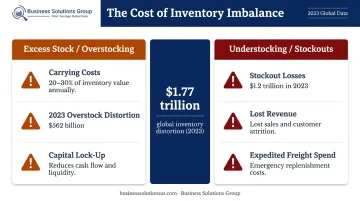
- Excess safety stock drives up carrying costs — APQC benchmarks inventory carrying costs at 20–30% of total inventory value annually
- Under-supply creates stockouts, expedited freight spend, and lost revenue
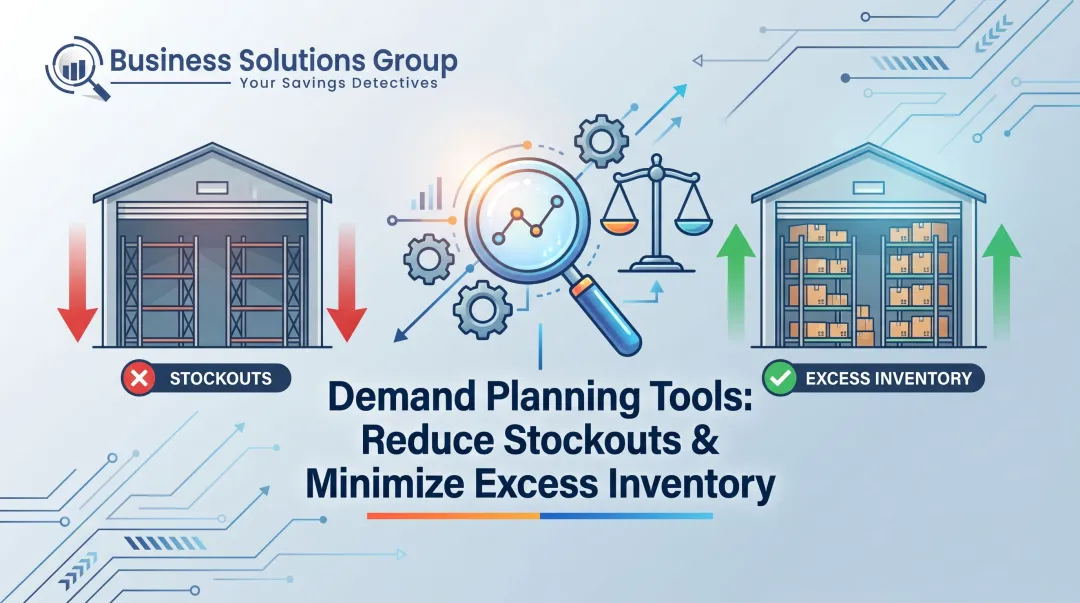
- Misalignment at scale is costly: global inventory distortion totaled $1.77 trillion in 2023, split between $1.2 trillion in stockouts and $562 billion in overstocks
- Small improvements in balance directly improve margin and cash flow
Stage 3: Cross-Functional Alignment Through S&OP
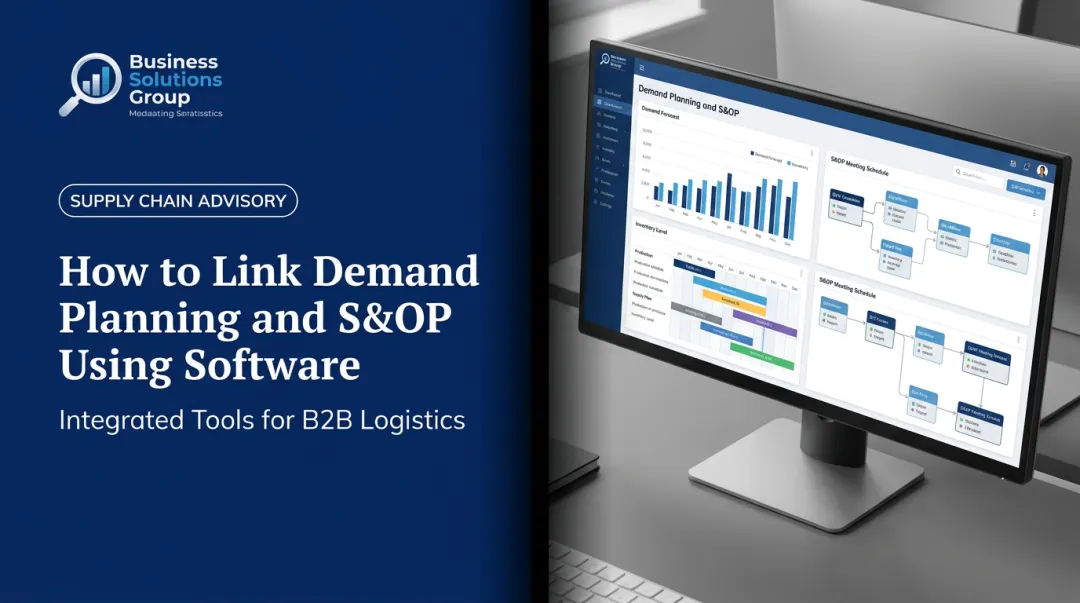
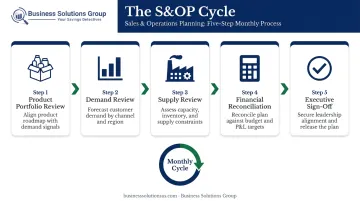
Sales and Operations Planning (S&OP) is the structured monthly process where sales, finance, operations, and procurement reconcile demand forecasts against supply constraints, producing a unified operating plan approved by executive leadership.
A standard S&OP cycle runs five steps:
- Product portfolio review — assess new products, phase-outs, and market changes
- Demand review — validate and reconcile the forecast across commercial teams
- Supply review — identify capacity constraints and sourcing gaps
- Pre-S&OP financial reconciliation — translate operational plans into financial impact
- Executive sign-off — resolve unresolved trade-offs and approve the final plan
A well-executed plan produces measurable downstream outcomes:
- Reduced emergency freight spend when exceptions are caught early
- Lower inventory holding costs through tighter replenishment cycles
- Improved fill rates and on-time delivery as variance shrinks
- Stronger carrier relationships from consistent, predictable volumes
Without active monitoring, deviations accumulate between planning cycles — and at enterprise scale, the cost of that drift adds up fast.
Key Components of an Enterprise Supply Chain Plan
Demand Planning
Demand planning uses statistical models, market intelligence, and historical data to produce the baseline forecast that drives all downstream planning activity. At enterprise scale, this requires consensus forecasting — aligning sales, marketing, and finance around a single number, rather than running parallel forecasts that diverge at the worst moments. Business Solutions Group's demand planning software, backed by 250+ forecasting algorithms and ERP integration, supports this consensus process across departments.
Supply Planning
Supply planning matches the demand forecast against available supply capacity, procurement lead times, and current inventory positions. The output is a constrained supply plan — one that reflects real-world production and sourcing limitations rather than an unconstrained wish list. That distinction matters operationally: only a constrained plan can be executed, which makes it the only plan worth building.
Production Planning
Production planning determines what to manufacture, when, and at which facility. It coordinates labor, equipment, and materials to avoid both idle capacity and production bottlenecks while meeting the demand plan. At enterprise scale, this involves sequencing decisions across multiple plants, often in multiple countries.
Inventory Management
Enterprise inventory management sets optimal stock levels — safety stock, reorder points, cycle stock — at each node in the network to balance service levels against carrying costs.
Poor inventory positioning is one of the most expensive planning failures. The costs run in both directions:
- Excess stock: With carrying costs at 20–30% of inventory value, overstocking is a measurable annual drain, not a neutral buffer
- Understocking: Lost sales, expedited replenishment, and customer attrition — costs that rarely show up cleanly on a balance sheet but compound quickly
Network and Distribution Planning
Network and distribution planning determines where inventory is positioned, which distribution centers or 3PLs are used, and how freight is routed. These decisions directly affect cost per unit and delivery lead times.
Transportation is the largest single cost category in logistics operations — accounting for roughly $1.59 trillion, or 67%, of total U.S. business logistics costs in 2023. Network design decisions also compound inventory positioning errors. Poorly located stock generates unnecessary freight spend on top of carrying costs — two avoidable drains running in parallel.
Carrier contract optimization is one lever many enterprises underutilize. Business Solutions Group's freight advisory work — which has delivered over $1 billion in collective client savings — consistently identifies 15–40% cost reduction opportunities through benchmark-based carrier negotiations, with LTL clients averaging 20–25% in savings.
Common Challenges in Enterprise Supply Chain Planning
Siloed Data and Systems
Data fragmentation is the most common reason enterprise planning breaks down. When ERP, WMS, TMS, and demand planning tools don't communicate in real time, planners make decisions on stale or incomplete information.
The scale of this challenge is stark: a Gartner survey published in April 2026 found that 56% of chief supply chain officers cite integrating AI with legacy systems as a major challenge, and 45% identify data quality as a significant obstacle. Only 15% of supply chain organizations have moved AI initiatives beyond the pilot phase.
Closing this gap requires connecting disparate systems into a single reporting environment — replacing manual spreadsheet reconciliation with automated, real-time data flows that planners can actually act on.
Demand Volatility and Forecast Error
Rapid shifts in consumer behavior, geopolitical disruptions, and seasonal swings create forecast errors that cascade through every planning stage. According to McKinsey, companies can expect supply chain disruptions lasting a month or longer every 3.7 years on average, with cumulative losses over a decade equal to roughly 45% of one year's profits.
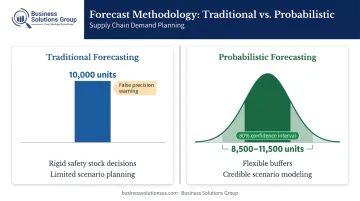
The response is a shift in methodology: enterprises increasingly rely on probabilistic forecasting, which produces a range of possible outcomes with associated likelihoods rather than single-point predictions that present false precision. Where traditional forecasting says "demand will be 10,000 units," probabilistic models say "there's an 80% chance demand falls between 8,500 and 11,500 units." That range enables better safety stock decisions and more credible scenario planning.
Cross-Functional Misalignment
Even well-designed planning processes fail when organizational incentives pull in different directions:
- Sales teams over-forecast to protect quota
- Finance applies budget constraints that conflict with operational reality
- Procurement acts independently of the supply plan
Governance structures, shared KPIs, and structured S&OP cadences are the primary tools for closing this gap. Without them, the monthly S&OP meeting becomes a negotiation rather than a planning process.
Conclusion
Enterprise supply chain planning is a continuous, cross-functional process — not a quarterly exercise or a software implementation project. It directly determines whether a company can respond to disruption, serve customers profitably, and capture margin at scale.
Enterprises that invest in process maturity, integrated data, and external spend intelligence are better positioned to convert supply chain operations from a cost center into a profit driver. Business Solutions Group works with clients to make that conversion measurable and repeatable — through:
- Benchmark analysis that surfaces where costs and processes are underperforming
- Freight advisory and contract negotiations that align carrier rates with actual shipping volume
- Spend intelligence that connects procurement data to planning decisions
- Demand and inventory planning that reduces both stockouts and carrying costs
The gap between planning intent and operational results is where margin gets lost. Closing it requires more than better software — it requires the right advisory framework to act on what the data is telling you.
Frequently Asked Questions
What is enterprise supply chain planning?
Enterprise supply chain planning is the structured, cross-functional process large organizations use to align supply with demand across multiple business units, geographies, and product lines. It differs from general supply chain management in scale and integration complexity. Coordinated data flows, governance structures, and dedicated technology are necessary at this scale — complexity that smaller operations don't face.
What is the purpose of supply chain planning?
The purpose is to ensure the right products are available at the right time and place, while minimizing costs, reducing waste, and maintaining the ability to respond to demand changes or disruptions. The result is high service levels without excess capital locked in inventory.
What is supply chain planning software?
Supply chain planning software includes tools for demand planning, S&OP, inventory optimization, and network design that automate and integrate enterprise planning decisions. Most platforms connect with ERP systems to give planners a unified environment instead of reconciling data across disconnected spreadsheets.
What is SIOP vs. S&OP?
S&OP (Sales and Operations Planning) aligns demand and supply on a monthly cycle. SIOP (Sales, Inventory, and Operations Planning) is an expanded version that explicitly treats inventory as a planning variable alongside demand and supply. This makes it more common in manufacturing-heavy enterprises where inventory positioning is a critical operational constraint.
What are the 6 steps of S&OP?
The typical S&OP cycle runs: (1) data gathering and product portfolio review, (2) demand review, (3) supply review, (4) pre-S&OP financial reconciliation, (5) executive review and approval, and (6) plan communication and execution handoff. Some organizations combine steps 1 and 2, which is why the cycle is described as either 5 or 6 steps depending on the source.
Is SCM a part of ERP?
SCM is a distinct discipline from ERP, though most ERP platforms include SCM modules. Enterprise organizations typically layer dedicated supply chain planning tools on top of their ERP to handle demand forecasting, S&OP, and network optimization, since core ERP systems aren't built to handle the depth enterprise planning requires.